
They Mocked His Triple-Walled Cabin — Until It Stayed 102° Warmer Than Every Home in the Valley
The first snow came early that year.
It drifted down in soft silence, coating the valley in a pale hush that made every sound feel distant. Smoke curled from chimneys in thin gray ribbons, dissolving into the overcast sky. The mountains behind the village rose jagged and white, their peaks swallowed by cloud.
Elias Mercer stood alone in the clearing above town, studying the skeleton of his cabin.
Three walls already stood—thick, squared logs stacked with stubborn precision. The fourth lay half-built, beams waiting to be lifted. Snow had begun settling into the gaps, dusting the wood, softening the sharp lines.
From below, voices carried faintly.
“They say he’s building it three walls thick.”
“That ain’t a cabin. That’s a coffin.”
“He’ll freeze anyway.”
Elias didn’t answer. He kept working.
He lifted another log, rolled it onto the outer frame, and checked the alignment. His gloves lay on a stump nearby, damp from use. The cold bit at his fingers, but he ignored it.
He had measured everything twice. Sometimes three times. The inner wall, the air gap, the outer shell. Every layer deliberate.
Triple-walled.
The idea had started the previous winter, when temperatures dropped so low the river froze solid enough to hold wagons. The wind found every crack in his old shack. Frost crept along the inside walls. His breath formed clouds even under blankets.
He had survived—but only just.
So when spring came, he started cutting timber.
By summer, he was hauling logs alone up the slope above the valley. By autumn, he was shaping beams, carving joints, sealing gaps with moss and resin.
And now, with winter already pressing in, he worked faster.
Two men trudged up the hill through the snow.
“Elias,” one called, pulling his coat tighter. “You serious about this?”
Elias didn’t look down. “Afternoon, Ben.”
Ben spat into the snow. “You wasting good timber. Could build two cabins with what you’re using.”
“I only need one.”
The other man laughed. “You planning to hide from cannons?”
Elias set another beam in place. “Planning to stay warm.”
Ben shook his head. “Ain’t no cabin stays warm in February. Not without burning half a forest.”
Elias nodded toward the stacked firewood already piling near the site. “I’ll burn less.”
They exchanged looks.
“Triple walls,” the second man muttered. “Never heard of such foolishness.”
Elias picked up his mallet and drove the beam tight.
They left shaking their heads.
By the time the snow deepened, the cabin stood complete.
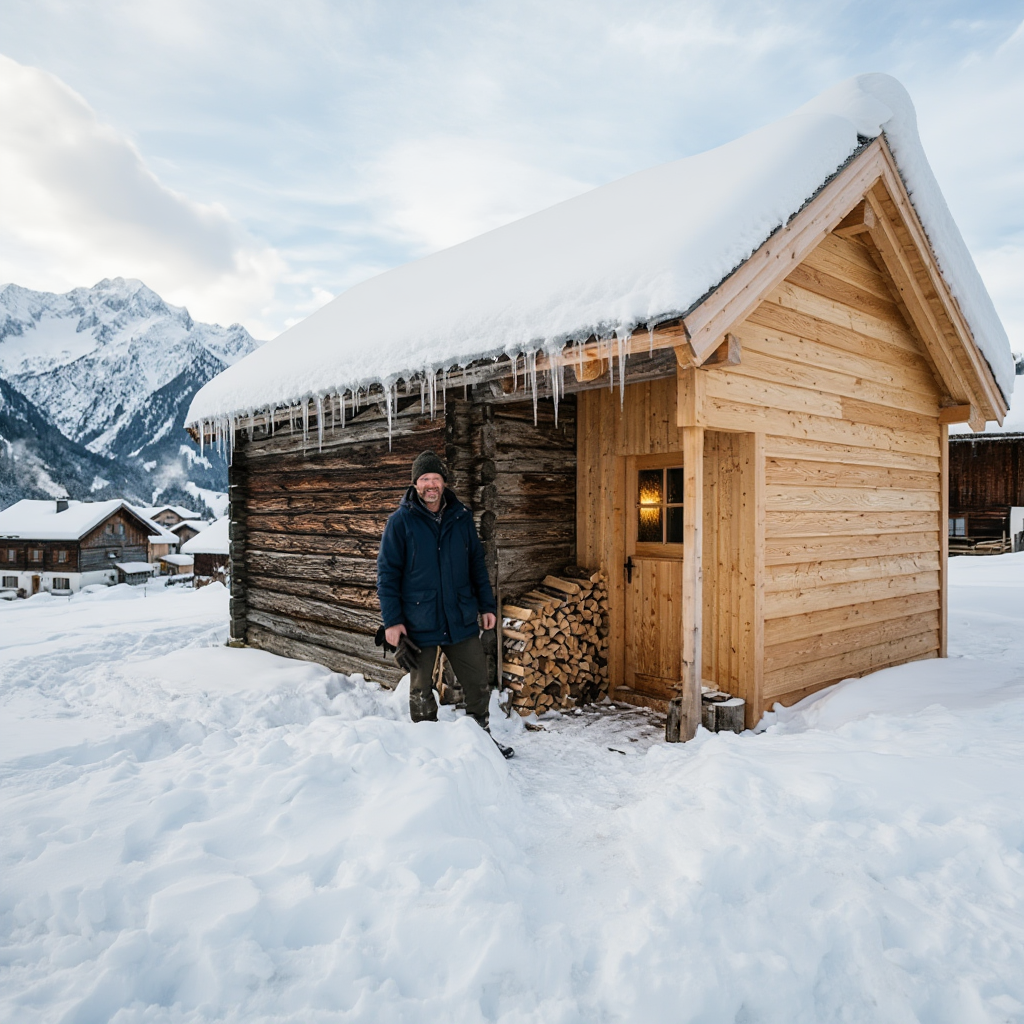
It looked strange—compact, thick, almost squat. The windows were small, the door heavy, the roof steep enough to shed snow. Icicles soon formed along the eaves, long and glassy. Elias stacked firewood neatly against the wall, each split piece dry and ready.
Inside, he lit the first fire.
The warmth stayed.
Not just near the stove—but across the room. The air felt still, insulated. The walls radiated a gentle heat even after the flames died low.
He slept without frost forming on his blanket.
Down in the valley, winter tightened.
The temperature dropped below zero. Then lower. The river froze deeper. Horses breathed steam like engines. Smoke from chimneys thickened as families burned wood nonstop.
One night, Ben knocked on Elias’s door.
The small window glowed amber. When Elias opened it, warm air spilled into the dark.
Ben blinked. “You just light the stove?”
“Been going since morning.”
Ben stepped inside, stamping snow from his boots. His eyes widened. “Feels… steady.”
Elias poured coffee. “Walls hold it.”
Ben touched the logs. “Warm.”
Outside, the wind howled across the slope.
Ben left later, shaking his head. “Still think you used too much timber,” he muttered—but he didn’t sound convinced.
Then came the cold snap.
It arrived without warning.
Clouds sealed the sky. The wind died. The air turned sharp and brittle. Thermometers in the valley dropped past numbers folks were used to seeing. Frost crept under doors. Windows glazed solid.
One morning, a man from town climbed up to Elias’s cabin carrying a thermometer.
“You hear?” he said. “Store reads minus forty.”
Elias nodded. “Feels like it.”
The man stepped inside, cheeks red. He held up the thermometer again after a few minutes.
“Inside’s… sixty-two.”
Elias shrugged. “Fire’s low.”
The man frowned. “Outside’s minus forty.”
Elias stirred the coals.
The difference was staggering.
By afternoon, word spread.
“They say his cabin’s sixty degrees.”
“No way.”
“He ain’t burning much wood either.”
Two more men came to check. Then a woman. Then Ben again.
Someone brought another thermometer.
They measured carefully. Outside. Inside.
The numbers didn’t lie.
Later, someone did the math.
“It’s over a hundred degrees warmer in there,” the man whispered.
The phrase spread like wildfire.
Over a hundred degrees warmer.
The next morning, more people climbed the slope. Elias stood outside in his dark blue parka, gloves in hand, watching them approach. Snow lay deep around the cabin, untouched except for narrow tracks. The woodpile stood neat beside the wall. Long icicles glittered under the gray sky.
Behind him, the window in the door glowed softly.
“You weren’t kidding,” Ben said quietly.
Elias shrugged. “Just built it thick.”
A woman pressed her palm to the door. “Feels like summer inside.”
Another man circled the cabin. “Three walls… air gap… you seal it with moss?”
“Yeah.”
“And the roof?”
“Double layer. Packed insulation.”
The man whistled. “No wonder.”
Down in the valley, smoke rose heavier than ever. People burned wood nonstop, but their homes still leaked heat into the frozen air.
Up on the slope, Elias’s chimney released only a thin, lazy plume.
By the third day of the cold snap, a family arrived.
Their youngest child’s cheeks were pale. Their house stove had cracked. They asked quietly if they could warm up.
Elias stepped aside.
More followed.
They crowded the small cabin, boots melting snow onto the floor. The warmth held. Even with the door opening repeatedly, the temperature barely dropped.
Ben leaned close. “You built more than a cabin,” he said.
Elias looked around at the people thawing their hands.
“Just didn’t want to freeze again.”
The storm lasted four days.
When it finally broke, the valley emerged stiff and exhausted. Several cabins had frozen pipes. One roof collapsed under ice. Woodpiles were half gone.
Elias’s cabin stood unchanged.
The snow around it remained deep and quiet. The icicles still hung long from the eaves. The stacked firewood was barely touched compared to others.
The villagers gathered below, staring up.
“They mocked him,” someone said.
“Triple walls,” another muttered.
Ben shook his head. “Turns out he was right.”
Elias stepped outside, breathing the cold air. The mountains behind the village glowed faintly through thinning clouds. The sky remained gray, but the worst had passed.
He looked down at the valley.
People waved.
He lifted a hand in return.
Later that afternoon, Ben approached again.
“You mind drawing it?” he asked.
“Drawing what?”
“The layout. Triple walls.”
Elias hesitated, then nodded. “Sure.”
Within weeks, others began reinforcing their cabins. Double walls. Better insulation. Smaller windows. Lessons learned the hard way.
But none matched Elias’s original.
Even months later, when temperatures dipped again, folks still spoke about the difference.
“One hundred and two degrees warmer,” someone would say.
And the phrase stuck.
They had mocked his triple-walled cabin.
Until it stayed 102° warmer than every home in the valley.