
“Please… We’re So Hungry” — They Shared One Crust, and the Cowboy Refused to Walk Away
The boy didn’t ask for money.
He didn’t ask for help.
He just lifted the crust of bread with both hands as if it were something fragile, something sacred, and said, “Please… we’re so hungry.”
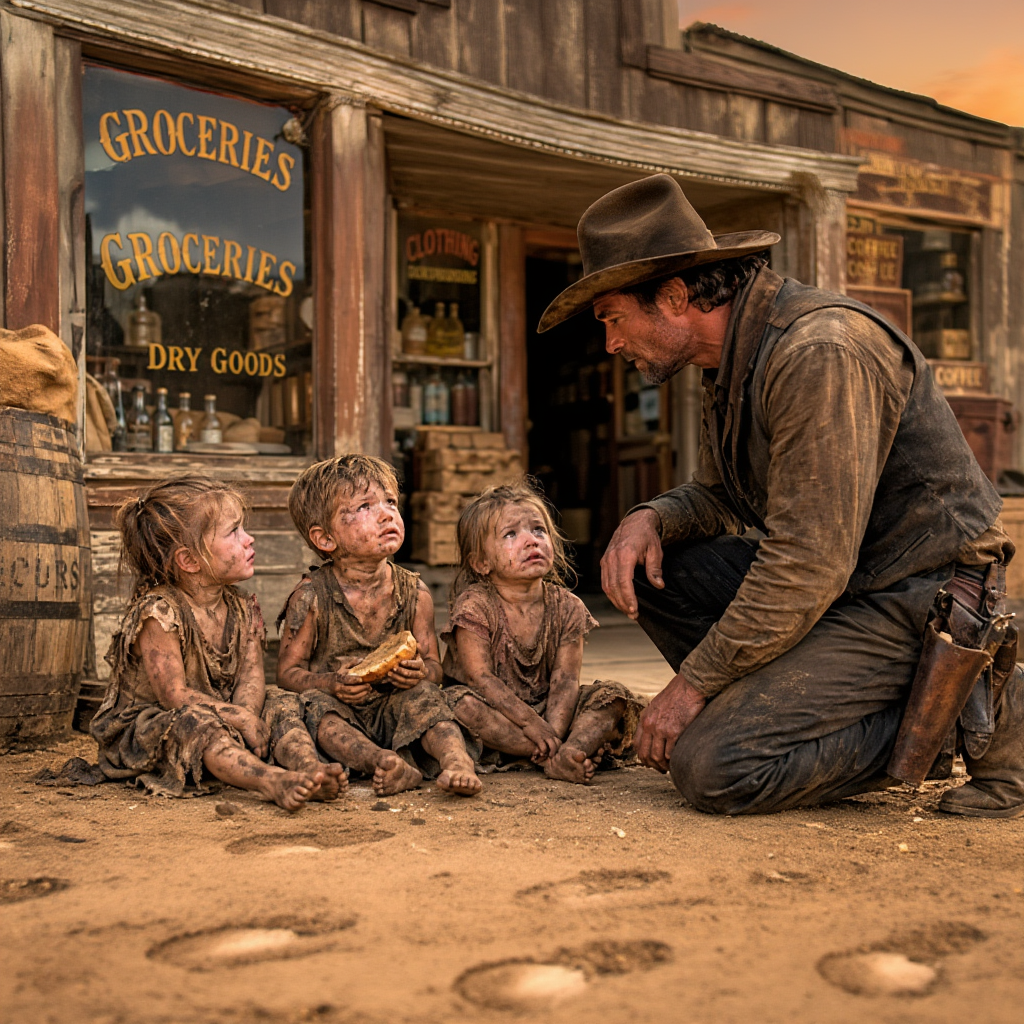
The words floated in the warm, dusty air of the late afternoon, thin as smoke. The sun hung low over the frontier town, staining everything gold—the crooked wooden storefronts, the rutted street, the faded paint of the sign that read GROCERIES beside another that promised DRY GOODS.
No one stopped.
A wagon rolled past, wheels groaning. Two men leaned against a hitching post, laughing over a bottle. A woman hurried by with her head down, pretending not to see.
The three children sat beside a weathered wooden barrel, their bare feet caked in dirt. The smallest girl leaned against her older brother’s shoulder, her eyes dull with hunger. The boy in the middle held the crust—no bigger than his palm—as if it might disappear if he loosened his grip.
That was when the cowboy stopped.
He had been crossing the street, boots kicking up small clouds of dust, hat pulled low against the sun. A revolver rested in a worn holster on his right hip, and his brown vest bore the pale scars of long travel. He looked like any other drifting rider passing through.
Except he didn’t keep walking.
He turned.
The children looked up.
He knelt slowly in front of them, joints cracking faintly, studying their faces. Dirt streaked their cheeks, but it couldn’t hide how thin they were. The smallest girl’s dress hung loose as if it belonged to someone else. The boy’s shirt had lost most of its buttons. The middle child—who held the bread—had eyes too serious for his age.
“You sharing that?” the cowboy asked quietly.
The boy nodded.
“With them?” The cowboy tilted his head toward the two girls.
Another nod.
“How long since you ate?”
The boy hesitated. “Yesterday… I think.”
The smallest girl tugged his sleeve. “Tommy said we should wait till supper time.”
The cowboy glanced around the street. “You got parents nearby?”
The three children went silent.
The wind rattled the sign above the storefront.
Finally, the older girl whispered, “Mama went to find work. She said to wait here.”
“When?”
“Two days.”
The cowboy looked at the crust again.
The boy carefully broke it into three uneven pieces. He handed the biggest one to the smallest girl. She stared at it, then at him.
“You take it,” she said.
“No. You’re littler.”
“You need it more.”
The cowboy swallowed.
The older girl intervened, splitting her piece again. Soon they were each holding something barely worth chewing. Still, they bowed their heads like it was a feast.
They took tiny bites.
The cowboy stayed kneeling, watching.
He had seen hunger before. Seen it in mining camps. In drought towns. In winter passes where wagons stalled and hope ran out before food did.
But there was something different here.
They weren’t fighting over the bread.
They were sharing it.
The boy noticed the cowboy still watching and froze mid-bite.
“Sorry,” he said quickly, lowering the crust. “We don’t got more.”
The cowboy blinked. “You think I’m here to take it?”
The boy shrugged. “Grown-ups usually do.”
Something tightened in the cowboy’s chest.
He stood up slowly.
The children’s eyes followed him, wary.
For a moment, it looked like he’d walk away like everyone else. His boots turned toward the street, his shoulders shifting as if he were already leaving.
Then he stopped.
He reached into his pocket and pulled out a coin. He turned it in his fingers, staring at the worn metal. It wasn’t much—barely enough for a meal.
He looked back at the children.
The smallest girl was licking crumbs from her palm.
The cowboy exhaled.
“Stay right here,” he said.
The boy stiffened. “You coming back?”
The cowboy met his gaze. “Yeah.”
The boy nodded, though he clearly didn’t believe him.
The cowboy pushed through the swinging door beneath the GROCERIES sign. A bell clanged overhead. Inside, shelves lined the walls, filled with jars, flour sacks, and tins catching the golden light from the window.
The shopkeeper glanced up. “Help you?”
“Bread,” the cowboy said. “And whatever’s cheapest.”
The shopkeeper eyed him. “You feeding a crew?”
“Three kids.”
The man sighed. “They still out there?”
“Yeah.”
“They’ve been there all afternoon.” He leaned on the counter. “Told ’em to move along. They don’t buy nothing.”
The cowboy set the coin down. “This what I got.”
The shopkeeper weighed it in his hand. “That’ll get you a loaf. Maybe some dried beans.”
“Do it.”
Moments later, the cowboy stepped back into the sunlight with a wrapped bundle.
The children looked up, stunned.
He walked over and crouched again. He unwrapped the cloth, revealing a whole loaf of bread.
The smallest girl gasped.
The boy’s eyes widened. “That… that’s for us?”
“Yeah.”
They didn’t move at first, as if afraid it might vanish.
“Go on,” the cowboy said.
The boy reached forward slowly, tore off a piece, and handed it to each girl before taking one himself. They ate fast this time, crumbs falling onto the dust.
The cowboy watched them devour the bread, something heavy settling inside him.
He could still walk away.
He told himself that.
Feed them once. That’s enough. Someone else would step in. The town had people. Churches. Folks with bigger pockets.
He stood.
The children froze again.
“You leaving?” the smallest girl asked.
The cowboy hesitated.
He looked down the street. His horse waited near the hitching rail. The road west stretched open, promising distance and silence. No ties. No obligations.
He looked back at the children.
The boy carefully wrapped the remaining bread in the cloth, saving it.
“For later,” he murmured.
The cowboy sighed.
“No,” he said quietly. “I ain’t leaving.”
The boy blinked. “You’re… staying?”
“For a bit.”
The cowboy pulled his hat lower and glanced toward the store. “Where’s your mama say she’d be?”
“Anywhere hiring,” the older girl said. “Laundry… dishes… anything.”
The cowboy nodded.
He turned toward the storefronts lining the street.
“Come on,” he said. “We’re gonna find her.”
The children scrambled to their feet. The smallest girl grabbed his sleeve without asking.
He didn’t pull away.
They walked together past the DRY GOODS sign, past the saloon, past a blacksmith hammering sparks into the dusk. People stared. Some whispered. No one offered help.
At the boarding house, the owner shook her head. “Woman with three kids? Haven’t seen her.”
At the laundry, a tired worker said, “Lots of women asking for work. None stayed.”
At the saloon, a bartender wiped a glass and muttered, “Try the church.”
The sun dipped lower.
The children grew quiet again.
The cowboy felt their pace slow, hunger replaced by exhaustion. The smallest girl stumbled. Without a word, he lifted her into his arms. She weighed almost nothing.
They reached the church just as the first lamps flickered to life.
The door creaked open.
Inside, a woman knelt near the front pew, head bowed. Her shoulders trembled.
The older girl gasped. “Mama?”
The woman looked up.
Her eyes widened as the children ran to her.
She wrapped them in her arms, sobbing. “I told you to stay… I told you…”
“We did,” the boy said. “We shared bread.”
She noticed the cowboy then, standing quietly near the door.
“You fed them?” she asked, voice shaking.
“Just bread,” he said.
She tried to stand, but her legs faltered. The cowboy stepped forward, steadying her.
“I couldn’t find work,” she whispered. “No one wants a woman with three mouths.”
The cowboy looked at the children clinging to her.
He thought about the road waiting outside.
He thought about the crust they had shared.
“You still need work?” he asked.
She nodded.
He tipped his hat. “I know a ranch two miles out. They’re always short hands. Pay ain’t much… but they feed their people.”
Her eyes filled again. “You’d… take us?”
The cowboy glanced at the children.
“I ain’t walking away,” he said.
Outside, the last light of sunset washed the dusty town in gold.
The cowboy led them toward the hitching rail. He lifted the smallest girl onto the saddle, then helped the others climb up behind her. The mother hesitated.
“You don’t even know us,” she said.
He swung into the saddle. “Didn’t need to.”
He clicked his tongue, and the horse stepped forward.
Behind them, the storefront signs faded into shadow. Ahead, the open road stretched beneath a darkening sky.
The boy leaned forward. “Mister?”
“Yeah?”
“Why’d you help us?”
The cowboy thought for a long moment.
“Because you shared,” he said.
The boy frowned. “Shared what?”
“The last thing you had.”
The horse moved steadily into the evening.
The cowboy didn’t look back.