
She Crawled Into the Old Mine Shaft Just Before the Storm — 60 Feet In, the Rock Was Still Warm
The wind began as a whisper.
By noon, it had teeth.
Snow swept across the mountains in long, slanted lines, burying the narrow trail that wound along the ridge. Pine trees bent under the weight of ice, their branches creaking like old doors. The sky turned the color of dull steel, and the air dropped so quickly that breath froze in front of lips.
Mara Ellison tightened her coat and pushed forward.
Her boots sank deep in fresh snow, each step harder than the last. The mule behind her snorted, reluctant, ears flat. She pulled the lead rope gently.
“Come on, Daisy,” she murmured. “Not much farther.”
But she wasn’t sure that was true.
The map in her pocket was half-faded and decades old. It showed a mining trail cut into the mountain—abandoned long before she was born. She had followed it since dawn, hoping it would lead to shelter.
Now the storm was closing in.
The first heavy gust hit her sideways, nearly knocking her down. Snow blasted across her face, stinging like sand. She squinted ahead.
That was when she saw it.
A dark opening in the slope.
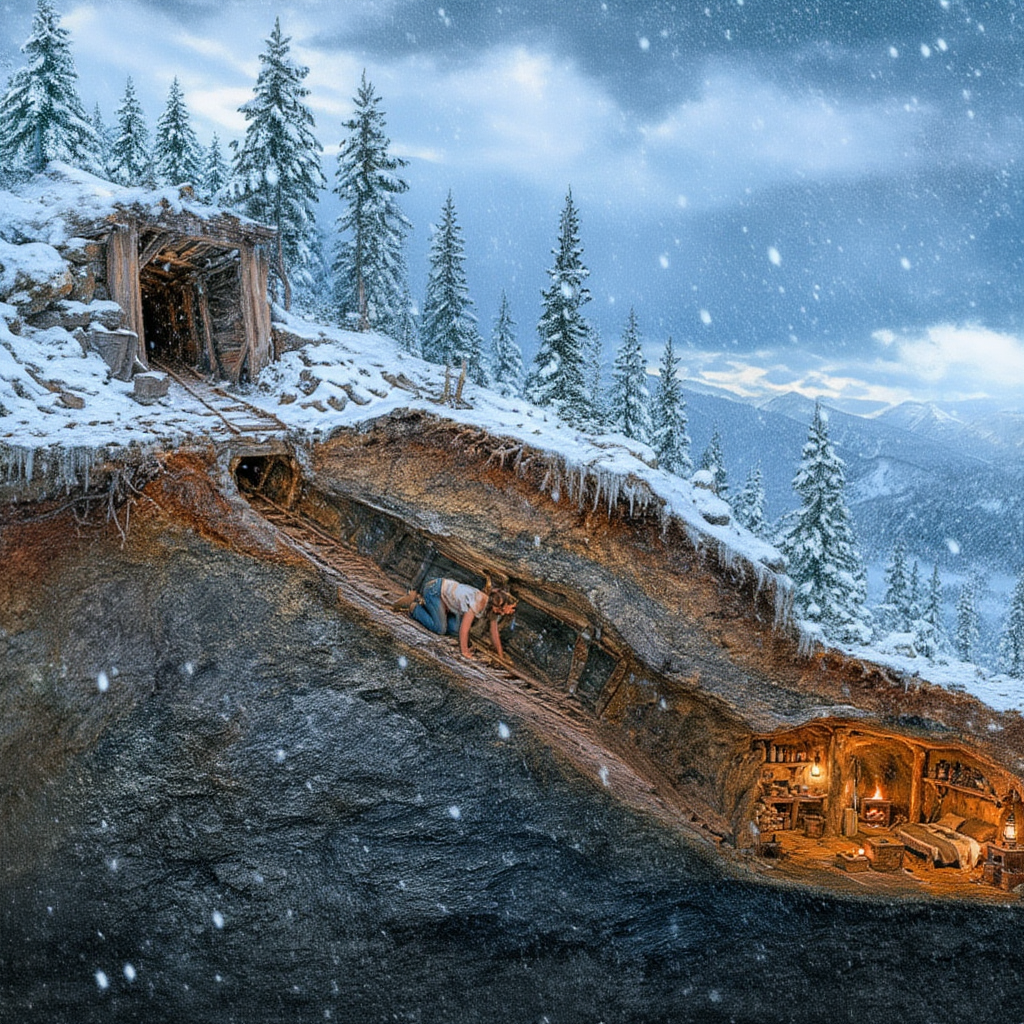
Half-buried in drifted snow, wooden beams jutted from the mountain like broken ribs. Rusted rails disappeared into shadow. The entrance of an old mine shaft.
Relief flooded her.
She led Daisy toward it, boots slipping on packed ice. The mule balked at the threshold, hooves clattering on the metal rails.
“It’s just for a bit,” Mara said.
She tied Daisy to a stunted pine just outside, pulling her blanket tighter. “I’ll check it first.”
The wind howled louder, as if urging her inside.
Mara stepped into the mine.
The air changed immediately.
Outside, the cold bit deep. Inside, the temperature felt… still. Not warm, but calmer. The tunnel sloped downward at a shallow angle, supported by old wooden braces darkened with age. Snow had blown in near the entrance, but farther inside the ground turned dry and dusty.
She lit a lantern.
The yellow glow revealed rails running deeper into the mountain. The tunnel angled downward more sharply about twenty feet in. The walls shifted from loose dirt to solid rock.
She crouched and listened.
No dripping water. No shifting timber.
Just silence.
Behind her, the wind roared outside.
She took a breath and moved deeper.
The tunnel narrowed slightly, forcing her to duck. She dropped to her knees and crawled under a sagging support beam. The rock felt smooth beneath her palms, worn by decades.
Thirty feet in, the air felt different again.
Still.
Less biting.
She paused, confused.
Her fingers brushed the stone wall.
It wasn’t cold.
She frowned and pressed her palm flat.
Warm.
Not hot—but unmistakably warmer than the air outside.
Mara blinked.
She crawled farther.
Forty feet.
The warmth increased slightly. The air no longer burned her lungs. Her breath didn’t fog as thickly.
She turned back briefly, glancing toward the entrance. The storm outside was now a white blur.
If she stayed near the opening, she’d freeze.
If she went deeper…
She crawled again.
Fifty feet.
The tunnel dipped more steeply. The rails disappeared under packed earth. Wooden supports became more frequent, but still solid. She moved carefully, lantern held ahead.
Then, around sixty feet in, the tunnel widened.
She gasped.
The space opened into a small chamber carved into solid rock. Old timbers formed a rough ceiling. Someone—long ago—had cleared the floor and stacked stones to create a level surface.
A rusted stove sat in the corner.
Beside it, shelves carved into the wall held broken jars, a dented tin cup, and scraps of cloth. A wooden frame—once a bunk—leaned against the rock.
It wasn’t just a mine.
Someone had lived here.
And the air—astonishingly—felt almost comfortable.
Mara knelt, pressing her hand to the floor. The rock held steady warmth, as if the mountain itself breathed heat. Not enough to sweat, but enough to keep the chill away.
She understood.
The deeper rock retained ground temperature. Shielded from wind, insulated by earth.
It was warmer than outside.
Much warmer.
She hurried back to the entrance.
Snow blasted into her face as she emerged. Daisy brayed nervously.
“It’s okay,” Mara said, tugging the rope. “You’re coming in.”
The mule resisted, hooves sliding, but finally followed her into the tunnel. The animal calmed as they moved deeper, ears lifting as the wind faded.
At the chamber, Mara tied Daisy to a support beam.
She gathered loose boards, stacked them near the stove, and checked the flue. Surprisingly, it still vented into a narrow chimney carved upward. She scraped debris free.
Soon, a small fire flickered.
The warmth spread slowly, combining with the natural heat of the rock. The chamber became cozy.
Mara exhaled deeply for the first time in hours.
Outside, the storm intensified.
Snow piled against the entrance, sealing it partially. Wind howled through the mountains, but inside the chamber, the air remained calm and steady.
She set up the old bunk with her blanket, arranged supplies on the shelf, and fed Daisy oats from her pack.
Hours passed.
Night came unnoticed underground.
The lantern glowed golden against dark stone. The fire crackled softly. The rock walls radiated gentle warmth, holding it even when flames died low.
Mara slept.
When she woke, silence greeted her.
She climbed toward the entrance.
The tunnel narrowed again, forcing her to crawl. Snow had drifted halfway inside. She pushed through carefully.
Outside, the world was buried.
Drifts rose waist-deep. The trail vanished entirely. Pine trees sagged under heavy snow. The sky remained gray, more flakes falling.
She looked back at the mine.
The opening now seemed like salvation carved into the mountain.
For three days, she stayed.
The chamber held warmth steadily. She burned minimal wood. The rock absorbed heat and released it slowly. Even at night, the temperature barely dropped.
She explored the shelves and found an old notebook, pages brittle but legible. A miner had written short entries—weather notes, supply lists, and one line underlined twice:
“Sixty feet in, rock stays warm. Best place to ride out winter.”
Mara smiled faintly.
The storm finally broke on the fourth day.
Sunlight filtered weakly through thinning clouds. The air outside remained brutal, but the wind had died.
Mara packed her things.
Before leaving, she looked around the chamber once more—the carved shelves, the stove, the bunk, the warm stone.
Someone had survived here before her.
Now she had too.
She led Daisy back into the light.
The mountain gleamed white under the pale sun. Smoke rose faintly from distant valleys. The trail would take time to find, but she no longer rushed.
Behind her, sixty feet into the earth, the rock still held its quiet warmth—unchanged, patient, waiting for the next traveler who might crawl inside just before another storm.