
STORY
When Clara Whitmore first saw the thirty acres her father had left her, she understood why everyone in town was laughing.
There was hardly enough soil to bury a fence post.
Gray limestone rose from the ground in crooked shelves. Scrub oak clung to cracks in the cliffs. The narrow pasture below the ridge turned brown before summer had properly begun, and the only building on the property was a leaning cabin with one window, a rusted stove, and a roof that complained whenever the wind blew.
Her cousin Nathan had inherited the good land.
One hundred and sixty acres of bottom ground.
A barn.
Two wells.
The family house.
Clara received the rocks.
At the reading of the will, Nathan had actually chuckled.
“Thirty acres of stone,” he said. “Uncle Henry always did have a strange sense of humor.”
Clara folded the deed and slipped it into her coat pocket.
The attorney cleared his throat. “Your father specified that the ridge property was not to be divided.”
“That supposed to make it valuable?” Nathan asked.
Clara looked at him.
“No,” she said quietly. “It makes it mine.”
That ended the conversation.
Or it should have.
For the next several weeks, everyone had an opinion.
At the general store, old Vernon Pike shook his head when Clara bought lamp oil and fifty pounds of flour.
“You planning on living up there?”
“I am.”
“There isn’t any water.”
“There’s a hand-dug cistern beside the cabin.”
“That’ll last until July.”
“Then I’ll worry about July in July.”
Vernon laughed.
By June, Clara had repaired the roof, patched the chimney, planted beans wherever she could find pockets of soil, and learned which sections of the ridge held shade longest.
But there was one thing she couldn’t understand.
Her father had loved that land.
As a child, Clara remembered him disappearing toward the ridge with a shovel, a rope, and an old canvas pack.
Sometimes he stayed gone until evening.
Whenever she asked what he did up there, he gave the same answer.
“Listening.”
“To what?”
“The mountain.”
She had thought it was one of his jokes.
Then came the drought.
By the first week of July, rain barrels were empty.
By the third, Nathan’s south pasture had turned the color of old straw.
By August, the creek was reduced to disconnected muddy pools.
The valley had survived dry summers before, but this was different.
The heat simply would not break.
Day after day, the sun rose white over the hills and burned until evening.
Families began hauling water in barrels from twenty miles away.
Then Vernon’s well failed.
Two days later, the Miller place lost theirs.
Nathan’s first well dropped so low that the pump began pulling sand.
He came to Clara’s cabin one afternoon covered in dust.
“You’ve got anything left?”
“Half my cistern.”
“That’s it?”
“That’s it.”
Nathan looked toward the rocky ridge.
“You ought to sell before this gets worse.”
“To whom?”
“Anybody foolish enough to buy it.”
Clara smiled.
“I thought I was the foolish one.”
He didn’t smile back.
“I’m serious, Clara. That land won’t feed you.”
She looked beyond him toward the valley.
Cattle stood around empty troughs. Gardens had withered. Even the cottonwoods along the creek had begun curling their leaves.
“I’m staying.”
Nathan shook his head and rode away.
Three mornings later, Clara’s cistern went dry.
She lowered the bucket and heard it strike stone.
For several seconds she stood there holding the rope.
Then she whispered, “All right, Papa. What were you listening to?”
She went inside.
Her father’s belongings filled a small wooden trunk beneath the bed.
Most were ordinary things: receipts, letters, a pocketknife, two shirts, an old Bible.
At the bottom was a folded survey map.
Clara spread it across the table.
The property boundary had been drawn in black ink.
But her father had added several markings in pencil.
Small crosses climbed toward the northern ridge.
Beside one was written:
June — still running.
Another:
August 14 — cold.
And farther up:
Never dry. Follow the limestone.
Clara stared at the words.
Then she grabbed her father’s canvas pack.
She followed the marks through the rocks for nearly two hours.
The trail barely existed.
She squeezed between limestone walls, crawled beneath a fallen cedar, and climbed until the cabin disappeared below her.
The final pencil mark corresponded to a narrow ravine she remembered visiting once as a child.
It looked completely dry.
Clara nearly turned around.
Then she heard something.
Drip.
She stopped.
Drip.
Not wind.
Not insects.
Water.
Clara pushed through brush and found a crack beneath an overhanging shelf of limestone.
Cool air touched her face.
She knelt.
A thin ribbon of water slid from the darkness.
She followed it around the rocks until the ravine suddenly opened.
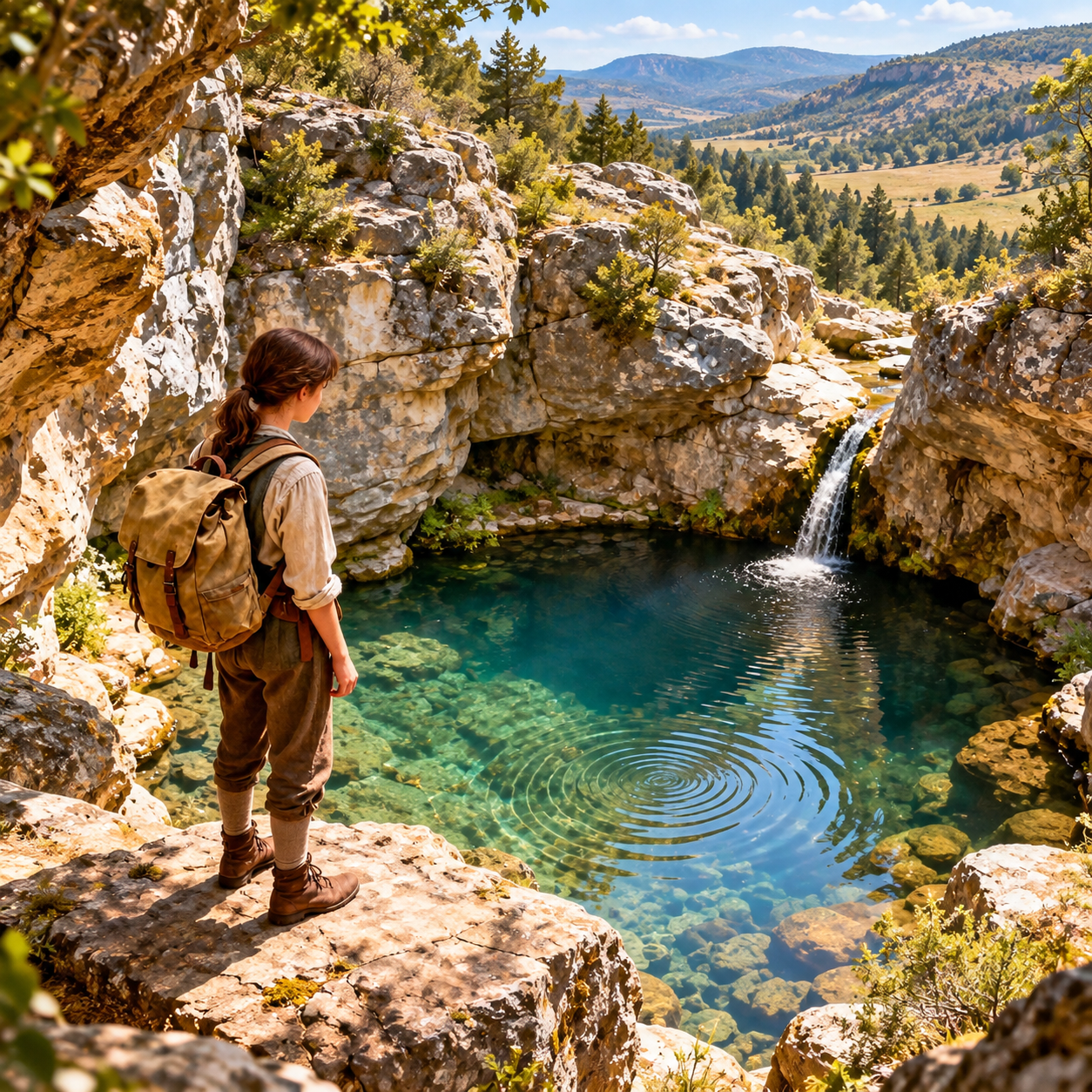
And there, hidden inside a bowl of limestone, was a pool.
Clear.
Deep.
Blue-green.
Water spilled continuously from a fracture in the rock, dropped several feet, and disappeared into the pool.
Clara stood frozen.
The entire valley below her was dying of thirst.
Yet here water was flowing as though the drought did not exist.
She dropped her pack and hurried to the edge.
The water was painfully cold.
She drank from her cupped hands.
Then she began laughing.
“Papa…”
Her voice echoed between the rocks.
“You knew.”
But the pool itself wasn’t the true secret.
That came when Clara noticed the water leaving it.
There was no visible outlet.
Yet the waterfall continued pouring in.
She walked around the basin and found a narrow channel disappearing beneath a limestone shelf.
Her father had scratched a small mark into the rock beside it.
An arrow.
Clara followed.
Beyond the pool, hidden by brush, she discovered an old stone-lined trench.
Not natural.
Someone had built it.
Her father.
Perhaps her grandfather before him.
The trench descended toward the valley.
Clara spent the next two days clearing it.
On the third morning, Nathan appeared.
He found her dragging branches from the channel.
“What are you doing?”
“Working.”
“You’ve been missing for three days.”
“I wasn’t missing.”
Nathan noticed the wet mud on her boots.
His expression changed.
“Where did you get water?”
Clara said nothing.
Nathan stepped closer.
“Clara.”
She sighed.
“Come with me.”
When he saw the pool, he stopped speaking.
For once, Nathan Whitmore had absolutely nothing clever to say.
He removed his hat.
“How much is here?”
“I don’t know.”
He stared at the waterfall.
“This is running now?”
“Yes.”
“In this drought?”
“Yes.”
Nathan crouched and touched the water.
“Good Lord.”
Clara pointed toward the trench.
“Papa knew about it.”
Nathan slowly looked at her.
“That’s why he gave you the ridge.”
“I think so.”
His face tightened.
“And gave me the farm.”
Clara understood immediately.
The spring sat above almost every farm in the valley.
Gravity could carry water downhill.
Nathan stood.
“We could pipe it.”
“We?”
“You know what I mean.”
“I know exactly what you mean.”
“Clara, people are losing cattle.”
“I know.”
“My second well is almost gone.”
“I know that too.”
He paced beside the pool.
“This could be worth a fortune.”
Clara looked at him sharply.
“That’s what you’re thinking about?”
“I’m thinking practically.”
“You’re thinking about selling water.”
“Why shouldn’t you? It’s yours.”
Clara looked into the clear pool.
Technically, Nathan was right.
She could charge whatever desperate families were willing to pay.
For the first time in her life, those thirty useless acres could make her wealthy.
By evening, word had spread.
The next morning, three wagons waited near Clara’s cabin.
Then six.
Then eleven.
People brought barrels, buckets, milk cans—anything that could hold water.
Vernon Pike was among them.
The same man who had laughed at her.