
STORY
Walter Mercer had been quiet through most of the auction.
At sixty-eight, he had learned that silence was cheaper than arguing and usually more useful. So while half the town crowded around the old Corbin Hollow Schoolhouse on a bright October Saturday, Walter stood near the back with his hands buried in the pockets of his faded work jacket.
Everything inside the school was being sold.
Desks went for twelve dollars each. Maps for five. A brass bell brought nearly four hundred after two collectors fought over it. Even the battered yellow school bus drew serious bids.
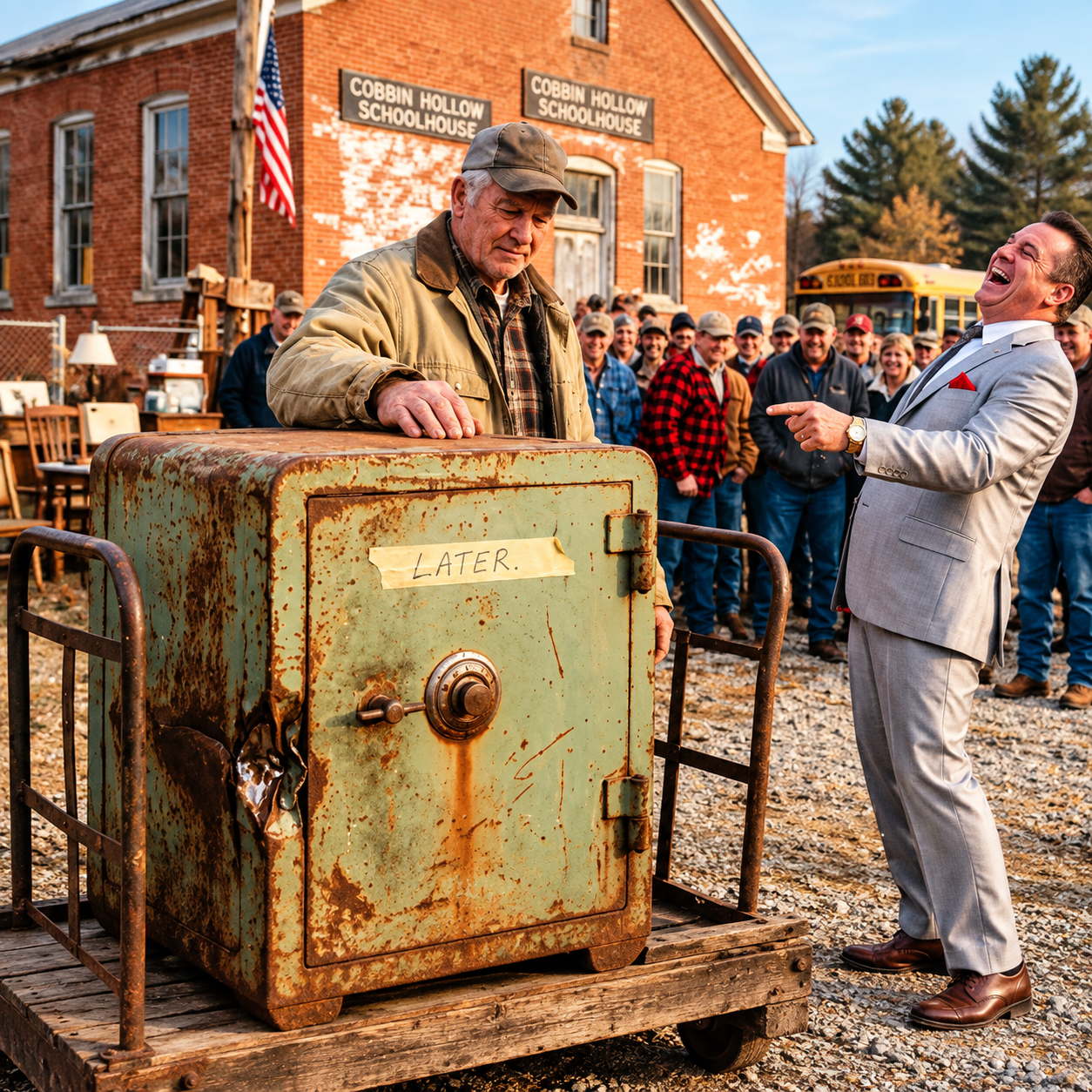
Then two workers rolled out the safe.
It was ugly enough to make people laugh.
Three feet high, green beneath layers of rust, dented along one corner and so heavy that four men had struggled to get it onto a wooden cart.
The auctioneer, Dean Pritchard, slapped its top.
“Ladies and gentlemen, behold the treasure chest of Corbin Hollow!”
Someone shouted, “Treasure? Looks like tetanus with a combination lock!”
The crowd roared.
Dean grinned.
“School district says it hasn’t been opened in years. Combination is gone. Bottom’s rusted. Door might be jammed forever. Who’ll give me fifty?”
Silence.
“Twenty-five?”
A man near the bus called, “You pay me twenty-five, I’ll haul it away!”
More laughter.
Walter stepped closer.
Something about the safe bothered him.
Not the lock.
Not the rust.
The bottom.
Along the lower edge, almost hidden beneath dried mud, was a narrow steel plate attached with four old rivets.
Walter crouched.
Dean noticed.
“Well, Walter, planning to keep your retirement money somewhere safe?”
Walter ran one thumb over the plate.
“Maybe.”
“Ten dollars!” someone yelled.
Dean pointed.
“Ten! Do I hear fifteen?”
Walter lifted two fingers.
“Fifteen.”
The bidding crawled upward mostly as a joke.
Twenty.
Twenty-five.
Thirty.
Finally Walter said, “Thirty-five.”
Nobody answered.
Dean waited theatrically.
“Sold! Thirty-five dollars to Walter Mercer, the only man in the county willing to buy a safe he can’t open!”
The crowd applauded and laughed.
Dean leaned against the safe.
“Walter, if there’s a million dollars inside, remember who sold it to you.”
Walter looked at him.
“If there’s a million dollars inside, Dean, I’ll buy you lunch.”
That got another laugh.
But Walter wasn’t smiling.
He was looking at those four rivets.
By sunset, his grandson Ethan helped him unload the safe inside Walter’s workshop.
“You actually paid money for this?” Ethan asked.
“Thirty-five dollars.”
“Grandpa, scrap value might be twenty.”
“Then I’m only fifteen dollars foolish.”
Ethan laughed.
“What are you looking for?”
Walter pointed toward the steel plate.
“That.”
They tipped the safe backward with a hydraulic jack.
Years of dirt had hardened beneath it.
Walter scraped carefully with a wire brush.
Metal slowly appeared.
Not part of the safe.
A separate plate.
And beneath the dirt were letters.
Ethan leaned closer.
“There’s writing.”
Walter stopped brushing.
His expression changed.
“What?”
“Nothing.”
“Grandpa?”
Walter wiped the plate with an oily rag.
The first line appeared:
PROPERTY OF CORBIN HOLLOW SCHOOL DISTRICT
Nothing unusual.
Below it was a serial number.
Still nothing.
But beneath that was a third line, hand-stamped into the steel.
Walter stared.
His fingers went still.
Ethan read it aloud.
CUSTODIAN: SAMUEL MERCER — 1958
“Mercer?”
Walter didn’t answer.
Ethan looked at him.
“Was that family?”
Walter lowered himself onto a stool.
For several seconds the only sound in the workshop was the ticking of the old wall clock.
“My father.”
Ethan blinked.
“I thought Great-Grandpa worked at the mill.”
“He did.”
Walter looked toward the safe.
“But before that, he worked at Corbin Hollow School.”
“I’ve never heard that.”
“No.”
“Why?”
Walter’s jaw tightened.
“Because nobody talked about it.”
Samuel Mercer had disappeared from Corbin Hollow history in 1959.
Walter had been six.
The story he grew up hearing was simple: Samuel had been dismissed after school money went missing. He left town in disgrace and died years later working at a lumber camp.
Walter’s mother never discussed it.
Whenever Walter asked, she gave the same answer.
“Your father made mistakes.”
By adulthood, Walter had stopped asking.
But now his father’s name was stamped onto a safe nobody seemed to remember.
Ethan pointed at the door.
“You think he knew the combination?”
Walter stared at the dial.
“He might’ve known more than that.”
They worked until nearly midnight.
Walter refused to cut through the door.
Instead he removed the damaged back panel where rust had weakened the steel. After two hours of drilling, hammering, and carefully prying, they opened a gap wide enough to see inside.
Empty shelves.
Dust.
A dead spider.
Ethan sighed.
“Thirty-five-dollar treasure.”
Walter shone his flashlight deeper.
“Wait.”
At the bottom was a sheet of steel that didn’t match the rest.
Walter knocked on it.
Hollow.
They exchanged glances.
Twenty minutes later, the false floor lifted.
Underneath lay a narrow compartment.
Inside was a canvas envelope.
Walter’s hands shook when he picked it up.
The fabric had nearly rotted away.
Inside were papers wrapped in waxed cloth.
Receipts.
Ledger pages.
Three letters.
And a photograph.
Walter stared at the picture.
A young man stood beside the schoolhouse wearing work overalls, one hand resting on the same safe.
Samuel Mercer.
On the back, written in pencil:
Sam — September 1958. The only man who wouldn’t sign.
Ethan frowned.
“Wouldn’t sign what?”
Walter unfolded the first letter.
It was addressed to the county superintendent.
The handwriting was Samuel’s.
Walter recognized it immediately from the few birthday cards he had kept since childhood.
The letter described money intended for repairs to the school roof.
$8,400.
A significant amount in 1958.
According to Samuel, the school board chairman and a local contractor had submitted invoices for work that had never been completed.
Samuel had discovered the receipts while repairing a broken drawer in the office.
He refused to certify the work.
Then money disappeared.
Samuel was blamed.
Walter read the letter twice.
Then a third time.
Ethan whispered, “They framed him.”
Walter didn’t answer.
There was another document.
A handwritten statement from the school secretary.
She had witnessed two board members removing records from the safe.
Another statement came from a teacher.
Then there was the ledger.
Every payment.
Every false invoice.
Every name.
Including one Walter recognized instantly.
Charles Pritchard.
Dean Pritchard’s grandfather.
The man whose portrait still hung inside the town hall.
Ethan stared at the page.
“Grandpa…”
Walter sat down.
For sixty years, he had believed his father had abandoned them in shame.
Now he understood something different.
Samuel hadn’t run because he was guilty.
He had tried to expose men powerful enough to make guilt stick to him.
The next morning Walter called Dean.
“You awake?”
“Walter? It’s seven-thirty Sunday morning.”
“I opened the safe.”
A pause.
Then Dean laughed.
“Million dollars?”
“No.”
“Gold?”
“No.”
“What’d you find?”
“Your grandfather.”
Silence.
Dean arrived forty minutes later.
He came alone.
Walter had arranged the papers across his workbench.
Dean entered smiling uncertainly.
“That was a strange phone call.”
Walter handed him the ledger.
Dean’s smile vanished.
He read the first page.
Then another.
Then the letter.
His face drained.
“Where did this come from?”
“Under a false floor.”
Dean slowly lowered the papers.
“This doesn’t prove—”
“Read the secretary’s statement.”
Dean did.
He sat down.
“My grandfather was chairman of the school board.”
“I know.”
“He was respected.”
“So was my father. Until this happened.”
Dean looked toward the safe.
“Why hide these documents instead of giving them to authorities?”
Walter held up the final letter.
Samuel had explained that too.
He had tried.
The county office returned his complaint unopened.
The sheriff told him to stop causing trouble.
When Samuel realized the records were about to be destroyed, he hid copies beneath the safe.
He intended to retrieve them.
He never got the chance.
Three days later he was arrested for theft.
The charges were eventually dropped for lack of evidence, but the accusation destroyed his reputation.
He left town.
Dean stared at the floor.
“I laughed at you yesterday.”
Walter gave a tired smile.
“Everybody did.”
“I mean… I stood there pointing at that thing like it was garbage.”
“It looked like garbage.”
Dean looked at him.
“What are you going to do?”
Walter answered quietly.
“Tell the truth.”
The following Wednesday, the old schoolhouse was packed again.
But there was no auction.
Walter stood near the front with Ethan beside him.
Dean had asked to speak first.
He walked to the microphone without his usual showman’s grin.
“Saturday,” he began, “I sold Walter Mercer an old safe for thirty-five dollars.”
A few people chuckled.
Dean didn’t.
“I thought the joke was on Walter.”
The room quieted.
“I was wrong.”
He explained everything.
The ledger.
The statements.
The hidden compartment.
And Samuel Mercer.
People shifted uncomfortably as a forgotten piece of the town’s history came back to life.
Then Walter stepped forward.
He held his father’s photograph.
“My father died believing his children were ashamed of him,” Walter said.
His voice nearly broke.
“For most of my life, I suppose I was.”
Nobody moved.
“I wish I could tell him I know now.”
A woman in the second row began crying.
Walter looked around the room.
“I don’t want anyone punished for something their grandparents did. That’s not why I’m here.”
His eyes briefly met Dean’s.
“I just want my father’s name returned to him.”
Two months later, the county historical society completed its review.
The evidence was authentic.
The financial records matched archived bank documents.
Samuel Mercer was officially cleared.
At the entrance to the restored schoolhouse, a small plaque was installed.
It didn’t call him a hero.
Walter had refused that wording.
Instead it said simply:
SAMUEL MERCER
CUSTODIAN, 1957–1959
WHO KEPT THE RECORDS WHEN OTHERS WANTED THEM FORGOTTEN
The old safe remained inside.
They cleaned it but didn’t repaint it.
Walter insisted the rust stay.
So did the dents.
And underneath, behind glass, they displayed the small steel plate bearing Samuel’s name.
At the dedication, Dean stood beside Walter.
“You know,” Dean said, “I’ve been thinking.”
“Dangerous habit.”
Dean smiled.
“That safe belongs to you. Technically.”
“I donated it.”
“Still, thirty-five dollars wasn’t a bad investment.”
Walter looked through the schoolhouse doorway.
Children were gathered around the exhibit while Ethan explained how the false floor had been discovered.
“No,” Walter said softly.
“It wasn’t.”
Dean put his hands into his pockets.
“So what do you think it was worth?”
Walter watched his grandson point to Samuel’s photograph.
Then he smiled.
“About sixty-eight years.”
Dean didn’t understand at first.
Then he did.
Walter stepped closer to the old safe and rested one hand on its rusted top exactly as his father had done in the photograph decades before.
He had gone to the auction looking at a piece of junk.
He had come home with something money couldn’t have bought.
His father’s good name.
And after sixty-eight years, Walter Mercer finally carried it home.