
STORY
The first frost arrived on a morning when nobody believed frost was possible.
Clara Bennett knew something was wrong before she even opened the cabin door.
There was a silence outside—a strange, brittle silence that made every small sound seem too sharp. Beside her, her twin sister Ruth was still fastening the buttons of her wool dress when Clara scraped a circle through the frost covering the window.
“Ruth.”
Her sister looked up.
Clara pointed outside.
The vegetable patch was white.
Not with dew.
With ice.
Ruth stepped closer. “It’s August.”
“I know.”
They hurried outside without breakfast.
The bean leaves had curled at the edges. The squash vines were stiff. Along the creek, a skin of ice clung to the shaded stones.
Their brown dog, Amos, sniffed the frozen grass and sneezed.
Ruth crouched beside the creek.
“Clara,” she whispered, “look at this.”
The water level had dropped nearly six inches overnight.
Clara felt the uneasiness she’d carried for weeks tighten inside her chest.
Their father had taught them to watch the mountains.
Not simply look at them.
Watch them.
Elias Bennett had spent thirty-two winters trapping, cutting timber, and guiding wagons through the high country. Before his death, he had taught his daughters the little signs most people ignored.
When squirrels gathered heavily before September, pay attention.
When birds left early, pay attention.
When mountain springs suddenly cooled while the valley remained warm, pay attention.
And when frost appeared beneath a clear August sky…
“Winter’s coming early,” Clara said.
Ruth stared toward the mountains.
“How early?”
Clara swallowed.
“Early enough to kill people.”
By noon, the sisters were in town.
They warned everyone who would listen.
“Cut your hay now,” Clara told the farmers outside the feed store. “Bring your cattle down from the northern pasture. Store twice the firewood you think you’ll need.”
Men laughed.
Old Silas Mercer slapped his knee.
“August isn’t winter, Miss Bennett.”
“I’m aware of the calendar.”
That earned another laugh.
Ruth stepped forward.
“The geese are already moving south.”
“They’re birds.”
“The creek dropped.”
“Creeks drop.”
“We found ice this morning.”
Silas grinned.
“Then perhaps your little corner of the valley needs more sunshine.”
Even Sheriff Wade Hollister dismissed them.
“Ladies, you’re frightening people.”
“We’re trying to prepare them,” Clara replied.
“For what?”
“A hard freeze before harvest.”
The sheriff sighed.
“Based on what?”
Clara hesitated.
Everything they knew sounded foolish when separated into pieces.
Frost.
Birds.
Water.
Squirrels.
Wind.
Clouds.
But together, they formed a warning as clear to her as church bells.
“My father taught us.”
That was when Silas laughed again.
“Your father also spent half his life sleeping in holes in mountains.”
Ruth’s face reddened.
“Those holes kept him alive.”
Someone behind them muttered, “Here come the frost prophets.”
Within days, the nickname spread.
The Bennett Prophets.
Then it became worse.
The Bennett Liars.
Someone painted LIARS across their fence.
Someone else nailed a dead crow to their gate.
But Clara and Ruth kept preparing.
They cut firewood.
Then more.
Then more.
They dried beans, apples, corn, and strips of venison.
They packed flour into sealed barrels.
They rendered fat.
They bought salt.
They collected lamp oil.
And every morning, Clara climbed the ridge to study the sky.
One evening she returned pale.
“We can’t stay in the cabin.”
Ruth stopped splitting kindling.
“What?”
“The wind will come from the north.”
“Our cabin has survived eleven winters.”
“Not the winter that’s coming.”
Ruth leaned against the ax.
“Where would we go?”
Clara looked toward the mountains.
“The cave.”
Ruth immediately understood.
Their father had once shown them an abandoned stone shelter high above the valley.
It wasn’t really a cabin.
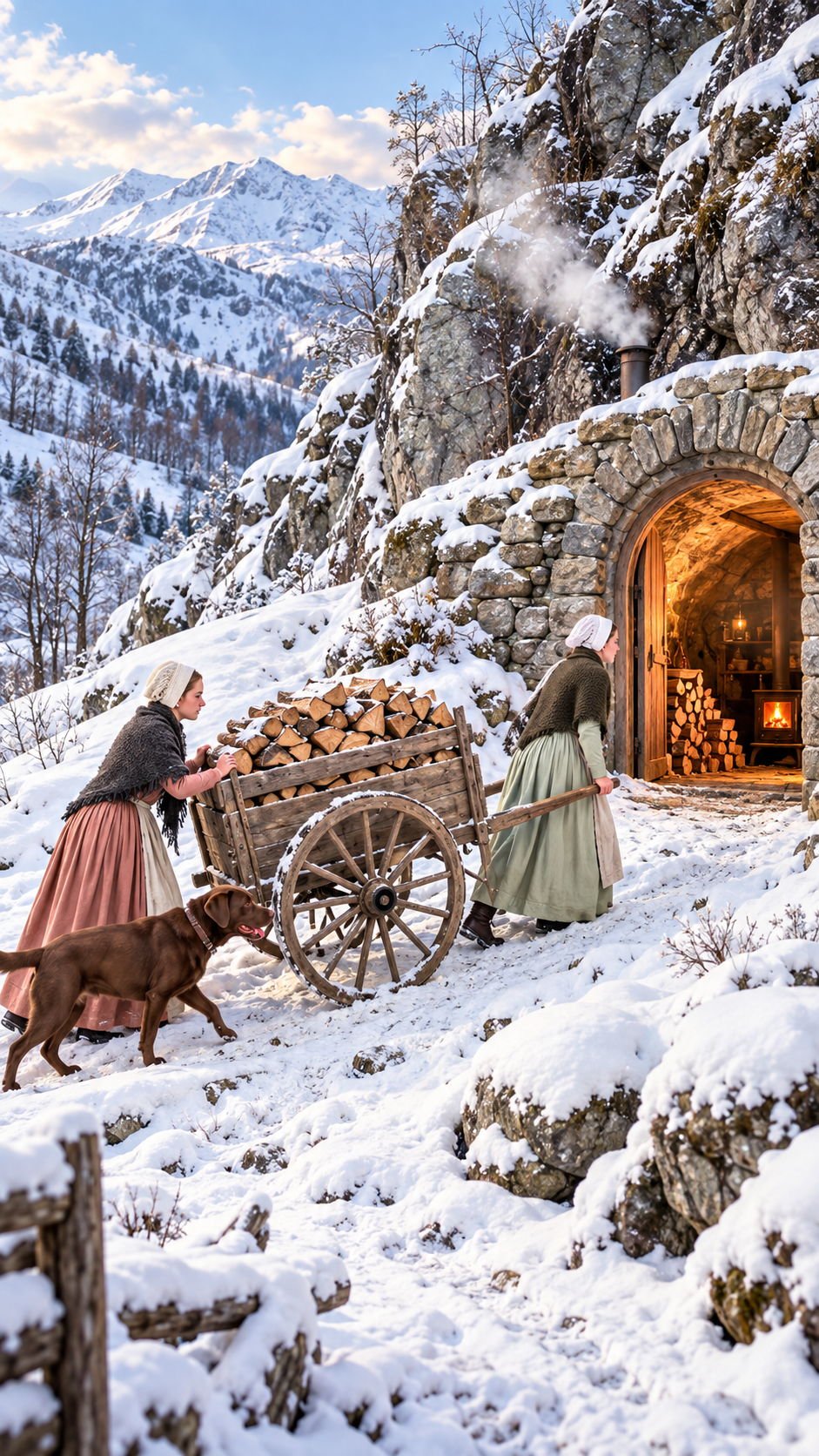
It had been built into a natural cave beneath a granite cliff. Years earlier, prospectors had fitted the entrance with a crude stone wall and timber door.
Behind it stretched nearly forty feet of dry rock.
Their father had called it “the bear hole.”
Ruth stared at her.
“You want us to live inside a mountain?”
“I want us alive in spring.”
Three days later, they began hauling supplies uphill.
Town gossip exploded.
“They’ve finally lost their minds.”
“The Bennett girls are moving into a cave!”
“Maybe they’ll hibernate.”
Clara heard every joke.
She answered none.
She and Ruth repaired the stone entrance.
They sealed cracks with clay.
They installed a small iron stove their father had stored there years before.
They cut a narrow ventilation pipe through the old chimney opening.
They built raised sleeping platforms.
They stacked wood along the dry wall.
They carried sacks of oats, beans, flour, dried fruit, potatoes, onions, and salt.
They hauled water barrels.
The work became exhausting.
One afternoon, Ruth collapsed beside the cart.
“I hate this mountain.”
Clara laughed despite herself.
“You said that yesterday.”
“I hated it less yesterday.”
Amos dropped beside her, tongue hanging out.
Ruth pointed at the dog.
“Even Amos agrees.”
But Clara was staring toward the valley.
Smoke rose lazily from chimneys below.
Fields remained green.
Men were still cutting hay at an ordinary pace.
Children played beside the creek.
Nobody was preparing.
“Maybe we’re wrong,” Ruth whispered.
Clara wanted desperately to say yes.
Instead, she said, “Then we’ll have too much firewood.”
On September 14, summer ended in six hours.
At dawn, the temperature was mild.
By noon, a north wind was roaring down the valley.
By three, rain had become sleet.
At sunset, snow began.
Not gentle snow.
A wall of it.
Clara and Ruth stood inside the stone doorway while the mountains disappeared behind white.
Ruth whispered, “You were right.”
Clara shook her head.
“Father was right.”
They closed the heavy door.
The first storm lasted four days.
When it finally cleared, nearly three feet of snow covered the mountain.
Then the temperature fell.
And kept falling.
The valley had never seen anything like it that early.
Unharvested crops died.
Hay froze beneath snow.
Cattle trapped in upper pastures began dying.
Firewood that families had expected to cut in October was now buried.
Within two weeks, people were burning fence rails.
Then furniture.
Then barn boards.
From the cave, the twins survived comfortably.
The stone held heat remarkably well.
Their stove burned slowly day and night.
The cave temperature never fell below fifty degrees.
Ruth baked flatbread on the stove.
Clara cooked beans and venison.
Amos slept beside the woodpile.
But neither sister felt victorious.
Because every evening they looked down toward the valley and counted fewer chimney fires.
Then one night, Amos began barking.
Clara sat upright.
“What is it?”
The dog rushed toward the entrance.
Someone was outside.
Ruth grabbed the lantern.
Clara opened the door.
A man collapsed into the snow.
Sheriff Hollister.
His beard was crusted with ice.
His lips were blue.
“Help,” he gasped.
They dragged him inside.
Ruth wrapped him in blankets while Clara heated water.
It took nearly an hour before he could speak properly.
“Mercer’s barn collapsed.”
Clara froze.
“How many?”
“Eleven people were sheltering there.”
Ruth whispered, “Silas?”
“Alive.”
The sheriff stared into the stove.
“But they’re running out of wood.”
Clara looked at Ruth.
They both knew what he was asking.
“How many people in the valley still need shelter?” Clara asked.
The sheriff’s eyes filled with shame.
“More than I can count.”
Silence filled the cave.
Months earlier, those same people had called them liars.
Mocked their father.
Painted their fence.
Driven them away.
Ruth looked toward the shelves.
Food.
Wood.
Blankets.
Space.
Not enough for an entire valley.
But perhaps enough for some.
Clara stood.
“Tomorrow morning, we go down.”
The sheriff stared at her.
“You’d help us?”
Clara pulled on her coat.
“We warned you because we wanted you alive.”
At dawn, the sisters hitched ropes to their wooden cart and loaded it with firewood.
They descended through deep snow.
Amos bounded ahead.
The valley they found barely resembled home.
Snow buried fences.
Roofs sagged.
Dead cattle lay beneath white drifts.
People had crowded into three surviving buildings.
Silas Mercer stood outside the feed store when he saw them.
He looked twenty years older.
Nobody laughed.
Clara stopped the cart.
Silas removed his hat.
“I owe you an apology.”
“You owe your family a warm fire,” Clara replied. “Unload the wood.”
For the next five days, the twins made trip after trip.
Then another storm appeared over the northern ridge.
Clara knew immediately it would be worse.
“There isn’t enough wood,” Sheriff Hollister said.
“There doesn’t need to be.”
Everyone turned toward her.
She pointed uphill.
“The cave.”
Silas frowned.
“That hole?”
“That hole stays above fifty degrees with one small stove.”
“How many can it hold?”
“Twenty comfortably.”
“And uncomfortably?”
Clara looked at Ruth.
Her twin smiled faintly.
“Let’s find out.”
They brought thirty-seven people into the mountain.
Children slept on shelves.
Men slept sitting against walls.
Women shared blankets.
The elderly received the raised beds.
The twins rationed food carefully.
Outside, the storm screamed for nine days.
Snow sealed the entrance twice.
Men dug it clear from inside.
On the fourth night, the wind became so violent that everyone went silent.
The mountain seemed to tremble.
A little boy named Henry began crying.
“Is the cave going to fall?”
Clara knelt beside him.
“No.”
“How do you know?”
She placed his hand against the stone wall.
“Feel that?”
He nodded.
“This mountain was here before your grandfather’s grandfather was born.”
Henry considered this.
“Will it be here tomorrow?”
Clara smiled.
“Yes.”
Across the room, Silas Mercer lowered his eyes.
On the ninth morning, the wind stopped.
Nobody moved at first.
They had grown accustomed to the roar.
Clara opened the door.
Sunlight flooded the cave.
The valley below was buried almost completely.
But they were alive.
All thirty-seven.
That spring, something strange happened.
Nobody called Clara and Ruth liars anymore.
Instead, neighbors climbed the mountain carrying stones.
Timber.
Iron.
Food.
They widened the entrance.
Built storage chambers.
Added benches.
Installed another stove.
Sheriff Hollister organized a communal emergency store.
Every family contributed grain or preserved food.
Silas Mercer donated enough timber for a second shelter farther down the valley.
Above the cave entrance, someone carved a small wooden sign.
THE BENNETT REFUGE.
Clara hated it.
Ruth loved it.
“You know Father would’ve laughed at this,” Ruth said.
“He would’ve complained about the lettering.”
“That too.”
Years passed.
The winter became known simply as the Early Freeze.
Children who survived it grew old telling the story.
But eventually the details changed.
Some claimed Clara predicted the storm by studying stars.
Others said Ruth dreamed about it.
One ridiculous version claimed Amos had howled three nights before the frost.
Whenever Clara heard those stories, she corrected them.
“There was no prophecy.”
People would ask, “Then how did you know?”
And Clara always gave the same answer.
“We paid attention.”
Years later, when another young farmer noticed geese leaving early and frost appearing strangely high on the ridge, nobody laughed when he raised the alarm.
Instead, wagons immediately began climbing toward the emergency shelters.
Firewood was stacked.
Food was stored.
Cattle were brought down.
And children helped their parents prepare.
By then Clara and Ruth were older women.
One autumn evening, they sat outside the stone entrance while Amos’s gray-muzzled grandson slept beside them.
Below, dozens of chimney fires glowed across the valley.
Ruth smiled.
“They finally learned.”
Clara watched families carrying supplies toward the mountain.
“No.”
She shook her head gently.
“We finally learned to listen to one another.”
Behind them, the old cave glowed warm and golden against the first falling snow.
Once, it had been the place two unwanted sisters went because nobody believed them.
Now its doors were never locked.
Because the greatest thing Clara and Ruth had stored inside that mountain wasn’t firewood, food, or warmth.
It was the lesson an entire valley had nearly learned too late:
A warning does not become a lie simply because no one wants to hear it.