
The Rancher Hadn’t Smiled in 7 Years—Until The Obese Widow’s Little Girl Said “My Mama Can Fix That”
For seven years, nobody in Willow Bend had seen Caleb Turner smile.
They’d seen him nod. Seen him tip his hat. Seen him ride hard across the plains like a man chasing something he’d never catch. But smile? No.
Not since the day the wagon overturned in the river.
Not since he buried his wife.
Not since he buried his son beside her.
The ranch kept running because Caleb Turner never stopped working. That was the only way he knew how to keep breathing. He rose before sunrise, mended fences, broke horses, hauled feed, repaired roofs, and rode the perimeter of his land until the stars came out.
He spoke when necessary.
He never laughed.
And the ranch — wide, wind-swept, and stubborn — mirrored him perfectly.
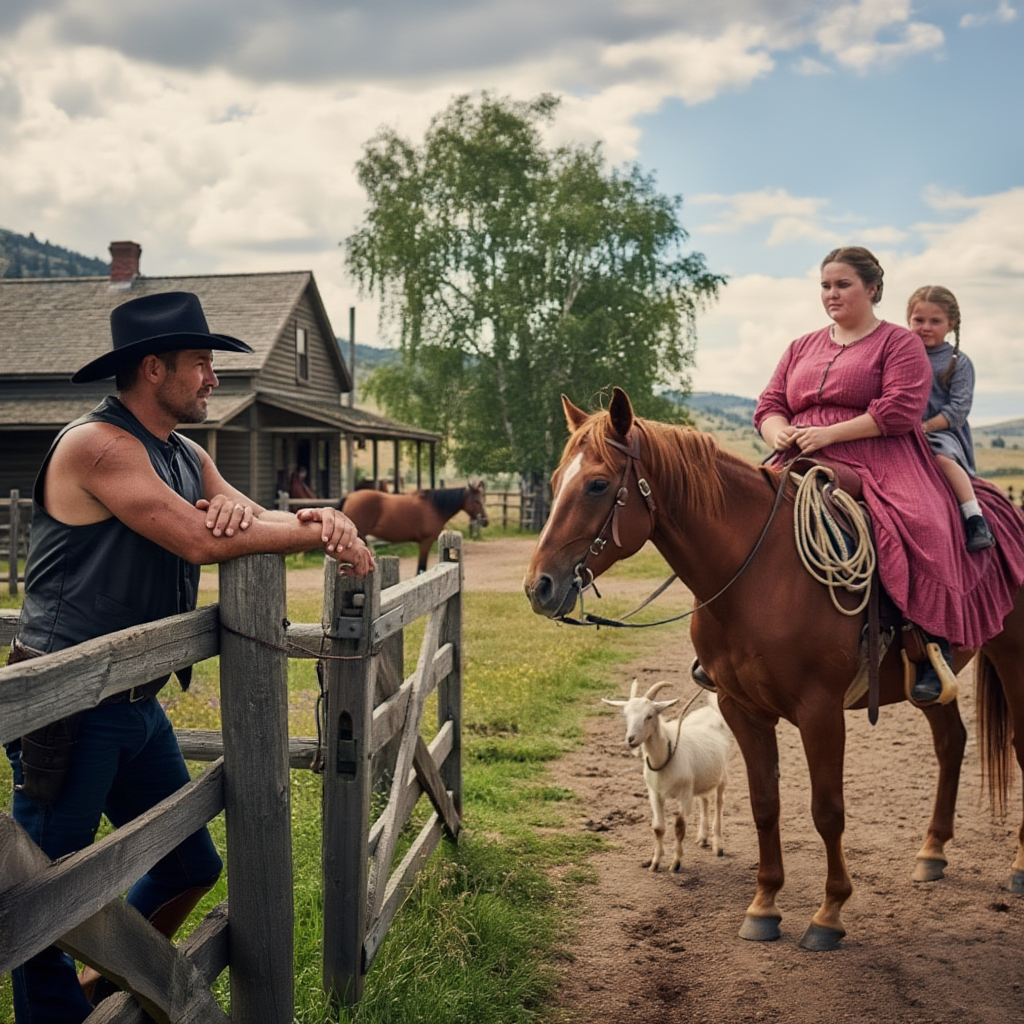
On an overcast afternoon in early spring, Caleb leaned against the old wooden fence that bordered the front pasture. He wore his usual black cowboy hat, a black sleeveless shirt stretched across powerful shoulders, and worn blue jeans. His beard was thick, his expression unreadable. A white goat wandered near his boots, chewing lazily on a patch of grass.
He watched the hills.
Clouds hung low, casting a soft gray light over the land. Another horse moved slowly inside a fenced enclosure behind him. The big ranch house stood quiet beneath a leafy cottonwood tree.
It was a still day.
Then he heard hooves.
Caleb didn’t move at first. Travelers occasionally passed the dirt road that cut near his property. Most didn’t stop. He preferred it that way.
But the sound slowed.
Closer.
He turned his head.
A brown horse approached at an easy walk. A woman rode sidesaddle, her long dusty-rose dress draped carefully over the saddle. Her hair was pulled back simply. She wasn’t thin — not even close. Her frame was full, sturdy, and she sat the horse with surprising balance.
Behind her sat a little girl in a blue dress, arms wrapped loosely around the woman’s waist.
The horse stopped near the fence.
The white goat looked up, then wandered closer.
The woman met Caleb’s eyes.
“Afternoon,” she said.
Her voice was warm, calm — not nervous.
Caleb nodded once. “Afternoon.”
Silence settled.
Wind moved through the grass.
The little girl leaned sideways, peeking around the woman.
She studied Caleb openly.
“You’re the rancher,” she declared.
“Yes,” he replied.
“You never smile.”
Caleb blinked.
The woman shifted slightly. “Lily…”
“It’s true,” the girl insisted. “Mr. Carter said you don’t smile. Mrs. Dunlap said you forgot how.”
Caleb looked at the child.
“I didn’t forget,” he said.
“You just don’t do it.”
“No.”
The girl leaned closer to her mother’s ear, whispering loudly enough for him to hear.
“My mama can fix that.”
The woman flushed. “Lily!”
Caleb stared at them.
The girl smiled brightly. “She fixes everything.”
Caleb’s mouth almost moved — almost.
But it didn’t.
The woman cleared her throat. “I’m Margaret Ellis. This is Lily.”
He nodded. “Caleb Turner.”
“We just bought the old Miller place,” she continued. “Couple miles east.”
Caleb raised an eyebrow. “That land’s rough.”
“We know.”
“House leaks.”
“We know.”
“Fence broken.”
“We know.”
She smiled slightly. “We still bought it.”
Lily added proudly, “Mama says broken things just need patience.”
Caleb looked at them both.
“You’ll need help,” he said.
Margaret shook her head. “We’ll manage.”
The goat bleated softly.
Lily giggled. “He’s cute.”
“That’s Daisy,” Caleb said.
“That’s a goat,” Lily replied.
Caleb almost corrected her — then realized she was right.
Margaret glanced toward the ranch house.
“You live here alone?”
“Yes.”
“For seven years?”
He looked at her sharply.
Word traveled fast.
“Yes.”
She nodded gently.
“Well,” she said, “we’re neighbors now.”
They lingered a moment longer.
Then she nudged the horse forward.
“Come on, Lily.”
As they passed, Lily waved.
“Bye, Mr. Not-Smiling Rancher!”
Caleb watched them ride away.
The goat bumped his leg.
He stared after them longer than he expected.
—
The Miller place looked worse than Caleb remembered.
Two days later, he rode past and saw Margaret hauling water from the well. Lily sat on the porch steps, swinging her legs.
Margaret’s dress was dusty. Sweat dampened her hairline. But she worked steadily.
Caleb slowed his horse.
“You’ll break that bucket,” he called.
She looked up.
“Probably,” she admitted.
He dismounted.
Without asking, he took the rope, adjusted the pulley, and showed her how to angle the lift.
She watched closely.
“Thank you,” she said.
Lily ran over. “Mama, he came!”
“I see that.”
“You smiling yet?” Lily asked.
Caleb shook his head.
She sighed dramatically. “Still broken.”
Margaret hid a smile.
Caleb fixed the pulley, then stepped back.
“That’ll hold.”
“Can I pay you?” Margaret asked.
“No.”
“At least let me—”
“No.”
She nodded.
“Then thank you.”
He mounted his horse.
Lily waved again. “We’ll fix you!”
Caleb rode off.
But later that night, he realized something strange.
He had stayed longer than necessary.
—
Over the next weeks, their paths crossed often.
Margaret mended fences slowly but carefully. Lily followed with a basket, picking wildflowers. Caleb occasionally stopped, offering quiet advice.
“Posts too shallow.”
“Roof needs pitch.”
“You’ll lose chickens without wire.”
Margaret listened. She never argued. Never acted embarrassed.
She simply learned.
One afternoon, Lily wandered into Caleb’s ranch chasing the white goat. Margaret followed, apologizing.
“Sorry — she’s taken a liking to Daisy.”
“It’s fine,” Caleb said.
Lily crouched beside the goat. “He likes me.”
“She,” Caleb corrected.
“Oh.” Lily thought. “She likes me.”
Margaret leaned against the fence near him.
“You didn’t have to help us,” she said.
“You’re neighbors.”
“Still.”
He shrugged.
“You work hard,” he added.
She smiled faintly. “So do you.”
They stood quietly.
Wind moved the grass.
Lily started singing to the goat.
Caleb listened.
Something in his chest loosened.
—
A month later, a storm rolled in fast.
Rain hammered the plains. Wind bent fences. Margaret’s roof began to tear.
Caleb rode over without thinking.
He climbed the ladder, securing loose boards while rain soaked him. Margaret held the ladder steady. Lily watched from the doorway.
“You didn’t have to come!” Margaret shouted.
“Yes, I did,” he replied.
When the storm passed, the roof held.
Margaret handed him a towel.
“Thank you.”
He nodded.
Lily tugged his sleeve.
“You almost smiled,” she said.
He looked down.
“Almost.”
“You’re getting closer.”
Margaret laughed softly.
Caleb felt something warm spread across his face.
Not a smile.
But close.
—
Summer came.
The Miller place transformed. Fence repaired. Chickens clucking. Garden growing. Margaret worked tirelessly, her full frame moving with determined rhythm.
Caleb admired her resilience.
She never complained.
Never asked for pity.
One evening, Lily ran up to him.
“Mama baked pie.”
“I don’t eat pie.”
“Yes you do.”
“No.”
“She said you would.”
Margaret approached, holding a tin.
“You can refuse,” she said, “but I made extra.”
He took it.
“Thank you.”
They sat on the fence.
He tasted it.
It was good.
Very good.
Lily watched his face intensely.
“Well?” she asked.
He paused.
Then… the corner of his mouth lifted.
Just slightly.
Lily gasped.
“MAMA!”
Margaret froze.
“He smiled!”
Caleb realized what he’d done.
But it was too late.
Lily clapped. “I told you! Mama fixed him!”
Margaret looked at him — surprised, gentle.
Caleb exhaled slowly.
“I guess she did.”
For the first time in seven years, the rancher smiled fully.
And the cloudy sky above Willow Bend seemed just a little brighter.