
A Widow Was Given a Paralyzed Mountain Man as a Joke—She Made Him the Pride of the Plains
The first time they saw him, they laughed.
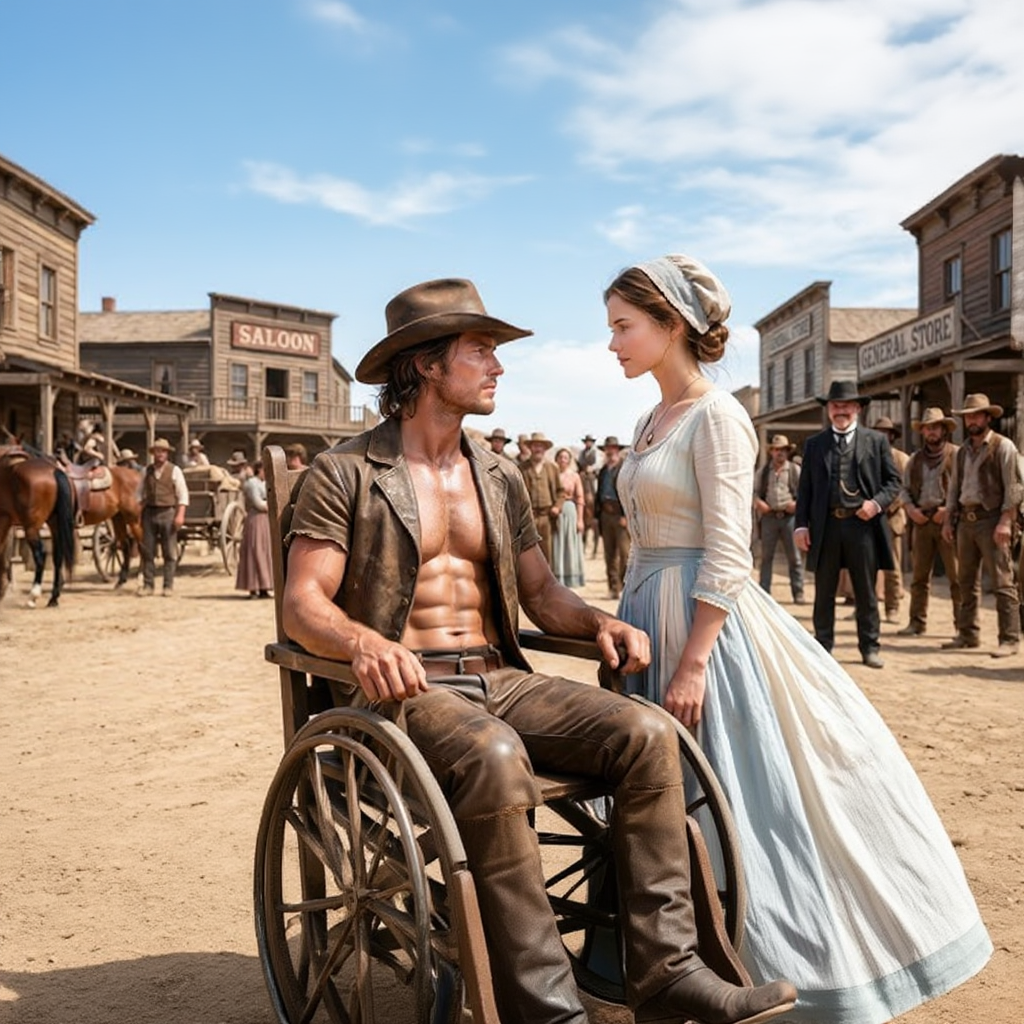
The dust rolled lazily across the main street of Dry Creek, a town so small it barely deserved a name. Wooden storefronts leaned like tired men after a long shift. The SALOON doors creaked. Horses stamped at hitching posts. Heat shimmered under a bright, merciless sky.
And in the middle of it all sat a man who once made grown cowboys step aside.
Now he couldn’t move his legs.
He sat in a crude wooden wheelchair, shoulders broad, chest bare beneath an open brown leather jacket. Sunlight carved sharp lines across his defined abs and scarred ribs. His hat cast a shadow over sharp cheekbones and a beard that hadn’t been trimmed in weeks. His hands rested on the armrests — big, calloused, useless for anything except gripping.
He didn’t look broken.
He looked furious.
The crowd gathered, whispering.
“That’s Boone Hale.”
“No way. Boone Hale rode the high country alone.”
“Got crushed in a rockslide, they say.”
“Can’t even stand.”
The laughter started quietly. Not cruel at first — just the uneasy laughter people use when they don’t know what else to do.
Then Sheriff Carter stepped forward, wiping sweat from his neck.
“Well,” he said, loud enough for everyone to hear, “since nobody wants him… we figured we’d give him to someone who don’t mind useless things.”
A few men snorted.
He turned.
And pointed.
“Mary Whitaker.”
Mary stood near the GENERAL STORE, a basket hooked over her arm. She was young, but widowhood had already carved calm into her face. Her bonnet shaded eyes that watched more than they spoke. Her blue skirt was dusty at the hem. Her hands were rough from work most men wouldn’t bother with.
She blinked once.
“You’re joking,” someone muttered.
Sheriff Carter smirked. “Widow’s got land. Widow’s got time. Widow ain’t got a man. Seems fair.”
The laughter grew louder.
Boone Hale didn’t laugh.
He lifted his head slowly and looked at her.
Their eyes met.
His were dark, sharp, dangerous — like a wolf forced into a cage. There was anger there, yes. But beneath it… humiliation. And beneath that… something worse.
He expected her to laugh too.
She didn’t.
Mary set her basket down.
The street quieted.
She walked forward, boots kicking dust with steady rhythm. No hesitation. No embarrassment. Just calm, deliberate steps until she stood in front of him.
Up close, Boone looked even larger. Even seated, he was nearly her height. His shoulders were wide enough to block sunlight.
“You can’t walk?” she asked quietly.
His jaw tightened. “No.”
“You can use your arms?”
“Yes.”
“You eat on your own?”
He stared at her. “Yes.”
She nodded once.
Then she turned to the sheriff.
“I’ll take him.”
The laughter died instantly.
Sheriff Carter blinked. “You serious?”
“Yes.”
“You know he’s—”
“I said I’ll take him.”
She stepped behind the wheelchair handles.
Boone’s shoulders tensed.
She pushed.
The chair rolled forward, wheels crunching over dry dirt. The crowd parted slowly, confused, silent. Some shook their heads. Others smirked again.
“She’s crazy.”
“That man’s dead weight.”
“She’ll send him back in a week.”
Boone didn’t look back.
Neither did Mary.
They left town together — widow and mountain man — under a sky too bright to hide what everyone believed was a joke.
—
Mary’s cabin sat where the plains rose toward the mountains. Wind moved through tall grass like waves. A small barn leaned beside a water pump. Chickens scattered as she pushed Boone toward the porch.
He finally spoke.
“Why?”
She stopped.
“Why what?”
“Why take me?”
She thought for a moment.
“Because they were laughing.”
“That ain’t a reason.”
“It is to me.”
He studied her.
“You know I can’t work.”
“You can.”
“No,” he said flatly. “I can’t ride. Can’t climb. Can’t haul. Can’t—”
“You can think.”
He frowned.
“You can see things,” she continued. “You lived in the mountains. You survived winters alone. You know land. Weather. Animals.”
“That ain’t worth much in a chair.”
Mary stepped around and faced him.
“We’ll see.”
She opened the cabin door.
“Come in, Boone Hale.”
He rolled himself inside.
That was the first time he moved on his own.
—
The first weeks were quiet.
Mary worked from sunrise to dusk. She chopped wood, hauled water, mended fences. Boone watched. At first, he stayed inside, pride choking him. But eventually he rolled himself to the doorway.
Then to the porch.
Then to the yard.
He studied everything.
Wind direction.
Cloud patterns.
How grass bent before storms.
One afternoon he said, “Fence on the north side’s gonna break.”
Mary looked up. “It’s fine.”
“Storm coming tonight.”
Sky was blue.
She hesitated… then reinforced it anyway.
That night, wind screamed across the plains. The old fence snapped — except the section she fixed.
She looked at him differently after that.
Days later, he pointed at the chickens.
“You’re losing them.”
“Fox?”
“No. Hawk. Builds in that cottonwood.”
She checked.
He was right.
They built a covered run together — Mary hammering, Boone measuring and directing. It was the first time they worked as a team.
He started giving more advice.
Where to plant corn.
When to rotate grazing.
How to dig a deeper well.
Each time, he was right.
Each time, Mary listened.
Each time, Boone sat a little straighter.
—
The first time he laughed again, it surprised them both.
Mary had been trying to move a heavy grain sack. She slipped, fell backward, and landed in dust.
She groaned.
Boone chuckled.
Then laughed.
A deep, rusty sound.
She laughed too.
And something shifted.
—
Months passed.
Mary modified the wheelchair. Wider wheels for dirt. Leather grips. A plank across the back so Boone could pull small loads. They built ramps. Then a small wagon he could guide using arm strength.
He started working.
Slowly.
Painfully.
But stubbornly.
His arms grew stronger. Veins stood out. Shoulders thickened. He could haul tools. Feed animals. Repair small things.
Travelers passing by stopped.
“Is that Boone Hale?”
“The cripple?”
“Looks like he’s running that place.”
Mary didn’t correct them.
She didn’t need to.
—
One afternoon, a rider from Dry Creek arrived.
Sheriff Carter.
He dismounted, surprised.
“Well I’ll be… he ain’t dead yet.”
Boone stared at him coldly.
Mary crossed her arms.
Sheriff chuckled. “Heard you made him useful.”
“He made himself useful,” she said.
Sheriff watched Boone directing a boy hired for seasonal work.
“Town’s got a problem,” he admitted. “Cattle keep wandering north. Losing weight. Don’t know why.”
Boone spoke.
“Poison weed.”
Sheriff blinked. “What?”
“Purple bloom. Grows after dry winter. Cattle eat it. Weakens them.”
Sheriff frowned. “You sure?”
“Yes.”
“Where?”
Boone pointed to distant hills.
Sheriff rode out.
Three days later he returned — pale.
“You were right.”
He looked at Boone differently now.
“Town could use you.”
Boone didn’t answer.
Mary did.
“He’s busy.”
Sheriff nodded slowly.
When he left, Boone stared at the horizon.
“They ain’t laughing anymore,” Mary said softly.
“No,” he replied. “They ain’t.”
—
Winter came hard that year.
Snow swept across plains like a white wall. Supply wagons stopped coming. Dry Creek panicked. Food ran low.
Mary and Boone had prepared.
Stored grain.
Dried meat.
Reinforced barn.
Neighbors started arriving.
“Can we buy feed?”
“Can you help us fix a well?”
“Boone, what do we do about frozen stock?”
He guided them all.
From his chair.
Calm. Precise. Confident.
People listened.
One night, Sheriff Carter returned again.
Town meeting.
They rolled Boone into the saloon.
Same street.
Same buildings.
But no laughter this time.
Men removed hats.
Women nodded respectfully.
Sheriff cleared his throat.
“We got through winter because of him.”
Silence.
Then someone clapped.
Another joined.
Soon the entire room applauded.
Boone looked stunned.
Mary stood beside him, hands resting lightly on the chair.
“She didn’t just help him,” the sheriff said. “She made him the pride of the plains.”
Boone turned toward her.
“You did that,” he said quietly.
Mary shook her head.
“No,” she replied. “You just needed someone who didn’t laugh.”
He reached out — hesitated — then took her hand.
Rough fingers. Strong grip.
The saloon watched.
Not laughing.
Not joking.
Just witnessing.
The widow they mocked.
The mountain man they discarded.
Together.
Unbreakable.
Outside, the wind moved across the plains, bending tall grass under a wide, clear sky — and for the first time since the rockslide, Boone Hale felt taller than any man standing.