
“I Want to Withdraw 1 Million,” Says the Farmer — The Businessman Laughs, But Is Deeply Moved Later
The man in the straw hat didn’t belong in a place like that.
The bank’s marble floors gleamed under bright chandeliers. Tall white columns stretched toward the ceiling, and polished wooden counters reflected the soft afternoon light. Businessmen in pressed suits spoke in quiet tones. Women in tailored coats filled out forms with gold pens.
Then the farmer walked in.
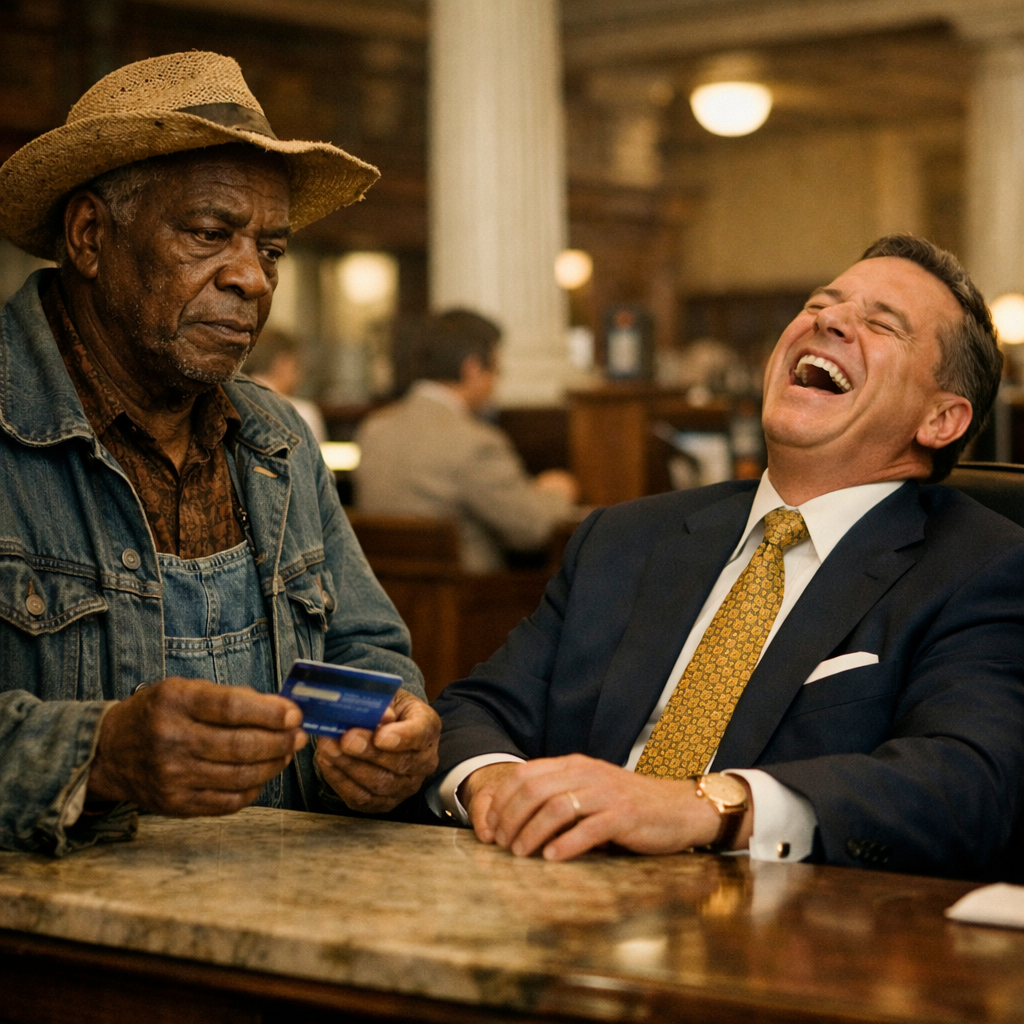
His boots left faint dust prints behind him. His denim overalls were faded, knees worn thin. A dirt-smudged blue jacket hung loosely on his shoulders. His straw hat looked like it had seen more sun than rain. His hands were rough, cracked, and darkened by years of soil.
But his expression was calm.
Serious.
He approached the marble counter slowly, pulling a small blue card from his pocket. He held it carefully, as though it mattered.
The banker sitting across from him leaned back in his black leather chair. He was sharply dressed — navy blue suit, crisp white shirt, yellow patterned tie. A gold watch gleamed at his wrist. His hair was neatly combed, his posture relaxed with the confidence of someone used to large numbers.
“Yes, sir?” the banker asked politely, though his eyes had already measured the farmer.
“I want to withdraw one million dollars,” the farmer said.
The banker blinked.
“I’m sorry?”
“One million,” the farmer repeated. “Cash.”
The businessman stared at him for a moment — then laughed.
Not politely. Not quietly.
He threw his head back, shoulders shaking, hands resting on the counter as he chuckled openly.
Behind them, a few customers glanced over.
“I’m… sorry,” the banker said between laughs. “Did you say one million?”
“Yes.”
The banker wiped the corner of his eye.
“That’s… quite a request.”
The farmer didn’t react.
He simply slid the blue card forward.
“I’d like to withdraw it.”
The banker leaned forward, still smiling. “Sir, do you have an appointment with private banking?”
“No.”
“Do you understand what one million dollars is?”
“Yes.”
The banker chuckled again. “Most farmers I know don’t keep that in checking.”
The farmer said nothing.
The banker picked up the card casually, intending to end the conversation quickly. He turned to his computer, typed the account number, and waited for the screen to load.
His smile faded.
He leaned closer.
Then closer still.
He blinked.
The laughter stopped.
The balance displayed on the screen wasn’t just one million.
It was far more.
He straightened slowly.
“Sir… may I confirm your name?”
“Elias Turner.”
The banker swallowed.
“Mr. Turner… this account… belongs to you?”
“Yes.”
The banker’s fingers hovered over the keyboard.
“Would you… mind if I asked why you’re withdrawing such a large amount?”
“I need it,” Elias replied calmly.
“For… a purchase?”
“Yes.”
The banker nodded, trying to regain composure.
“I’ll need to verify identification.”
Elias pulled out a worn leather wallet. The ID matched.
The banker’s tone changed completely.
“Would you prefer a wire transfer?”
“No.”
“Certified check?”
“No.”
“You… want cash?”
“Yes.”
The banker hesitated.
“That will take time.”
“I can wait.”
Elias stepped aside and sat in a wooden chair near the counter, straw hat resting on his knee. He watched the room quietly while the banker made calls, arranged security, and processed the withdrawal.
But curiosity gnawed at him.
After twenty minutes, he walked over.
“Mr. Turner,” he said gently, “I hope you don’t mind me asking… what are you planning to do with the money?”
Elias looked up.
“I’m buying land.”
“Land?”
“Yes.”
“For farming?”
Elias nodded.
The banker smiled faintly. “That makes sense.”
Then Elias added, “It used to be mine.”
The banker paused.
“I lost it… seven years ago.”
The room seemed quieter.
“Bad harvest?” the banker asked.
“Drought. Then debt. Bank took it.”
The banker shifted slightly.
“And now… you’re buying it back?”
“Yes.”
The banker studied him.
“That must mean a lot.”
Elias looked down at his hands.
“My father built that farm,” he said softly. “His father too. My wife’s buried there. My son planted the first apple tree.”
The banker’s throat tightened.
“I promised… I’d bring it back,” Elias continued. “Took me years.”
“How did you…?” the banker began.
“I worked.”
“Farming?”
“Anything. Truck driving. Repair work. Night shifts. Saved everything.”
The banker looked at the computer again — at the massive balance.
“You saved… all that?”
Elias nodded.
“Didn’t spend much.”
The banker felt a strange weight settle in his chest.
The man he had laughed at… had built a fortune one dollar at a time.
Not for luxury.
Not for status.
For home.
Security returned with a locked case.
“Your withdrawal will be ready shortly,” the teller said.
The banker sat across from Elias now, no longer behind the counter.
“Mr. Turner,” he said quietly, “I owe you an apology.”
Elias looked up.
“I shouldn’t have laughed.”
Elias shrugged. “People laugh.”
“Yes… but I didn’t understand.”
They sat in silence.
Then the banker asked, “When do you close on the land?”
“Tomorrow.”
“Do they know it’s you?”
Elias shook his head.
“They just know someone’s buying.”
The banker smiled faintly. “That’s going to be quite a surprise.”
Elias’s eyes softened slightly.
“I hope so.”
The teller returned with a secure briefcase.
“Your funds, sir.”
Elias stood, lifting the case carefully.
It was heavy.
The banker extended his hand.
“Good luck, Mr. Turner.”
Elias shook it firmly.
“Thank you.”
As he walked toward the exit, the banker watched him — the worn clothes, the straw hat, the steady pace.
The laughter from earlier felt distant now.
What remained was respect.
Deep, unexpected respect.
The next afternoon, Elias stood at the edge of the farm.
Rolling fields stretched beneath the sun. The old barn leaned slightly. The apple tree still stood near the house.
The realtor handed him papers.
“Congratulations,” she said. “You’re the new owner.”
Elias signed slowly.
His hands trembled just slightly.
When it was done, he walked to the apple tree.
He placed his palm against the bark.
“I brought it back,” he whispered.
Miles away, in the bank’s quiet office, the businessman stared at the empty counter where the farmer had stood.
He thought about wealth.
About success.
About what truly mattered.
And for the first time in years, he felt humbled — deeply moved by a man in a straw hat who came asking for one million dollars… and carried something far more valuable out the door.