
“Can I Sleep in Your Barn? I’ll Work for Food” — The Widowed Farmer’s Answer Changed Everything
The mud reached halfway up his boots before Thomas Hale noticed her.
Rain had fallen for three days straight, turning the farm into a patchwork of puddles and slick earth. The sky hung low and gray, heavy clouds dragging across the horizon. Water dripped steadily from the metal roof of the barn, each drop landing with a dull plop into the churned ground below.
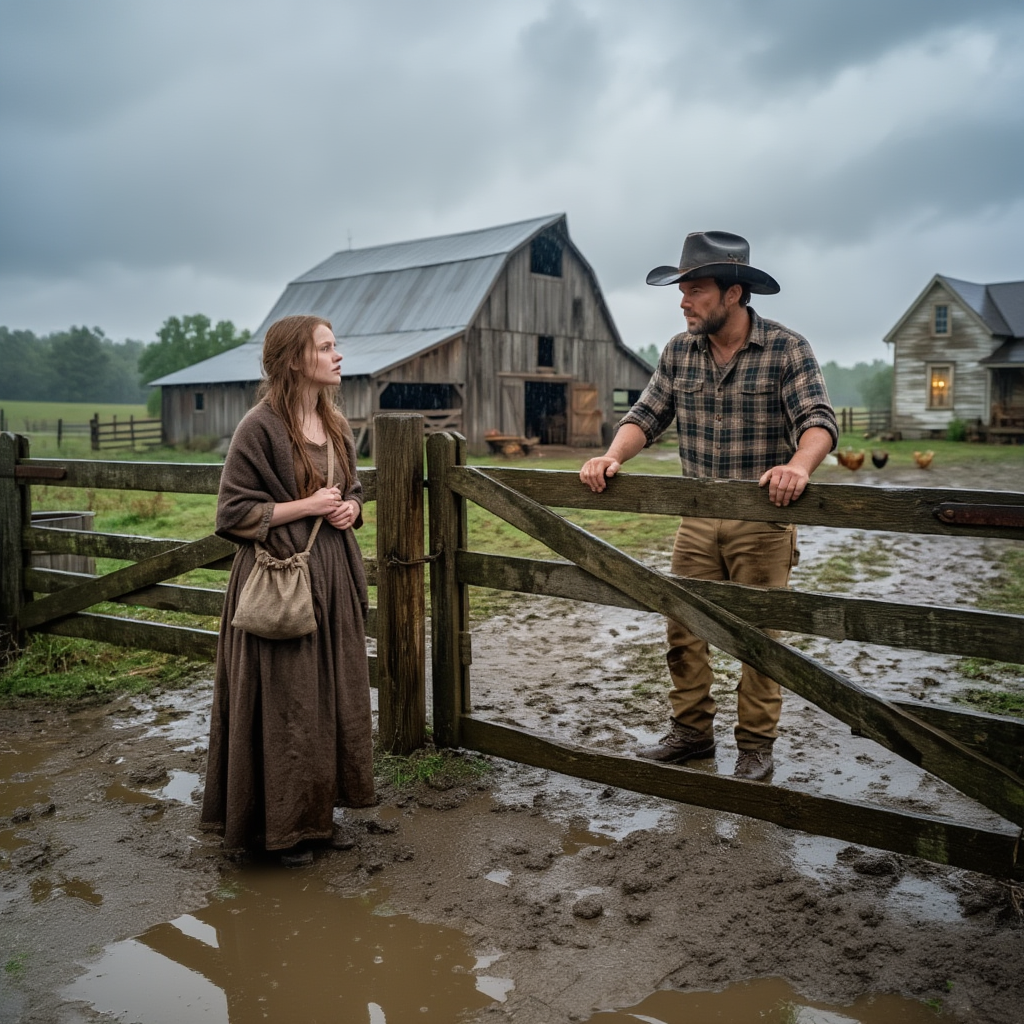
Thomas leaned against the wooden fence, studying the cattle huddled near the far field. His plaid shirt clung damp to his back, and his hat brim sagged slightly from the moisture. He wiped his beard with his sleeve and turned toward the farmhouse. One window glowed faintly—he’d left the lamp lit, though he had no real reason to.
Then he saw her.
She stood at the far end of the fence, motionless, as if unsure whether she belonged in the scene. Mud clung to the hem of her long brown dress. A shawl wrapped tight around her shoulders. A small pouch hung at her side, worn thin with travel. Her light brown hair fell loose, damp from the drizzle.
Thomas straightened.
She didn’t move closer.
She just waited.
The wind pushed a ripple through the puddles between them. Somewhere behind the barn, a loose sheet of metal rattled faintly.
Thomas walked along the fence, boots sucking free of mud with each step. He stopped a few feet away.
“Afternoon,” he said.
Her eyes lifted to his. “Afternoon.”
Her voice was quiet but steady.
He noticed how thin her face looked. Not sick—just worn. Like someone who had walked too far without rest.
“You lost?” he asked.
She shook her head. “No.”
He waited.
She took a breath, fingers tightening around the pouch strap.
“Can I sleep in your barn?” she asked. “I’ll work for food.”
The words hung in the damp air.
Thomas blinked once.
He had expected directions, maybe a request for water. Not that.
He glanced at the barn behind him. Its doors stood half open. Hay stacked inside. A stall empty since last winter.
“You alone?” he asked.
“Yes.”
“You got somewhere headed?”
She hesitated. “Anywhere I can earn my keep.”
Rain began again, light at first.
Thomas studied her. Mud streaked her boots. The shawl had been mended several times. She carried no bedroll—just the pouch.
“How long you been walking?” he asked.
“Three days.”
He nodded slowly.
The farm had been quiet since Mary died. Too quiet. The barn echoed when he stepped inside. The farmhouse felt larger each night.
Still, letting a stranger stay wasn’t something he’d done before.
“I don’t need trouble,” he said.
“I won’t cause any.”
“You know farm work?”
“Yes.”
“What kind?”
“Feeding animals. Cleaning stalls. Sewing. Cooking… if needed.”
Thomas shifted his weight. The fence creaked.
“You got a name?” he asked.
“Clara.”
“I’m Thomas.”
She nodded once.
The rain picked up, dotting the puddles harder. A drop ran down her cheek, though she didn’t wipe it away.
Thomas looked toward the barn again.
“You can stay tonight,” he said finally. “We’ll talk tomorrow.”
Relief flickered across her face, small but unmistakable. “Thank you.”
He pushed open the fence gate. “Come on.”
She followed him carefully, stepping where the mud looked shallowest. Inside the barn, the air smelled of hay and damp wood. Rain drummed steadily on the metal roof, louder now.
Thomas pointed to an empty stall. “You can bed down there.”
Clara set her pouch on a bale. “I’ll clean it first.”
“You don’t have to—”
“I’d rather.”
He watched as she grabbed a pitchfork and began clearing old straw. Her movements were slow but practiced. She stacked fresh hay neatly, then spread it evenly.
Thomas leaned against the doorway, surprised.
“You’ve done this before,” he said.
She nodded. “My father kept a small place.”
He left her there and walked back toward the house. The lamp still glowed in the window. He paused at the door, listening to the rain.
For the first time in months, he didn’t feel like the farm was empty.
He brought back a bowl of stew and a chunk of bread. Clara accepted it quietly, sitting on the hay. She ate slowly, carefully, as if stretching each bite.
“You’ll need blankets,” he said.
“I’ll be fine.”
He shook his head and returned with two old quilts. She murmured thanks, her voice softer now.
That night, the storm deepened. Wind rattled the barn walls. Thomas lay in his bed, staring at the ceiling. He could faintly hear movement outside—Clara shifting, the horses stamping.
The farm felt… alive.
In the morning, he found her already working.
She had swept the barn aisle. Buckets filled. Feed laid out. Even the loose boards had been stacked.
Thomas frowned. “You didn’t have to do all that.”
“You said I’d work for food.”
He nodded slowly.
Days passed.
Clara mended fences, cleaned stalls, and helped with chores without complaint. She spoke little but noticed everything. When a calf limped, she wrapped its leg. When rain pooled near the barn, she dug a trench.
Thomas found himself watching her from the fence.
One evening, she approached him. “You should move the haystack.”
“Why?”
“The wind’s shifting. If it rains again, it’ll soak.”
He considered, then followed her advice.
That night, another storm hit.
The hay stayed dry.
Thomas stood in the barn doorway afterward. “You’ve got a good eye,” he admitted.
Clara shrugged. “Just paying attention.”
They began talking more.
She told him she’d worked farms since childhood. After her parents died, she traveled town to town. Some let her stay. Some didn’t.
“Why not settle?” he asked.
She looked at the muddy yard. “Never found a place that felt… safe.”
Thomas nodded.
Weeks passed. The mud slowly dried. Spring sunlight replaced gray skies. The farmhouse window glowed less lonely at night.
One evening, Clara approached the fence where Thomas leaned.
“I should move on soon,” she said.
He felt something tighten in his chest. “Why?”
“I only asked to stay in the barn.”
“You earned more than that.”
She looked down. “Still.”
Thomas stared across the fields. The farm looked different now—tidier, steadier. The barn no longer echoed.
“You don’t have to leave,” he said quietly.
She looked up.
“I could use the help,” he added. “And… it’s quieter without someone around.”
A faint smile touched her lips.
“You sure?” she asked.
He nodded.
The wind moved gently through the fence posts. The farmhouse window glowed warm behind them.
Clara adjusted her shawl. “Then I’ll stay.”
Thomas exhaled slowly.
Weeks later, the barn door stood open to dry sunlight. The mud had hardened into firm ground. The farm felt less lonely, less heavy.
Sometimes, Thomas thought back to that rainy afternoon when she first appeared at the fence.
“Can I sleep in your barn? I’ll work for food.”
He hadn’t realized then that saying yes wouldn’t just give her shelter.
It would give him back a life.