
His Neighbors Called the Stone Dome a Folly — Until the 1899 Blizzard Shattered Every Wooden Home
The wind came down from the high country with a voice like tearing cloth.
People in Dry Willow Valley had lived with winter all their lives, but that sound—thin at first, then rising—made even the oldest settlers glance toward the mountains. Snow already lay in long ridges along the fences, and the sky had been the color of dull tin for three days. Chickens refused to leave their coops. Dogs paced and whined. The air smelled metallic, like a storm waiting for permission.
At the edge of the valley, where the land rose slightly and the trees thinned, Thomas Calder stacked another armful of stone.
He set each rock carefully, turning it until it locked against the others. The structure behind him—round, squat, and strange—rose to shoulder height now. Snow dusted its top, but the curve shed most of it. There were no boards, no beams, no nails. Just stone fitted tight, spiraling inward.
From the road, Eli Barker leaned against his sled and shook his head.
“Still at it, Tom?” he called.
Thomas didn’t stop working. “Still at it.”
Eli trudged closer, boots crunching in frozen snow. “You’re building a smokehouse?”
“No.”
“A root cellar?”
“No.”
Eli walked a slow circle around the rising structure. “Then what in heaven’s name is it?”
Thomas finally straightened. He wiped his hands on his trousers and looked at the dome. “A winter house.”
Eli barked a laugh. “A pile of rocks? That thing’s barely big enough to turn around in.”
“It will be,” Thomas said. “And it’ll hold heat better than logs.”
Eli tapped one of the stones with his boot. “You’ve got a perfectly good cabin.” He pointed to the log house a short distance away—solid, squared timber, chinked with clay. Smoke curled from its chimney. “Why build this… this turtle shell?”
Thomas shrugged. “Logs burn. Roofs collapse. Wind gets in. Stone doesn’t.”
Eli looked out across the valley, where dozens of cabins stood in orderly lines. “Been winters here thirty years. Never needed to live in a rock.”
Thomas met his eyes. “Not yet.”
That answer traveled faster than gossip ever had.
Within a week, nearly everyone in Dry Willow had walked out to see the “stone dome.” Some came with curiosity, some with amusement, others with open mockery. Children threw snowballs at it. Men knocked on the stones as if expecting them to fall apart.
Old Martha Keene stood with her hands on her hips. “You planning to hibernate in there like a bear?”
“Something like that,” Thomas said.
Young Jacob Miller snorted. “You’ll suffocate. No windows.”
“There’s a vent,” Thomas said, pointing to a narrow opening near the top. “Smoke goes out. Air comes in.”
Jacob laughed. “If the wind don’t pack it with snow first.”
The name came from Eli Barker, and it stuck.
“Calder’s Folly.”
By mid-December, everyone in Dry Willow was using it.
The dome grew steadily. Thomas worked alone most days, hauling fieldstone from the frozen creek bed. He shaped the doorway low and narrow, forcing anyone entering to duck. Inside, he built a small raised platform of flat stones and lined the floor with packed earth. A cast-iron stove—smaller than the one in his cabin—sat near the center, its pipe running up and out through the vent.
He tested it one night. Snow fell quietly outside while the stove glowed red. The stones warmed slowly, then held the heat. Hours after the fire died, the air inside remained mild. He slept there, wrapped in a wool blanket, and woke without frost on his beard.
He moved his supplies the next day.
Firewood stacked inside along the curved wall. Barrels of flour and beans. A crate of dried apples. Two water crocks. A lantern. A bedroll.
When neighbors saw him carrying his bedding out of the log cabin, laughter returned.
“You really going to live in that hole?” Eli asked.
“Just for winter,” Thomas said.
Eli shook his head. “You’ll come crawling back when the wind picks up.”
Thomas glanced toward the mountains. “Maybe.”
Christmas came with brittle cold. The valley glittered under blue sky, and for a few days it seemed winter had settled into its usual rhythm. People chopped wood, mended fences, traded preserves. Calder’s Folly became more of a joke than a concern.
Then, on January 9, 1899, the temperature dropped thirty degrees in a single afternoon.
The sky turned white—not cloudy, but blank. The wind started at dusk.
By midnight, it roared.
Snow came sideways, then upward, then in spirals that erased the world beyond arm’s length. Fences vanished. Drifts climbed past windowsills. The sound of branches snapping echoed like rifle shots.
Inside his log cabin, Eli Barker shoved another log into the stove. The fire struggled, smoke backing into the room as wind forced itself down the chimney. The walls creaked. Snow forced through gaps in the chinking, dusting the floor.
“Mary,” he called to his wife. “Pile blankets over the door.”
The wind struck the cabin broadside. Something heavy slammed into the wall—maybe a fallen limb. The roof groaned. Eli felt the floor tremble.
Across the valley, Jacob Miller’s barn roof lifted like a lid and vanished into the white.
By morning, the storm had become something else entirely.
The blizzard didn’t just fall—it swallowed.
Visibility dropped to nothing. Snow climbed higher than doors. Chimneys clogged. Fires died. Roofs sagged under the weight. Cabins built of logs—solid, trusted—began to fail.
At noon, the Keene family’s roof collapsed inward, burying their stove.
By evening, three cabins had partially caved in.
The wind did not stop.
Inside the stone dome, Thomas Calder sat quietly, feeding the stove small sticks. The interior walls radiated steady warmth. The curved ceiling shed the vibration of wind. Snow piled outside, but the low doorway and sloping sides prevented buildup from crushing anything.
He listened.
Through the storm, faintly, came a sound.
A shout.
Thomas set down the poker, pulled on his coat, and pushed open the door. Snow had piled halfway up the entrance, but he’d expected that. He dug a narrow trench outward, each scoop immediately filling with drifting powder.
The shout came again.
He followed it, leaning into the wind, rope tied around his waist and anchored to the dome. Twenty yards out, he saw movement—a man half-buried, crawling.
It was Eli.
Thomas dragged him back, both men nearly blind. Inside the dome, Eli collapsed, gasping, face white with frost.
“Mary…” he choked. “Cabin… roof’s going…”
Thomas handed him a blanket. “She still inside?”
Eli nodded weakly.
Thomas didn’t hesitate. He refilled the stove, tightened the rope, and went back out.
It took two trips. Mary Barker could barely walk. The wind pushed them sideways, but the rope guided them home. When she entered the dome, her eyes widened.
“It’s… warm,” she whispered.
They sat close to the stove, thawing. Outside, the storm raged louder, but inside the stone held steady.
Hours later, another knocking—this time frantic.
Jacob Miller stumbled in, carrying his daughter. Their cabin had split at the roof seam. Snow filled half the room before they escaped.
Then came Old Martha, wrapped in quilts, led by her grandson.
Then two more families.
The dome filled beyond what Thomas had planned, but the warmth held. The stones absorbed the heat and gave it back. Breath fogged the air but didn’t freeze. Snow blocked the entrance repeatedly, and Thomas dug it out each time, reinforcing the trench.
For two days, the blizzard screamed.
Wooden homes across Dry Willow collapsed one by one. Roofs caved. Walls bowed inward. Fires died as chimneys clogged. Those who could, crawled toward the only structure still visible—the rounded hump of stone with smoke rising gently from its top.
By the third night, fourteen people crowded inside.
No one laughed about Calder’s Folly anymore.
When the storm finally broke, it did so quietly. The wind faded to a whisper. Snow stopped. A pale sun pushed through haze.
Thomas opened the door.
The valley looked erased.
Drifts rose taller than cabins. Only broken roofs and tilted walls showed where homes once stood. The Keenes’ cabin lay flattened. The Miller place was split open, bed exposed to the sky. Eli’s cabin had lost half its roof, the cast-iron stove buried in snow.
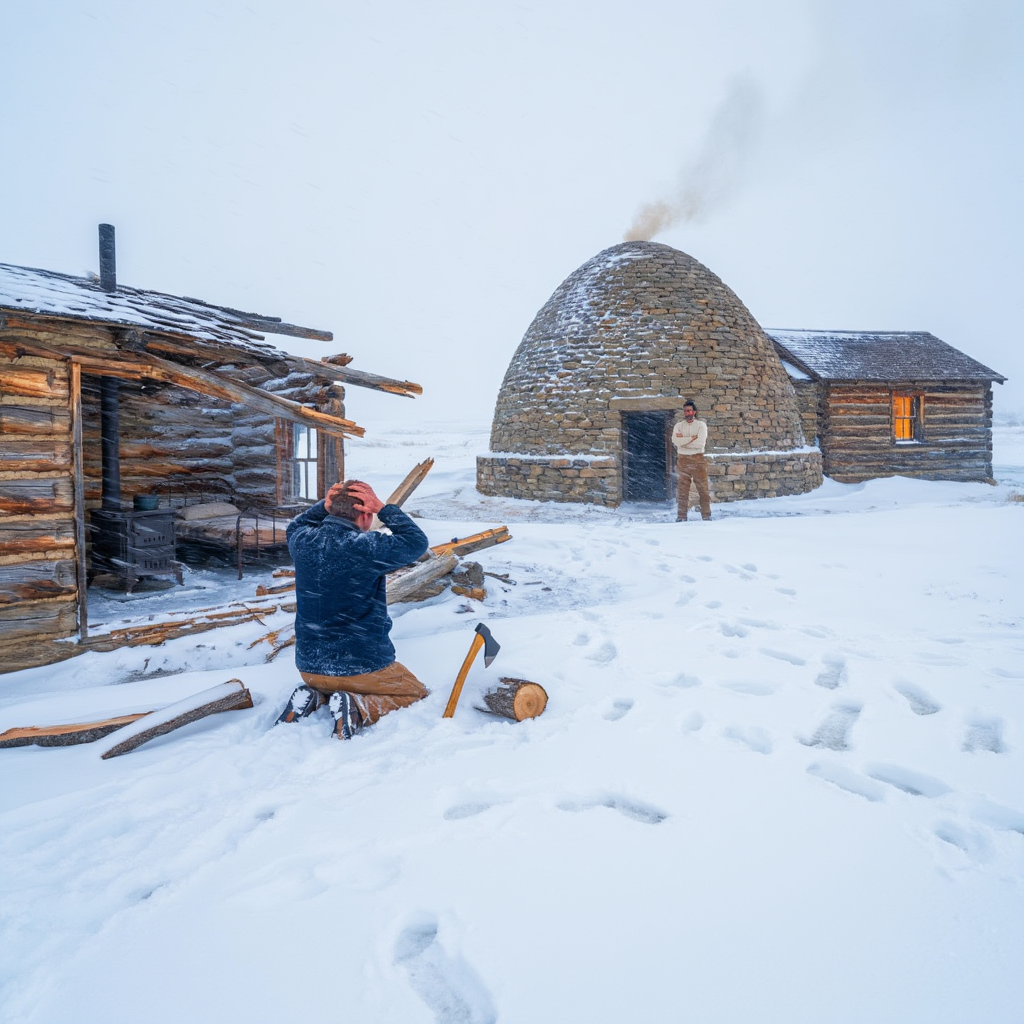
The stone dome stood untouched.
Smoke still curled upward.
In the foreground, Jacob Miller dropped to his knees in the snow, hands clutching his head. He stared at what remained of his house—then at the dome behind him. Footprints crisscrossed the deep drifts. Firewood lay scattered. An axe stuck upright in a frozen log, half-buried.
No one spoke for a long time.
Eli finally turned to Thomas. “You knew.”
Thomas shook his head. “I knew wood fails. Stone doesn’t. That’s all.”
Mary Barker stepped outside, wrapping her shawl tighter. She looked at the ruined valley, then back at the dome. “You saved us.”
Thomas glanced at the curved walls. Snow slid harmlessly from the top. “The stone did.”
Over the next days, survivors dug paths between the wreckage. They salvaged what they could—pots, blankets, tools. The stone dome became headquarters, kitchen, shelter. The stove burned constantly. People slept in shifts.
No one called it a folly anymore.
By February, men began hauling stone.
Not just Thomas.
Eli laid the first ring for his own dome beside the ruins of his cabin. Jacob followed. Others marked circles in the snow. The valley echoed with the sound of rocks being set, turned, and fitted.
Thomas worked alongside them, showing how to shape the curve, how to lock the keystone, how to vent smoke without losing heat.
Spring came slowly, revealing the full damage. Nearly every wooden home had suffered. Some were beyond repair. But dotted across the valley now were rising domes—low, sturdy, patient.
By autumn, Dry Willow looked different.
Log cabins still stood, but beside many of them were stone domes—winter houses. Smoke rose from their tops on cold mornings. Children played around their rounded sides.
One evening, as frost returned, Eli sat with Thomas outside the original dome.
“Funny thing,” Eli said. “All those years we trusted timber.”
Thomas nodded.
Eli tapped the stone wall. “Turns out rocks were better neighbors.”
Thomas smiled faintly.
The wind whispered across the valley, but the domes didn’t answer. They simply stood—quiet, solid—waiting for whatever winter might bring next.