
He Paid $3,200 for the Worst Farm in the County — His First Harvest Shocked Them
The auctioneer didn’t even bother raising his voice.
“Next parcel,” he said, flipping a page. “Thirty-two acres. Old house, partial barn, poor soil classification… starting bid three thousand.”
The crowd barely looked up.
Most of them were there for the Henderson farm—the 240-acre prime bottomland that would sell later. The little parcel on the edge of the county? Everyone already knew it. Clay-heavy ground. Drainage problems. The well ran dry every August. The house leaned. The barn roof had more holes than tin.
Folks called it the “Graves mistake,” after the family that lost everything trying to make it work.
A few men shuffled papers. Someone coughed.
“Three thousand,” the auctioneer repeated.
Silence.
Then a hand rose in the back.
“I’ll give thirty-two hundred.”
Heads turned.
The man standing near the folding chairs looked out of place—sunburned, lean, wearing a worn denim jacket despite the heat. His name was Caleb Turner. He’d moved into the county two months earlier, renting a trailer behind the gas station.
Old Mr. Harlan leaned toward his neighbor.
“That boy don’t know what he’s doing.”
“Worst farm in the county,” the neighbor muttered.
The auctioneer shrugged.
“Thirty-two hundred… anyone else?”
No one spoke.
“Sold.”
The gavel hit.
Just like that, Caleb Turner owned thirty-two acres everyone else had already given up on.
The first time Caleb walked the property, he didn’t look discouraged.
He walked slow, hands in pockets, boots sinking slightly into clay that held water even days after rain. The house leaned left. The porch sagged. The barn door hung on one hinge.
But Caleb noticed things others ignored.
The slope of the land.
The wind pattern.
The shallow depression running across the middle—dry now, but shaped like it once carried water.
He crouched, scooped soil, rubbed it between his fingers.
Heavy clay. But dark.
He smiled faintly.
“Not dead,” he murmured.
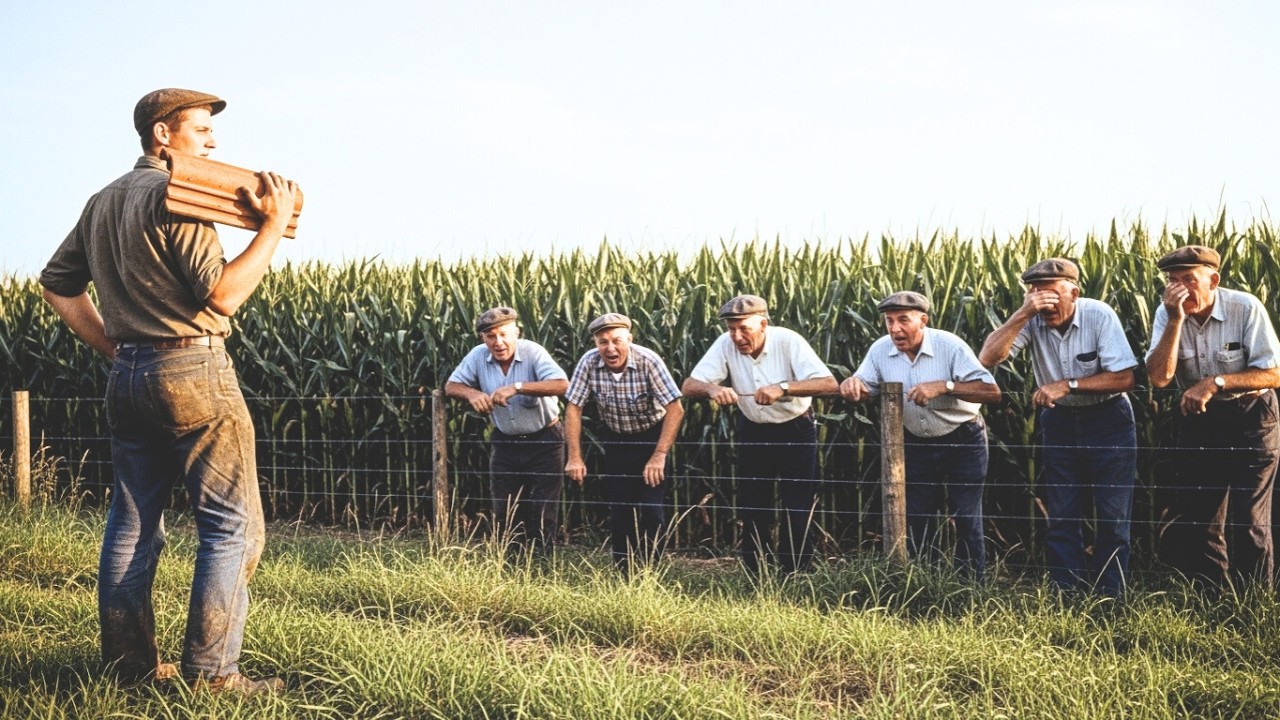
The locals watched him with quiet curiosity.
He didn’t bring big equipment. No shiny tractor. No hired crews.
Instead, he started with a shovel.
He cleared debris from the shallow depression, turning it into a proper drainage swale. He dug narrow trenches by hand. He hauled rocks from the fence lines and stacked them into low terraces.
Day after day, he worked alone.
At the diner, farmers shook their heads.
“He’s wasting his time.”
“Clay don’t change.”
“That land’s been cursed for forty years.”
Caleb kept digging.
Then he did something stranger.
He didn’t plow.
Instead, he spread hay—old, moldy bales he bought cheap. He laid them thick across the ground. Then compost—truckloads from the town landfill. Then more hay.
By early spring, his fields looked like someone had covered them in blankets.
“What’s he doing?” people asked.
“Smothering weeds?”
“Or burying money.”
Caleb planted through the hay using a hand seeder. No rows. No straight lines. Just scattered patches.
He planted everything—beans, squash, sunflowers, sorghum, clover.
“It’s a mess,” said one farmer.
Caleb didn’t argue.
Summer came hot and dry.
Neighboring fields began to crack. Corn curled. Pastures browned.
But something strange happened on Caleb’s land.
The hay mulch held moisture. The clay underneath stayed damp. Plants rooted deep.
Green patches spread.
By July, his farm looked… alive.
Vines crawled. Sunflowers rose tall. Sorghum swayed in the wind. Bees hummed. The ground, once hard as brick, softened.
People slowed their trucks to stare.
“What the…?”
“That place was dead.”
“He didn’t even plow.”
Caleb worked quietly, repairing the barn roof with salvaged tin, fixing fences with mismatched posts. He installed rain barrels along the house. Dug a small pond where the drainage swale widened.
Still, no one expected much.
Not from the worst farm in the county.
Harvest came early for some crops.
Caleb loaded the first pickup with squash and drove to the Saturday market. His stand looked small at first, tucked between larger vendors.
Then customers started tasting.
“These are sweet,” one woman said.
“Grown right here,” Caleb replied.
“They look… different.”
“No chemicals.”
By noon, he’d sold out.
Next week, he brought more. Beans, melons, herbs. Again, sold out.
Word spread.
“Turner’s vegetables taste like the old days.”
“He’s got something.”
Restaurants called. He delivered directly.
Meanwhile, his sorghum ripened tall and thick. Sunflowers seeded heavily. Clover covered bare patches.
By fall, he harvested hay—dense, green, nutritious.
The same neighbors who laughed now watched closely.
At the feed store, old Mr. Harlan cornered him.
“You fertilize heavy?” he asked.
“Nope.”
“Irrigation?”
“Just rain.”
“Then how?”
Caleb shrugged.
“Soil was tired. Just needed feeding.”
Harlan frowned.
“That land’s clay.”
“Clay holds nutrients. Just needed structure.”
Harlan stared at him.
“You’re telling me… that worst farm…?”
Caleb smiled slightly.
“Wasn’t worst. Just neglected.”
Then came the numbers.
Caleb’s first year revenue surprised everyone.
Vegetables. Hay. Sorghum seed. Sunflower oil sold to a small press in town.
Total profit—after expenses—just over $18,000.
On a farm he bought for $3,200.
At the diner, conversations shifted.
“You hear what he made?”
“More than my eighty acres.”
“No way.”
“It’s true.”
People drove past his farm just to look.
The clay ground now darkened with organic matter. Worms visible when he turned soil. The pond held water. Birds nested in hedgerows he planted.
The worst farm in the county… wasn’t anymore.
The second year, Caleb expanded carefully.
He didn’t buy more land. Instead, he improved what he had. Added fruit trees along the terraces. Rotated crops. Introduced chickens to fertilize fields.
Production doubled.
A local newspaper ran a headline:
“$3,200 Farm Becomes County Surprise.”
Tour groups came. Young farmers asked questions. Caleb answered simply.
“Feed the soil. Don’t fight it.”
The third year, something unexpected happened.
The Henderson farm—the prime land everyone wanted at auction—struggled. Years of heavy tillage had drained nutrients. Yields dropped. Costs rose.
Meanwhile, Caleb’s yields kept climbing.
One afternoon, Mr. Henderson himself drove over.
“I got 240 acres,” he said. “You got thirty-two. But you’re outproducing me per acre.”
Caleb nodded.
“You mind showing me?”
They walked the fields together. Henderson kicked the soil.
“Soft,” he muttered.
“Lots of organic matter.”
Henderson sighed.
“Think I ruined mine.”
“You didn’t ruin it,” Caleb said. “Just needs time.”
Five years after the auction, the farm looked completely different.
The house straightened. Painted white. The barn rebuilt. Trees lined the edges. Fields rotated in careful mosaics.
And the value?
A land agent offered Caleb $120,000.
He declined.
“I just got it right,” he said.
One evening, Caleb stood near the pond, watching sunset reflect across the water he’d carved from clay. The same clay everyone said was worthless.
He remembered the auction. The silence. The whispers.
Worst farm in the county.
He picked up a handful of soil. Dark. Rich. Alive.
“Not anymore,” he said quietly.
Across the road, a truck slowed. A farmer leaned out.
“You really paid thirty-two hundred?” he called.
Caleb smiled.
“Yep.”
The farmer shook his head.
“Best investment I ever seen.”
Caleb looked across his fields—green, layered, thriving.
His first harvest had shocked them.
But the real surprise wasn’t the crops.
It was that the worst farm had never been worst at all.
It just needed someone willing to see what everyone else had already decided wasn’t there.
Part 2 — He Paid $3,200 for the Worst Farm in the County — His First Harvest Shocked Them
By the sixth year, Caleb Turner’s farm didn’t just look different — it felt different.
The wind slowed when it crossed his land. Birds nested in the hedgerows. The pond he’d carved from clay now reflected rows of fruit trees that were finally mature enough to produce. The soil, once hard and cracked, crumbled like chocolate cake.
But the biggest change wasn’t the land.
It was the attention.
Pickup trucks rolled past daily. Some slowed. Some stopped. A few people knocked on his door asking questions.
“How’d you fix clay?”
“What’d you plant first?”
“You really don’t use chemicals?”
Caleb answered everyone the same way.
“I didn’t fix the land. I just stopped hurting it.”
Most nodded politely. Some actually listened.
Then the county assessor showed up.
He stepped out of a government sedan, clipboard in hand, boots too clean for a farm visit. He walked the property slowly, writing notes.
Caleb met him near the pond.
“Something wrong?” Caleb asked.
The assessor cleared his throat.
“Your land value’s being reassessed.”
Caleb raised an eyebrow.
“Why?”
“You’ve improved it significantly. Productivity’s increased. Market value too.”
Caleb understood immediately.
Taxes.
“How much?” he asked.
The man flipped pages.
“Based on comparable sales… your property’s now valued at eighty-five thousand.”
Caleb nodded slowly.
“And taxes?”
“Triple what you’ve been paying.”
The wind rustled the trees.
Caleb looked across the land. He’d expected this day. Improvement always brought attention. Attention brought cost.
“Alright,” he said calmly.
The assessor seemed surprised.
“No argument?”
Caleb shrugged.
“Land’s worth more. That’s good.”
The man nodded.
“Some folks improve too fast. Taxes push them out.”
Caleb smiled faintly.
“I didn’t buy this place to flip it.”
The next challenge came two months later.
A black SUV pulled into his driveway — the same kind corporate buyers favored. A man in a pressed shirt stepped out, smiling like he already owned the place.
“Mr. Turner,” he said, extending his hand. “I’m Rick Dalton, Dalton Agricultural Investments.”
Caleb shook it.
“What can I do for you?”
Dalton glanced around, impressed.
“I’ve heard about this place. Clay land turned premium. Quite the story.”
Caleb didn’t answer.
Dalton opened a folder.
“I’d like to make an offer.”
Caleb leaned against the fence.
“I’m not selling.”
“You haven’t heard the number.”
“I don’t need to.”
Dalton slid the paper forward anyway.
$150,000.
Caleb looked at it briefly, then closed the folder.
“No.”
Dalton blinked.
“You paid thirty-two hundred.”
“I remember.”
“That’s nearly fifty times your investment.”
Caleb nodded.
“Still no.”
Dalton shifted his weight.
“You could buy better land. Larger acreage. Expand.”
Caleb looked across his fields.
“I already have better land.”
Dalton followed his gaze — fruit trees, layered crops, chickens scratching, soil alive.
He sighed.
“You’re one of those.”
“One of what?”
“Farmers who fall in love with dirt.”
Caleb smiled.
“Only when the dirt loves back.”
Dalton left without another word.
The seventh year brought a drought.
Rain stopped in May. By June, nearby fields yellowed. By July, ponds shrank to mud.
But Caleb’s land held moisture.
The thick organic matter acted like a sponge. The pond he built slowly released water into the soil. Trees shaded the ground.
His crops survived.
Not lush — but alive.
Neighbors weren’t so lucky.
One afternoon, Mr. Henderson drove over again, worry etched across his face.
“You got hay?” he asked.
“Some.”
“I’ll pay.”
Caleb nodded.
“Fair price.”
Henderson exhaled in relief.
Within weeks, more farmers came. Caleb sold carefully — never emptying his own reserves.
Word spread.
“Turner’s farm holds water.”
“He planned for drought.”
“That clay saved him.”
By fall, Caleb made more profit than any year before — not because he exploited prices, but because he still had something to sell.
The same clay people mocked had become his advantage.
That winter, something unexpected happened.
The county hosted a soil conservation meeting. Usually, attendance was low. This time, the room filled.
The speaker? Caleb Turner.
He stood awkwardly at the front, hands in pockets.
“I didn’t invent anything,” he began. “Just copied old ideas.”
He explained mulch. Compost. Crop diversity. Water retention. Patience.
Farmers asked questions for two hours.
Afterward, an older man approached him.
“You saved my pasture,” he said quietly. “I tried your method. Grass came back.”
Caleb nodded.
“That’s good.”
The man shook his hand firmly.
“Worst farm in the county, huh?”
Caleb smiled.
“Guess not.”
Two years later, the Henderson farm went up for sale.
The big 240-acre parcel everyone once wanted.
But yields had dropped. Soil worn thin. Buyers hesitant.
At the auction, Caleb stood quietly in the back — just like years earlier.
Bidding started low.
Lower than expected.
Caleb listened. Calculated.
Then he raised his hand.
The room turned.
“Two hundred thousand,” he said.
Whispers spread.
“Turner’s buying it?”
“That’s huge.”
Bidding crawled. Stopped.
“Sold.”
The gavel hit.
Caleb now owned the best land in the county… and the one that used to be the worst.
He didn’t rush.
Instead, he applied the same patience. Mulch. Rotation. Trees. Time.
The first year, yields stayed modest.
The second, soil improved.
By the third, the Henderson farm started producing like never before.
People noticed again.
“You fixed that too?”
Caleb shrugged.
“Land just needed rest.”
Ten years after buying the worst farm, Caleb stood between both properties. The small thirty-two acres that started everything — and the sprawling Henderson fields beyond.
A young boy rode up on a bike.
“Mister Turner?” he asked.
“Yes?”
“My dad says you bought the worst farm in the county.”
“I did.”
The boy looked around.
“It don’t look worst.”
Caleb smiled.
“Land changes.”
The boy frowned.
“Or people change?”
Caleb considered that.
“Maybe both.”
The boy nodded, then pedaled away.
Caleb watched him go, then looked across the fields glowing in late afternoon light.
Ten years earlier, they laughed at $3,200.
Now they studied his methods.
His first harvest shocked them.
But the bigger shock came later — when the worst farm didn’t just succeed…
It taught the entire county how to grow again.