
They Laughed When She Said Plant Sunflowers — 2 Years Later Her Crop Saved the Whole Farm
They started laughing before she even finished her sentence.
Emily Carter stood in the gravel lot outside Harper’s Feed & Seed, clutching a spiral notebook against her chest while eight men in faded caps and mud-stained boots circled her like she’d just suggested planting bananas in a blizzard.
“Sunflowers?” Hank Harper repeated, wiping his hands on his denim overalls. “You’re serious?”
Emily nodded. “Yes, sir. Sunflowers.”
A snort rippled through the group. Someone muttered, “Lord help us.” Another chuckled openly.
Behind them, the wind rolled across the flat Iowa fields, carrying dust from acres that had once grown corn thick as a wall. Now the soil looked tired—gray, crusted, worn down from years of the same rotation: corn, soybeans, corn again. The drought hadn’t helped. Neither had the rising fertilizer costs.
But tradition ran deeper than drought.
“You’re saying,” Hank continued, pointing at her notebook, “instead of corn… we plant flowers?”
“Not flowers,” Emily corrected gently. “Oilseed sunflowers. Drought-resistant. Deep taproots. They’ll break up compacted soil, pull nutrients back to the surface, and—”
“—and make us look like a tourist attraction,” laughed Roy Miller. “Maybe we’ll start selling lemonade too.”
The men laughed again.
Emily felt her cheeks warm, but she didn’t back down. She’d learned long ago that backing down meant never being heard again.
“I ran the numbers,” she said, flipping open her notebook. “Seed costs are lower. They need less nitrogen. They tolerate dry conditions. And there’s a processing plant two counties over buying sunflower oil at a premium.”
“Kid,” Hank said, not unkindly, “we’ve been farming this land before you were born. Sunflowers are for postcards.”
“My dad used to say that,” Emily replied quietly.
The laughter faded slightly.
“Used to?” Hank asked.
She nodded. “Before we lost half our acreage.”
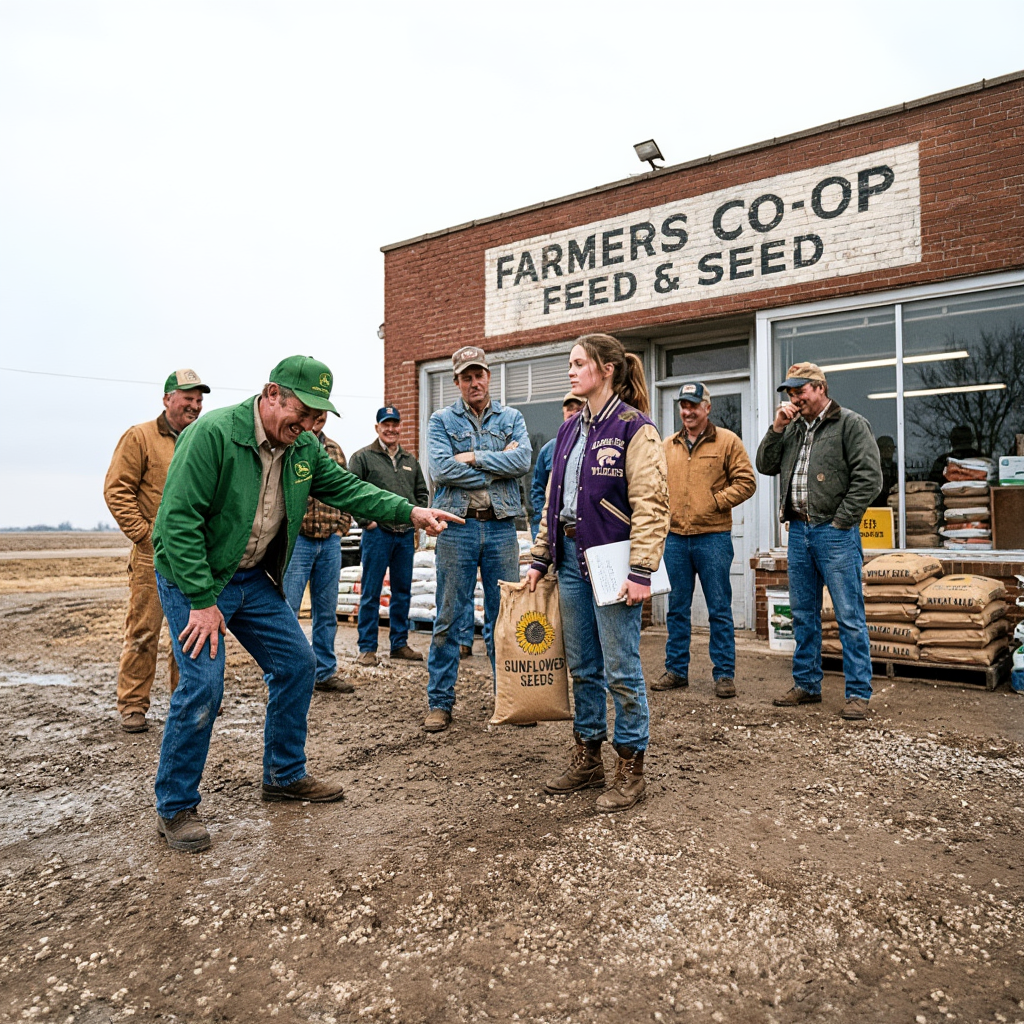
That silenced them for a moment. Everyone in that circle knew what that meant. Losing land wasn’t just financial—it was personal, generational. Like losing a piece of family history.
Still, Roy shook his head. “Even if you’re right, you want us to risk acreage on a maybe? We barely survived last year.”
“I’m not asking for all of it,” Emily said. “Just forty acres. The north field. It’s already underperforming.”
“Because it’s bad soil,” Roy replied.
“Exactly,” she said. “Sunflowers thrive in bad soil.”
Another chuckle. But softer this time.
Hank studied her. He remembered her father—Tom Carter—a quiet, stubborn man who’d once experimented with winter wheat despite everyone’s doubts. It had worked. For a while.
But Tom was gone now. Heart attack during harvest. Emily had returned from Iowa State with an unfinished agronomy degree and more ideas than acreage.
“You’re asking me,” Hank said slowly, “to bet on a college kid with a notebook.”
“I’m asking you to bet on the soil,” she replied.
The wind rattled the stacked feed bags beside the store. A crow called from a distant fence post.
Finally, Hank sighed. “Forty acres,” he said. “If it fails, you eat the cost.”
“I will,” Emily said immediately.
Roy laughed again. “You don’t even own forty acres.”
“I’ll lease it,” she said. “From Mr. Harper.”
Now all eyes turned to Hank.
He rubbed his chin. “You’re serious.”
“Yes, sir.”
He stared out at the fields, then back at her determined expression. Finally, he shrugged.
“Alright,” he said. “Forty acres of sunflowers.”
The men shook their heads.
Roy muttered, “We’ll be the prettiest broke farmers in Iowa.”
They laughed again.
Emily didn’t. She was already planning.
Planting happened late that spring.
The soil was dry enough to crumble like old cake. Emily walked behind the rented planter, checking seed spacing, adjusting depth, making notes. The men watched from trucks, half-amused, half-curious.
Rows stretched across the north field—tiny seeds buried in tired ground.
“You know,” Roy called out, “they might not even sprout.”
“They will,” Emily replied.
Two weeks later, green shoots appeared.
Three weeks later, they spread.
By midsummer, the field transformed.
Tall stalks rose shoulder-high, then higher. Leaves broad as dinner plates soaked in sunlight. And then, one morning in July, the first yellow blooms opened.
Within days, the entire forty acres turned gold.
Cars slowed on the county road. People stopped for photos. A local paper ran a small feature: “Sunflowers Bloom in Harper County.”
Roy grumbled. “Great. We’re famous.”
But Hank noticed something else.
The soil between rows stayed moist longer. Weeds were fewer. And despite the heat, the plants looked strong—stronger than the struggling corn nearby.
Emily kept records obsessively: rainfall, soil temperature, insect activity. She tracked pollinators too—bees, butterflies, even birds.
By harvest, the heads drooped heavy with seed.
The yield surprised everyone.
Not record-breaking—but profitable.
After costs, Emily cleared more per acre than the north field had in five years.
Roy whistled when he saw the numbers. “Beginner’s luck.”
Emily smiled. “Maybe.”
Hank didn’t say anything. But the next spring, he set aside another forty acres.
Year Two brought trouble.
The winter snowpack was thin. Spring rains never came. By June, cracks split the cornfields like dry riverbeds. Soybeans wilted. Farmers gathered at the co-op, voices low, worry thick in the air.
Emily’s sunflowers, though smaller, kept growing.
Their roots drilled deep—six feet, sometimes more—pulling moisture where other crops couldn’t reach.
“Still think they’re postcards?” she asked Roy gently.
He didn’t answer.
By July, the drought worsened. Corn leaves curled tight as paper. Some fields were abandoned entirely.
Hank walked his land each morning, calculating losses. Insurance would help, but not enough. Not after last year’s fertilizer loans.
One evening, he drove past Emily’s fields.
Golden.
Not lush—but alive.
He pulled over, stepped out, and ran a hand along the rough stalk. Bees hummed lazily. The soil felt cool beneath his boots.
He exhaled slowly.
Harvest that year was brutal.
Combines crawled through stunted corn, yields barely worth the fuel. Soybeans failed outright in places.
But the sunflowers—though shorter—produced.
Not only that, prices had risen. Drought across the Midwest meant oilseed demand surged. The processing plant expanded buying hours.
Emily’s trucks rolled in steady.
Hank’s accountant stared at the ledger. “These sunflowers… they’re carrying you.”
He nodded.
By the end of harvest, the numbers told the story:
Without sunflowers, the farm would’ve posted a major loss.
With them… they broke even.
Broke even in a drought year.
At the co-op, Roy leaned against the coffee counter. “Alright,” he admitted, “maybe you were onto something.”
Emily raised an eyebrow. “Maybe?”
He chuckled. “Alright. You were right.”
But the real test came later.
In late fall, Hank called a meeting outside Harper’s Feed & Seed—the same gravel lot where laughter had greeted her idea.
Farmers gathered, faces lined from a hard season.
Hank cleared his throat. “Two years ago, Emily Carter suggested we plant sunflowers.”
A few smiles.
“We laughed,” he continued. “I laughed. But this year… her crop saved this farm.”
Heads nodded.
“She’s agreed to share her data,” Hank added. “So next spring, we’re expanding sunflower acreage.”
Roy folded his arms. “How much?”
Hank glanced at Emily.
She answered, “Two hundred acres.”
Murmurs spread.
“That’s a big jump,” someone said.
“It’s a smart one,” Hank replied.
He turned to Emily. “You ready for that?”
She smiled. “Been ready since year one.”
Roy chuckled. “Guess we’ll be a whole county of postcards.”
Emily looked across the fields, imagining miles of gold swaying in the wind.
“Or maybe,” she said softly, “we’ll just be a county that survives.”
Spring of Year Three brought change.
More seed orders. More planters. More farmers asking questions instead of laughing.
By summer, patches of gold dotted the county.
By fall, they stitched together.
Sunflowers didn’t replace corn entirely—but they balanced risk. Restored soil. Brought pollinators. And most importantly, gave farmers breathing room.
At the annual county fair, a banner read:
“Harper County Sunflower Festival.”
Roy shook his head, smiling. “You did this.”
Emily laughed. “The drought did.”
Hank placed a hand on her shoulder. “No. You did.”
She looked out across the fields—gold stretching toward the horizon.
Two years earlier, they had laughed.
Now, they were listening.
And the farm—the whole farm—was still standing.
By the third year, the laughter had disappeared.
But fear hadn’t.
Emily Carter stood at the edge of the expanded sunflower acreage, boots sunk into soft morning soil, watching the early light spill across hundreds of acres of green. The plants were still young—only knee-high—but they stretched farther than she had ever dared imagine.
Two hundred acres.
Two years ago, she had begged for forty.
Now the entire north half of Harper’s land—and portions leased from neighboring farms—were planted in sunflowers. Even Roy Miller had committed eighty acres, though he still pretended he was “just experimenting.”
Hank Harper pulled his truck beside her and stepped out, coffee in hand.
“You sleep?” he asked.
“Not much,” she admitted.
“Me neither.”
They both stared across the rows. The wind moved gently, rippling leaves like water.
“Big gamble,” Hank said quietly.
Emily nodded. “Bigger reward.”
“Or bigger loss.”
She didn’t argue. They both knew it.
The bank had extended credit based on last year’s numbers. Seed orders had doubled. Equipment had been rented. If something went wrong—hail, pests, early frost—it wouldn’t just hurt.
It could wipe them out.
By late June, the fields looked strong.
Rain had come in short bursts—just enough. The soil, improved by previous sunflower cycles, held moisture better. Corn planted nearby even looked healthier.
Emily documented everything: infiltration rates, organic matter changes, pollinator density. She planned to publish the data someday—prove scientifically what they were seeing.
Then came the storm.
The forecast had warned of “severe weather,” but nobody expected what arrived.
Black clouds rolled in from the west, swallowing the sky. Wind slammed across the fields, bending young stalks nearly horizontal. Hail followed—hard, fast, relentless.
Emily watched from the farmhouse porch, heart hammering, as white pellets shredded leaves.
“No…” she whispered.
The storm lasted twenty minutes.
It felt like an hour.
When it passed, silence fell.
She ran to the fields.
Leaves were torn. Some stalks snapped. Others leaned heavily.
Hank arrived minutes later. Roy’s truck bounced in behind him.
They walked into the damage.
Roy kicked a broken plant. “That’s bad.”
Emily knelt, examining stems. “Some will recover.”
“Some won’t,” Hank said.
They spent the afternoon surveying acres. Rough estimate: thirty percent damaged.
Emily didn’t sleep that night.
A week later, something unexpected happened.
The surviving sunflower plants adjusted.
Bent stalks curved upward again, chasing sunlight. Side branches developed where the main stems were damaged. Instead of one large head, many produced two or three smaller ones.
Emily stared in disbelief.
“They’re compensating,” she said.
Roy scratched his beard. “Never seen corn do that.”
“They’re resilient,” she replied.
The damaged acres wouldn’t yield as high—but they wouldn’t fail either.
Still, another problem emerged.
Aphids.
Tiny green clusters appeared on undersides of leaves, multiplying rapidly. Warm weather accelerated them. Within days, patches of plants looked stressed.
Roy cursed. “Here we go.”
Spraying pesticides would cost heavily—and risk harming pollinators that made the sunflower ecosystem valuable.
Emily considered options.
“We try biological control,” she said.
Roy blinked. “Meaning?”
“Lady beetles. Lacewings. Natural predators.”
“You want to fight bugs… with bugs?”
“Yes.”
He shook his head, but Hank nodded. “Do it.”
Emily contacted a regional supplier. Boxes of beneficial insects arrived—thousands released across fields at dusk.
At first, nothing changed.
Then, slowly, aphid populations declined.
Lady beetles spread. Leaves recovered.
Roy whistled. “Well I’ll be.”
Emily smiled faintly. “Nature balances itself… if we let it.”
By August, the fields turned gold again.
But this time, it wasn’t just forty acres.
It was miles.
Drivers pulled over constantly. A photographer from Des Moines took aerial shots. A regional news crew arrived, interviewing Hank.
“You’re saying sunflowers saved your farm?” the reporter asked.
Hank glanced toward Emily. “Saved all of us.”
Roy, standing behind camera, muttered, “Don’t make me emotional on television.”
Harvest came late September.
Combines rolled slowly through thick stands. The yield monitor flickered numbers higher than expected—storm damage hadn’t hurt as much as feared.
Emily rode in the cab with Hank.
He stared at the screen. “This… this is strong.”
She nodded. “Soil’s improving every year.”
When the final truck rolled to the processing plant, the total stunned them.
Not just profitable.
Record-breaking.
Sunflower oil demand had surged nationwide. Prices climbed. Their county—once struggling—suddenly held one of the largest regional supplies.
At the co-op meeting, farmers compared checks.
Roy leaned over to Emily. “I hate being wrong.”
She grinned. “You’re getting used to it.”
He laughed.
But the real moment came two weeks later.
Hank called everyone back to Harper’s Feed & Seed—the same gravel lot.
This time, no one laughed.
Instead, trucks filled the parking area. Farmers from neighboring counties came. Even bank representatives attended.
Hank stood on a flatbed trailer.
“Three years ago,” he began, “we were on the edge. Drought, soil exhaustion, debt. Then Emily Carter suggested sunflowers.”
Heads turned toward her.
“We laughed,” he admitted again. “But this year… not only did her crop save our farm… it changed this county.”
Applause broke out.
Emily flushed, embarrassed.
Roy shouted, “Speech!”
She climbed onto the trailer reluctantly.
“I didn’t save anything,” she said. “The soil did. We just gave it a chance to heal.”
She looked across the crowd—men who once dismissed her, now listening carefully.
“Sunflowers weren’t magic,” she continued. “They were rotation. Diversity. Risk management. We stopped putting everything into one crop.”
Hank nodded. “And now?”
She smiled. “Now we keep going.”
Roy raised his hand. “How many acres next year?”
Emily hesitated… then said:
“Half the county.”
Laughter returned—but this time, it wasn’t mocking.
It was hopeful.
That winter, seed catalogs ran out of sunflower varieties. Equipment dealers ordered specialized headers. The processing plant announced expansion.
Emily finished her agronomy degree remotely while managing fields. She started consulting other farmers.
One snowy evening, she stood beside Hank outside the store.
“You realize,” he said, “you changed farming here.”
She shook her head. “We changed it.”
He smiled. “Two years ago, they laughed.”
Emily looked across quiet fields, imagining them gold again.
“And now?” she asked.
Hank answered softly:
“Now they plant.”