
“By Spring, You’ll Give Me Three Sons” — The Reclusive Mountain Man’s Bold Claim Left the Amish Woman Speechless
The wind flattened the tall grass into long silver waves.
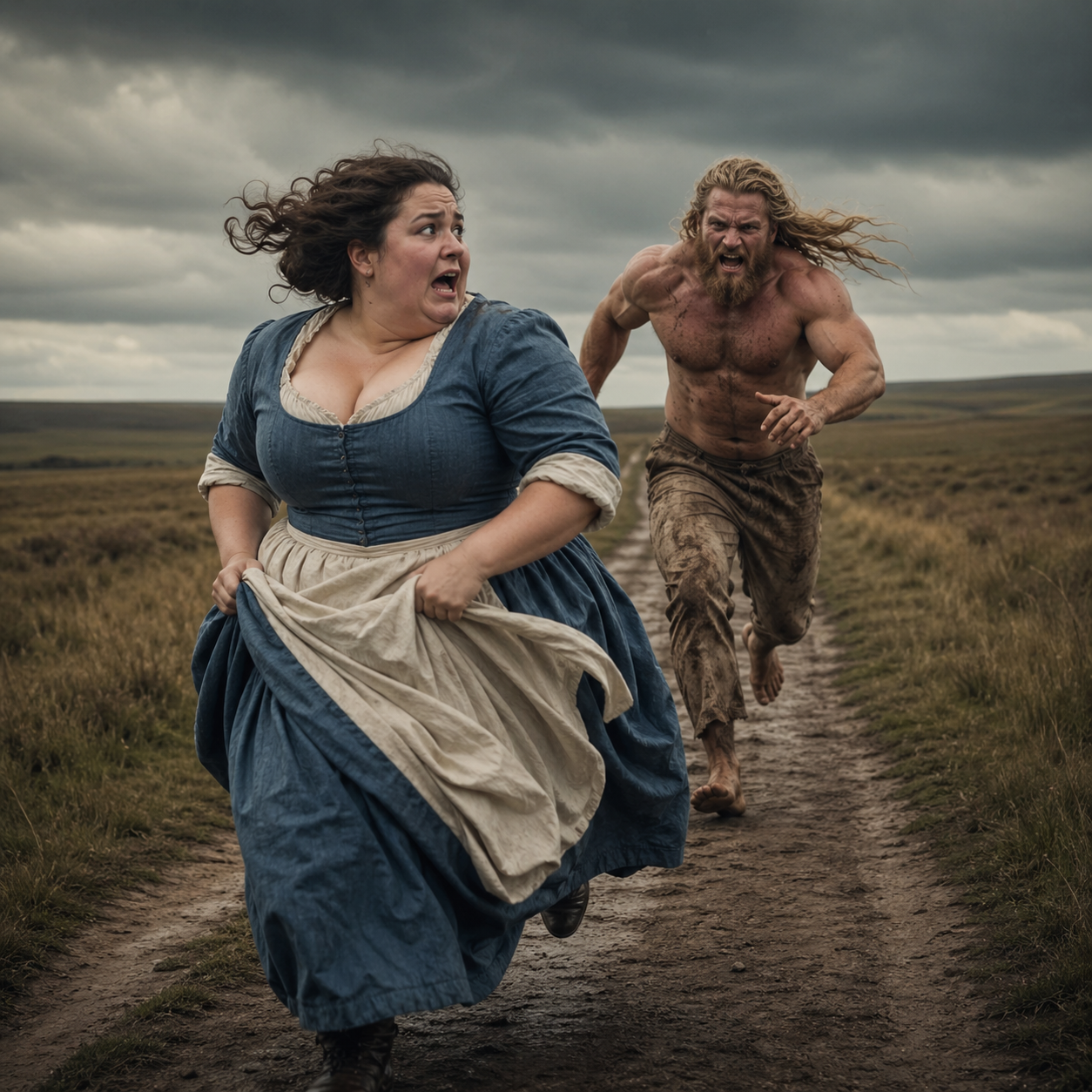
Mary Kauffman ran through it, clutching her apron with one hand and lifting her blue dress with the other so she wouldn’t trip. Her breath came in sharp bursts, each one tearing at her chest. The dirt path beneath her feet curved across the open plain, offering no cover, no trees, no fences—only endless land beneath a low, gray sky.
She risked a glance over her shoulder.
He was still there.
Bare-chested. Broad as an ox. Long blond hair whipping behind him. Mud-streaked trousers clinging to powerful legs that devoured ground with frightening ease. His beard framed a face that looked carved from stone, his expression intense—not quite angry, but determined in a way that made her heart hammer harder.
Mary stumbled, caught herself, and kept running.
She had only meant to cross the pasture.
That was all.
The Amish settlement lay three miles behind her. She’d gone farther than usual, following a stray goat that had wandered toward the plains. She’d found the animal grazing near a shallow creek… and then she’d heard footsteps.
Heavy ones.
She turned.
And saw him.
He’d stepped from behind a low rise, tall and silent, watching her. For a moment, neither moved. Then he began walking toward her, slow and steady.
“Stop,” he’d called.
She hadn’t.
Now she ran.
The wind carried the sound of his boots striking the ground behind her. Closer. Always closer.
Mary’s lungs burned. Her bonnet had slipped loose, hanging by its ties. Her cheeks flushed hot despite the cold air. She tried to push harder, but her legs trembled.
“Wait!” he called again.
She didn’t trust her voice to answer.
The path dipped slightly. Mud from last week’s rain made the ground slick. Her foot slid. She nearly fell.
A hand closed around her elbow.
She gasped and twisted away, stumbling to a halt.
He stood before her now, chest heaving but not nearly as winded as she was. Up close, he looked even larger—taller than any man she’d seen, muscles corded across his shoulders, skin marked by old scars. His blue eyes studied her, intense but not cruel.
Mary backed away a step. “Don’t—”
“I wasn’t chasing,” he said, voice deep and rough from disuse.
“You were running after me.”
“You were running first.”
She swallowed hard.
The wind tugged her skirt around her legs. The plains stretched empty in every direction.
“I don’t know you,” she said.
He nodded. “Name’s Rowan.”
She hesitated. “Mary.”
He looked at her as if memorizing it.
“You shouldn’t be out here alone,” he said.
“I was retrieving a goat.”
He glanced around. “Where?”
She pointed weakly behind him. The goat grazed calmly twenty yards away, utterly unconcerned.
Rowan nodded. “I live nearby.”
Her eyes widened slightly. “Out here?”
He gestured toward the distant hills barely visible through the haze. “Cabin. Near the ridge.”
Mary’s heart slowed slightly—but not fully.
“You frightened me,” she admitted.
He frowned faintly. “Didn’t mean to.”
They stood in silence a moment.
Then he said it.
“By spring, you’ll give me three sons.”
Mary blinked.
“What?”
He said it again, calm as stating the weather. “By spring, you’ll give me three sons.”
Her mouth fell open.
“I—what?” she stammered.
Rowan watched her carefully, as if expecting confusion.
“You strong,” he said simply. “Good build. You survive winter. Three sons likely.”
Mary’s face flushed bright red. “You can’t say something like that!”
He tilted his head. “Why?”
“Because—because—” She waved her hands, unable to find words. “You don’t even know me!”
“I know enough.”
Her shock turned into indignation. “I’m Amish. We don’t speak that way.”
He considered. “Then I speak wrong.”
“Yes, you do!”
He nodded slowly, unbothered.
Mary took a breath, steadying herself. “And I am not… having sons with a stranger in the plains.”
Rowan shrugged. “Not stranger if we talk.”
She stared at him, unsure whether to laugh or scold.
The wind howled softly through the grass.
“You live alone?” she asked.
“Yes.”
“For how long?”
“Since boy.”
Mary frowned. “You don’t see many people, do you?”
“No.”
“That explains… some things.”
He accepted that without offense.
The goat wandered closer, bleating softly. Mary grabbed its rope.
“I should go,” she said.
Rowan stepped aside immediately. “Storm coming.”
She looked up. Clouds thickened low on the horizon. “I know the way back.”
“Long way.”
“I’ll manage.”
He watched her begin walking.
After a few steps, she turned. “And don’t say things like that again.”
He nodded once. “Alright.”
She walked faster, heart still pounding—not entirely from fear anymore, but from the absurdity of it all.
By the time she reached the settlement, the sky had darkened.
That night, wind rose.
By morning, snow fell.
Not light flakes—but heavy, thick sheets that swallowed the road and buried fences. The Amish families gathered indoors, concerned. It was early for such a storm.
Mary watched from the window, remembering the plains.
And Rowan.
By afternoon, the storm worsened. Snow piled against doors. The wind screamed across the fields.
Then someone knocked.
Hard.
Mary’s father opened the door.
Rowan stood there, covered in snow.
He looked enormous in the doorway, hair crusted white, breath steaming.
“You,” Mary whispered.
He nodded. “Storm worse than expected. I help bring animals in.”
Her father studied him carefully. “You came all this way?”
Rowan shrugged. “She was out there. Thought… maybe family needs help.”
Within minutes, he was hauling feed, lifting gates, guiding animals into shelter. His strength turned hours of work into minutes.
Mary watched quietly.
He worked without speaking, focused and efficient.
Later, inside the barn, he wiped snow from his beard. Mary approached.
“You didn’t have to come.”
He shrugged. “Storm.”
She hesitated. “Thank you.”
He nodded.
Over the next days, he stayed. The snow trapped everyone indoors. Rowan repaired fences, chopped wood, and carried water as if it weighed nothing.
The settlement warmed to him slowly.
Mary noticed he spoke little, but listened carefully. He watched children play with curiosity, as if studying a world he’d never known.
One evening, they stood outside, snow glowing pale under moonlight.
“You really think three sons?” she teased lightly.
He looked at her, serious. “You strong. But I was wrong to say.”
She smiled faintly. “Yes. You were.”
He nodded. “Still… I think you change my life.”
She blinked.
“You run,” he said quietly. “I follow. Now I stay.”
The wind moved gently across the snow.
Mary looked at him—this strange, blunt mountain man who spoke without polish but acted with quiet kindness.
Her fear from the plains felt distant now.
“You changed mine too,” she admitted softly.
He didn’t answer.
But he smiled—small, uncertain, and genuine.
Spring came slowly that year.
The snow melted. Grass returned. And Rowan kept visiting.
Not chasing.
Just walking beside her across the plains.