
All He Wanted Was a Baker…Then His Silent Daughter Spoke for the First Time—and Everything Changed
The first thing Daniel Harper noticed was the smell.
It drifted down Pine Creek’s dusty main road just after sunrise—warm, buttery, alive. Not the usual burnt biscuit scent that came from the boardinghouse, nor the sour tang of yesterday’s bread reheated over a weak fire. This was different. Rich. Comforting. The kind of smell that made a man stop walking without realizing why.
Daniel paused outside the old mercantile building and inhaled again.
Bread. Fresh.
He hadn’t smelled bread like that since before winter took his wife.
Behind him, small footsteps stopped too. His daughter Lily stood close, her tiny hand gripping the edge of his coat. Her blonde hair fell in uneven strands across her cheeks. She looked up at him, curious, but silent as always.
Daniel glanced down. “You smell that, kiddo?”
She nodded.
Lily hadn’t spoken in nearly two years.
Not since the night fever took her mother. She had screamed then—once, long and broken—and after that, nothing. Doctors called it shock. Preachers called it grief. Daniel called it the hardest silence he’d ever known.
The scent grew stronger as he pushed open the door.
Warmth spilled out.
Inside, the old mercantile had changed. The shelves that once held nails and lantern oil now displayed loaves of bread cooling on cloth-lined boards. A flour-covered wooden table stood in the center. Copper pots hung from beams overhead, catching the golden lantern light. Dried herbs and garlic braids dangled gently, filling the air with soft, earthy fragrance.
And at the center, kneading dough with steady hands, stood a woman.
Her blonde hair was wrapped in a white headscarf. A grey long-sleeve shirt was rolled at the forearms, dusted with flour. A white apron hung loosely, streaked with dough. She pressed and folded the bread with practiced rhythm, smiling slightly as she worked.
Lily stepped forward before Daniel could stop her.
The child climbed onto a wooden chair beside the table, fascinated. The woman looked up, surprised, then softened immediately.
“Well now,” she said gently. “You want to help?”
Lily didn’t speak, but she reached out and pressed her small fingers into the dough.
The woman laughed softly. “Careful. It bites back.”
Daniel cleared his throat. “Morning.”
She looked at him, then wiped her hands on her apron. “Morning. Sorry—we’re not officially open yet.”
“That’s alright,” he said. “Didn’t even know this place changed hands.”
“I arrived three days ago,” she replied. “Name’s Hannah Carter.”
“Daniel Harper.”
She nodded, then glanced at Lily. “And this helper?”
“My daughter. Lily.”
Hannah smiled at the child. “She’s got good instincts. Dough likes gentle hands.”
Lily pressed the dough again, watching it slowly spring back. A faint smile appeared—small, hesitant, but unmistakable.
Daniel hadn’t seen that smile in months.
He shifted, unsure why his chest suddenly felt tight.
“You baking to sell?” he asked.
“Yes. Bread, pies, biscuits. Whatever folks need.” She shaped the dough into a smooth round. “Town seemed to be missing a proper baker.”
“That it was,” he admitted.
Lily giggled softly—just breath, no sound—but her shoulders shook. She was pressing the dough flatter, her fingers leaving tiny impressions.
Hannah leaned closer. “You’re making a mess, you know.”
Lily looked up, eyes wide.
“That’s alright,” Hannah added quickly. “Best bakers always do.”
Daniel watched the two of them. Something about the warmth, the quiet laughter, the smell of bread—it filled the empty spaces he’d grown used to.
“All I wanted was a baker,” he muttered, half to himself.
Hannah looked up. “Pardon?”
“Town needed one,” he said quickly. “That’s all.”
She smiled knowingly.
Over the next week, Daniel found reasons to return.
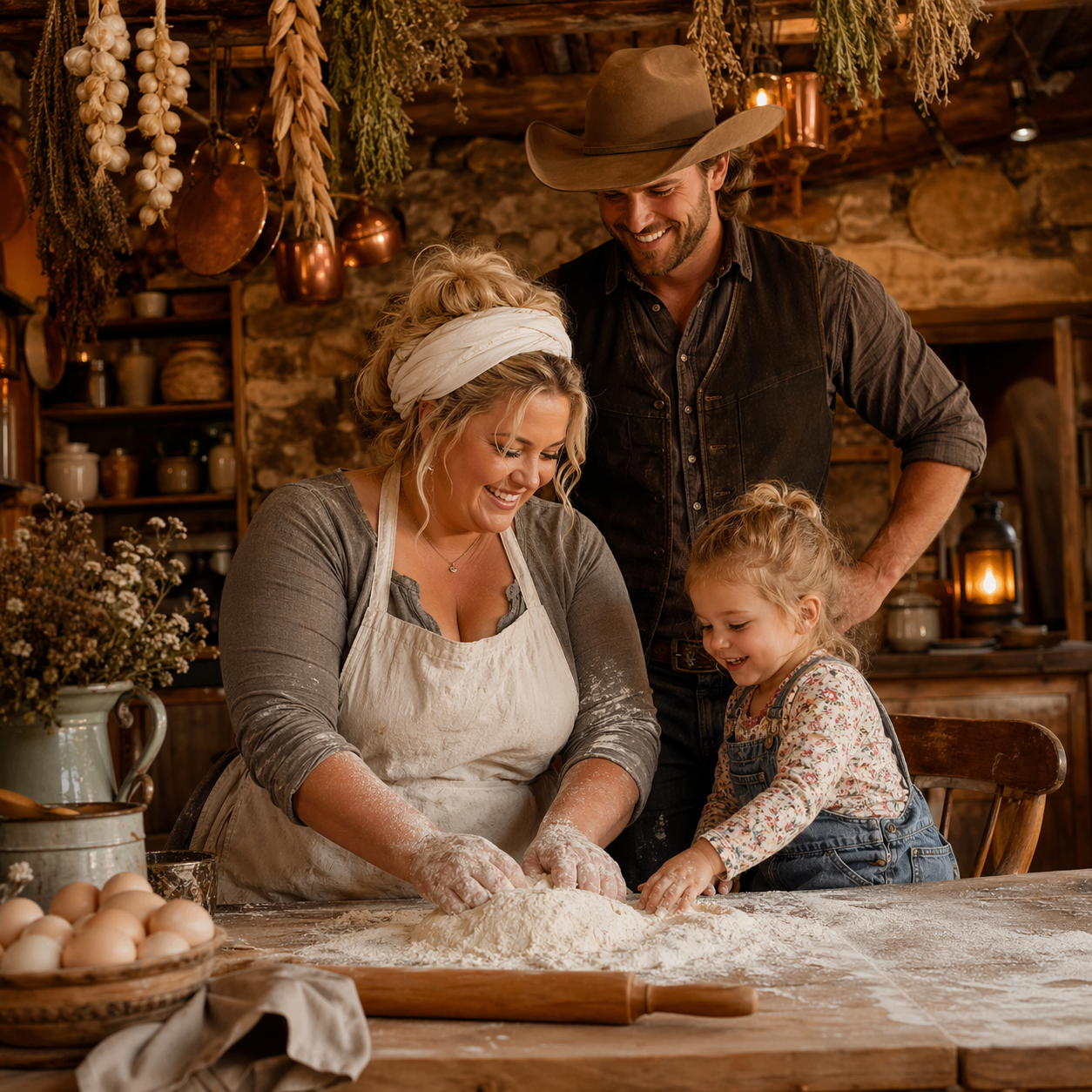
First, he came for bread. Then eggs. Then pie. Sometimes he brought Lily, sometimes she insisted on coming. Each time, Hannah welcomed them with the same warm smile.
The kitchen became Lily’s favorite place.
She would sit in the wooden chair, legs swinging, dusting flour across the table. Hannah taught her to roll dough, to crack eggs, to shape biscuits. Lily never spoke, but she watched carefully, learning.
Daniel leaned against the doorway often, hat in hand, watching.
The kitchen glowed in the evenings. Lanterns cast soft light across stone walls. Copper pots shimmered overhead. The wooden table filled with bowls, rolling pins, and linen cloths. It felt… alive.
One afternoon, Daniel arrived to find Lily already laughing silently as Hannah spun a lump of dough in her palms.
“Look,” Hannah said. “It’s becoming a little loaf.”
Lily clapped softly.
Daniel crossed his arms. “You’re spoiling her.”
Hannah smiled. “She’s helping.”
“She’ll expect to come every day.”
“Would that be so bad?”
He didn’t answer.
Winter approached slowly. Cold air crept through the valley. The bakery became even warmer, more inviting. Townsfolk gathered there, drawn by fresh bread and friendly conversation.
But Lily still hadn’t spoken.
One evening, Daniel lingered after everyone left. Hannah wiped down the table while Lily played with leftover dough.
“You’re good with her,” he said.
“She’s easy to like.”
“She doesn’t talk.”
Hannah shrugged. “She doesn’t need to.”
Daniel stared at the floor. “Doctors say she might never again.”
Hannah paused. “Children surprise us.”
He gave a humorless chuckle. “Not this one.”
She didn’t argue.
Days later, snow fell—light at first, then steady. The bakery became a refuge. Hannah baked constantly, filling shelves with bread. Lily stayed longer each day, bundled in a small shawl.
One morning, Hannah placed Lily’s hands over the dough.
“Push,” she said softly.
Lily pressed.
“Fold.”
She folded.
“Again.”
They worked together in silence.
Daniel leaned against the wall, watching.
Hannah began humming—a gentle, wordless tune. Lily tilted her head, listening. Her hands slowed, then matched the rhythm.
“Push… fold…” Hannah whispered.
Lily’s lips moved.
Daniel straightened.
He stepped closer.
Hannah kept humming, eyes on the dough.
Lily’s mouth opened again—barely.
Then, softly, fragile as a falling snowflake, she whispered:
“Warm.”
The word hung in the air.
Daniel froze.
Hannah stopped humming.
Lily blinked, startled by her own voice.
“Warm,” she repeated, touching the dough.
Daniel’s knees nearly gave out. He dropped to one knee beside her.
“Lily?” he whispered.
She looked at him, unsure.
“You… you said something.”
She nodded slowly.
His eyes filled. He reached for her, but stopped, afraid to break the moment.
Hannah stepped back quietly, hands trembling.
Lily touched Daniel’s beard. “Warm,” she said again.
He pulled her into a tight embrace, his shoulders shaking.
The kitchen felt brighter than ever.
After that day, everything changed.
Lily didn’t suddenly chatter, but words began to come—small, careful ones. “Bread.” “Flour.” “Mama.” Each one like a miracle.
Daniel visited the bakery daily.
Hannah pretended not to notice.
Spring crept into the valley. Snow melted. The bakery doors stayed open. Lily now spoke in short sentences, always while helping knead dough.
One afternoon, Daniel stood behind Hannah as she worked.
“You did something,” he said quietly.
“No,” she replied. “She was ready.”
He shook his head. “She spoke here. With you.”
Hannah wiped flour from her hands. “Sometimes warmth brings words.”
He smiled faintly. “All I wanted was a baker.”
“And?”
He looked at Lily, laughing softly as she rolled dough unevenly.
“Then my silent daughter spoke,” he said. “And everything changed.”
Hannah met his gaze.
Outside, the sun dipped low, casting golden light through the window. Inside, the rustic kitchen glowed—flour scattered across the table, herbs swaying overhead, lanterns flickering softly.
Lily held up a misshapen loaf proudly.
“Papa,” she said clearly.
Daniel’s heart lifted.
He took the loaf, smiling. “Best bread I’ve ever seen.”
Hannah laughed softly.
The warmth of the kitchen wrapped around them—three lives quietly stitched together by flour, fire, and the first fragile words of a child who had finally found her voice.