
They Mocked Her Goat Wall on the Open Prairie… Then the Cold Never Crossed It
The first frost came early that year, thin as breath on glass and just as quiet. It crept across the open prairie in the night, silvering the dry grass and stiffening the earth. By dawn, every fence post wore a brittle crown of white, and the sky hung low and heavy like unwashed wool.
Abigail Turner stood alone in the field, her hands tucked into the sleeves of her beige dress. A white bonnet framed her wind-reddened face. She watched her goats move slowly across the brittle grass, their hooves crunching softly, their breath drifting like smoke. Beyond them, the prairie stretched in all directions—flat, exposed, and unforgiving.
Her husband had called it “a fine piece of land.”
That was two winters ago.
Now he lay beneath a crude wooden cross behind the cabin, taken by fever in late autumn. The neighbors had helped bury him, then returned to their own preparations for winter. Everyone understood the arithmetic of survival: one family saved meant one family fed.
Abigail remained with the cabin, six goats, a stack of firewood too small, and a wind that never seemed to stop.
The first time she mentioned building a wall for the goats, they laughed.
Not cruelly, not at first. Just puzzled.
“You’ll need lumber,” said Thomas Reed, leaning against his wagon wheel. “And you’ve none to spare.”
“I won’t use lumber,” Abigail replied quietly.
He looked around at the empty prairie. “Then what?”
“Brush. Straw. Sticks. Whatever the land gives.”
Thomas chuckled. “That’ll stop a rabbit, maybe. Not a prairie wind.”
The others nodded. The prairie wind was a living thing—cold enough to kill chickens overnight, strong enough to tear loose poorly set doors. People built barns tight and low, dug cellars, stacked sod. No one built walls from woven branches.
But Abigail had spent the last winter listening to the wind.
It came hardest across the open fields, sweeping low, gathering snow, and pushing it against whatever resisted. Fences caught drifts. Wagons buried halfway to their hubs. The north side of her cabin always grew a deep ridge of snow, packed hard as stone.
She began gathering sticks the next morning.
At first, it seemed pointless work. She walked the creek bed miles away, cutting willow branches, dragging them back in bundles. She pulled dead brush from hedgerows. She saved straw from the goats’ bedding. Her hands blistered, then toughened. The goats followed her sometimes, nibbling bark.
The structure began as a circle scratched into the dirt.
She drove stakes into the ground—crooked, uneven. Then she wove branches between them, bending green willow into rough lattice. It looked fragile, like a child’s play fence. The wind slipped through easily.
Thomas rode by once, watching her work.
“You’d be better off patching your roof,” he said.
“I already did.”
He studied the woven circle. “You know snow’ll pile right through that.”
“I hope so,” she answered.
He frowned, unsure whether she was joking.
She wasn’t.
Day by day, the wall thickened. Abigail layered straw between woven branches, then another layer of sticks, then more straw. She packed dried grass into gaps. The circle grew chest-high, then shoulder-high. She left a narrow entrance facing south, away from the worst winds.
The neighbors began calling it the “goat wall.”
Children pointed at it from passing wagons. One boy laughed aloud. “Miss Turner’s building a nest!”
Another man shook his head. “Won’t last the first storm.”
Abigail kept working.
She didn’t argue. She didn’t explain. She only added more layers, packing, weaving, reinforcing. She hauled fallen branches after every wind. She lined the inside with more straw. The goats started sleeping there at night, their bodies adding warmth.
The first snow came in late November.
It arrived sideways, driven by a sharp northern wind. By morning, drifts formed along fences and against the cabin. Abigail stepped outside and saw snow caught in the woven wall—thin at first, filling gaps like white mortar.
She nodded to herself.
Within days, another storm came. More snow packed into the wall. Wind pushed it deeper, compressing it. The structure thickened, turning white. From a distance, the circle looked like a low, rounded mound.
Inside, the goats stood quietly, sheltered. Their bedding stayed dry.
Thomas Reed returned a week later, dismounting near the enclosure. He circled it slowly.
“Well,” he muttered. “I’ll be.”
Snow had sealed the outer layers. Straw inside held it in place. The wall now stood nearly three feet thick in places. The wind, instead of slicing through, broke against it and slid upward.
“It’ll melt,” he said, though without conviction.
“Eventually,” Abigail replied. “But not before the worst cold.”
December came harder.
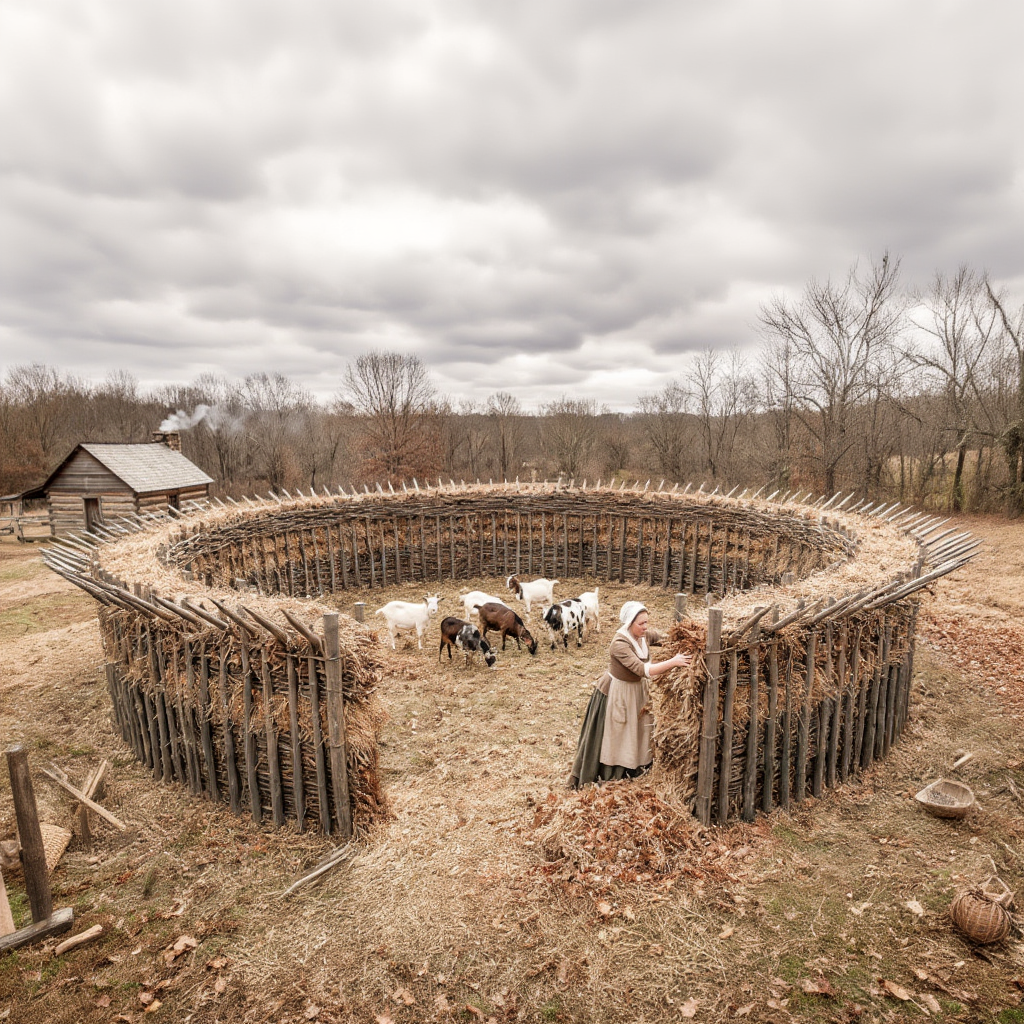
Temperatures dropped so low that water buckets froze solid overnight. Chickens died in poorly sealed coops across the prairie. One family lost two calves. The wind roared for three days straight, pushing snow into sharp ridges.
On the second night of the storm, Thomas woke to find frost creeping along his bedroom wall. He added more wood to the stove. Outside, the air screamed.
He thought of Abigail.
At dawn, he rode out, scarf wrapped tight.
Her cabin stood partly buried in drifts. Smoke rose thinly from the chimney. The circular goat wall was nearly invisible—just a rounded snow mound with a narrow opening.
He approached cautiously. Inside, the goats shifted, alive and warm. The ground was dry. Their breath filled the air with steam.
Abigail stood near the entrance, her hands tucked under her shawl.
“They made it,” she said simply.
Thomas touched the wall. It felt solid as packed earth.
“How thick is this?” he asked.
She shrugged. “However much the wind gave me.”
He let out a low whistle.
By January, the story spread.
Some neighbors began copying the idea—smaller enclosures, woven brush, packed straw. They didn’t admit they learned from her, but everyone knew.
The cold intensified.
One night, temperatures plunged so suddenly that a man named Eli Barnes lost nearly all his sheep. Their pen, made of thin boards, offered little shelter. The wind cut through gaps, chilling them to death.
The next day, he rode to Abigail’s place.
He stood awkwardly near the enclosure. “Mind if I look?”
“Go ahead.”
He walked around, studying the layered construction. Snow fused the outer shell. Straw trapped air. The circular shape deflected wind.
“You reckon this’d work for sheep?” he asked.
“Yes,” she said. “If you build it before the storms.”
He nodded, shame flickering across his face.
The winter deepened into something people would later call the hardest in a decade.
Blizzards came one after another. Drifts swallowed fence lines. Some families burned furniture to keep warm. The prairie became silent except for wind.
Through it all, Abigail’s goat wall held.
Snow packed tighter. Ice formed on the outside, sealing cracks. Inside, the goats survived, their warmth maintaining a small pocket of livable air. Abigail collected manure for fuel, straw for insulation, milk for food.
By February, no one laughed anymore.
They began asking questions.
“How tall should the stakes be?”
“What kind of brush works best?”
“Should the entrance face south?”
Abigail answered each quietly, never boasting.
One afternoon, a group of men gathered near the enclosure, examining it like engineers. Thomas ran his gloved hand along the surface.
“Cold never crossed it,” he murmured.
The phrase stuck.
People repeated it: “That wall? Cold never crossed it.”
It became less a joke, more a kind of respect.
When the final blizzard came in early March, it struck without warning. Temperatures dropped, wind howled, and snow fell for nearly two days. Several barns collapsed under weight. Chickens froze despite heavy bedding.
Abigail stayed inside her cabin, listening.
The wind battered the walls. The door rattled. But outside, the circular enclosure took the brunt. Snow piled against it, reinforcing it further.
When the storm passed, she stepped out.
The prairie lay buried, smooth and white.
She walked to the enclosure, brushing snow from the entrance. The goats stirred, alive. One nuzzled her sleeve.
She exhaled slowly.
Later that day, Thomas rode by again. He looked at the enclosure, now almost entirely snow-covered.
“Never seen anything like it,” he said.
Abigail smiled faintly. “It’s just sticks and straw.”
“No,” he replied. “It’s listening to winter.”
Spring arrived reluctantly.
The snow melted unevenly, revealing flattened grass, broken fences, and lost livestock. The goat wall softened, collapsing in sections as the packed snow thawed. Beneath it, the woven branches sagged.
But the goats lived.
Milk returned to the table. Abigail traded cheese for flour. The neighbors rebuilt with new ideas—circular pens, thicker insulation, windbreaks.
By summer, the prairie looked ordinary again.
But no one forgot.
When autumn returned, families began gathering brush early. Circles appeared across the land—woven walls, straw-packed, ready for snow. Some called them “Turner rings.” Others simply “goat walls.”
Children no longer laughed.
One crisp October morning, Thomas rode up to Abigail’s place, where she was already rebuilding the enclosure.
“You started early,” he said.
She nodded. “Winter always comes.”
He looked across the prairie. In the distance, several similar circles dotted the land.
“You changed things,” he added.
She paused, tying a bundle of straw. “I just needed my goats to live.”
He smiled. “And now half the prairie will.”
The sky turned gray again, hinting at another cold season.
Abigail stepped back, studying the growing wall. Sticks woven tight. Straw packed deep. Circular, low, patient.
The wind rose lightly, whispering across the grass.
She listened.
And this time, the prairie listened back.