
A Widowed Cowboy Hired a Quiet Cook—Days Later, His Children Called Her “Mama”… and He Realized Their Prayers Had Been Answered
The first time Margaret Ellis stepped into the Harper cabin, she counted the children before she noticed the man.
One… two… three…
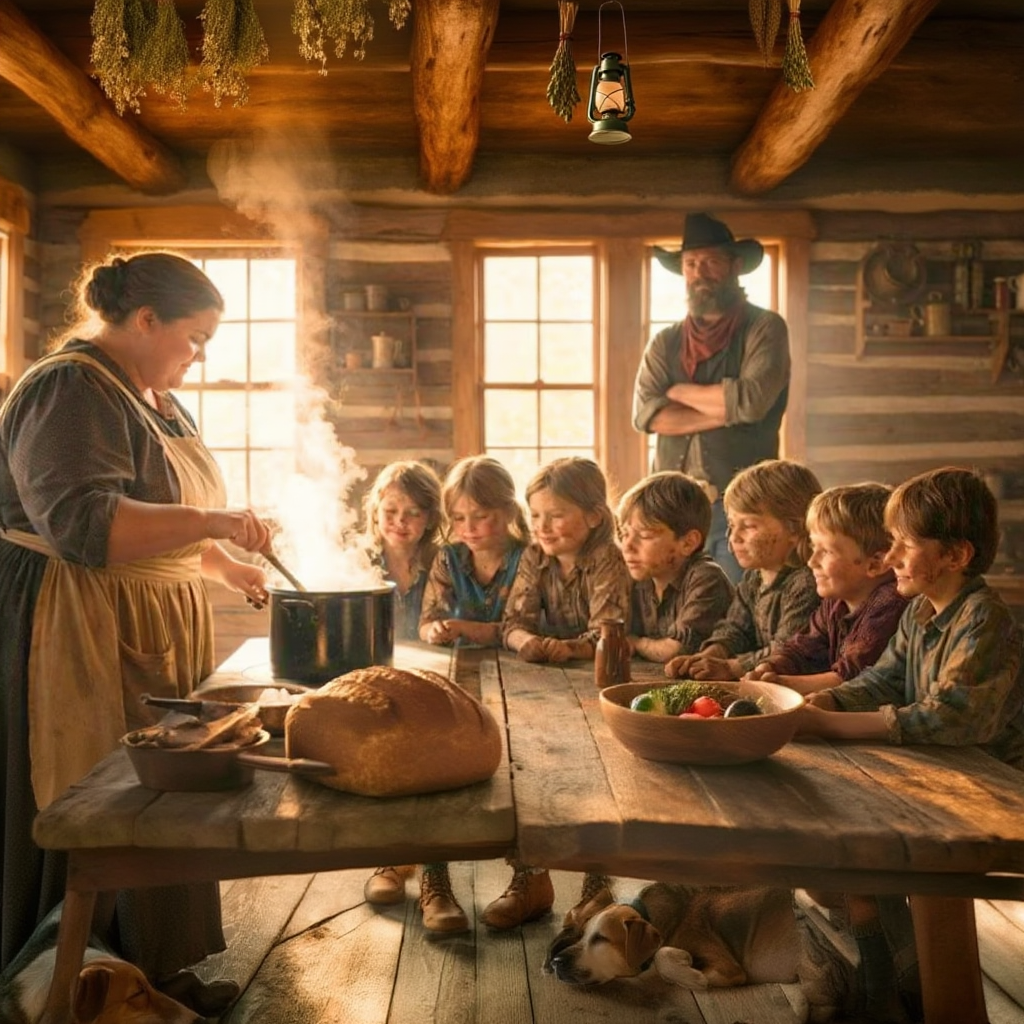
They sat at a long, rough wooden table, seven small figures with dirt-smudged cheeks and tangled hair, staring at her like she was something that had wandered in from another world. A loaf of crusty bread rested in the center of the table, untouched. A wooden bowl filled with turnips and carrots sat beside it. No one spoke.
Four… five… six… seven.
Seven children. All quiet.
Then she saw him.
He stood near the window, arms crossed, broad shoulders filling the space between the wall and the wood-burning stove. A dark hat shadowed his eyes. A red bandana hung loosely at his neck, and his beard was thick, untrimmed. He didn’t smile.
Jacob Harper.
Widowed cowboy. Rancher. The man who had placed the advertisement.
Cook needed. Must be quiet. Seven children. Room and board.
Margaret set her small satchel down near the door. “Mr. Harper?”
“That’s me,” he said.
His voice was low, worn, like he hadn’t used it much.
She glanced again at the children. The youngest—a boy no older than three—sat swinging his feet, watching her apron.
“You’re the cook?” Jacob asked.
“Yes.”
“You traveled far?”
“Two days by wagon. One on foot.”
He nodded once. “Stove’s there. Food’s… what we’ve got.”
He gestured toward a sack of potatoes, a few onions, and dried beans.
Margaret stepped toward the stove. The black pot hanging over the fire was empty. She rolled up her sleeves, tied her beige apron tighter, and began.
The cabin smelled faintly of smoke and cold wood. Dust drifted in the golden light pouring through the window. Above her, dried herbs hung from beams, brittle and forgotten. A kerosene lantern swayed slightly overhead.
She filled the pot with water, added beans, chopped onions. The knife thudded softly against the wooden board.
The children leaned forward.
Jacob stayed by the window, watching.
No one spoke.
Margaret stirred the pot slowly. Steam began to rise, curling into the golden light. The smell of onions softened the room.
The smallest girl whispered, barely audible, “Soup?”
Margaret glanced at her. “Yes.”
The girl nodded, eyes wide.
Jacob shifted slightly but said nothing.
Margaret worked quietly, adding salt, slicing potatoes, dropping them into the bubbling water. The dog beneath the table lifted its head briefly, then settled back to sleep.
Minutes passed.
The steam thickened, filling the cabin with warmth. The children leaned closer, elbows on the table. One boy wiped his nose with his sleeve. Another nudged his sister.
Margaret stirred again.
“Hungry?” she asked gently.
Seven heads nodded.
Jacob uncrossed his arms.
“Usually they just eat bread,” he muttered.
Margaret didn’t answer. She kept stirring.
When the soup thickened, she ladled it into mismatched bowls. She set them carefully along the table. The children didn’t move.
“You may eat,” she said.
They looked at Jacob.
He gave a short nod.
Seven spoons dipped at once.
The sound of eating filled the cabin—soft slurps, quiet sighs, one small laugh. The youngest boy grinned, broth dripping down his chin.
Margaret handed him a cloth. He wiped his mouth clumsily.
Jacob watched, unmoving.
After a moment, he stepped forward and took the last bowl. He tasted it. His expression shifted—barely, but enough.
“It’s good,” he said.
Margaret nodded.
That first night, the children fell asleep at the table, one by one.
Margaret carried the youngest to a bedroll near the wall. Jacob watched her, surprised.
“You don’t have to,” he said.
“I don’t mind.”
He studied her quietly.
“Why’d you come?” he asked.
She tucked a blanket around the child. “I needed work.”
“That all?”
She paused. “I like cooking.”
He nodded slowly.
The next morning, she rose before sunrise. She lit the stove, mixed dough, and set bread to bake. The smell woke the children.
They shuffled in, hair wild, rubbing their eyes.
“Bread,” one whispered.
Margaret smiled. “Fresh.”
They crowded the table.
Jacob entered last, stopping when he saw them already seated, waiting.
“You woke early,” he said.
“Bread did,” one boy replied.
Margaret sliced thick pieces, spreading them with a little butter. The children ate quietly, but their shoulders relaxed.
By the third day, the cabin had changed.
Margaret swept the floor. She washed dishes. She rearranged herbs above the stove. She mended torn sleeves. She added carrots to stew, apples to porridge.
The children began to follow her.
The youngest girl clung to her apron while she stirred. Two boys gathered firewood without being asked. The oldest helped knead dough.
Jacob noticed.
He stood near the window again, arms crossed, watching steam rise from the pot. The golden light made the kitchen glow. The dog slept beneath the table. The children leaned forward, waiting.
It looked… different.
Warmer.
On the fourth day, Margaret braided the youngest girl’s hair. The child stared at her reflection in a tin plate, smiling shyly.
Jacob cleared his throat. “You don’t have to fuss.”
“She asked.”
The girl nodded vigorously.
He looked away.
That evening, thunder rolled across the plains. Rain hammered the roof. The children gathered close, uneasy.
Margaret kept stirring the stew, humming softly.
The youngest boy crawled into her lap.
Jacob stiffened.
She kept humming.
The boy fell asleep against her shoulder.
Jacob stared at the fire.
He remembered another woman standing there, years ago. Laughter. Warmth. Then sickness. Silence.
He swallowed hard.
“Thank you,” he said quietly.
Margaret nodded.
On the sixth morning, something unexpected happened.
Margaret set bowls along the table. The children gathered as usual. The youngest girl tugged her sleeve.
“Ma—”
The sound stopped halfway.
The girl looked confused.
Margaret froze.
Jacob’s head snapped up.
The child tried again, softer.
“Mama… soup?”
Silence fell.
The other children stared.
Margaret’s eyes widened. “You don’t have to—”
But the girl smiled shyly.
“Mama,” she repeated.
The youngest boy echoed it. “Mama.”
One by one, the others followed, hesitant at first.
“Mama, bread?”
“Mama, more?”
The word filled the cabin like a quiet prayer finally spoken aloud.
Jacob felt something break open in his chest.
He gripped the edge of the table.
Margaret shook her head gently. “I’m just the cook.”
The oldest boy looked at her. “You stay?”
She hesitated.
Jacob stepped forward. “That’s up to her.”
Seven pairs of eyes turned to her.
She swallowed. “I… can stay.”
The children smiled, relief washing over them.
Jacob turned toward the window, blinking hard.
All he wanted was a cook.
Someone to stir pots, keep the children fed, nothing more.
But now the cabin felt alive again.
Days passed. The word “Mama” came naturally. Margaret corrected them at first, then less often. Eventually, she stopped.
Jacob noticed how the children laughed more. How they washed before meals. How they sat closer together.
One evening, he found Margaret alone at the stove.
“You didn’t expect this,” he said.
“No.”
“You mind it?”
She shook her head. “No.”
He nodded. “Neither do I.”
The sun dipped low, casting golden light through the window. Steam rose from the pot. The children gathered at the table, waiting.
The dog slept beneath their feet.
Jacob leaned against the wall, arms crossed—but this time, he was smiling.
Seven children watched Margaret stir the pot, and one small voice whispered again:
“Mama, is it ready?”
She turned, smiling softly. “Almost.”
Jacob realized then that the quiet prayers his children whispered each night—ones he pretended not to hear—had been answered.
And all he had wanted… was a cook.