
Widow Forced Into the Cold Built a Cave Home — Then Winter Proved Her Right
Snow came early the year Eleanor Whitmore buried her husband.
In the high country of northern Arizona, winter usually waited until late November before descending from the red cliffs and pine ridges. Ranchers counted on that. Miners counted on it. Even widows, Eleanor supposed, counted on it.
But grief never cared about seasons.
By the second week of October, frost coated the wooden fence posts each morning, and thin sheets of ice glazed the horse trough behind the small cabin Eleanor had once shared with her husband, Thomas.
And Thomas was gone.
A falling timber in the copper quarry had crushed his chest before any man could pull him free.
The town of Black Hollow brought casseroles, prayers, and promises.
Then, as towns often did, it moved on.
Eleanor Whitmore was twenty-nine years old, too young to be widowed and too stubborn to leave.
She had fair skin that burned in summer and blushed crimson in winter, and a thick mane of chestnut hair she kept tucked beneath a red wool hat Thomas had bought her during their first Christmas.
She still wore it every day.
Not because it was warm.
Because it was his.
And because some things, once stitched into your life, could not be removed without unraveling the whole garment.
The first letter came three weeks after the funeral.
It was folded neatly, stamped with the seal of the mining company.
Inside, the message was short.
Housing occupancy tied to active employment.
Vacate premises within fourteen days.
She read it once.
Then twice.
Then she laughed.
Not because it was funny.
Because if she didn’t laugh, she might scream.
Thomas had given seven years to that mine.
Seven years underground.
Seven years coughing copper dust.
Seven years building a future.
And now his widow was being thrown out before the first snow.
Eleanor marched into town the next morning wearing her long brown coat over a yellow dress, boots stiff with frost.
She carried the letter in one gloved hand.
At the office, Mr. Preston—the mine supervisor—didn’t even stand when she entered.
“Mrs. Whitmore.”
She dropped the letter on his desk.
“Tell me this is a mistake.”
He adjusted his spectacles.
“I’m afraid company policy is clear.”
“My husband died for that company.”
He sighed, as though inconvenience weighed heavier than grief.
“And we compensated you.”
Compensated.
The word hit harder than any slap.
Eleanor leaned over his desk.
“You paid me enough to bury him.”
Preston folded his hands.
“The cabin is reserved for active employees.”
“Winter’s coming.”
He didn’t blink.
“Then I suggest you find somewhere warm.”
She tried.
She truly did.
She asked at the boarding house.
Full.
She asked the church.
No room.
She asked neighbors.
Eyes dropped.
Doors closed.
Not because people hated her.
Because Black Hollow feared crossing the mining company.
And fear, Eleanor learned, was stronger than kindness.
Two weeks later, her belongings sat in the snow.
A trunk.
Two blankets.
A box of books.
Thomas’s tools.
And a shovel.
The cabin door was locked behind her.
She stood in the road while snow drifted around her boots.
No horse.
No family.
No money worth mentioning.
Just winter.
And silence.
Then old Martha Keegan, who’d survived two husbands and half the town, shuffled up beside her.
The woman stared toward the cliffs west of town.
“You know what the Paiute used to do?”
Eleanor wiped her nose.
“No.”
Martha pointed toward the sandstone ridges.
“They lived in the rock.”
At first, Eleanor thought the old woman had lost her mind.
Then Martha handed her a map.
Crude.
Hand-drawn.
Marked with an X near the canyon wall.
“Used to be sheep caves there,” Martha said.
“Natural hollows.”
Eleanor studied it.
“You’ve been there?”
Martha grinned.
“I’ve been everywhere.”
The next morning, Eleanor left town.
She wore her red hat.
Her long brown coat.
Her yellow dress.
Heavy boots.
Over one shoulder she carried a gray blanket.
In her other hand, a dark iron shovel.
Her footprints stretched behind her through fresh snow as she climbed into the red-rock wilderness.
By noon, wind sliced through her coat.
By afternoon, she thought about turning back.
By evening, she found the arch.
Half-hidden beneath a ledge of sandstone, the opening curved naturally into the mountain.
A shallow cave.
Protected from wind.
Dry.
Solid.
Eleanor stepped inside.
And for the first time in weeks…
She smiled.
Most people would’ve seen a hole in a cliff.
Eleanor saw walls.
A roof.
Shelter.
A home.
The first week nearly killed her.
She hauled stones until her fingers bled.
She stacked them into a front wall.
She scavenged timber from abandoned sheds.
She bartered Thomas’s old pocket watch for hinges.
She built a door.
Crooked.
Ugly.
Perfect.
At night, coyotes howled across the canyon.
Wind screamed through pine branches.
Snow piled outside.
Inside, Eleanor worked by lantern light.
Mortar.
Stone.
Wood.
Sweat.
Grief.
Everything mixed together.
By the end of November, the cave had transformed.
A stone archway.
A wooden door.
A chimney vent.
Shelves carved into sandstone.
A bed platform.
A fire pit.
And above the door, carved with Thomas’s hunting knife:
WHITMORE HOLLOW
When Eleanor returned to town for supplies, people stared.
Children whispered.
Men chuckled.
Women shook their heads.
At the general store, one rancher laughed openly.
“Living like a badger now, Ellie?”
Another joined in.
“Give it one snowfall.”
“She’ll come crawling back.”
Eleanor set her flour on the counter.
Looked them dead in the eye.
And said—
“No.”
Then walked out.
December came hard.
The kind of winter old men talked about decades later.
Snow fell for six straight days.
Roads vanished.
Barn roofs collapsed.
Water pipes froze.
Even the mining company suspended operations.
Black Hollow disappeared beneath white silence.
And then the real storm came.
The blizzard started at dusk.
By midnight, wind roared like freight trains through the canyon.
Trees snapped.
Windows shattered.
Livestock froze standing up.
In town, chimneys failed.
Fires died.
Families huddled beneath blankets praying for dawn.
And all across Black Hollow, people wondered the same thing.
The widow.
The cave woman.
Did she survive?
Inside Whitmore Hollow…
Eleanor sat beside a glowing fire.
Warm.
Dry.
Safe.
The sandstone walls held the day’s heat.
The narrow entrance blocked the wind.
Her chimney pulled smoke cleanly upward.
The earth itself wrapped around her like a giant hand.
She stirred rabbit stew in an iron pot.
Listened to the storm.
And smiled.
“Guess we were right, Tom.”
The fire crackled in answer.
Three days later, when the snow finally stopped, Black Hollow emerged.
Frozen.
Broken.
Exhausted.
Men dug doors free.
Women hauled firewood.
Children shoveled paths.
And then someone looked toward the canyon.
Smoke.
A thin gray line rising from the cliffs.
By noon, half the town had followed it.
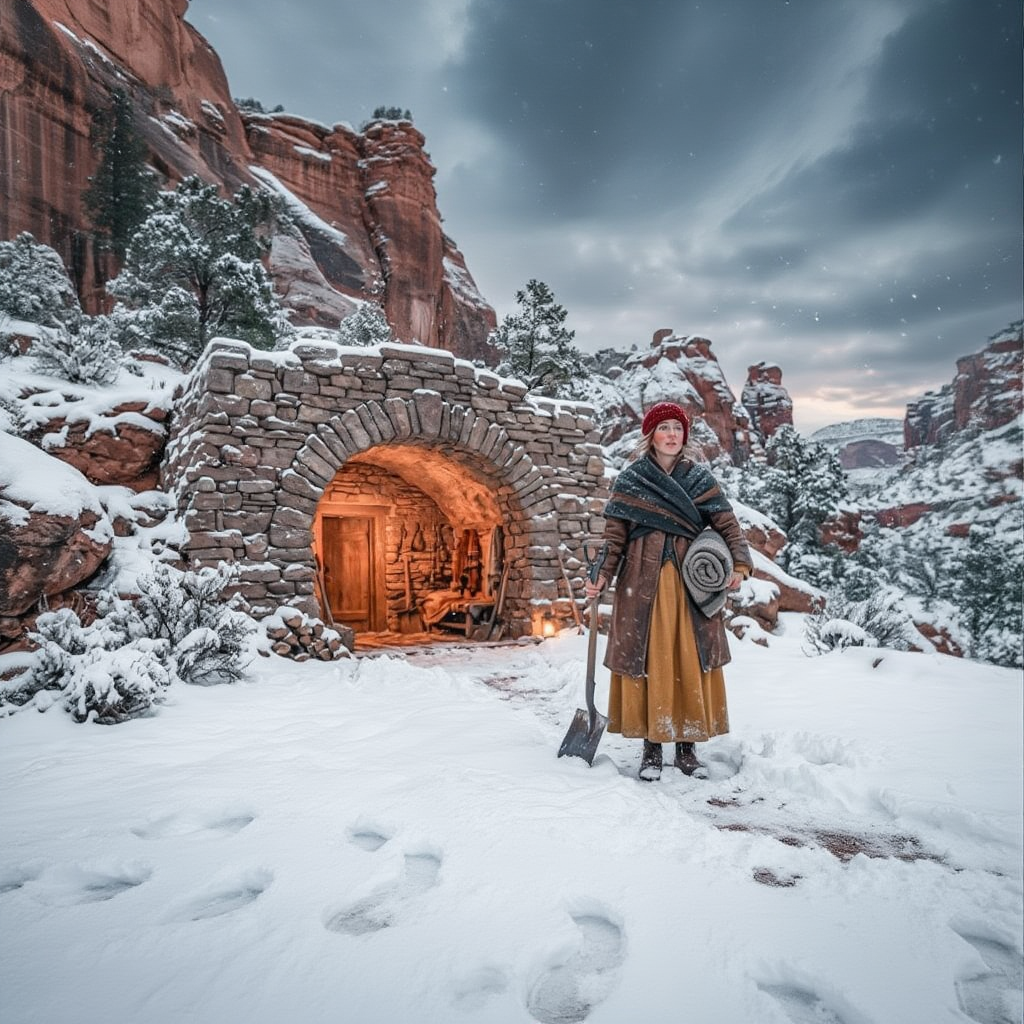
Their boots crunched through knee-deep snow until they reached the stone archway.
And there she stood.
Fair skin pink from warmth.
Red hat bright against the snow.
Long brown coat over her yellow dress.
A gray blanket folded over one arm.
A dark shovel in the other.
Standing before her stone home.
Behind her, a warm glow spilled from the wooden door.
No frost.
No fear.
No apology.
Just proof.
One rancher removed his hat.
Another muttered—
“I’ll be damned.”
Old Martha Keegan only smiled.
“Told you.”
The first visitor came the next day.
Then another.
Then five more.
A young mother whose cabin leaked.
A trapper whose roof collapsed.
A carpenter whose children needed warmth.
Eleanor welcomed them all.
She showed them insulation with moss.
Heat storage with stone.
Wind-blocking entrances.
Underground food storage.
Natural spring collection.
And slowly, laughter turned into listening.
Mockery turned into respect.
Then respect turned into imitation.
By February, six families had started building stone shelters along the canyon walls.
By March, twelve.
By spring, Black Hollow had changed forever.
No longer dependent on mining cabins.
No longer terrified of eviction.
No longer owned by men in offices.
And at the center of it all…
A widow in a red hat.
Years later, travelers crossing northern Arizona would hear stories about the canyon village carved into sandstone.
About homes warm in winter and cool in summer.
About chimneys hidden in cliffs.
About gardens growing where snow once gathered.
And every guide would point to the first stone doorway.
The one beneath the tallest pine.
The one marked:
WHITMORE HOLLOW
And if visitors were lucky…
They’d find an older woman sitting by the doorway, wrapped in a brown coat, her red hat faded by years of snow and sun.
And when they asked how she built all this alone…
Eleanor Whitmore would smile.
Look toward the mountains.
And say—
“I didn’t.”
Then she’d touch the brim of her hat.
And whisper—
“Thomas just taught me how to keep digging.”