
Widow and Her Mother Dug a Hidden Wood-Drying Tunnel — The Blizzard Made It Their Only Hope
The first storm warning came on a wind so sharp it seemed to peel paint from wood.
In the high country of northern Montana, where winter never politely announced itself but instead arrived like a verdict, thirty-one-year-old Eleanor Hayes stood in the yard of her late husband’s homestead and watched the sky turn from pale blue to iron gray.
Snow was coming.
Not the kind children prayed for.
Not the kind that dusted rooftops and made postcards.
This would be a killer.
She knew it in her bones.
Beside her, her mother, Margaret Whitmore, wrapped her green wool shawl tighter around narrow shoulders that age had not managed to bend.
“Three days,” Margaret said quietly.
Eleanor glanced at her.
“You sure?”
Margaret looked west, toward the mountains.
“I was born in these valleys. I know the color of death when it’s gathering.”
Neither woman spoke after that.
There wasn’t much left to say.
Two years earlier, Eleanor had buried her husband, Samuel Hayes, beneath a cottonwood tree overlooking the creek. A logging accident had taken him in less than a minute.
One falling pine.
One wrong step.
One widow left with forty acres of unforgiving land.
Most folks in Bitterroot County had assumed Eleanor would sell.
A young widow with no children and no brothers nearby.
What chance did she have?
Then Margaret had arrived with one suitcase, one mule, and enough stubbornness to outlive common sense.
And somehow…they’d stayed.
Barely.
The first winter after Samuel’s death had nearly ended them.
Wet firewood.
Frozen stove pipes.
Rotting timber.
Half their woodpile had turned useless before Christmas.
By February they’d been burning furniture.
By March they’d nearly starved.
That spring, Eleanor swore she would never let winter corner them again.
She just didn’t know how.
Until one afternoon in June.
Until her mother disappeared underground.
—
“Mother!”
Eleanor dropped the bucket of creek water and ran toward the old root cellar.
Margaret’s boots stuck halfway out of a collapsed section of dirt behind the barn.
For one horrifying second Eleanor thought the earth had swallowed her.
Then came Margaret’s muffled voice.
“Stop yelling and pull.”
Eleanor grabbed both boots and yanked.
With a grunt, Margaret emerged covered head to toe in dirt, gray hair filled with straw and clay.
But instead of fear—
She was smiling.
And Eleanor knew that smile.
It meant trouble.
“Mother…”
Margaret brushed dirt off her dress.
“Come look.”
Eleanor followed reluctantly into the half-collapsed trench.
Below the barn’s foundation was a hollow corridor of stone and old cedar beams, running farther than Eleanor expected.
She frowned.
“What is this?”
Margaret crouched, touching the cool earth.
“Your grandfather built freight tunnels under his tobacco sheds back in Virginia.”
Eleanor crossed her arms.
“This isn’t Virginia.”
“No.”
Margaret looked up.
“It’s colder.”
Then she smiled wider.
“Which means it’ll work even better.”
—
At first, the idea sounded insane.
Digging a tunnel…in mountain clay…by hand…with two women and one mule.
But Margaret explained.
Wood didn’t dry because of heat.
Not really.
It dried because of moving air.
Steady temperature.
Controlled moisture.
Underground, insulated by earth, they could create a long drying tunnel where split firewood would cure faster than outdoors—and stay protected from snow.
If they built it right, warm air from their greenhouse could flow through it naturally.
No machinery.
No fuel.
No waste.
Just physics.
Eleanor stared.
“How do you know all this?”
Margaret shrugged.
“Because old women don’t waste time learning useless things.”
And that was that.
They started the next morning.
—
Summer became sweat.
Clay.
Blisters.
And splinters.
They dug before sunrise.
They dug after sunset.
They dug until fingernails cracked.
Until shoulders burned.
Until Eleanor’s hands bled through gloves.
Neighbors laughed.
Some openly.
Others from horseback.
“Building yourselves a grave?”
“Starting a mine?”
“Widows gone crazy!”
Margaret ignored every one of them.
Eleanor tried.
But some nights, lying awake beside the lantern, she wondered if they were right.
The tunnel grew slowly.
Ten feet.
Twenty.
Thirty.
Then fifty.
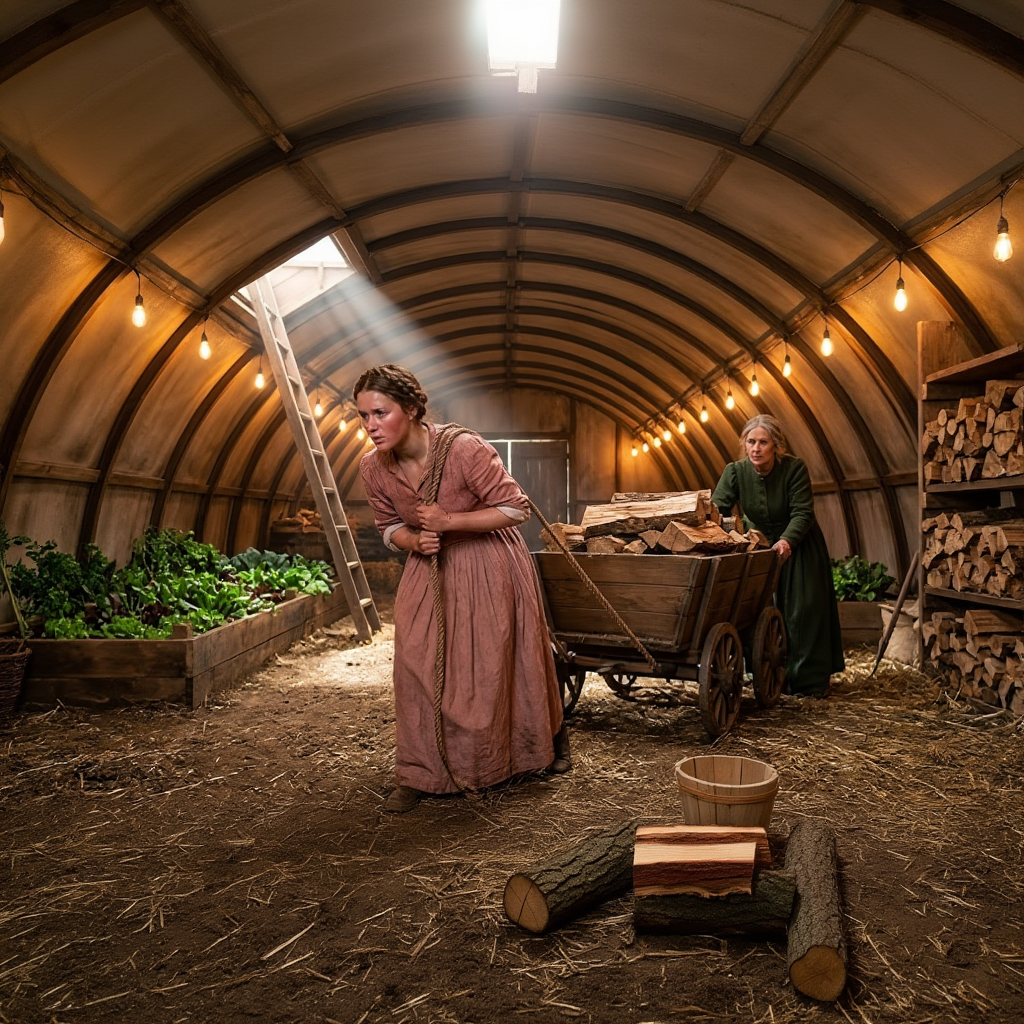
Arched cedar ribs held back the earth.
Salvaged greenhouse panels covered the upper section where sunlight could enter.
Shelves lined one wall.
Planters lined another.
Vent shafts rose toward the surface.
Margaret insisted on stringing lantern lights along the beams.
“Why?”
Eleanor asked.
Margaret smiled.
“Because if we’re going to survive underground, we might as well make it beautiful.”
—
By September…
It was finished.
A long earthen corridor stretching nearly eighty feet beneath the western slope.
Warm.
Dry.
Glowing.
Part greenhouse.
Part workshop.
Part hidden refuge.
Sunlight streamed through roof panels in golden shafts.
Wood racks climbed the walls.
Fresh spinach and kale grew in planter beds.
The floor was packed dirt layered with straw.
And at the center—
A heavy cart.
Built by Eleanor from Samuel’s old wagon parts.
Every day they hauled split wood into the tunnel.
Load after load.
Cart after cart.
By October, the shelves were full.
By November…
They had more dry wood than they’d ever owned.
And still, the neighbors laughed.
Until the blizzard came.
—
It arrived at night.
No warning.
No mercy.
The wind hit first.
Then snow.
Then darkness.
By dawn, the world was gone.
Windows disappeared behind white walls.
The barn vanished.
The fences vanished.
Even the mountains vanished.
Only wind remained.
And it screamed.
Eleanor forced the front door open three inches before snow blocked it completely.
She shoved with all her strength.
Nothing.
She looked back at Margaret.
“We’re trapped.”
Margaret sipped coffee.
“No.”
She pointed downward.
“We’re prepared.”
—
By noon, the chimney froze.
By evening, the stovepipe clogged.
By nightfall, the cabin temperature dropped below freezing.
Eleanor’s breath fogged the lantern glass.
Panic clawed at her ribs.
“What now?”
Margaret stood slowly.
She grabbed her coat.
“Now…”
She smiled.
“…we use the tunnel.”
—
The trapdoor beneath the pantry had been Margaret’s final addition.
Hidden under a rug.
Bolted.
Sealed.
Protected.
Eleanor pulled it open.
Warm air rose immediately.
Earth-scented.
Wood-scented.
Alive.
They climbed down.
And Eleanor stopped halfway.
Even after helping build it…
She still couldn’t believe it.
Lantern lights glowed from cedar beams.
Vegetables shimmered green under warm light.
Rows of perfectly dried firewood climbed the shelves.
The air moved softly through vent shafts.
And at the center…
Sunlight streamed diagonally through a roof opening like a blessing.
Margaret smiled.
“Home.”
—
For six days…
The blizzard buried the valley.
Roofs collapsed.
Livestock froze.
Roads disappeared.
Men with stronger farms than theirs ran out of wood.
Families burned fence posts.
One rancher slaughtered furniture.
Another nearly lost his children to frost.
But underground—
Eleanor and Margaret thrived.
They cooked.
They slept.
They worked.
They laughed.
They pulled heavy carts of firewood through the glowing tunnel.
Margaret pushed from behind.
Eleanor leaned into the rope over her shoulder, muscles straining, boots digging into straw-covered dirt.
Wood cracked in the stove.
Soup simmered.
Greens grew.
Lanterns glowed.
And for the first time since Samuel died…
Eleanor didn’t feel like she was surviving.
She felt like she was winning.
—
On the seventh day—
Silence.
The storm had passed.
Eleanor climbed out first.
The world was unrecognizable.
Snowdrifts stood twelve feet high.
Barn roofs had collapsed across the valley.
Trees snapped like matchsticks.
Smoke rose from desperate chimneys.
Then she heard shouting.
Neighbors.
Three men trudging through chest-deep snow.
One of them—the same man who’d laughed all summer—stopped dead when he saw Eleanor standing warm and smiling.
“How…”
He stared.
“How are you alive?”
Eleanor looked back toward the trapdoor.
Then at her mother climbing out behind her.
Margaret brushed straw from her dress.
Eleanor smiled.
“We planned ahead.”
The men followed them underground.
And for the first time in their lives…
They had nothing to say.
—
By spring…
The tunnel had a name.
Not from Eleanor.
Not from Margaret.
From the valley.
People called it:
The Widow’s Furnace.
Farmers came from counties away to see it.
Loggers studied the ventilation.
Builders copied the cedar arches.
Gardeners copied the planter beds.
And widows—
Widows came just to meet Eleanor.
To see what grief could become when it refused to die quietly.
—
Years later…
Children would run through that tunnel laughing.
Travelers would warm their hands by its stove.
And old men who once mocked two women with shovels would tell newcomers:
“You see that place?”
They’d point toward the hillside.
“Built by a widow and her mother.”
Then they’d lower their voices.
“Whole valley survived because folks laughed too soon.”
And deep underground…
Among cedar ribs, drying wood, glowing lanterns, and sunlight pouring through earth…
Two women kept building.
Because winter, they had learned…
Never beats those who prepare in secret.