
“We Want Her, Daddy!” The Mountain Man’s Twins Chose the Widow the Town Called ‘Too Wide to Wed’
The first time anyone heard the twins shout it, half the town turned to stare.
“We want her, Daddy!”
The words rang across the dusty street like a bell.
Elias Boone stopped mid-step, one boot still lifted from the ground. He looked down at the two small hands gripping his fingers—one on each side. His twins, Caleb and Josie, identical in their wild brown hair and stubborn eyes, were pointing across the road with perfect, determined alignment.
Toward Mary Holloway.
Mary froze beside the general store’s porch. A sack of flour rested against her hip, and her other hand clutched a coil of rope. She had heard them. Everyone had. Her cheeks flushed deep red as she realized exactly where those small fingers were pointing.
Toward her.
A murmur rippled through the gathered townsfolk.
Mary was used to murmurs.
She was used to the sideways glances, the hushed comments, the polite smiles that faded the moment she passed. Since her husband died three years earlier, she had become something of a quiet curiosity in Cedar Ridge. A widow with land. A widow who worked her own fields. A widow with broad shoulders, strong arms, and a figure the town women whispered about behind lace handkerchiefs.
Too wide to wed, they called her.
Not cruelly—never openly—but often enough.
Elias Boone followed the direction of his children’s pointing hands. He saw Mary standing stiffly, flour sack against her side, wind tugging loose strands of her dark hair. She wore a faded blue dress patched at the elbows, and dust clung to the hem. Her boots were scuffed from work, not town walking.
He had noticed her before.
Anyone with eyes had.
She moved like someone used to lifting feed sacks and splitting wood, not someone waiting to be chosen. She rarely spoke unless spoken to. When she laughed—which was rare—it came low and warm, surprising everyone.
Now she looked like she wished she could disappear.
Elias cleared his throat. “Kids…”
Josie tightened her grip. “We want her.”
Caleb nodded fiercely. “She smiled at us.”
Mary blinked. “I… did?”
“You helped me pick up my marbles,” Caleb explained loudly. “And you didn’t laugh when I dropped them again.”
Josie added, “And you fixed my ribbon.”
Mary instinctively touched her pocket. She still had the spare ribbon she carried for tying sacks. “That was nothing.”
But the twins shook their heads as if she’d done something heroic.
Elias felt half the town watching him. He was used to that too. A mountain man stepping into town always drew attention. His coat smelled faintly of pine smoke, his beard was thick and uneven, and a rifle rested casually across his shoulder. He had arrived in Cedar Ridge only two weeks earlier, bringing two children and very little explanation.
Rumors filled the gaps.
Widower. Trapper. Former soldier. Fugitive. No one knew for sure.
He crouched slightly to speak to his children. “You can’t just point at folks and say things like that.”
“But we chose her,” Josie insisted.
“Chose?” he repeated carefully.
“For our mama,” Caleb said.
The silence that followed was heavy.
Mary’s breath caught.
Someone coughed. Another woman whispered to her neighbor. The storekeeper suddenly found something fascinating on the floor.
Elias rubbed the back of his neck. “Kids…”
Josie stomped her foot. “You said we’d know when we found the right one.”
Elias had said that.
Late at night, when they asked why other children had mothers and they didn’t. When they asked why he looked tired all the time. When Josie cried quietly into his shoulder.
He had told them someday, maybe, they’d find someone kind.
He hadn’t expected them to decide so publicly.
Mary shifted awkwardly. “They’re just children.”
Caleb shook his head. “You’re strong. You carried two sacks.”
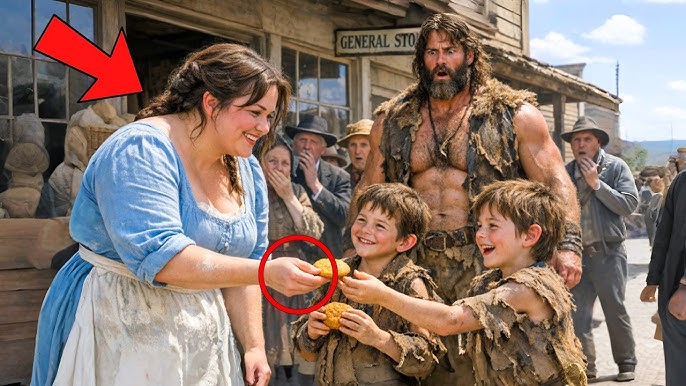
Mary almost laughed. “That’s not much.”
Josie leaned forward. “And you smell like bread.”
Mary blinked again. “That’s because I baked this morning.”
“That’s good,” Josie declared.
Elias exhaled slowly. “I’m sorry, Miss…?”
“Holloway,” Mary said quietly. “Mary Holloway.”
“Elias Boone.” He tipped his head slightly. “They don’t mean to embarrass you.”
“It’s… alright.” She shifted the flour sack. “Children speak honestly.”
“That they do,” he said.
The twins still stared at her with bright, hopeful eyes.
Mary felt something twist gently in her chest.
She had not been looked at like that in years.
Not judged. Not measured. Just… chosen.
“Well,” she said softly, “I should be getting home.”
The twins looked alarmed.
“Will we see you again?” Josie asked.
Mary hesitated. “I come into town most Saturdays.”
Caleb nodded firmly. “We’ll wait.”
Elias gave an apologetic smile. “We won’t block your path.”
Mary stepped around them, heart beating faster than she expected. As she passed, Josie slipped her small hand into Mary’s for just a second.
Warm. Trusting.
Then she let go.
Mary walked down the street feeling every eye on her back. But beneath the embarrassment, something else stirred—something she hadn’t felt since before her husband passed.
Hope.
—
Over the next week, the twins mentioned Mary constantly.
“She makes real bread.”
“She fixed Josie’s ribbon.”
“She didn’t look scared of you, Daddy.”
Elias pretended not to notice how those words lingered.
He had noticed.
Most women looked uncertain when they saw him. He was large, quiet, and carried the wilderness with him. Mary had looked startled—but not afraid.
That mattered.
On Saturday, the twins dragged him into town earlier than usual.
They spotted her first.
Mary stood beside the blacksmith’s well, drawing water into a bucket. The sun glinted on her dark hair. Her sleeves were rolled, revealing strong forearms dusted with flour.
“Daddy!” Josie whispered loudly.
Mary turned.
Her expression shifted from surprise to shy warmth. “Hello again.”
The twins ran to her.
“You came!” Caleb said, as if she might not.
“I said I would,” Mary replied.
Josie studied her. “You look tired.”
Mary laughed softly. “Harvest season.”
Elias approached more slowly. “Morning, Miss Holloway.”
“Mary,” she corrected gently.
“Mary.” He nodded. “They’ve been talking about you all week.”
She looked amused. “I hope only good things.”
“Only,” he said.
They walked together toward the store. Conversation came awkwardly at first, then easier. Mary told them about her chickens. The twins described the creek near their cabin. Elias listened, occasionally adding a quiet remark.
People watched.
They always did.
By the time they parted, the twins had secured a promise.
“Come see our place,” Josie insisted.
Mary hesitated. “I wouldn’t want to intrude.”
“You wouldn’t,” Elias said quietly. “We’re just outside town.”
She studied him. He seemed sincere, not pushy.
“I’ll bring bread,” she offered.
Josie clapped. “Then it’s decided.”
—
Mary arrived the next afternoon with two loaves wrapped in cloth.
The Boone cabin sat at the edge of the timberline, simple but sturdy. Smoke curled from the chimney. Chickens scratched near the fence.
The twins rushed out to greet her.
“You came!”
Elias stepped onto the porch, wiping his hands. “Welcome.”
Mary handed him the bread. “Peace offering.”
He inhaled the scent. “That’s worth more than gold.”
She laughed.
They spent the afternoon together. Mary helped Josie braid her hair. Caleb showed her a wooden horse Elias had carved. Elias repaired a loose step while listening to their chatter.
It felt… natural.
As the sun dipped, Mary prepared to leave.
Josie tugged her sleeve. “Stay for supper?”
Mary glanced at Elias.
“You’re welcome,” he said.
She stayed.
They ate stew around the small table. The twins talked nonstop. Mary laughed more than she had in years. Elias watched quietly, something softening in his expression.
After supper, Mary rose. “I should head back before dark.”
Josie’s face fell. “Will you come again?”
Mary knelt. “If your father allows.”
Elias met her eyes. “Anytime.”
She nodded, cheeks warm.
—
The visits became regular.
Mary brought pies. Elias chopped extra wood for her. The twins grew attached quickly, clinging to her skirts, asking for stories, falling asleep against her shoulder.
Town whispers grew louder.
“She’s getting ideas.”
“He could do better.”
“She’s too big for him.”
Mary heard them all.
One evening, she stopped coming.
A week passed.
The twins grew restless.
“Why isn’t she here?” Josie asked.
Elias suspected the reason. He had heard the whispers too.
“I’ll go see,” he said.
He rode to Mary’s ranch at dusk. She stood in the yard, hauling water. She looked surprised to see him.
“Everything alright?” he asked.
“Yes.”
“You haven’t come.”
She stared at the bucket. “People talk.”
“They always do.”
“They say I’m… not suitable.” Her voice was tight.
Elias studied her. “You believe them?”
She shook her head. “But your children deserve someone better.”
“They chose you,” he said simply.
She looked up.
“And I’m not arguing,” he added.
Mary’s breath caught.
“You’re kind,” he continued. “You work harder than anyone I’ve met. And my kids… they’re happier when you’re around.”
She swallowed. “And you?”
He hesitated, then answered honestly. “So am I.”
Silence stretched.
“You don’t think I’m… too wide?” she asked quietly.
He shook his head. “I think you’re strong enough to carry a life. That matters more.”
Tears filled her eyes.
Behind them, small voices rang out.
“We found you!”
The twins ran from behind the wagon—they had followed him.
Josie threw her arms around Mary. “We want her, Daddy!”
Caleb echoed, “We still do!”
Mary laughed through tears.
Elias looked at her gently. “So… will you come back?”
She nodded. “Yes.”
The twins cheered.
And under the fading sky, the widow the town called “too wide to wed” realized she had finally been chosen—not despite who she was, but because of it.