
The divorce papers were still warm when Daniel Harper leaned back in his leather chair and smiled.
He had rehearsed the moment in his mind for months. The office overlooked downtown Cedar Ridge, a small Colorado town that had grown just enough to make a man like him feel important. Glass windows. Framed business awards. A polished desk that reflected the overhead lights like still water. Everything in the room said success.
Everything in the room said he had won.
“She signed?” he asked without looking up.
His lawyer nodded. “Everything. The house, the savings, the vehicles, the company shares. You keep it all. She agreed to a lump settlement.”
Daniel chuckled. “Settlement. That’s generous.”
“Five thousand dollars isn’t much, Daniel.”
“It’s more than she deserves,” he said, finally glancing up. “She never understood business. She never contributed.”
The lawyer hesitated. “She helped you build the first location.”
Daniel waved his hand. “She waited tables. Anyone could’ve done that.”
But he remembered. Of course he did. Emily had stood beside him when Harper’s Grill was nothing but a rented diner space with flickering lights and a broken freezer. She had worked double shifts, smiling at customers even when their tips were coins. She had learned recipes, balanced books, scrubbed floors.
Back then, she believed in him.
Now she walked away with five thousand dollars and two suitcases.
Daniel felt nothing.
“She’ll be fine,” he added, dismissing the thought. “She always lands somewhere.”
He signed the final document and slid it back. The pen clicked shut with a satisfying snap. A chapter closed.
Outside, the world moved on.
Emily Harper didn’t cry when she left.
She carried her bags down the courthouse steps while people passed her without noticing. The sky was wide and pale, the kind that made everything feel quiet. Her phone buzzed once—bank notification. The transfer had arrived.
$5,000.00.
Ten years of marriage. Reduced to a number.
She exhaled slowly. She had expected worse.
Daniel had already emptied their joint account weeks ago. The house was gone. The car she had driven for years now belonged to him. Even the cookware she loved had been itemized in the divorce list.
But she still had something.
Freedom.
She rented the cheapest motel she could find on the edge of town. The room smelled faintly of detergent and dust. The bed sagged in the middle. Outside, trucks roared along the highway.
Emily sat on the bed and opened her notebook.
She had carried it for years. Inside were recipes, ideas, scribbled floor plans, notes about customer service, sketches of menus. She had started writing them during the early days of Harper’s Grill.
Daniel never looked at it.
“This is cute,” he once said, flipping through it. “But real restaurants don’t run on dreams.”
She had smiled back then. Now she turned the pages carefully.
Her fingers stopped at a drawing.
A small restaurant. Brick exterior. Big windows. Warm lights. A chalkboard menu. Underneath she had written: Simple food. Honest prices. Everyone welcome.
She stared at the page.
Her heart began to beat faster.
The next morning, Emily walked.
She walked past the busy downtown cafes she couldn’t afford. Past trendy brunch spots. Past polished storefronts filled with customers. She kept walking until the sidewalks cracked and weeds pushed through concrete.
Then she saw it.
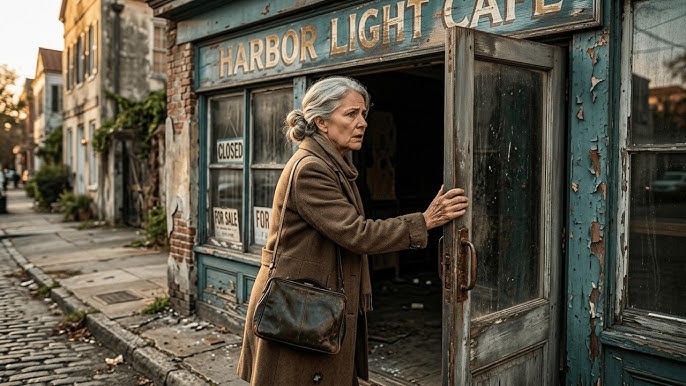
The building sat on the corner of Maple and Third. The sign above the door hung crooked, letters faded almost white. The windows were dusty. A paper notice curled at the edge of the glass.
FOR SALE — AS IS
Emily stepped closer.
Inside, she saw overturned chairs, a long counter, and a kitchen dark with silence. The place looked forgotten, like time had stopped mid-shift and never returned.
Her pulse quickened.
She pressed her hand to the glass.
This wasn’t the polished restaurant she had imagined. It was smaller. Rougher. But she could see it—the lights on, people laughing, the smell of coffee, the sound of plates.
She called the number on the sign.
The owner arrived an hour later, a tired man named Carl with a sunburned neck and a ring of keys.
“Been closed two years,” he said, unlocking the door. “Roof leaks. Freezer’s dead. Plumbing’s temperamental.”
Emily stepped inside.
Dust lifted with each step. But the layout was perfect. Ten tables. Long counter. Compact kitchen. She could manage it alone if needed.
“How much?” she asked.
Carl scratched his beard. “Nobody wants it. Town’s moved east. I’d let it go for five grand.”
Emily blinked.
“All… five thousand?”
He shrugged. “Cash. You take responsibility. No complaints later.”
Her fingers tightened around her notebook.
This was everything she had.
Every dollar.
If she failed, she’d have nothing.
She looked around again.
Then she smiled.
“I’ll take it.”
Daniel first heard about it three weeks later.
He was at Harper’s Grill, shaking hands with investors for a second location. The restaurant buzzed with customers, waiters moving fast. He thrived in the noise.
Then his manager leaned in. “You hear about Emily?”
Daniel frowned. “Why would I?”
“She bought that old diner on Maple. The abandoned one.”
He laughed.
“Emily? Bought a restaurant?”
“Yeah. Word is she’s fixing it herself.”
Daniel shook his head. “That place is a dump. She’ll burn through that money in a week.”
“Maybe.”
Daniel dismissed it. “She doesn’t know what she’s doing.”
But later that night, curiosity pulled at him.
He drove past Maple Street.
Lights glowed inside the building.
He slowed.
Emily stood on a ladder, painting the wall. Her hair was tied back, streaks of white across her cheek. A small radio played faintly. The sign above the door now read:
Second Chance Café
Daniel stared.
She was alone.
No contractors. No staff. Just her.
He smirked and drove away.
“She won’t last,” he muttered.
Emily worked eighteen-hour days.
She cleaned grease from the kitchen with aching hands. She patched the roof with borrowed tools. She painted tables. Rewired lights. Scrubbed floors until the tiles shone again.
Money disappeared quickly.
She bought used chairs from a closing diner. A second-hand coffee machine. Discount plates mismatched in color.
When she ran out of funds, she improvised.
She sanded old tables instead of replacing them. Sewed curtains from thrift-store fabric. Painted the menu board herself.
Neighbors began to notice.
An old mechanic fixed her sink for free.
A bakery donated leftover bread.
A teenager offered to help in exchange for meals.
The place slowly transformed.
Opening day arrived quietly.
No grand advertising. Just a hand-painted sign:
OPEN — Home Cooking
The first customer was a truck driver.
“What’s good?” he asked.
Emily smiled. “Everything’s fresh.”
He ordered eggs, bacon, and coffee.
He came back the next day.
Then two construction workers stopped in.
Then a retired couple.
Word spread.
The food was simple but warm. Prices were fair. Emily remembered names. She listened. She laughed. She stayed late.
Within a month, every table filled at breakfast.
Two months later, lunch lines reached the door.
Daniel noticed when his own morning traffic dipped.
“Where are people going?” he asked his manager.
“Second Chance Café,” she replied.
He scoffed. “Impossible.”
But the numbers didn’t lie.
One afternoon, he walked in.
The bell above the door rang.
Emily looked up.
Their eyes met.
She froze for half a second—then smiled politely. “Table for one?”
Daniel glanced around. Every seat was filled. People laughed. Plates clinked. The place felt alive.
He sat at the counter.
“You did all this?” he asked quietly.
“Mostly,” she said, pouring coffee.
He took a sip.
It was perfect.
“How?” he asked.
She shrugged. “I remembered what mattered.”
He looked at her. She seemed lighter. Stronger. Not the woman he had dismissed.
“You risked everything,” he said.
“I already had nothing,” she replied gently.
The words landed harder than he expected.
He left without finishing his meal.
Six months passed.
Second Chance Café became the heart of Maple Street. New shops opened nearby. Traffic returned. The neighborhood revived.
Emily hired staff—people who needed work. A single father. A college student. A woman rebuilding her life.
Daniel watched from a distance.
Harper’s Grill still succeeded, but something felt different. Customers came and left. No one lingered. No one laughed the same way.
One evening, a storm hit Cedar Ridge.
Rain poured. Power flickered.
Daniel’s restaurant lost electricity. He closed early, frustrated.
As he drove home, he saw lights glowing on Maple.
Second Chance Café ran on a small generator. Inside, people gathered—neighbors, families, stranded drivers. Emily served soup by candlelight.
The place looked like a beacon.
Daniel parked across the street and watched.
He finally understood.
He hadn’t left her with nothing.
He had left her with herself.
And that was more dangerous than any amount of money.
A year later, Emily opened a second location.
Not downtown.
But another forgotten corner.
Daniel attended the opening quietly.
When she saw him, she walked over.
“You didn’t have to come,” she said.
“I wanted to,” he replied.
He looked around. Warm lights. Familiar energy.
“You built something real,” he admitted.
Emily smiled. “So did you. Just… differently.”
He nodded slowly.
“Do you regret it?” he asked.
She thought for a moment.
“No,” she said. “Losing everything forced me to find what I actually needed.”
He exhaled.
For the first time, Daniel Harper realized something uncomfortable.
He had taken her house.
Her savings.
Her security.
But he had never owned her strength.
And when she spent her last dollars on a broken restaurant, she didn’t lose.
She finally began.
He thought he left her with nothing.
But he had unknowingly given her the one thing she needed most—
A second chance.