
Thrown Out After the Funeral, She Built Into a Hillside — The Blizzard Couldn’t Find Her
The wind started whispering the day they buried Thomas Hale.
It wasn’t loud—not yet. Just a low, restless murmur threading through the pine trees that ringed the valley, like something waiting for its moment. Most people didn’t notice it. They were too busy watching Eleanor Hale stand alone beside the grave.
She wore black, but not the polished, elegant kind. Her coat was worn thin at the cuffs, her gloves mismatched. A widow before fifty, though grief had carved deeper years into her face. The townspeople kept their distance, offering soft condolences that floated away like breath in cold air.
Thomas had been well-liked. A quiet man, a steady worker. But the land—his land—was another matter.
After the last shovel of dirt fell, Eleanor didn’t cry. She just stood there, her eyes fixed on the fresh mound as if memorizing it. As if she understood something no one else did.
By sunset, the whispering wind grew sharper.
And by morning, she was gone.
“You can’t stay here.”
The words came from Martin Hale—Thomas’s younger brother. He stood in the doorway of the cabin, arms folded, his boots planted like stakes in the earth.
Eleanor didn’t argue.
She stood inside what had been her home for twenty-three years, her hands resting on the back of a chair Thomas had built. The fire in the hearth had gone cold overnight.
“This was Thomas’s place,” Martin continued, not meeting her eyes. “And now… well. You know how it works.”
She did.
No children. No written will. The land passed to blood, not marriage.
To him.
“I’ll be out by noon,” Eleanor said quietly.
Martin nodded, relief flickering across his face before he masked it. “There’s a wagon in town heading east. You could—”
“I won’t be going east.”
He hesitated. “Then where?”
Eleanor finally looked at him.
“Somewhere the wind can’t follow.”
By noon, everything she owned fit into two canvas sacks and a wooden crate.
Most of it wasn’t clothing.
It was tools.
A hatchet with a worn handle. A rusted shovel. Nails sorted into small tins. A coil of rope. A hand drill Thomas had once repaired with careful patience.
And food.
Dried beans. Salted meat. A sack of flour tied tight against moisture.
She left the cabin without looking back.
The valley stretched wide and open, framed by mountains that turned blue in the distance. Winter had already begun creeping down from the peaks. Frost clung stubbornly to the grass, and the sky carried that pale, metallic color that meant snow was coming—soon, and heavy.
Most people would have followed the road out.
Eleanor didn’t.
She turned toward the hills.
The hillside she chose wasn’t obvious.
It sat beyond a line of crooked birch trees, where the land rose unevenly into a slope of packed earth and stone. To most, it looked like poor ground—too rocky for farming, too steep for building.
But Eleanor saw something else.
Shelter.
The slope faced south, catching what little winter sun remained. A cluster of large boulders broke the wind’s path, creating a natural barrier. And the earth—when she drove the shovel into it—held firm but not impossible.
She set her crate down.
“This will do,” she murmured.
The wind, still whispering, curled around the hill as if listening.
The first night was the hardest.
She built a small fire between stones and wrapped herself in blankets that barely kept the cold from biting through. Every sound felt louder in the open—the crack of branches, the distant howl of something unseen.
Sleep came in fragments.
But morning came, too.
And with it, purpose.
Eleanor began to dig.
Not straight down—but into the hillside.
She worked slowly, carving a narrow entrance just wide enough to crawl through. The soil was stubborn, threaded with roots and rocks that resisted every inch. Her hands blistered, then hardened. Her back ached until it felt like part of the earth itself.
She didn’t stop.
By the third day, she had a shallow hollow—barely a cave. Just enough to sit inside, shielded from the wind on three sides.
She reinforced the entrance with branches and packed dirt around them, shaping the opening so it angled downward slightly.
Thomas had once told her, “Cold air sinks. If you let it fall away from you, you’ll stay warmer.”
She remembered everything he had ever said.
The town buzzed with talk of the coming storm.
“They’re saying it’ll be the worst in years.”
“Maybe decades.”
“Snow up to the rooftops.”
Martin Hale heard it all. And sometimes—late at night—he thought about the woman he had turned away.
“She won’t survive out there,” someone said at the general store.
Martin didn’t answer.
But the thought stayed with him.
On the hillside, Eleanor kept building.
She widened the chamber, inch by inch, until she could lie down fully inside. She carved a second, smaller pocket into the side wall—a place to store food, raised slightly above the ground to keep it dry.
She lined the floor with pine needles, then covered them with a rough layer of boards she’d salvaged from an abandoned fence.
Every detail mattered.
Every mistake could kill her.
The wind stopped whispering.
It began to howl.
The storm arrived without mercy.
Snow fell in thick, relentless sheets, swallowing the landscape in hours. The valley disappeared beneath white. Paths vanished. Fences sank. The sky and earth blurred into one endless storm.
In town, doors were barred. Fires burned day and night. People huddled together, listening to the wind slam against walls like a living thing.
Martin stood at his window, staring toward the hills.
He couldn’t see them anymore.
Only white.
Inside the hillside, Eleanor lay still.
The entrance to her shelter had been sealed—not by her, but by the storm itself. Snow packed against the angled opening, forming a dense barrier that blocked the wind completely.
Inside, the air was still.
Quiet.
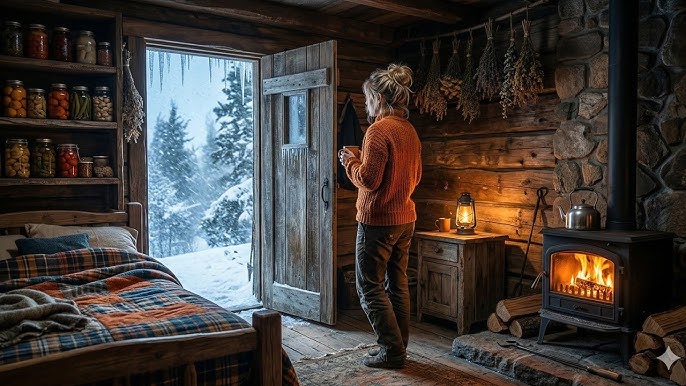
She lit a small candle, its flame steady and golden in the darkness.
Her breath fogged faintly, but the cold was… manageable.
The earth around her held the day’s warmth. The narrow space trapped it, preventing it from escaping. Her body heat added to it.
She listened.
No howling wind.
No snapping branches.
Just silence.
“The blizzard can’t find me,” she whispered.
Days passed.
Or maybe weeks.
Time lost its shape in the dim glow of candlelight and the slow rhythm of survival.
She rationed her food carefully. Melted snow in a tin cup over a tiny flame. Slept when her body demanded it, waking to check the air, the walls, the fragile balance she had built.
Once, she heard something outside—a distant roar as part of the hillside shifted under the weight of snow.
Her heart pounded.
But the shelter held.
In town, supplies began to run low.
The storm didn’t stop.
Roofs groaned under the weight. One barn collapsed. A man nearly froze trying to reach his livestock.
“Never seen anything like it,” people muttered.
Martin stopped sleeping well.
Every time the wind screamed, he thought of her.
Alone.
Buried.
Gone.
When the storm finally broke, it did so suddenly.
The wind died.
The sky cleared.
And the valley emerged—transformed.
Snow lay deep and heavy, reshaping the land into unfamiliar curves and mounds. Trees bent under the weight. Paths had to be carved anew.
People stepped outside cautiously, blinking in the harsh sunlight reflecting off endless white.
“We made it,” someone said.
But not everyone had.
Martin waited two days.
Then three.
On the fourth, he couldn’t take it anymore.
“I’m going up there,” he told the men at the store.
“Up where?”
“The hills.”
They exchanged looks.
“You’re wasting your time.”
“Maybe,” he said.
But he went anyway.
The climb was brutal.
Snow reached his thighs in places. The cold bit through his coat. More than once, he nearly turned back.
But something pulled him forward.
Guilt.
Or something like it.
He found the place by accident.
A slight dip in the snow. A curve that didn’t match the natural slope.
He knelt, brushing away the top layer.
His hand struck something solid.
Wood.
“Eleanor?” he called.
No answer.
He dug faster, heart hammering.
“Eleanor!”
Inside, Eleanor heard a faint sound.
A dull, distant thud.
She froze.
Then came a voice—muffled, uncertain.
Her breath caught.
“Eleanor!”
She crawled toward the entrance, her hands shaking as she pushed against the packed snow.
“Here!” she called, her voice hoarse. “I’m here!”
The moment the opening broke, light flooded in.
Blinding.
Cold.
Alive.
Martin stared at her, disbelief written across his face.
“You… you’re—”
“Alive?” she said, a faint smile touching her lips. “Yes.”
He sank back onto his heels, stunned.
“How…?”
Eleanor glanced at the hillside around them.
“I built where the storm couldn’t reach,” she said.
They returned to town together.
People stared.
Some in shock.
Some in something quieter—respect.
The woman they had pitied… had outlasted them all.
Weeks later, when the snow began to melt, Martin stood beside her on the hillside.
“I was wrong,” he said.
Eleanor didn’t answer.
“This land… Thomas would’ve wanted you to have it.”
She looked at him then.
“You don’t owe me anything,” she said.
“I know,” he replied. “That’s why it matters.”
She stayed on the hillside.
But she didn’t stay hidden.
The shelter grew—expanded into something more permanent. Others came to see it, to learn from it. A place born from loss became a place of quiet strength.
And when the wind returned—soft, whispering through the trees—
It no longer sounded like a warning.
It sounded like a memory.
One she had survived.
Thrown Out After the Funeral, She Built Into a Hillside — The Blizzard Couldn’t Find Her
Part 2: The Valley That Came to Learn
Spring did not arrive all at once.
It crept in—slow, uncertain, like a guest unsure if it was welcome after what winter had done.
The snow softened first. Then it sagged. Then it began to vanish, revealing the valley beneath in patches of brown and green that looked almost fragile. Fences leaned where they had been crushed. Roofs still bore scars. The land, like the people, was alive—but changed.
And on the hillside, Eleanor Hale kept building.
Her shelter no longer looked like a desperate hole carved into the earth.
It had become something intentional.
The entrance was reinforced with thick timber beams salvaged from old structures in the valley. A second chamber had been carved deeper into the hill, wider and more stable, with a carefully shaped ceiling that curved just enough to prevent dripping as the frozen soil thawed.
She had even built a small vent—angled upward through the hillside—to let smoke escape from her modest cooking fire without letting the cold air rush in.
It wasn’t pretty.
But it was brilliant.
And people had started to notice.
The first visitor was a boy.
No more than ten, thin as a branch, with eyes that darted everywhere like he expected the world to collapse again at any moment.
He stood a few yards from the entrance, unsure.
Eleanor saw him before he spoke.
“You’re not lost,” she said, stepping out into the sunlight.
He startled, then shook his head. “My pa sent me.”
“Did he?”
“He said… he said you lived through it.” The boy hesitated. “The storm.”
Eleanor studied him for a moment.
“I did.”
He looked at the hillside, then back at her. “How?”
She didn’t answer right away.
Instead, she gestured toward the entrance.
“Come see.”
Word spread faster after that.
In small towns, it always does.
By the end of the week, three more people had come. Then five. Then a dozen over the next month.
Farmers. Mothers. Men who had nearly lost everything when the storm sealed them inside their homes for days with dwindling supplies.
They came with questions.
Eleanor gave them something better.
She showed them.
“You don’t fight winter,” she said one afternoon, kneeling beside a half-finished excavation while a small group watched. “That’s where most people go wrong.”
A man crossed his arms. “So we just… hide from it?”
She shook her head.
“You prepare for it. You use what the land gives you instead of trying to stand against it.”
She drove the shovel into the hillside.
“The earth doesn’t freeze the same way the air does. It holds heat. Even when everything above is dead cold.”
She carved out another section, then stepped back.
“If you build into it—correctly—you create a space the wind can’t touch.”
The group was silent.
They weren’t just listening.
They were understanding.
Martin came often.
At first, he kept his distance, watching from the edge of the gatherings like a man unsure of his place.
But one morning, Eleanor handed him a shovel.
“You’re going to wear a hole in the ground just standing there,” she said.
He almost smiled.
Almost.
From that day on, he worked beside her.
Guilt is a heavy thing.
He carried it in the way he avoided her eyes sometimes. In the way he took on the hardest tasks without being asked. In the quiet way he stayed late after others left, reinforcing beams or hauling stones.
One evening, as the sun dipped low and painted the hillside gold, he finally spoke what had been sitting in his chest.
“I thought I was doing what was right.”
Eleanor didn’t stop working.
“I know.”
“I didn’t think…” He swallowed. “I didn’t think you’d survive.”
This time, she paused.
“No,” she said softly. “You didn’t.”
The truth hung between them—not sharp, but solid.
“I’m sorry,” he said.
Eleanor nodded once.
And that was enough.
By early summer, the hillside had transformed.
What had once been a single hidden shelter was now a small network of earth-built spaces—each one slightly different, shaped by the hands and needs of the people who built them.
Some were simple.
Others more elaborate, with reinforced walls, storage niches, and raised sleeping platforms.
They weren’t homes in the traditional sense.
They were something else.
Something smarter.
The valley changed with them.
People started storing more food before winter. They reinforced their homes differently—lower, stronger, less exposed to the wind.
They watched the land more carefully.
Respected it.
And always, they looked to the hillside.
To the woman who had seen what they hadn’t.
Late one afternoon, a wagon arrived.
Not from their town.
From beyond the ridge.
Two men climbed down, their coats dusty from travel, their faces drawn with the kind of exhaustion that didn’t come from a single journey—but from many hard days strung together.
“Which one of you is Eleanor Hale?” one of them asked.
She stepped forward.
“I am.”
He looked at her, then at the hillside behind her.
“They said you built something that could survive a blizzard.”
“I did more than survive,” she replied.
A flicker of something—hope, maybe—passed across his face.
“Our town…” He hesitated. “We lost people this winter. More than we should have.”
Eleanor didn’t look away.
“We weren’t ready,” he admitted. “But we want to be.”
The second man spoke, quieter. “We heard about you.”
A long silence followed.
Then Eleanor nodded.
“I’ll show you.”
She traveled with them a week later.
It was the first time she had left the valley since Thomas died.
The road felt different now.
Not like something that took her away—but something she chose to walk.
The town beyond the ridge was smaller. Harder.
The kind of place where survival had always been a struggle—but winter had turned that struggle into something cruel.
Eleanor saw it in the way people watched her arrive.
Not with curiosity.
With need.
She stayed for two months.
Teaching.
Digging.
Building.
The same way she had on her own hillside—one careful step at a time.
Some people doubted her.
At first.
But doubt doesn’t last long when faced with quiet certainty.
And Eleanor Hale had that in abundance.
When she returned home, the valley greeted her differently.
Not just as someone who had survived.
But as someone who had changed things.
The hillside was alive with activity.
New faces. New structures. New ideas taking shape in the earth.
Martin met her at the base of the slope.
“You’ve been busy,” she said.
He rubbed the back of his neck. “Tried to keep up.”
She looked at the work—at the care in it.
“You did more than that.”
That night, for the first time in a long while, Eleanor allowed herself to rest.
Not the kind of rest that comes from exhaustion.
But the kind that comes from knowing something has taken root.
Something that will last.
The wind returned in the fall.
Soft at first.
Then sharper.
Carrying with it the promise of another winter.
But this time, the valley did not fear it.
They prepared.
They built.
They remembered.
On the first night of snowfall, Eleanor stood at the entrance of her hillside home.
The sky was heavy with clouds. The air still.
Waiting.
Martin stepped up beside her.
“Do you think it’ll be as bad?” he asked.
Eleanor watched the first flakes drift down.
“It might be worse,” she said.
He exhaled slowly.
Then nodded.
“Good,” he replied.
She glanced at him, surprised.
He gave a small, steady smile.
“We’re ready this time.”
Snow began to fall in earnest.
Covering the ground.
Soft.
Silent.
Relentless.
But beneath the surface—hidden from the storm—was a different kind of strength.
Built not from fear.
But from understanding.
Eleanor stepped inside her shelter, the warmth of the earth wrapping around her like a quiet promise.
The wind rose.
The blizzard came.
But it no longer mattered.
Because this time—
It wasn’t just one woman the storm couldn’t find.
It was an entire valley.