
They Called Her Breeding Stock — So Her Brother Sold Her for $600 to the Rich Giant Rancher
The first time Lila Mae Carter heard the words, she pretended she hadn’t.
“Strong hips,” one of the men said, leaning against the fence as she hauled water from the well. “Good for breeding stock, if you ask me.”
They laughed.
Lila didn’t turn around. She kept walking, the bucket sloshing against her skirt, her knuckles white from gripping the handle too tightly.
She told herself they were just words.
But words had a way of sticking—especially when they came from people who thought you were worth less than a mule.
Her brother, Caleb, didn’t correct them.
That was what hurt the most.
He stood nearby that day, mending a broken gate, his head bent low. He didn’t laugh—but he didn’t say a word either. Not when the men made their jokes. Not when they looked her up and down like she wasn’t even human.
Later that night, Lila sat across from him at the small wooden table in their cabin.
“You heard them,” she said quietly.
Caleb didn’t look up from his plate. “Men talk.”
“They weren’t talking about cattle.”
“They weren’t buying cattle either,” he replied, sharper now. “You think I don’t know that?”
Silence settled between them like dust.
The farm had been failing for years. Ever since their father died, debts had piled up faster than crops could grow. The soil had turned stubborn. The seasons harsher.
They were surviving.
Barely.
“You’re all I’ve got left,” Lila said, her voice softer now.
Caleb’s jaw tightened.
“And I’m trying to keep it that way.”
Two weeks later, he sold her.
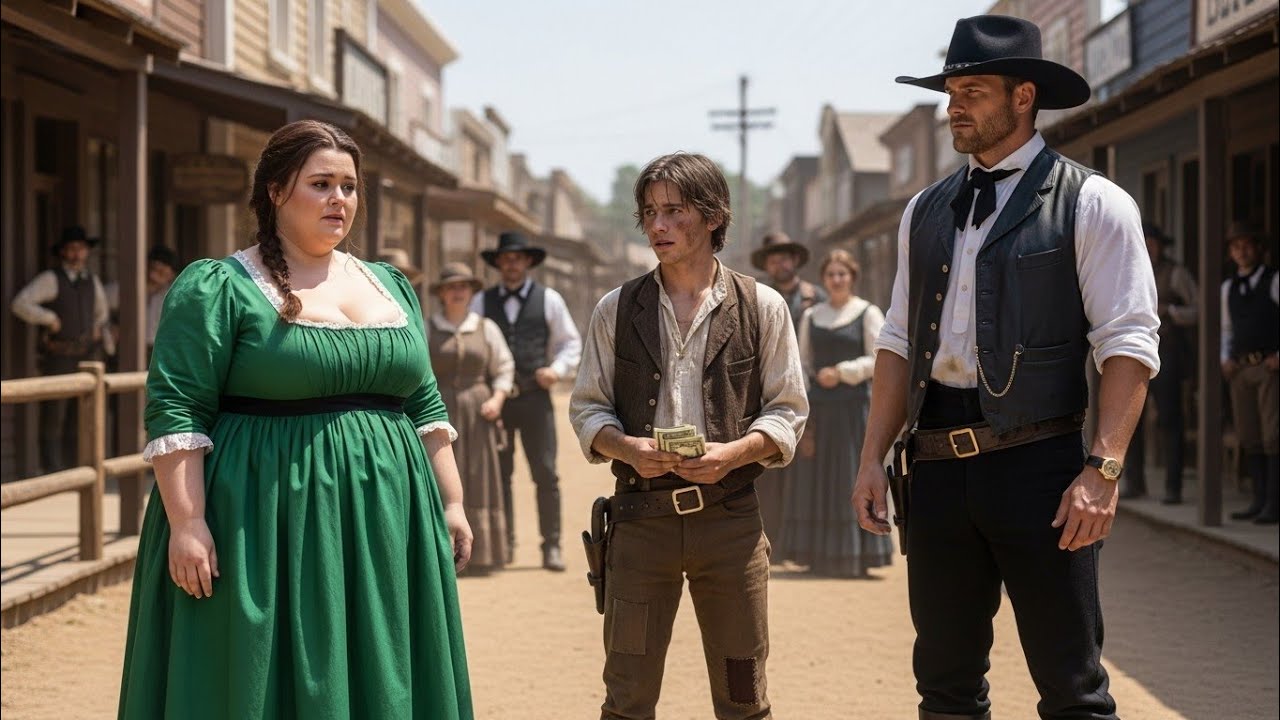
Lila didn’t know until the wagon arrived.
It was bigger than anything that had ever come down their dirt road—wide wheels, polished wood, pulled by two massive draft horses that snorted clouds into the cold morning air.
A man climbed down.
No—stepped down.
He was enormous.
Tall enough that he had to duck under the low branch near the gate. Broad enough that his shadow seemed to swallow the ground around him. His coat was clean, well-made. His boots barely marked by mud.
He looked like he belonged to a different world.
Lila stood frozen in the doorway.
Caleb stepped outside to meet him.
They spoke in low voices. Too low for her to hear. But she didn’t need to hear the words.
She saw the exchange.
A small pouch.
Coins.
Heavy enough that Caleb’s hand dipped slightly when he took it.
Her stomach turned cold.
“No.”
The word left her before she could stop it.
Both men turned.
Caleb’s face hardened. “Go pack your things.”
“I’m not livestock,” she said, louder now. “You can’t just—”
“I already did.”
The words hit harder than a slap.
Lila stared at him.
“You sold me?”
His eyes flickered, just for a second.
Then he nodded.
“Six hundred dollars,” he said. “It’ll save the farm.”
“What about me?”
He didn’t answer.
The giant rancher stepped forward.
His voice, when he spoke, was surprisingly calm.
“You’ll be treated well,” he said.
Lila laughed—a sharp, broken sound.
“That’s what they say about animals too.”
Something shifted in his expression. Not anger. Not quite.
Something… thoughtful.
“I don’t treat people like animals,” he replied.
“You just buy them?”
Another silence.
Longer this time.
Then he said, “Get your things. We leave in ten minutes.”
She packed nothing carefully.
Just a few dresses. A shawl. A small photograph of her parents, edges worn from being handled too often.
As she stepped outside, she paused.
The farm looked smaller than she remembered.
Or maybe she had just outgrown it.
Caleb stood by the wagon, avoiding her gaze.
“You don’t have to do this,” she said one last time.
“Yes,” he replied. “I do.”
She searched his face for something—regret, guilt, anything.
But all she saw was desperation.
And something worse.
Relief.
The ride was long.
Hours stretched into something endless, the road winding through fields, then hills, then wide-open land that seemed to go on forever.
Lila sat stiffly on the wooden bench, her hands folded tightly in her lap.
The rancher held the reins with ease, his massive frame steady despite the uneven ground.
Neither of them spoke.
Not until the sun began to dip low.
“You can ask,” he said suddenly.
She frowned. “Ask what?”
“Whatever you’re thinking.”
Lila hesitated.
Then, quietly, “Why me?”
He didn’t answer right away.
Finally, he said, “Because you’re strong.”
Her jaw tightened. “That’s what they all say.”
“That’s not all I said.”
She turned to look at him.
He kept his eyes on the road.
“I said I don’t treat people like animals,” he added.
“Then prove it.”
The ranch appeared at sunset.
It was enormous.
Bigger than anything Lila had ever imagined—rolling land, sturdy buildings, fences that stretched far into the distance. Smoke curled from a large house set slightly apart from the rest.
This wasn’t survival.
This was wealth.
As the wagon came to a stop, a few workers glanced over.
Their eyes lingered on Lila.
Curious.
Not cruel.
Not like back home.
Still, she felt exposed.
The rancher climbed down and offered his hand.
She ignored it, jumping down herself.
He didn’t seem offended.
“Come on,” he said. “You should eat.”
“I’m not hungry.”
“You will be.”
Inside, the house was warm.
Clean.
Simple, but solid.
Nothing like the drafty cabin she had left behind.
A woman in her fifties greeted them, her expression calm but sharp.
“This her?” she asked.
“Yes.”
The woman nodded once. “Good. She looks like she can work.”
Lila bristled.
“I’m not here to—”
“You’re here to live,” the rancher interrupted gently. “Working is part of that.”
The older woman snorted. “Name’s Martha. You’ll answer to me when he’s not around.”
Lila crossed her arms. “And if I don’t?”
Martha smiled faintly.
“Then you’ll learn quick.”
That night, Lila lay in a bed softer than anything she had ever known.
She didn’t sleep.
Not really.
Every sound felt unfamiliar. Every shadow strange.
She kept waiting for something to happen.
For the truth of why she had been brought here to reveal itself.
But morning came quietly.
Days turned into weeks.
And nothing happened.
No demands.
No expectations beyond work.
Hard work—but fair.
She helped in the kitchen at first, then with the animals, then eventually out in the fields.
The ranch ran like a machine, each person knowing their role.
And slowly, Lila found hers.
The giant rancher—whose name she finally learned was Daniel Reeves—kept his distance.
He worked harder than anyone else, rising before dawn, finishing after dark.
He didn’t hover.
Didn’t watch her the way she had expected.
When he spoke, it was always direct. Respectful.
Confusingly so.
One evening, as the sky turned orange and gold, Lila found him repairing a fence alone.
“You bought me,” she said without preamble.
He didn’t look up. “I did.”
“Why?”
He hammered a nail into place.
“Because I knew what would happen if I didn’t.”
She frowned. “What does that mean?”
Now he looked at her.
“Men were already talking,” he said. “Bidding, in their own way. You think your brother had many options?”
Her stomach twisted.
“He could’ve said no.”
Daniel shook his head.
“He couldn’t afford to.”
Silence.
Then, quietly, “So you saved me?”
“No,” he said. “I made a choice.”
“Which was?”
He met her eyes.
“To give you one.”
The words stayed with her.
Long after she walked away.
Long after the sun disappeared.
Weeks became months.
And something began to change.
Not just in how others saw her.
But in how she saw herself.
No one called her “breeding stock” here.
No one looked at her like she was something to be traded.
She worked.
She learned.
She earned her place.
One afternoon, a group of men arrived.
Traders.
Their eyes scanned the ranch, assessing everything.
Including her.
One of them smirked.
“Didn’t know you were buying women now, Daniel.”
The air shifted.
Lila felt it.
Before she could react, Daniel stepped forward.
“I don’t buy women,” he said, his voice calm but firm.
The man chuckled. “Word says otherwise.”
Daniel didn’t raise his voice.
Didn’t need to.
“She’s not for sale,” he said. “And if you speak about her like that again, you can take your business elsewhere.”
The silence that followed was heavy.
The trader lifted his hands slightly.
“Didn’t mean anything by it.”
“Then don’t say it.”
That night, Lila sat outside, staring up at the stars.
Daniel approached quietly.
“You didn’t have to do that,” she said.
“Yes, I did.”
“Why?”
He took a moment before answering.
“Because you’re not property.”
She looked at him.
For the first time, really looked.
At the man everyone else seemed to fear—or respect.
“You paid for me,” she said softly.
“I paid your brother,” he corrected. “That doesn’t mean I own you.”
“Then what am I doing here?”
He met her gaze.
“Deciding.”
The word settled into her chest.
Warm.
Unfamiliar.
Powerful.
Spring came again.
And with it, a letter.
From Caleb.
The farm was saved. The debt paid. The land holding steady for the first time in years.
“I hope you’re well,” he had written.
Nothing more.
Lila folded the letter carefully.
She didn’t feel anger anymore.
Just distance.
That evening, she found Daniel by the barn.
“I want to stay,” she said.
He nodded, as if he had already known.
“Then stay.”
“Not because I have nowhere else to go,” she added.
“I know.”
“Because I choose to.”
A faint smile touched his face.
“That’s the only reason that matters.”
The wind moved gently across the land.
Not harsh.
Not cruel.
Just steady.
Like something that had finally found its place.
And for the first time in her life—
So had she.
They Called Her Breeding Stock — So Her Brother Sold Her for $600 to the Rich Giant Rancher
Part 2: The Price of a Name
The first time someone called her Miss Carter, Lila didn’t realize they were speaking to her.
She turned, expecting to see another woman behind her—someone older, someone deserving of that kind of respect.
But the young ranch hand just nodded politely and repeated, “Miss Carter, Mr. Reeves is asking for you.”
It took her a second to answer.
“Alright,” she said slowly.
Miss Carter.
Not girl.
Not that one.
Not something to be bought, measured, or laughed at.
A name.
Her name.
Daniel Reeves was standing by the far pasture when she found him, sleeves rolled up, hands marked with dirt and work like anyone else on the ranch.
He didn’t look like a man who could buy people.
That thought had started to settle in her mind over the past months—and every time it did, it confused her all over again.
“You wanted to see me?” she asked.
He nodded toward the fence line. “We’re expanding the north boundary. I wanted your opinion.”
She blinked. “My opinion?”
“You’ve worked that section more than anyone lately.”
“That doesn’t mean I know more than you.”
He shrugged slightly. “Doesn’t mean you know less either.”
Lila stared at the unfinished fence stretching into the distance.
Back at the farm, her opinion had never been asked for.
Here… it was expected.
She walked the line slowly, studying the slope of the land, the way water would run if the rains came heavy, the weak points where posts might shift.
“You’ll lose this section,” she said finally, pointing to a slight dip. “Ground’s too soft. It’ll give by winter.”
Daniel followed her gaze.
“Then where would you move it?”
She hesitated—just for a moment.
Then she stepped forward, marking a new path with her boot.
“Here. Higher ground. Less water flow.”
He studied it.
Then nodded.
“Alright,” he said simply.
No argument.
No dismissal.
Just trust.
That evening, Martha cornered her in the kitchen.
“You’re getting comfortable,” the older woman said, not unkindly.
Lila glanced up from the dough she was kneading. “Is that a problem?”
Martha snorted. “Depends. You planning on staying?”
“I already told Daniel I was.”
“That’s not what I asked.”
Lila paused.
Martha leaned against the counter, arms crossed. “Staying isn’t just about sleeping under the same roof. It’s about planting yourself somewhere. Putting down something that grows.”
Lila frowned slightly. “I work. I pull my weight.”
“That’s survival,” Martha said. “Not belonging.”
The words stuck.
Because deep down, Lila knew the difference.
Belonging wasn’t something you were given.
It was something you built.
The test came sooner than she expected.
Late summer brought trouble.
Not the kind that announced itself with storms or failing crops—but the quieter kind.
Men.
The same kind she had grown up around.
Only now, they had ridden in from other places, drawn by rumors of Reeves Ranch’s success.
Opportunity, they called it.
But Lila recognized something else in their eyes.
Calculation.
She was at the well when she heard them.
“…heard he paid six hundred for her.”
“Six hundred? For that?”
“Must’ve had plans.”
Laughter.
The same kind she had heard months ago.
The same tone.
The same weight.
Her hands stilled on the rope.
For a moment, it felt like nothing had changed.
Like she was still standing on that broken farm, still something to be priced and passed around.
But then—
Something inside her shifted.
She turned.
Walked straight toward them.
Didn’t stop until the laughter died.
“Say it again,” she said, her voice steady.
The men exchanged glances.
One of them smirked. “Didn’t realize you were listening.”
“I heard enough.”
He leaned back casually. “Then you know we’re just talking.”
“No,” Lila said. “You’re measuring.”
Silence.
“You think because someone once put a price on me,” she continued, “that you get to do the same.”
The smirk faltered.
“You’re wrong.”
One of the other men chuckled uneasily. “Easy now—”
“I’m not finished.”
Her voice didn’t rise.
But it didn’t need to.
“I’m not for sale. Not anymore. Not ever again.”
The wind seemed to still around them.
“And if you can’t understand that,” she added, “then you shouldn’t be here.”
Daniel had been watching.
He hadn’t stepped in.
Hadn’t interrupted.
And when the men finally muttered something under their breath and walked off, he still didn’t say anything.
Not right away.
Later, as the sun dipped low, he found her near the barn.
“You handled that yourself,” he said.
She didn’t look at him. “I had to.”
“No,” he replied quietly. “You chose to.”
She turned then.
“There’s a difference?”
“There is.”
She considered that.
Back then, she had been forced into silence.
Now… she had chosen to speak.
Martha found her again that night.
“You planted something today,” the older woman said.
Lila raised an eyebrow. “Did I?”
Martha nodded toward the window, where the ranch stretched out under the fading light.
“They heard you,” she said. “Not just those men. Everyone.”
“And?”
“And now they know where you stand.”
Weeks passed.
And something subtle—but powerful—began to change.
People didn’t just respect Lila because she worked hard.
They respected her because she claimed her place.
She started taking on more responsibility.
Managing supplies. Organizing work rotations. Making decisions when Daniel was away.
Not because she was told to.
Because people trusted her to.
One afternoon, a young woman arrived at the ranch.
Thin. Nervous. Eyes full of the same fear Lila once carried.
“She came from the south farms,” one of the hands explained. “Family couldn’t keep her. Said she might find work here.”
Martha gave Lila a look.
The kind that said this is yours now.
Lila approached the girl slowly.
“What’s your name?” she asked.
“Anna,” the girl whispered.
“You know how to work, Anna?”
A hesitant nod.
“Good,” Lila said. “That’s all we ask here.”
Anna glanced around. “And… the rest?”
Lila understood the question beneath the question.
She stepped closer.
“The rest,” she said gently, “you decide for yourself.”
That night, Lila sat alone on the porch.
The sky stretched wide above her, filled with stars that felt closer somehow.
Not because they had moved.
But because she had.
Daniel joined her after a while.
“You’ve changed this place,” he said.
She shook her head. “It was already here.”
“Not like this.”
She smiled faintly. “You started it.”
“Maybe,” he admitted. “But you gave it something I couldn’t.”
“And what’s that?”
He looked out over the land.
“A reason to stay.”
She thought about that.
About the farm she had left behind.
About Caleb.
About the girl she used to be—the one who walked away with nothing but a sack and a name that meant very little to anyone.
Now—
Her name meant something.
Not because someone gave it value.
But because she did.
Winter came again.
Not as cruel as the last—but strong enough to test them.
The ranch held.
The people held.
And when the wind howled across the land, it didn’t sound like a threat anymore.
It sounded like something they understood.
Something they were ready for.
One morning, as snow dusted the ground, Anna approached her.
“They don’t call me things here,” she said quietly.
Lila smiled.
“They won’t,” she replied.
“Why?”
Lila looked out over the ranch—the fences, the fields, the people moving with purpose.
“Because we don’t let them.”
The wind moved gently through the valley.
Carrying with it the echoes of something that had once been true—
But wasn’t anymore.
Because the girl they had called breeding stock…
Had become something far stronger.
She had become the one who decided what she was worth.
And no one—
Would ever put a price on her again.