
The Quiet Bride He Ordered Shocked the Entire Ranch — By Sunrise, the Cowboy Wasn’t the One in Control
The letter arrived folded twice, sealed with careful hands, and addressed in looping ink:
Mr. Thomas Hale,
Hale Ranch, Willow Creek Territory
Thomas turned it over in his fingers while leaning against the hitching rail. The afternoon sun sat low over the pasture, gilding the tall grass and the long fence lines he’d spent the last three years repairing. He already knew what it was. He had written for it himself.
A bride.
Not for love—Thomas didn’t believe in that kind of luxury—but for stability. The ranch needed a woman’s touch. Someone quiet. Practical. Someone who wouldn’t mind long winters, sparse neighbors, and a man who spoke only when necessary.
He opened the letter.
Her name was Eliza Whitmore. She described herself as modest, calm, and eager for a simple life. She preferred reading to social gatherings. She had grown up helping her aunt on a small farm. She valued silence, routine, and kindness.
Thomas nodded as he read.
Quiet. Exactly what he wanted.
He wrote back the same day.
Two weeks later, the stagecoach rolled into Willow Creek under a haze of dust. Half the ranch hands wandered into town just to see. Mail-order brides were rare, and Thomas Hale—steady, silent Thomas—ordering one stirred curiosity.
“Think she’ll talk his ear off?” Jake laughed.
“Or maybe she’ll be quieter than him,” Ben replied.
Thomas ignored them, standing near the platform, hat pulled low.
The stagecoach door opened.
First came a traveling salesman. Then an older couple. Then—
Her.
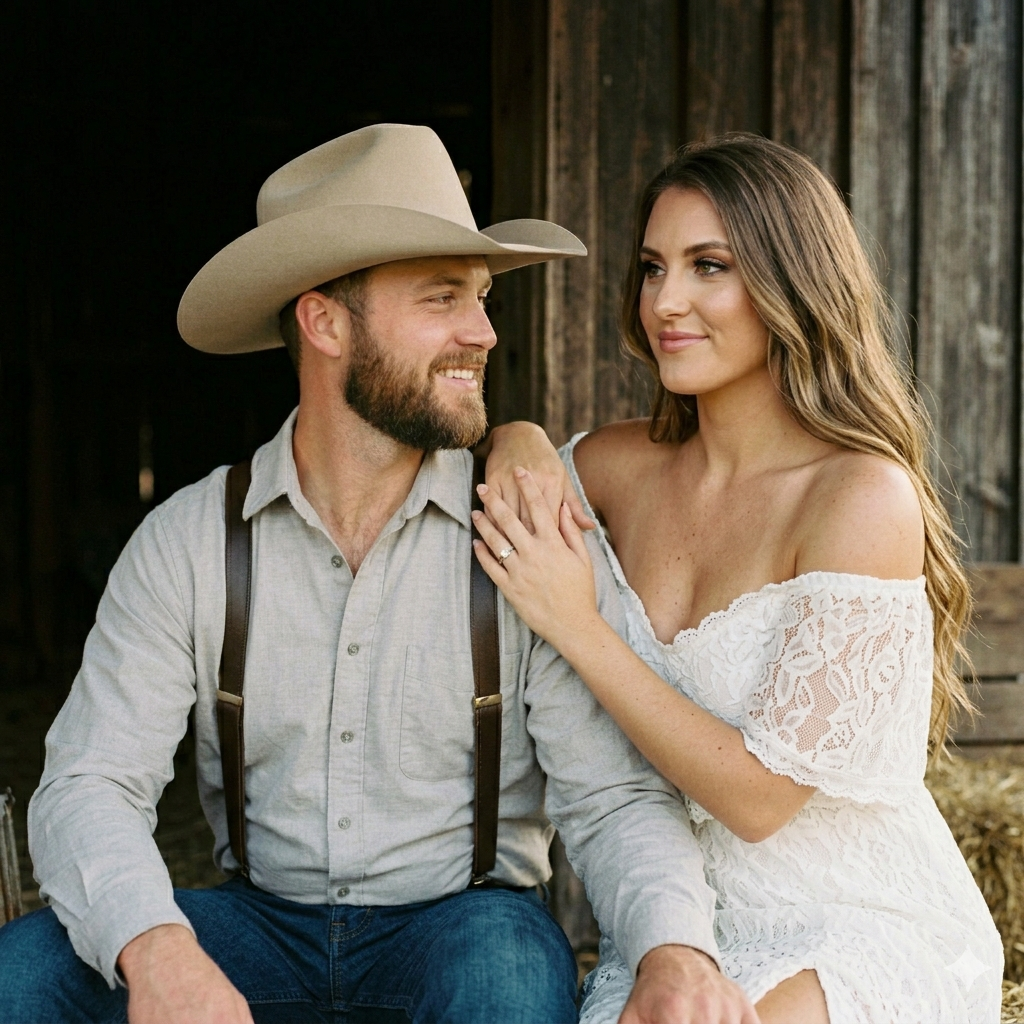
She stepped down slowly, gathering her white dress so it wouldn’t drag in the dust. The fabric was simple but elegant, lace trimming the off-the-shoulder sleeves. Her long brown hair fell in soft waves over her back. She wore patterned cowboy boots—practical, but stylish.
She looked around calmly, not timid, not nervous—just observant.
Her eyes landed on Thomas.
“You must be Mr. Hale,” she said.
Her voice was warm, steady. Not shy at all.
“Yes.”
“I’m Eliza.”
She extended her hand. Her grip was firm.
Jake whistled quietly behind him.
Thomas cleared his throat. “Welcome.”
She smiled—soft, but confident. “I hope the ride back isn’t too long. I’d like to see the ranch before sunset.”
That was the first surprise.
Most mail-order brides he’d heard about seemed nervous, overwhelmed. Eliza looked like she had already decided this was her place.
They rode back in silence at first. Then she asked questions.
“How many head of cattle?”
“Forty-two.”
“Any drought trouble?”
“Last summer.”
“Do you rotate pasture?”
“Yes.”
Thomas glanced at her. “You know ranching?”
“A little,” she said. “Enough to ask questions.”
Another surprise.
When they reached the ranch, the sun dipped low. The barn cast long shadows across the yard. She dismounted smoothly, brushing dust from her dress.
“It’s beautiful,” she said.
Thomas followed her gaze. Weathered wood. A sagging fence. A windmill squeaking slowly.
He’d never heard anyone call it beautiful before.
That night, she cooked. Not fancy—beans, potatoes, and biscuits—but everything came together quickly, efficiently. She moved through the kitchen like she’d lived there for years.
Jake leaned toward Thomas and whispered, “You sure you didn’t order yourself a foreman instead of a wife?”
Thomas didn’t answer.
Eliza placed plates on the table. “Eat before it cools.”
They obeyed.
The next morning, Thomas woke before dawn, as always. He stepped outside to saddle his horse.
Eliza was already there.
She wore a simple blouse, skirt tucked slightly for movement, boots dusty. Her hair was braided loosely over one shoulder.
“You rise early,” she said.
“So do you.”
“I wanted to see the morning chores.”
He handed her a tin mug of coffee. She accepted it, eyes scanning the pasture.
“You move the cattle today?” she asked.
“Yes.”
“Mind if I ride along?”
Thomas hesitated.
“You can ride?”
She raised an eyebrow. “Try me.”
He saddled an extra horse.
She mounted easily.
By mid-morning, she’d proven herself. She rode confidently, guiding a stray calf back into line. Not flashy—controlled, deliberate. The ranch hands noticed.
“Well I’ll be,” Jake muttered.
Thomas watched quietly.
Another surprise.
Days passed.
Eliza didn’t chatter. She worked. She listened. She observed.
But she wasn’t quiet in the way Thomas expected.
She made decisions.
“Fence line’s weak near the creek,” she said one afternoon.
He checked. She was right.
“You’re losing feed storing hay that close to the barn door,” she pointed out.
He adjusted. Loss stopped.
“You should rotate the herd sooner,” she added another day.
Thomas found himself following her suggestions.
The ranch improved.
Jake noticed first. “Boss… she’s running this place.”
Thomas didn’t argue.
One evening, after a long day, Thomas sat on the wooden porch of the old barn. The sky glowed gold. A lantern rested near his boot. A coiled rope lay beside the steps.
Eliza stepped out and sat close to him.
Closer than she had before.
Her white dress brushed his knee. The scent of hay and warm sunlight clung to her.
“You don’t talk much,” she said.
“No.”
“Do you mind if I do?”
He glanced at her. “No.”
She smiled. “Good.”
They sat quietly anyway.
Then she rested her arm on his shoulder.
Thomas stiffened slightly.
“You’re tense,” she said softly.
“Not used to… this.”
“To what?”
She tilted her head, meeting his eyes.
“Someone close,” he admitted.
She studied him for a moment.
“I ordered a quiet wife,” he added.
She laughed gently. “You got one.”
“You’re not quiet.”
“I am. Just not silent.”
He considered that.
The sun dipped lower.
“You expected someone timid,” she said.
“Yes.”
“And you’re disappointed?”
He looked at her. “No.”
Her fingers tightened slightly on his shoulder.
That night, the wind picked up. The barn doors creaked. Thomas couldn’t sleep. He stepped outside and found Eliza already sitting on the porch again, wrapped in a shawl.
“You too?” she asked.
He nodded.
They sat side by side.
“You’ve built something good here,” she said.
“Needs work.”
“So do most things.”
She leaned her head lightly against his shoulder.
Thomas’s breath slowed.
“You trust me?” she asked.
“Yes.”
“Then let me help you run it.”
“You already are.”
She smiled.
Hours passed unnoticed.
They talked quietly—about winters, cattle, her childhood, his lonely years. The stars shifted overhead.
At some point, she took his hand.
He didn’t pull away.
By midnight, they sat closer. By two, she rested fully against him. By three, he realized she had guided every moment without him noticing.
She led. He followed.
And he didn’t mind.
Just before dawn, the sky softened.
Eliza turned toward him, her eyes warm in the early light.
“You know,” she said softly, “you’re not the only one who took a risk.”
He looked at her.
“I asked for a quiet life,” she continued. “But I didn’t want a silent one.”
“And now?” he asked.
She smiled. “Now I think I chose right.”
She leaned in slightly, their foreheads almost touching.
The first rays of sun lit the barn behind them. The porch boards glowed gold. The lantern flickered faintly beside their boots.
Thomas realized something then.
He had expected to lead. To teach. To guide.
Instead, she had changed everything.
The ranch ran better. The house felt warmer. And somewhere between dusk and dawn, the quiet bride had taken control—gently, naturally, completely.
He didn’t resist.
He didn’t want to.
By sunrise, they sat together on the porch, close enough that the world beyond the pasture felt distant.
“You still want a quiet wife?” she teased.
He shook his head.
“No,” he said.
She smiled.
“Good,” she whispered.
And as the sun climbed over Willow Creek, the cowboy who had ordered silence found himself following the steady, confident rhythm of the woman beside him—content, surprised, and no longer alone.