
He Waited for a Beautiful Mail-Order Bride… But When an Overweight Teen Stepped Off the Wagon, the Entire Mountain Town Started Laughing — Until They Learned the Truth
The first snow of October came early that year, sweeping down the Bitterroot Mountains in a pale curtain that softened the edges of pine and stone. Caleb Turner stood outside his cabin, hat in his hands, boots half-buried in frost. He had shaved that morning—awkwardly, carefully—and nicked his chin twice. The sting still burned, but he didn’t mind. He wanted to look presentable.
After all, his mail-order bride was arriving.
Caleb had never met a woman he could call his own. Thirty-one years old, broad-shouldered, quiet, he’d spent his life trapping, cutting timber, and hauling furs down to the small trading post in Hollow Creek. He spoke little, laughed rarely, and when he did, it sounded rusty, like hinges that hadn’t moved in years.
The advertisement had taken him three days to write.
“Hardworking mountain man seeks honest wife. Cabin, land, livestock. No luxuries, but steady life.”
He mailed it east and forgot about it—until a letter came back. Then another. Then one he kept folded inside his shirt pocket for weeks.
Her name was Emily Carter. She wrote in careful handwriting, neat and hopeful. She liked cooking, she said. She wanted a quiet life. She didn’t mind cold winters. She had no family left and longed for somewhere she belonged.
Caleb read her letters by lamplight until he nearly memorized them. He imagined her small and kind, with gentle eyes and a laugh like wind chimes. He pictured her sitting by the fire, sewing, while he chopped wood outside.
So when the wagon from town creaked into view, he straightened his coat and stepped forward.
Three men rode along with it, grinning. Hollow Creek didn’t get much entertainment, and a mail-order bride arriving in the mountains counted as a spectacle.
“Well, Turner,” one called. “Hope she ain’t too pretty for you.”
Caleb didn’t answer. His heart thudded in his chest.
The wagon stopped. The driver hopped down and opened the back.
For a moment, nothing happened.
Then a girl stepped out.
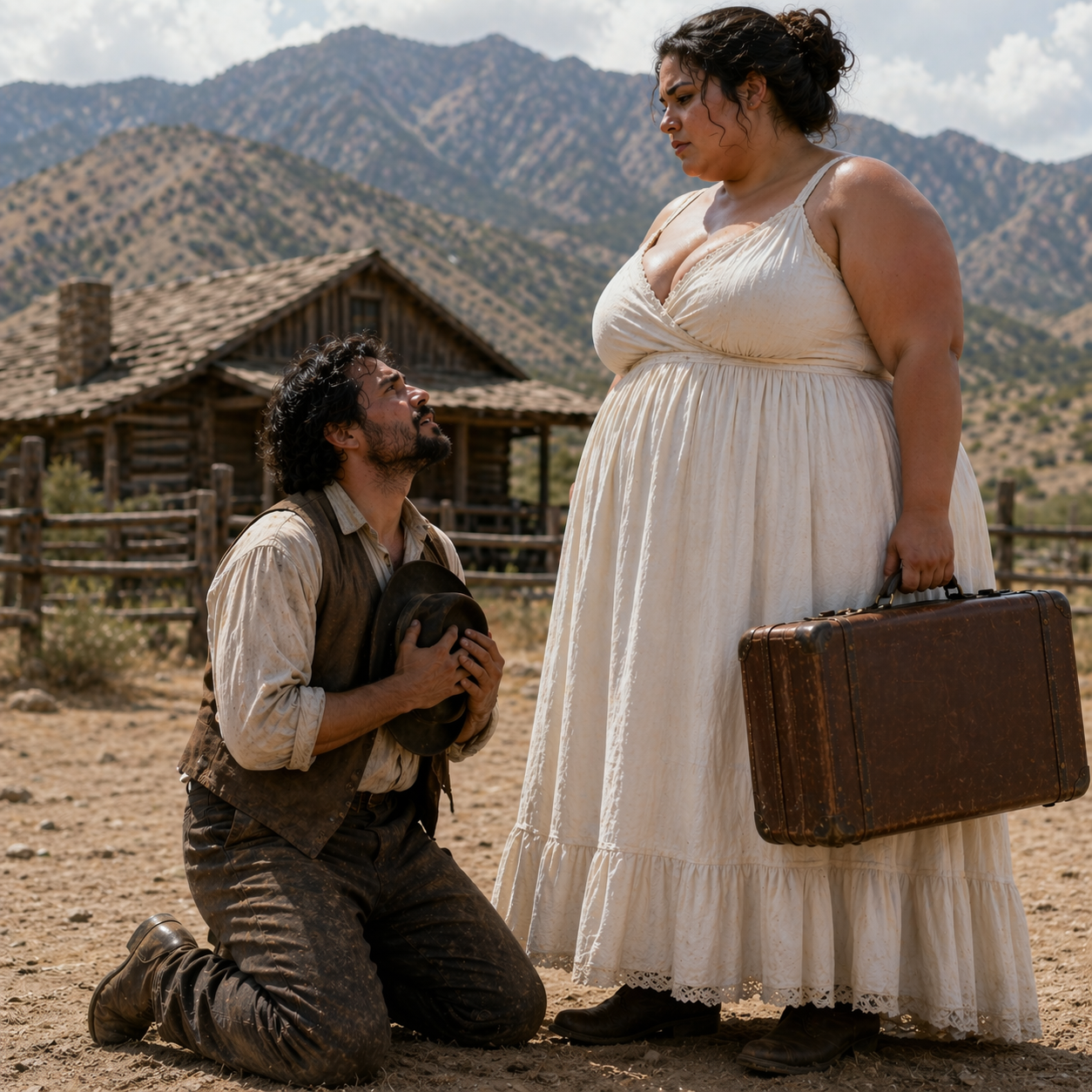
She was large—much larger than Caleb expected. Not just plump, but heavyset, with round cheeks flushed from the cold and a coat stretched tight across her middle. She clutched a small carpetbag, breathing hard from the step down.
She looked… young.
Not a woman in her mid-twenties, like he imagined—but a teenager, maybe seventeen or eighteen. Her boots were scuffed, her hair pulled back unevenly, and her eyes darted nervously toward the watching men.
The laughter started almost immediately.
“Turner, you ordered extra rations?”
“Boy, she’ll eat you outta that cabin!”
“Didn’t know you were adopting instead of marrying!”
Caleb’s face burned.
The girl flinched at every laugh, her shoulders curling inward. She looked at Caleb, uncertainty flickering in her eyes.
“You… you’re Mr. Turner?” she asked.
Her voice was soft, trembling.
He swallowed. “Yes.”
“I’m Emily.” She held out her hand.
He hesitated only a second before taking it. Her palm was warm despite the cold.
The men kept laughing.
Caleb turned to them, jaw tight. “That’s enough.”
They quieted, surprised by the edge in his voice.
He took Emily’s bag and nodded toward the trail. “Cabin’s this way.”
She followed him silently, boots crunching in snow.
The walk took nearly an hour. Emily lagged behind, breathing heavily. Twice Caleb slowed his pace. The third time, he stopped entirely.
“You need rest?”
She shook her head quickly. “No. I’m fine. I just… I’m not used to mountains.”
He nodded. “You’ll get used to them.”
They walked again.
When they reached the cabin, Emily stared at it as though she’d stepped into a storybook. Smoke curled from the chimney. Firewood stacked neatly along the wall. A small fenced pen held two goats.
“It’s… nice,” she said quietly.
Inside, the cabin smelled of pine and coffee. Caleb set her bag down near the bed—he only had one. He realized that suddenly and flushed.
“I can sleep by the stove,” he muttered.
Emily looked surprised. “You don’t have to—”
“I do.”
She nodded, grateful.
That evening, she insisted on cooking. Caleb watched awkwardly as she unpacked a small bundle of spices, carefully measuring them into a pot of beans. The smell filled the cabin—richer than anything he’d eaten in months.
They sat across from each other.
“This is good,” he said after the first bite.
She smiled—small, uncertain, but real.
“Thank you.”
They ate in silence for a while.
Finally, Caleb asked, “How old are you?”
She froze. “Eighteen.”
He nodded slowly. “You wrote older.”
“I know.”
“Why?”
She stared into her bowl. “Because nobody would’ve answered otherwise.”
The honesty hit him harder than he expected.
“Why me?” he asked.
She hesitated. “You sounded… kind.”
He looked away, uncomfortable.
“I also… didn’t have anywhere else,” she added softly.
The fire crackled.
That night, Caleb lay awake near the stove, listening to her breathing. He wondered what he’d done. He’d expected a wife. Instead, he felt like he’d brought home someone who needed protecting.
But he didn’t send her away.
The first week was awkward.
Emily worked hard—harder than Caleb expected. She swept, cooked, cleaned, even tried chopping wood, though she tired quickly. She apologized often.
“I’m slow,” she said one morning.
“You’re learning,” Caleb replied.
She smiled.
By the second week, she laughed more. Her cheeks lost some of their nervous tension. She told stories—about a crowded boardinghouse in St. Louis, about working in a bakery, about children who teased her size.
“They called me ‘Dough Girl,’” she said, shrugging. “I got used to it.”
Caleb didn’t like that.
He noticed something else too: she ate carefully, not greedily. Small portions. Slow bites. As if she were used to being judged.
One afternoon, while hauling water, she slipped on ice. Caleb caught her before she hit the ground. She clung to his arm, startled.
“Sorry,” she whispered.
“You’re fine.”
But he didn’t let go right away.
By December, the snow deepened. Emily moved easier now, stronger. Her cheeks were still round, but her steps grew more confident. She learned to milk goats, mend coats, even set small traps for rabbits.
The town’s laughter faded.
Then one day, a rider came.
He arrived at dusk, his coat dusted with snow. Caleb stepped outside.
“You Caleb Turner?” the man asked.
“Yes.”
The rider handed him a folded paper. “For the girl. Came through the post.”
Caleb took it inside.
Emily’s hands trembled when she saw the handwriting.
She opened it slowly.
Her face drained of color.
“What is it?” Caleb asked.
She didn’t answer. She handed him the letter.
It read:
“Emily,
You ran, but you can’t hide. I know where you went. You belong to me until the debt is paid. I’ll be there before spring.
—Mr. Halvorsen”
Caleb looked up. “Who’s this?”
Emily’s voice shook. “The boardinghouse owner. He… he said I owed him for food. For rent. He wouldn’t let me leave.”
“You left anyway.”
“I had to.” She swallowed. “He said he’d make me work it off. I didn’t believe him at first. Then… he locked the door one night.”
Caleb’s jaw tightened.
“I took money from the kitchen and ran. Bought passage west.”
“You don’t owe him,” Caleb said.
“He thinks I do.”
Snow tapped the window.
“He’ll come?” Caleb asked.
She nodded.
Caleb folded the letter carefully.
“Then we’ll be ready.”
Winter stretched long and harsh. Caleb taught Emily how to handle a rifle—not to hunt, but to defend. She practiced, awkward at first, then steady.
“You don’t have to,” she said.
“Yes, I do.”
He built stronger shutters. Reinforced the door.
By March, the snow began to melt.
One afternoon, hoofbeats echoed up the trail.
Emily froze.
Caleb stepped outside.
Three men approached. One rode ahead—thin, sharp-faced, with cold eyes.
“Mr. Turner,” he called. “I’m here for the girl.”
Caleb didn’t move. “She’s not going.”
“She owes me.”
“No.”
The man smirked. “You think you can stop me?”
Emily stepped outside beside Caleb. Her hands trembled, but she didn’t hide.
“I paid you back,” she said. “I worked months.”
“You ate more than you worked,” he snapped.
Caleb’s fists clenched.
The man dismounted. “I’ll take her now.”
Caleb stepped forward. “No.”
The two other men shifted uneasily.
Emily suddenly spoke, louder than before. “I’m not your property.”
The man laughed. “Girl like you? No one else wants you.”
Caleb’s voice was quiet. “I do.”
Emily looked at him, stunned.
The man sneered. “Then you pay the debt.”
“How much?”
The number he named was absurd—more than Caleb earned in a year.
Caleb didn’t flinch. “No.”
The man reached for Emily’s arm.
Before he touched her, Caleb stepped between them.
The standoff lasted seconds—but felt longer.
Finally, one of the other riders muttered, “Halvorsen, this ain’t worth it.”
The man glared. “Fine.” He mounted. “You’ll regret this.”
They rode away.
Emily’s knees buckled.
Caleb caught her.
“They’re gone,” he said.
She began to cry—quietly, then harder.
“I thought… I thought he’d take me,” she whispered.
“He won’t.”
She looked up at him. “Why did you say you wanted me?”
He hesitated. Then answered honestly.
“Because I do.”
Spring came late, but when it did, wildflowers dotted the hills.
Emily laughed more now—freely. She walked stronger. Her figure changed slightly from months of mountain life, but Caleb didn’t notice that as much as her confidence.
One evening, she sat beside him on the porch.
“You expected someone else,” she said.
“Yes.”
“Are you disappointed?”
He shook his head. “No.”
She smiled.
After a long pause, she said, “I didn’t expect someone like you either.”
“What like me?”
“Someone who stayed.”
The sun dipped behind the mountains.
Caleb cleared his throat. “Emily… we never really decided. About… marriage.”
She looked at him, eyes bright.
“No,” she said softly. “We didn’t.”
He pulled a small ring from his pocket—simple, hammered silver.
“I thought… maybe now.”
Her hands covered her mouth.
“Yes,” she whispered.
The mountains were quiet around them. No laughter. No spectators.
Just wind, pine, and two people who found something unexpected.
The virgin mountain man who waited for a beautiful bride… and the girl who arrived instead—overweight, frightened, and alone—stood together as the snow melted.
And in Hollow Creek, when word finally spread, nobody laughed anymore.