
She Was Rejected Seven Times — Until the Mountain Man Walked Past Them All and Chose Her
She stood in a line of women who had already learned how to disappear while still being seen.
The wind that morning cut through the valley like a blade, tugging at shawls, skirts, and loose strands of hair. It smelled of pine, horse sweat, and something colder—judgment, perhaps. Men had been coming through since dawn, riding in from scattered homesteads and distant ridges, looking for wives the way they might inspect livestock or tools: necessary, practical, replaceable.
Mary Callahan kept her hands folded in front of her, fingers trembling despite the gloves. She had worn her best dress—the blue one her mother had stitched years ago—but it no longer fit the way it once had. Time had altered her shape, softened her waist, broadened her shoulders. Not ruinous, but enough to draw glances that lingered a moment too long, then turned away.
Seven men had already rejected her.
Seven.
Each one had approached with that same cautious curiosity, like they might find something worthwhile if they looked closely enough. And each time, the ending had been the same: a polite nod, a murmured excuse, a step to the next woman.
Too quiet. Too plain. Too strong-featured. Not young enough. Not delicate enough.
Too something.
Or simply not enough.
Mary had stopped trying to guess which reason belonged to which man.
Behind her, two younger women whispered, their voices barely contained beneath nervous laughter.
“She’s still here?” one said.
“Seven times,” the other replied. “I counted.”
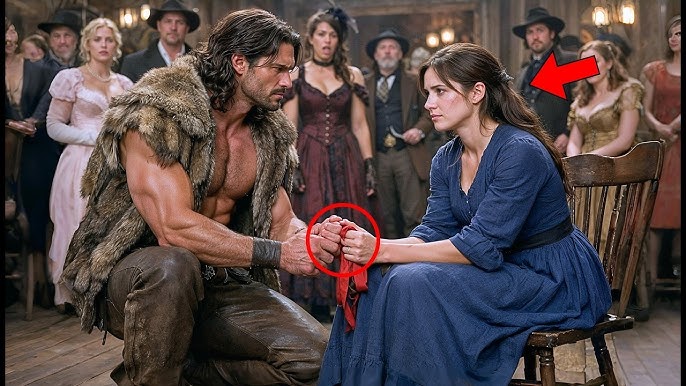
Mary stared straight ahead, refusing to turn. She had learned that lesson early—never give them the satisfaction of seeing hurt. Out here, vulnerability was currency, and she had none left to spend.
The town square was little more than a patch of packed dirt bordered by a church, a general store, and a stable. Yet today it felt like a stage, and they were all actors in a cruel play where the ending had already been written.
Across the square, another man approached the line.
He was older than most—mid-forties, perhaps—with a neatly trimmed beard and a coat that spoke of modest success. Not wealthy, but comfortable. His eyes moved methodically from woman to woman, assessing, weighing.
Mary braced herself.
He stopped in front of her.
For a moment—just a moment—his gaze lingered. She felt it like a hand pressing against her chest, measuring her worth.
“Miss,” he said, tipping his hat slightly.
“Sir,” she replied.
“You can cook?”
“Yes.”
“Sew?”
“Yes.”
“Children?”
She hesitated. “I would hope so.”
He studied her face more closely now, as if searching for something hidden beneath the surface. Then, almost imperceptibly, he sighed.
“I’m sorry,” he said.
And just like that, he moved on.
Eight.
Mary swallowed, her throat tight. The number echoed in her mind, louder than the wind, louder than the murmurs around her.
Eight.
At some point, rejection stopped feeling like a blow and started feeling like confirmation. Like proof that perhaps the world saw something in you that you refused to admit.
She shifted her weight, boots scraping against the dirt. The line had grown shorter now. Some women had been chosen and led away, their faces a mixture of relief and uncertainty. Others had left on their own, unable to endure the quiet humiliation.
Mary remained.
Because leaving meant admitting defeat.
And she wasn’t ready for that. Not yet.
A horse’s hooves sounded at the far edge of the square—slow, deliberate, out of rhythm with the restless energy of the crowd.
Heads turned.
The rider was unlike the others.
He didn’t wear the polished look of a town man. His coat was heavy and worn, lined with fur that had seen too many winters. His beard was thick, untamed, streaked with gray. A rifle rested across his back, not for show but for use.
He rode as if the world had never asked him for permission.
A mountain man.
Mary had heard of them—men who lived beyond the reach of towns and laws, carving out lives in the high country where survival depended on skill, not charm. They rarely came down unless necessity forced them.
And they almost never came looking for wives.
The horse stopped near the edge of the square. The man swung down with an ease that spoke of long practice. For a moment, he simply stood there, surveying the scene.
There was no hurry in him.
No eagerness.
If anything, he looked faintly irritated to be there at all.
A few of the town men exchanged glances, some amused, others wary.
“Lost your way?” someone called out.
The mountain man ignored him.
Instead, he began to walk.
Not toward the front of the line, where the youngest and prettiest women stood.
Not toward the center, where the most eager smiles were offered.
He walked past them all.
Past the laughter, the hopeful glances, the subtle adjustments of posture meant to draw attention.
He didn’t even slow down.
Mary watched him approach, her heart beginning to pound—not from hope, but from confusion. Men didn’t do this. They didn’t skip options. They examined, compared, chose.
This man moved as if the choice had already been made.
He stopped in front of her.
Up close, he seemed even larger—not just in size, but in presence. His eyes were a pale gray, sharp and steady, like storm clouds over stone.
For a long moment, he said nothing.
Neither did she.
The square seemed to quiet around them, as if the world itself was holding its breath.
“You’ve been passed over,” he said finally.
It wasn’t a question.
Mary felt heat rise in her cheeks, but she forced herself to meet his gaze.
“Yes.”
“How many times?”
She hesitated, then answered, “Eight.”
He nodded, as if confirming something to himself.
“Good,” he said.
Mary blinked. “Good?”
A flicker of something—almost amusement—crossed his face.
“Means you’re not what they’re looking for.”
“I suppose not,” she said, unsure whether to feel insulted or relieved.
He studied her for another moment, eyes moving over her face, her posture, her hands.
Not judging.
Not measuring.
Observing.
“You want a husband?” he asked.
The question was so direct it caught her off guard.
“I… yes,” she said. “That’s why I’m here.”
He shook his head slightly.
“That’s not what I asked.”
Mary frowned. “I don’t understand.”
“You want a husband,” he repeated, “or you want a life?”
The words hung between them, heavier than anything that had been said all day.
Mary opened her mouth, then closed it again.
No one had asked her that before.
Not her father, who had arranged her journey here before he died.
Not the women who had advised her on how to stand, how to smile, how to be chosen.
Not the men who had looked at her and seen only what she lacked.
A life.
What did that even mean?
“I want…” She paused, searching for the truth beneath layers of expectation. “I want something that’s mine. Not borrowed. Not given because I was the best of what was left.”
The mountain man’s gaze sharpened.
“Good,” he said again.
He extended his hand.
“Name’s Elias Boone.”
Mary stared at his hand, then at his face.
“Mary Callahan.”
“Mary,” he said, testing the name. “You can cook?”
A faint smile tugged at her lips despite herself. “Yes.”
“Sew?”
“Yes.”
“Work?”
She straightened slightly. “Harder than most.”
That earned her the smallest hint of approval.
“Good,” he said. “I don’t need pretty. I don’t need quiet. I need someone who won’t break when winter comes.”
A murmur rippled through the crowd.
Mary could feel eyes on her, hear whispers beginning to rise.
“She? He chose her?”
“He didn’t even look at the others—”
“Is he blind?”
But for the first time that day, the voices didn’t reach her.
Because for the first time, someone wasn’t asking her to prove her worth.
He was offering her a place to use it.
“Where do you live?” she asked.
He gestured vaguely toward the mountains rising in the distance, their peaks dusted with snow.
“Up there.”
Mary followed his gaze.
It was far.
Farther than she had ever gone.
And harder.
More dangerous.
More uncertain.
Everything about it should have frightened her.
Instead, she felt something else.
Something unfamiliar.
Possibility.
“You’d leave today,” Elias said. “No long goodbyes. No second thoughts. It’s a hard life. Might not suit you.”
Mary looked back at him.
“You didn’t even ask if I’m pretty,” she said.
“I’ve got eyes,” he replied.
“And?”
He shrugged. “Doesn’t matter much when you’re chopping wood in a blizzard.”
A laugh escaped her before she could stop it.
It felt strange—light, almost foreign.
“When do we leave?” she asked.
Elias’s expression didn’t change, but something in his eyes shifted—approval, perhaps.
“Now,” he said.
He took her bag—light, because she had brought little—and slung it over his shoulder as if it weighed nothing.
Mary hesitated for just a moment, glancing back at the line.
At the women still waiting.
At the men still choosing.
At the life she had almost accepted.
Then she turned away.
Elias helped her onto the horse, settling in behind her. His presence was solid, steady, like the mountains themselves.
As they began to ride, the town fell away behind them.
So did the whispers.
The judgments.
The numbers.
Mary leaned slightly into the rhythm of the horse, the wind no longer biting but bracing.
“Elias?” she said.
“Yeah?”
“Why me?”
He was quiet for a moment.
Then, simply, “Because you didn’t look like you needed saving.”
Mary let that settle.
For the first time in a long while, she didn’t feel like something left behind.
She felt chosen.
Not despite who she was.
But because of it.
And as the mountains rose to meet them, she realized something else.
She hadn’t been rejected eight times.
She had been spared eight times—
Until the right man walked past them all and saw her clearly.
The mountains did not welcome them.
They loomed.
By the second day, the soft dirt roads had given way to narrow trails carved into stone. Pines thickened around them, their branches swallowing the sky until only thin slivers of light reached the ground. The air grew colder, thinner, sharper in the lungs.
Mary had stopped thinking about the town.
Not because she forgot it—but because it no longer mattered.
Elias rode mostly in silence, speaking only when necessary. At first, the quiet unsettled her. She had been raised on conversation, on the constant hum of voices filling empty spaces. But up here, silence wasn’t empty.
It was full.
Full of wind threading through branches. Full of distant water rushing over rock. Full of the steady rhythm of hooves and breath and heartbeat.
On the third night, they camped beside a frozen stream.
Mary knelt by the fire, trying to steady her hands as she struck the flint. The spark caught on the third try, flames licking up through the dry kindling Elias had gathered.
“You learn fast,” he said from behind her.
She didn’t turn. “I have to.”
A pause.
“Most don’t,” he replied.
Mary finally glanced over her shoulder. “Most don’t come this far.”
That earned the faintest curve at the corner of his mouth.
They ate in near silence—dried meat, hard bread, and a bit of coffee boiled black in a dented tin pot. It wasn’t much, but after a full day in the cold, it tasted better than anything she could remember.
Later, wrapped in a blanket beneath a sky scattered with sharp, endless stars, Mary stared upward.
“I’ve never seen them like this,” she murmured.
Elias followed her gaze. “No smoke up here. No lamps. Just what’s there.”
“They feel… closer.”
“They are,” he said simply.
She turned her head slightly. “You always talk like that?”
“Like what?”
“Like everything has only one answer.”
He shrugged. “Most things do.”
Mary smiled faintly. “I think you just don’t like wasting words.”
“That too.”
Silence settled again—but this time, it was easier.
Not awkward.
Not heavy.
Just… shared.
They reached his cabin on the fifth day.
Mary had expected something rough—perhaps barely standing, a shelter more than a home.
What she found was different.
The cabin stood tucked against a slope, sheltered by a ring of tall pines. It was solid, built from thick logs fitted tightly together. Smoke curled from a stone chimney, and a stack of chopped wood stood neatly along one side.
It wasn’t large.
But it was strong.
Like the man who built it.
Elias dismounted first, then helped her down. His hands were steady, warm even in the cold.
“This is it,” he said.
Mary stepped forward slowly, boots crunching on the thin layer of frost.
“This is home?” she asked.
“If you stay.”
She looked at him. “And if I don’t?”
He met her gaze evenly. “Then I take you back in the spring.”
No pressure.
No trapping.
Just truth.
Mary turned back to the cabin.
Then she walked inside.
The air smelled of woodsmoke and something faintly earthy—leather, perhaps, or pine sap. The space was simple: a table, two chairs, a narrow bed, shelves lined with supplies. Everything had a place. Everything had a purpose.
No decorations.
No excess.
But it was clean.
Cared for.
“You built this?” she asked.
“Yeah.”
“Alone?”
He nodded.
Mary ran her fingers lightly over the edge of the table. The wood was smooth, worn by use.
“It’s… good,” she said.
Elias set her bag down near the bed. “It keeps the cold out.”
“That’s more than most places can say.”
He glanced at her, as if weighing something.
“You can change it,” he said. “Make it yours.”
Mary blinked. “Just like that?”
He shrugged. “If you’re staying, it should feel like yours too.”
Something in her chest tightened unexpectedly.
No one had ever said that to her before.
Not in a way that meant it.
The days that followed were harder than anything Mary had ever known.
And yet…
They were clearer.
There was no guessing what needed to be done. No pretending. No trying to fit into expectations she didn’t understand.
There was work.
Endless, necessary work.
She learned to haul water from the stream without slipping on the ice. Learned to split kindling, then larger logs, her arms aching until they grew stronger. Learned how to stretch supplies, how to mend not for beauty but for durability.
The first time she tried to bake bread in the iron stove, it came out dense and half-burnt.
Elias ate it anyway.
Didn’t complain.
Didn’t praise.
Just ate.
The second time was better.
The third, better still.
“You’ll get there,” he said once.
Mary wiped flour from her hands, a bit of frustration slipping through. “You always sound so certain.”
“I’ve seen people try,” he replied.
“And fail?”
“Some.”
She met his gaze. “And me?”
He held it for a moment.
“You’re still here.”
That was answer enough.
Winter came early.
The first heavy snowfall arrived overnight, blanketing the world in white so deep it swallowed the trail they had ridden in on.
Mary stood in the doorway, staring out at it.
“It’s… beautiful,” she whispered.
“It’s dangerous,” Elias corrected.
She glanced back at him. “Can’t it be both?”
He considered that.
“Yeah,” he admitted. “It can.”
The cold settled in after that.
Not just outside—but into everything.
Into the walls. Into the floor. Into bones.
There were mornings when Mary woke before dawn, her breath visible in the dim light, her body reluctant to leave the warmth of the blankets.
But she did.
Every time.
Because out here, you didn’t get to choose comfort over survival.
One evening, as the wind howled against the cabin, Elias returned later than usual.
Mary had been pacing.
Worried.
When the door finally opened, she rushed forward.
“You’re late.”
“Got turned around near the ridge,” he said, brushing snow from his coat.
“You could have—” She stopped herself, swallowing the fear that had been building. “You should have told me where you were going.”
He looked at her, surprised.
“I always go that way.”
“That doesn’t mean I know that,” she shot back.
Silence.
Then, slowly, he nodded.
“Fair.”
Mary exhaled, tension easing just slightly.
“I just…” She hesitated. “I don’t want to be left not knowing.”
Something shifted in his expression.
Not irritation.
Understanding.
“I’ll tell you next time,” he said.
It was a small thing.
But it mattered.
Days turned into weeks.
Weeks into months.
The cabin changed.
Not dramatically—but enough.
Mary added touches where she could. A cloth over the table. A small bundle of dried flowers near the window. Little things that served no purpose except to remind her that life wasn’t only about surviving.
Elias noticed.
He didn’t comment.
But one morning, she found a small carved wooden spoon resting beside her cup.
Rough.
Imperfect.
But clearly made by hand.
“For you?” she asked, holding it up.
He nodded once. “Figured you’d want something that wasn’t just… useful.”
Mary smiled.
“Thank you.”
One night, as they sat by the fire, the wind quieter than usual, Mary spoke.
“I used to think something was wrong with me.”
Elias glanced over. “Why?”
“Because no one chose me,” she said simply.
The fire cracked softly between them.
“And now?” he asked.
Mary looked around the cabin.
At the walls they had reinforced together.
At the table they had shared.
At the life they were building—piece by piece, day by day.
“Now I think…” She paused. “Maybe they just didn’t know what to do with someone like me.”
Elias leaned back slightly, considering that.
“Most people don’t,” he said.
She met his eyes.
“But you did.”
He shook his head.
“No,” he said quietly. “I just didn’t need you to be anything else.”
Mary felt something settle deep inside her.
Not excitement.
Not relief.
Something steadier.
Belonging.
Outside, the snow continued to fall.
But inside, the fire burned warm.
And for the first time in her life, Mary Callahan wasn’t waiting to be chosen.
She already had been.
And more importantly—
She had chosen back.