
Kicked Out at 18, She Built a Home Inside the Grain Silo—Unaware It Would Be The Town’s Only Refuge
The day she turned eighteen, they gave her a trash bag.
Not a suitcase.
Not a goodbye worth remembering.
Just a thin black bag stuffed with everything they had decided she deserved to keep.
“You’ve had enough chances, Ellie.”
Her foster mother didn’t raise her voice. She didn’t need to. The finality in it was colder than anger.
“You’re an adult now.”
Ellie Harper stood on the porch, the late summer heat pressing against her skin, the cicadas buzzing loud enough to fill the silence they left behind.
“I finished school,” she said quietly. “I’ve been working—”
“That’s not the point.”
It never was.
It had never been about effort. Or improvement. Or hope.
It was about space.
And she had run out of it.
The door closed before she could say anything else.
Not slammed.
Just… shut.
Like she had never been there at all.
Ellie didn’t cry.
Not at first.
She walked.
Down the gravel road. Past the rusted mailbox. Past the fields that stretched farther than she had ever been allowed to explore.
The trash bag cut into her fingers after a while, so she switched hands.
Then again.
Then again.
She kept walking.
Because stopping meant thinking.
And thinking meant feeling.
And she wasn’t ready for that yet.
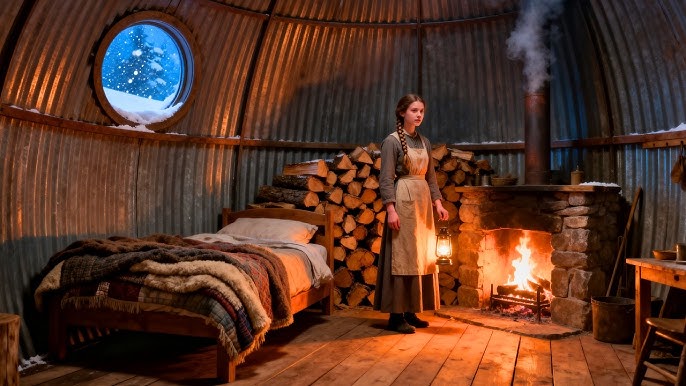
By sunset, she reached the edge of town.
Or rather—the edge of everything.
A stretch of abandoned farmland sat just beyond the last row of houses. The land had once been productive, maybe even thriving, but now it was quiet. The fences leaned. The barn sagged. The wind moved through it like it had nothing left to disturb.
And in the middle of it—
The silo.
Tall.
Cylindrical.
Concrete weathered by years of sun and storms.
It stood like a forgotten monument to a life that had ended long before Ellie arrived.
She stopped.
Stared up at it.
“You’ve got to be kidding me,” she muttered.
But there was something about it.
Not welcoming.
Not warm.
But… solid.
Still standing.
The door at its base was half off its hinges.
It creaked when she pushed it open, the sound echoing up into the hollow space above.
Inside, it smelled like dust and old grain.
The floor was uneven but dry. Light filtered down from a broken hatch near the top, casting a narrow beam that shifted as the sun sank lower.
Ellie stepped inside slowly.
“Not the worst place I’ve seen,” she said to no one.
Her voice echoed back.
At least it answered.
That first night, she slept curled against the wall, her bag under her head.
It was uncomfortable.
Cold.
Loud with every tiny sound magnified by the empty space.
But no one told her to leave.
No one judged her.
No one watched.
For the first time in years—
She was alone.
And somehow, that felt safer than anything else.
The next morning, she made a decision.
“If I’m staying,” she said aloud, “this can’t be like this.”
The silo wasn’t a home.
But it could be something.
Ellie had always been good with her hands. Not because anyone taught her—but because she had learned that if she didn’t fix things herself, no one else would.
She started small.
Cleared debris from the floor. Swept out dust with a broken broom she found in the barn. Used scraps of wood to create a raised platform so she wouldn’t have to sleep directly on the concrete.
It took days.
Then weeks.
She found old pallets behind the general store and dragged them out at night, one at a time. She patched gaps with sheet metal scavenged from the barn. She rigged a makeshift ladder using nails and stubbornness.
Each step upward inside the silo became something new.
A place to sit.
A place to store.
A place to breathe.
It wasn’t pretty.
But it was hers.
People noticed.
Of course they did.
Small towns always notice.
At first, it was whispers.
“She’s living out there.”
“In that old silo?”
“Won’t last a month.”
Ellie heard them sometimes when she came into town for supplies.
She didn’t respond.
Didn’t explain.
Didn’t defend.
Because she had learned something important:
People who decided your story without asking rarely changed their minds.
Autumn came.
The air turned crisp, the fields shifting from green to gold to brown.
Inside the silo, Ellie adapted.
She insulated the lower walls with burlap and straw. Built a small stove from a rusted drum she found near the barn. Collected rainwater in a cracked barrel and filtered it the best she could.
Every improvement mattered.
Every small success felt… earned.
One evening, sitting on the second level she had built, wrapped in a patched blanket, she looked around and smiled.
“Not bad,” she said.
And she meant it.
Then winter came.
And everything changed.
The first storm hit hard.
Wind howled across the open land, slamming against the silo with a force that made the entire structure groan.
Ellie stood inside, heart pounding.
“Don’t you dare fall,” she muttered, pressing her hand against the cold concrete.
The storm raged for hours.
Snow piled high outside.
The temperature dropped fast.
But the silo held.
Solid.
Unmoving.
Like it had been waiting for this.
By the third storm, the town wasn’t doing so well.
Power lines went down.
Roads became impassable.
The small grocery store ran low on supplies.
People who had lived comfortably for years suddenly found themselves unprepared for how quickly things could change.
Ellie watched from a distance.
Not out of indifference.
But because she knew what it meant to survive alone.
And she didn’t assume she was wanted.
The knock came at night.
Soft.
Uncertain.
Ellie froze.
No one came out here.
No one.
Another knock.
“Hello?” a voice called, trembling. “Please… is anyone there?”
Ellie moved slowly toward the door.
Opened it just enough to see.
A woman stood outside, bundled in a thin coat, a child clinging to her side.
“We… we got stuck,” the woman said. “The car won’t start. The road—”
Her voice broke.
Ellie looked at them.
At the shaking hands.
The red, wind-bitten cheeks.
The fear.
And something inside her shifted.
Not hesitation.
Not resentment.
Something else.
Recognition.
“Come in,” Ellie said, stepping aside.
The woman hesitated.
Then stepped inside.
Warmth hit her immediately—not much, but enough.
“Oh my God,” she whispered. “You live here?”
Ellie shrugged. “Yeah.”
The child looked around, eyes wide.
“It’s like a tower,” he said.
Ellie almost smiled.
They stayed the night.
Then another.
Because the storm didn’t stop.
And by the time it did—
More people came.
At first, just a few.
A farmer whose house had lost heat.
An older man who couldn’t make it into town.
A young couple stranded on the road.
Each one arrived the same way.
Cold.
Uncertain.
Desperate.
And each time—
Ellie opened the door.
“You built this?” someone asked one night, looking around at the layered platforms, the careful structure, the way everything fit together.
“Yeah,” Ellie said.
“How?”
She shrugged. “I needed a place to stay.”
They looked at her differently after that.
Not with pity.
Not with judgment.
With something else.
Respect.
By the time the worst of winter passed, the silo wasn’t just hers anymore.
It had become something else.
A place people came to when everything else failed.
A place that held.
A place that didn’t turn anyone away.
The town started calling it—
The Refuge.
Spring came slowly.
Snow melted.
Roads cleared.
Life returned.
People went back to their homes.
Their routines.
Their normal.
But something had changed.
One morning, Ellie stepped outside to find a man standing near the base of the silo.
Not staring.
Not judging.
Just waiting.
“You’re Ellie Harper?” he asked.
“Yeah.”
He nodded. “Name’s Daniel Brooks. Town council.”
She crossed her arms slightly. “That supposed to mean something?”
A faint smile.
“Means we should’ve talked to you a long time ago.”
Ellie said nothing.
“We want to help fix this place up,” he continued. “Make it… safer. Stronger. For next time.”
“Next time?” she echoed.
“There’s always a next time,” he said.
She looked back at the silo.
At the structure she had built piece by piece.
Alone.
“You think I can’t handle it?” she asked.
“I think,” Daniel said carefully, “you already proved you can.”
A pause.
“Now we want to stand with you.”
Ellie considered that.
For a long moment.
Then she nodded.
“Alright,” she said. “But we do it my way.”
Daniel smiled. “Fair enough.”
That evening, Ellie climbed to the top level of the silo.
The hatch above her now fully repaired, the sky open and endless.
She looked out over the town.
The same town that had once whispered about her.
The same town that had never expected anything from her.
And yet—
When it mattered most—
They had come to her door.
And she had opened it.
Not because she had to.
But because she chose to.
Ellie leaned back against the wall, a quiet sense of something settling deep inside her.
She hadn’t just found a place to survive.
She had built something stronger than that.
Something people could depend on.
Something that stood when everything else didn’t.
A home.
Not given.
Not borrowed.
Built.
And this time—
No one could take it away.
Spring didn’t fix everything.
It just made the damage easier to see.
Roofs sagged where snow had sat too long. Fences lay broken, fields waterlogged and slow to recover. Even the town itself felt… quieter. Not peaceful—just aware of how close things had come to breaking.
And in the middle of it all—
The silo stood.
Still.
Unshaken.
But no longer forgotten.
Ellie noticed the difference right away.
People didn’t whisper when she walked into town anymore.
They nodded.
Some even smiled.
It felt… strange.
Not bad.
Just unfamiliar.
At the general store, the same clerk who used to barely meet her eyes now set a small bundle on the counter.
“Extra nails,” he said gruffly. “Figured you might need them.”
Ellie glanced at the bundle.
Then at him.
“Thanks,” she said.
He shrugged like it didn’t matter.
But it did.
Work began a week later.
Not official.
Not organized.
Just… people showing up.
A farmer with spare timber. A mechanic with tools. Two brothers who didn’t say much but worked hard and fast. Even the older man who had stayed through the storm arrived with a dented kettle and a quiet determination to be useful.
Ellie stood at the base of the silo, arms crossed, watching them gather.
“You’re staring,” Daniel said, stepping up beside her.
“They’re early,” she replied.
“They’re motivated.”
She raised an eyebrow. “That what we’re calling it?”
Daniel smiled faintly. “Grateful might be closer.”
Ellie looked back at the group.
Grateful.
The word sat oddly in her chest.
She wasn’t used to people feeling that way toward her.
“Alright,” she said, pushing off the wall. “If you’re gonna help, you follow my lead.”
One of the brothers chuckled. “Yes, ma’am.”
“I’m serious,” Ellie shot back, though there was no heat in it. “This place stands because I built it a certain way. You change that without understanding it, and it falls.”
The mechanic nodded. “Then you teach us.”
A pause.
Then Ellie gave a short nod.
“Fine,” she said. “Let’s get to work.”
They reinforced the base first.
Added support beams where the old concrete had begun to weaken. Replaced the broken door with something solid—thick wood, iron hinges, a latch that wouldn’t give in a storm.
Ellie showed them everything.
How the weight inside had to be balanced across levels.
How airflow mattered more than insulation in certain places.
How the stove had to be positioned just right to keep heat rising without choking the space.
She spoke with certainty.
Not theory.
Experience.
And they listened.
Really listened.
By the second week, the silo had changed.
Not in spirit.
But in strength.
It was no longer just something Ellie had fought to survive in.
It was something built to protect.
Deliberately.
Carefully.
Together.
Lily came out one afternoon.
Her small figure running across the field before anyone could stop her.
“Ellie!” she called, breathless.
Ellie turned just in time to catch her as she collided into a hug.
“You’re back,” Lily said, grinning.
Ellie ruffled her hair lightly. “Looks like it.”
Martha followed at a slower pace, her steps steadier than they had been months ago.
“You’ve been busy,” she said, taking in the changes.
“Had some help,” Ellie replied.
Martha’s gaze softened.
“Looks like more than that.”
Ellie didn’t answer right away.
Because she knew what Martha meant.
This wasn’t just about fixing a structure.
It was about something else.
Something harder to name.
That evening, as the sun dipped low, a small group stayed behind.
Not working.
Just sitting.
Talking.
The silo cast a long shadow across the field, stretching toward the town like a quiet reminder.
Daniel leaned back against a stack of timber.
“You ever think about leaving?” he asked.
Ellie sat on the lowest step, elbows resting on her knees.
“Used to,” she said.
“And now?”
She looked up at the silo.
At the marks in the wood she had carved herself.
At the layers built from nothing.
“At some point,” she said slowly, “this stopped being a place I ended up.”
Daniel tilted his head slightly. “And became?”
“A place I chose.”
Silence settled.
Not heavy.
Just… understood.
Summer came faster than expected.
Heat replaced cold.
Fields began to recover.
And life moved forward.
But people didn’t forget.
Not this time.
The first storm of the new season came without warning.
Not snow.
Rain.
Heavy.
Relentless.
The kind that turned roads to mud and fields into rivers.
Ellie stood at the top level of the silo, watching the sky darken.
“Not good,” she muttered.
Below, the wind had already begun to pick up.
Then—
A distant sound.
Not thunder.
Something else.
A shout.
She climbed down fast.
Stepped outside into the rising storm.
“What is it?” Daniel called, running up beside her.
Ellie pointed.
Near the edge of town, water had begun to surge through a low area, flooding faster than anyone expected.
Houses sat right in its path.
“Damn,” Daniel breathed.
Another shout.
Closer now.
“Ellie!”
It was one of the brothers.
“People are heading this way!”
Ellie didn’t hesitate.
“Open it up,” she said. “All of it.”
Daniel nodded. “On it.”
The silo came alive.
Not with fear.
With purpose.
Doors opened.
Supplies moved.
Space cleared.
Ellie directed everything.
“Keep the lower level dry—no one stays there if the water rises.”
“Get blankets up top—heat rises, we use that.”
“Food gets rationed now, not later.”
No panic.
No confusion.
Because this time—
They were ready.
Families arrived soaked and shaken.
Children crying.
Men carrying what they could.
Women holding onto what mattered.
And once again—
Ellie stood at the door.
Letting them in.
Every time.
Hours passed.
The storm worsened.
Water crept closer.
But the silo held.
Solid.
Unmoving.
Just like before.
At some point in the night, Lily found Ellie.
“You did it again,” she said, her voice small but certain.
Ellie looked down at her.
“We all did,” she corrected.
Lily shook her head. “No. You built it.”
Ellie glanced around.
At the people huddled together.
At the space filled with life instead of emptiness.
At something she had once thought would only ever belong to her.
And now—
Belonged to everyone who needed it.
“Yeah,” she said softly. “I guess I did.”
By morning, the storm had passed.
The water began to recede.
And slowly—
Carefully—
People stepped back out into the world.
This time, no one needed to say anything.
No speeches.
No grand gestures.
Just looks.
Nods.
Understanding.
Later that day, as the sun broke through the clouds, Ellie stood outside the silo.
Mud clung to her boots.
Her arms ached.
But she didn’t feel tired.
Daniel walked up beside her.
“You ever realize,” he said, “this is the strongest building in town now?”
Ellie glanced up at it.
Then shook her head slightly.
“It’s not the building,” she said.
He frowned. “No?”
She looked past it.
At the people.
At the way they moved differently now.
Together.
“It’s the people inside it,” she said.
Daniel smiled.
“Still,” he added, “doesn’t hurt that you built it.”
Ellie let out a small breath.
Not quite a laugh.
But close.
“Yeah,” she said.
“Doesn’t hurt.”
That night, she climbed to the top again.
The sky clear.
The air calm.
The town below still standing.
And for the first time since she had been handed that trash bag and told she didn’t belong—
Ellie Harper didn’t just have a place in the world.
She had built one.
And when everything else failed—
It was the place everyone else came back to.