
She Paved Cabin Floor With Layered Birch Bark — Unaware It Saves Her as a Blizzard Buries the Town
The first thing Hannah Miller noticed about the cabin was the cold.
It seeped up from the floorboards like a living thing, creeping through the thin soles of her boots and settling into her bones. The walls, made of thick weathered logs, held back the wind well enough, but the floor was another matter. Every step across the wooden planks sounded hollow, and each night the cold rose from below as if the earth itself were breathing frost.
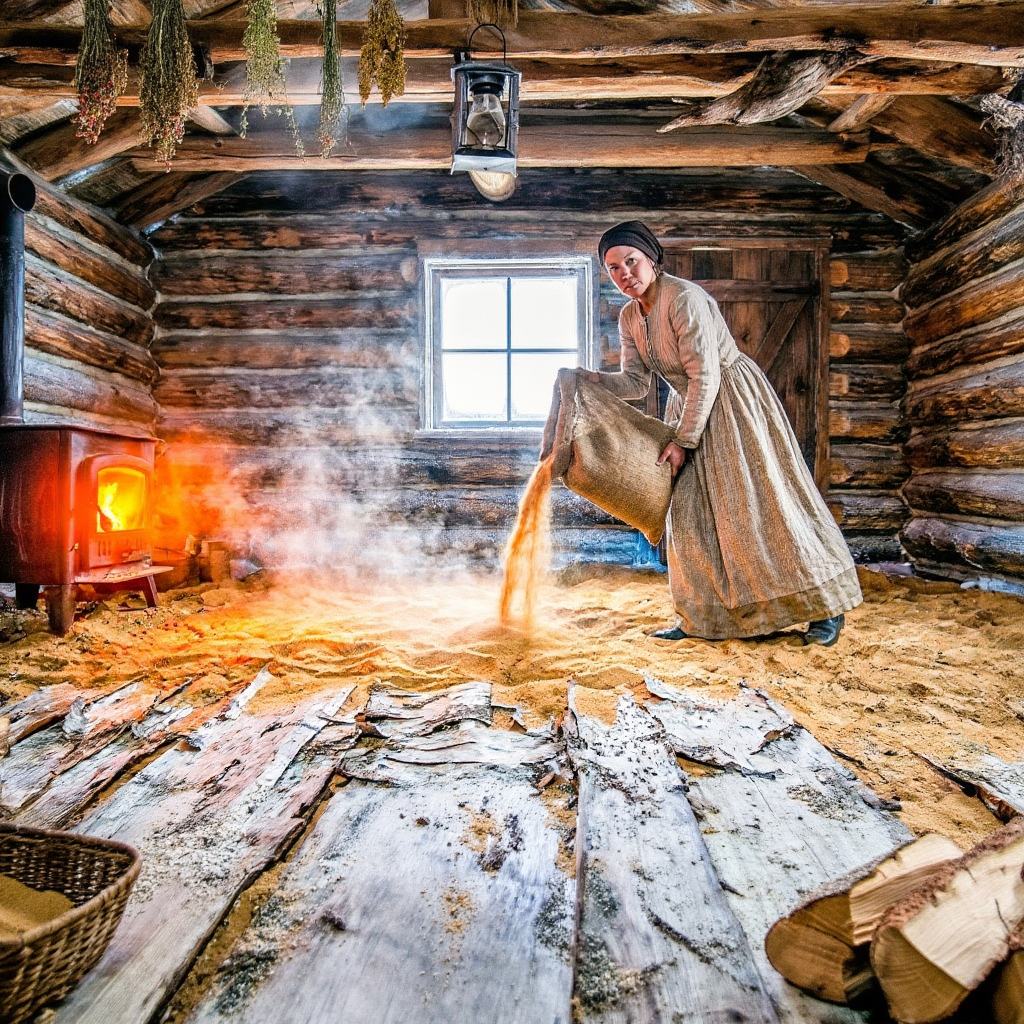
She stood in the center of the cabin, clutching a burlap sack in both hands. Pale sand poured from its mouth in a slow stream, spreading across the weathered boards. Dust lifted into the air, glowing faintly in the bright daylight pouring through the window behind her.
To her left, the wood-burning stove roared. Flames licked the iron sides, and heat shimmered in waves. A kettle rattled faintly on top, releasing thin steam that curled toward the exposed beams above. Dried herbs hung from those beams, swaying slightly as the warm air rose.
Hannah tipped the sack again.
More sand fell, forming a thin layer across the floor.
“You’re wasting it,” came a voice from the doorway.
Hannah turned. Her neighbor, Elias Carter, stood just inside, brushing snow dust from his coat. He looked around the cabin, eyes landing on the scattered sand.
“I traded for it,” she said. “It’s mine to waste.”
Elias walked forward slowly. “You planning to turn the place into a beach?”
She smiled faintly. “Trying to stop the cold.”
He crouched and dragged his fingers through the sand. “Won’t do much.”
“It’s not the sand,” she said.
He looked up.
She set down the empty sack and crossed to a woven basket near the wall. Inside lay curled sheets of pale birch bark, layered like thin leather. She picked up a handful.
“I’m laying bark first,” she explained. “Then sand. Then another layer of bark.”
Elias raised an eyebrow. “Never seen that before.”
“My father used to do it in Michigan,” she said. “Keeps damp from rising. Holds heat better than bare boards.”
He nodded slowly, though he still looked unconvinced.
“You living alone out here?” he asked.
“Yes.”
“That’s a hard winter coming.”
She glanced at the window. The sky beyond was clear, painfully bright. “I’ve had harder.”
Elias stood, brushing sand from his palms. “Town’s stocking up. You should come tomorrow. Storm’s brewing, they say.”
“I will,” she promised.
He looked once more at the floor. “Birch bark, huh?”
She smiled faintly. “We’ll see if it works.”
After he left, the cabin fell quiet again except for the crackling stove.
Hannah knelt and began her work.
She laid the bark carefully, overlapping each strip like shingles. The pale sheets covered the gaps between boards, forming a thin but continuous layer. When she finished one section, she scattered sand across it, spreading it with her hands.
The grains filled spaces, settling into a firm cushion.
Then she laid another layer of bark.
The work took hours. Sunlight shifted across the room. The fire burned low, then roared again when she fed it. By evening, half the floor was covered in layered bark and sand.
She stepped onto it and paused.
The difference was immediate.
The cold no longer rose through her boots. The surface felt softer, warmer, quieter. Even the sound of her steps changed—muted instead of hollow.
She smiled to herself.
“Worth it,” she murmured.
For the next two days, she continued. More bark. More sand. Another layer. She extended the flooring from the stove outward, covering nearly the entire cabin. Near the door, she left extra thickness, knowing cold would seep in there first.
On the third day, she finished.
The cabin looked different now. The floor still showed weathered planks in places, but most of it lay covered in pale bark dusted with sand. A pile of firewood sat near the stove. The woven basket now held only scraps. Herbs swayed gently overhead.
Hannah brewed coffee and sat near the fire.
Warmth lingered around her feet.
Outside, wind began to rise.
By afternoon, clouds rolled over the sky, heavy and gray. Snow fell lightly at first, then thicker. She stood at the window, watching flakes drift down in slow spirals.
“It’ll pass,” she whispered.
But the wind grew stronger.
That night, it howled around the cabin. Snow struck the walls like handfuls of gravel. The door rattled. Hannah fed the stove and pulled her shawl tighter.
By midnight, she could barely see the window through the swirling white.
The storm had arrived.
Morning brought no light—only a pale gray glow. Snow had piled halfway up the window. The wind still screamed.
Hannah checked the door. It resisted when she tried to open it. Snow pressed hard from outside.
She closed it again, unease settling in her chest.
The stove roared, but the air felt heavier, colder. She added more wood.
Hours passed.
Snow rose higher. By afternoon, only the top of the window showed daylight. The cabin groaned as wind pushed against it.
Hannah paced the floor.
Her boots pressed into the sand-dusted bark. The surface stayed warm, holding heat from the stove. She realized the warmth lingered longer than before—far longer than bare wood ever allowed.
That night, the storm worsened.
Wind roared like a train. Snow hammered the roof. At one point, the cabin shook so hard she grabbed the table for balance.
Then came the silence.
Not calm—just muffled. The sound of snow piling thick against the walls.
She checked the door again.
It wouldn’t budge.
The window was nearly buried.
A flicker of fear crossed her face.
She added more wood to the stove, but the fire began to struggle. The draft weakened. Smoke lingered in the air.
“The chimney…” she whispered.
Snow might be blocking it.
She opened the stove slightly. Smoke curled into the room.
Her heart tightened.
Without draft, the fire would die.
Without fire—
She looked down at the floor.
The layered bark and sand held warmth beneath her feet. Even as the air cooled slightly, the ground remained insulated.
She dragged her chair closer to the stove and wrapped herself in blankets.
The fire dimmed slowly.
The cabin cooled.
But the floor stayed warm.
Hours passed. She drifted in and out of uneasy sleep. Each time she woke, she expected freezing air—but the layered floor kept the cold from rising. Her body retained heat longer.
By morning, the fire had nearly died.
The room was cold—but not deadly.
She stood, stamping her feet. The bark floor still felt insulated, trapping what little warmth remained.
She realized something then.
If the floor had been bare boards, cold from the buried earth would have pulled heat from her body all night. She would have frozen faster.
Instead, she was alive.
She opened the door again.
Still blocked.
Snow pressed solid.
She checked the window.
Only a thin strip of light remained.
The town, she realized, might be buried too.
She gathered wood—thankful she had stacked it indoors—and coaxed the fire back to life. Slowly, warmth returned.
Outside, the storm finally weakened by afternoon.
By evening, sunlight pierced the clouds.
Hannah pushed at the door with all her strength. It shifted slightly. Snow cracked.
She grabbed a shovel and began digging.
It took hours.
Finally, the door opened.
A wall of snow nearly chest-high surrounded the cabin. The world lay silent and white.
She stepped out carefully.
The path to town had vanished.
The next morning, she walked anyway.
Snow reached her knees. Wind carved drifts across the fields. It took her nearly two hours to reach the first buildings.
Her heart sank.
The town was buried.
Roofs barely showed. Doors blocked. Smoke rose from only a few chimneys.
She hurried to Elias’s place and knocked.
After a moment, he opened, wrapped in blankets.
“Hannah?” he said, shocked. “You made it?”
“Yes. You?”
“Barely.” He shook his head. “Half the town’s freezing. Fires went out. Floors turned to ice.”
She frowned. “Floors?”
“Cold came up from below. Folks couldn’t keep warm.”
She thought of her layered birch bark.
“It held the heat,” she whispered.
Elias stared. “What?”
“My floor. Birch bark. Sand. It kept warmth in.”
He blinked slowly. “You’re telling me that saved you?”
She nodded.
He looked back toward town. “Then you better show us.”
By afternoon, she was explaining the method to anyone who would listen. They scavenged bark, spread sand, layered what they could.
It wasn’t perfect—but it helped.
By nightfall, more chimneys smoked.
Elias stood beside her, watching the quiet town.
“You didn’t just save yourself,” he said.
Hannah looked at the snow-covered roofs.
She thought of the cold that once rose through her floor… and the simple idea that stopped it.
“I just wanted warmer feet,” she said softly.
Elias smiled. “Sometimes that’s enough.”
The wind settled. The town slowly breathed again.
And beneath Hannah’s cabin, the layered birch bark held warmth—proof that small choices can stand against the harshest winter.