
He Posted for a Farm Cook — Then a Plus-Size Widow with 3 Kids Showed Up… He Sneered, “I Asked for a Cook, Not a Family!” But When Her Flour Sack Split Open, a Hidden Truth Spilled Out — and What He Discovered Changed His Life Forever.
The notice was nailed crookedly to the post outside the general store, half-covered in frost.
WANTED — FARM COOK.
Room, board, and fair wages.
No trouble. No questions.
— Caleb Turner, Turner Ridge
By noon, three men had laughed at it, one teenager had pretended to apply, and the wind had begun peeling one corner loose.
By sunset, Mary Caldwell stood in front of it with numb fingers and three children pressed close against her.
Snow drifted around their boots. The baby in her arms stirred weakly beneath the blanket. Her two boys clung to her dress, their suspenders hanging loose over thin shoulders.
“You think he’ll take us?” whispered the older one.
Mary swallowed. “He only asked for a cook.”
“That’s not us,” the younger boy said quietly.
She looked down at them.
“It has to be,” she said.
The flour sack over her shoulder felt heavier than it should have. She tightened her grip on it, then turned toward the road leading out of town.
Behind them, the winter wind picked up.
Turner Ridge sat two miles outside town, tucked between pine trees and a frozen creek. Smoke rose from a single chimney. Snow covered the fences, and the barn doors creaked in the wind.
Caleb Turner stepped out onto the porch as the figures approached.
At first, he thought he was seeing things—four shapes moving slowly through the snow.
Then he saw the woman.
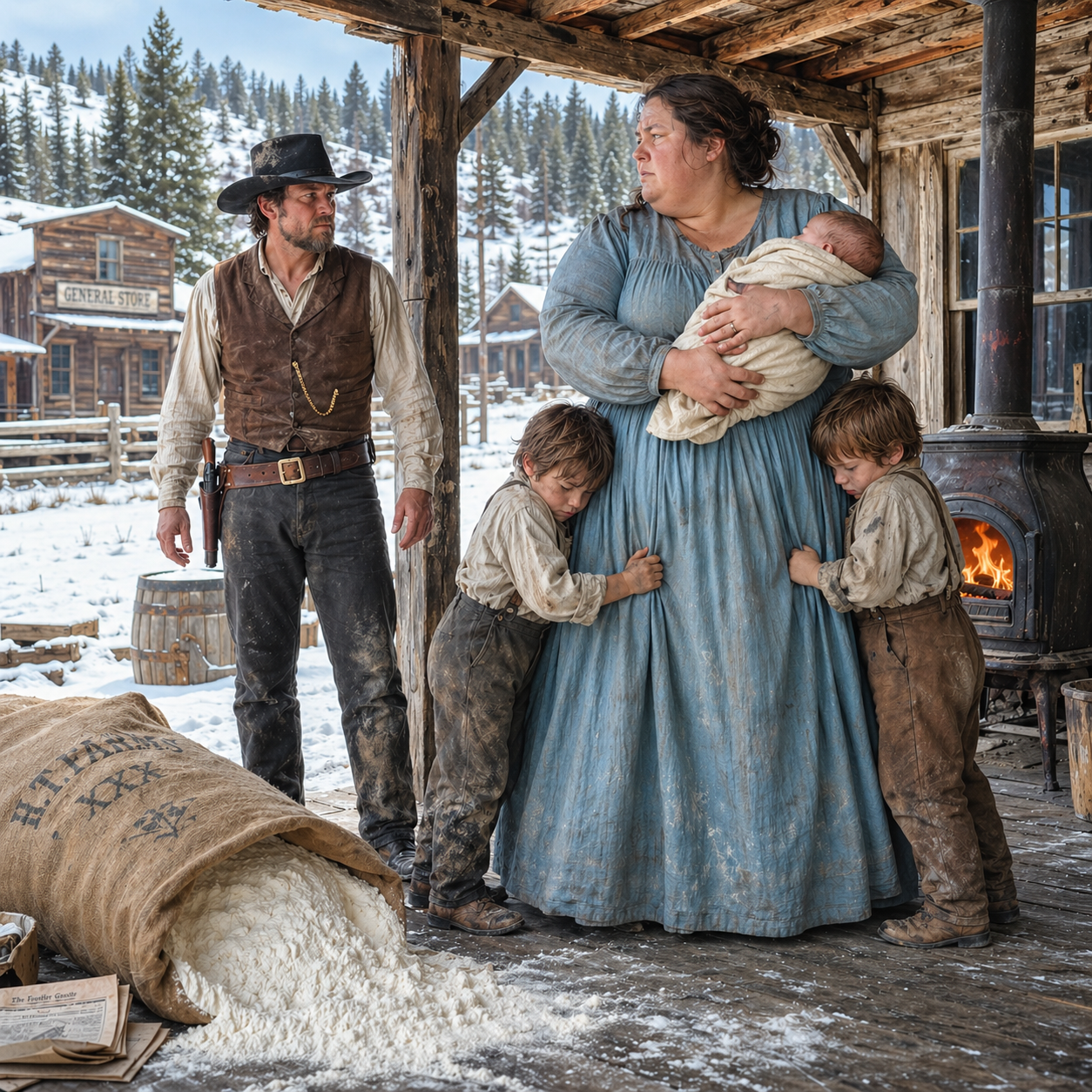
She was plus-sized, wrapped in a dusty light-blue dress that hung heavy with frost. A baby rested in her arms. Two boys clung to her sides, stumbling as they walked.
Caleb’s expression hardened immediately.
He stepped down from the porch.
They stopped under the wooden overhang near the stove vent, where faint warmth drifted into the air. The baby whimpered softly.
“You here for something?” Caleb asked.
Mary nodded. “Your notice. For a cook.”
His eyes moved from her face… to the children… then back again.
“I posted for a farm cook,” he said flatly.
“I can cook,” she replied.
He gestured sharply. “I need a cook, not a family.”
The words landed hard.
The older boy tightened his grip on her dress. The younger one lowered his head.
Mary’s face flushed with cold and embarrassment. “They’re quiet. They won’t be trouble.”
“I didn’t ask for three mouths to feed.”
“We can share rations—”
“No.”
The baby began to cry, thin and weak.
Caleb exhaled sharply. “You should head back to town.”
“We walked two miles,” she said quietly.
“That’s not my problem.”
Snow drifted between them. The wind rattled the stove pipe behind him.
Mary shifted the flour sack on her shoulder. “Please. Just let me cook supper. If you don’t like it, we’ll leave.”
Caleb shook his head. “I don’t need charity.”
“It’s not charity,” she said. “It’s work.”
The older boy whispered, “Mama…”
Caleb looked away briefly, jaw tightening.
Then he pointed toward the road. “I’m sorry. I can’t.”
Mary nodded slowly, though her eyes glistened. She turned to leave.
As she stepped forward, the flour sack slipped from her shoulder.
It hit the ground hard.
The burlap split.
White flour burst across the snow like powder, scattering in a wide cloud. The boys jumped back. The baby cried louder.
Mary gasped and dropped to her knees, trying to gather it.
“No—no—” she whispered.
But something else fell out with the flour.
Folded papers.
They slid across the snow, partially dusted in white.
Caleb frowned.
Mary froze.
The wind lifted one page, flipping it open.
Caleb stepped forward and picked it up.
Mary reached for it. “Please—don’t—”
But he had already seen the header.
County Court — Temporary Custody Notice
He looked up sharply.
Mary’s face drained of color.
“What is this?” he asked.
“Nothing,” she whispered.
He unfolded another paper.
A stamped date. A judge’s signature. A line reading:
Children to be placed in county care pending review.
Caleb’s voice hardened. “They’re taking your kids?”
Mary shook her head rapidly. “No—it’s—just—”
“Then why are you carrying court papers in a flour sack?”
Tears spilled down her cheeks. “Because I didn’t want them to see.”
The boys looked confused.
“See what?” the older one asked.
Mary pressed her lips together.
Caleb read more.
“Failure to provide adequate shelter… insufficient food… winter risk…” he murmured.
His eyes lifted slowly.
“They’re going to separate them from you.”
Mary nodded once, trembling.
“They told me I had a week,” she whispered. “Find work. Find a place. Or they’d take them.”
Caleb glanced at the children.
The younger boy clung tighter to her dress.
“You walked out here because of this?” he asked.
“Yes.”
“And the flour?”
“It was all I had left,” she said. “I thought… if I could bake… you might let me stay.”
The wind carried the loose flour across the snow.
Caleb stared at the papers again.
“You hid them,” he said.
“I didn’t want them scared.”
The older boy looked between them. “Mama?”
She pulled him close.
Caleb exhaled slowly.
He looked at the scattered flour, the trembling woman, the three children bundled against the cold.
Then he looked back at his empty house.
“I only needed a cook,” he muttered.
Mary nodded. “I understand.”
She began gathering what little flour she could salvage.
Caleb watched her.
Then he said quietly, “Can you make biscuits?”
She looked up, startled. “Yes.”
“Gravy?”
“Yes.”
He hesitated.
“Then get inside before that baby freezes.”
Mary blinked. “You mean—”
“I need supper,” he said roughly. “That’s all.”
Relief flooded her face. She nodded quickly.
The boys stared in disbelief.
Caleb picked up the papers and folded them carefully. He handed them back.
“You dropped these,” he said.
She accepted them, clutching them tightly.
They stepped inside.
Warmth from the stove filled the room. The boys hovered near it, holding their hands out. The baby quieted.
Mary moved quickly, instinctively. She measured salvaged flour, added water, stirred. Her movements were practiced, efficient.
Caleb watched silently.
The smell of biscuits soon filled the cabin.
The boys sat at the table, eyes wide.
“Smells good,” the younger one whispered.
Mary placed a pan in the oven.
Caleb leaned against the wall, arms crossed.
“You got a name?” he asked.
“Mary Caldwell.”
“Caleb Turner.”
She nodded.
Minutes later, she set biscuits on the table.
They ate quietly.
Caleb took a bite.
Then another.
“They’re good,” he admitted.
Mary exhaled softly.
The boys ate fast, trying not to appear hungry.
Caleb noticed.
“You can stay tonight,” he said.
Mary’s eyes filled again. “Thank you.”
“Tomorrow we’ll figure things out.”
She nodded.
That night, after the children slept, Caleb sat by the stove, staring at the court papers.
He thought about the county taking them.
He thought about the snow.
He thought about his own empty house.
By morning, he had made a decision.
When Mary woke, he said, “You’ll work here. Cooking. Cleaning.”
She nodded eagerly.
“And the kids?”
“They stay,” he said.
Her hand covered her mouth.
“I’ll write the county,” he continued. “Tell them you’ve got work. Shelter.”
Tears rolled down her cheeks.
“Why?” she whispered.
Caleb looked at the folded papers.
“Because no one should lose their family over winter.”
Weeks passed.
Mary cooked. The boys helped in the barn. The baby grew stronger.
Caleb found himself smiling more.
One afternoon, a county wagon arrived.
The official stepped down. “We received notice.”
Caleb nodded.
Mary stood behind him, nervous.
The man looked at the children playing in the snow.
Then at the warm smoke from the chimney.
He folded the papers.
“Case dismissed,” he said.
Mary burst into tears.
The boys hugged her.
Caleb watched quietly.
Later, as snow fell gently across the ranch, Mary stood beside him.
“You changed our lives,” she said.
Caleb shook his head.
“No,” he said. “That flour sack did.”
She smiled through tears.
He looked at the children laughing in the snow.
And for the first time in years, his house didn’t feel empty anymore.