
Rich Rancher Pays an Old Couple Wages—Until He Opens Their Cabin and Finds an Orphans’ Home
The first time anyone saw the old couple, they were standing beside the broken fence at the edge of the Miller ranch, holding hands as though the wind might carry one of them away.
The man was thin and bent, his hat worn almost white. The woman stood straighter, but her coat had been patched so many times it looked like a quilt. Between them rested a wooden cart loaded with a few blankets, a kettle, and a crate tied with rope.
They looked like people who had already lost everything—and were prepared to lose a little more.
Daniel Miller watched them from horseback.
He was known across Wyoming as the richest rancher in three counties. His land stretched farther than most men could ride in a day. He owned cattle, timber, and even a small rail siding. People said he could buy half the valley if he wanted.
But Daniel Miller didn’t buy people.
He studied them quietly.
“You folks lost?” he called.
The old man lifted his head. “No, sir. Just looking for work.”
Daniel rode closer.
“What kind of work?”
“Anything,” the old man said. “Fixing fences. Tending animals. Cleaning. My wife cooks.”
The woman nodded gently. “We don’t need much. Just a place to stay.”
Daniel glanced at the cart. That really was all they had.
“You got names?” he asked.
“Thomas,” the man replied. “This is Mary.”
Daniel nodded. “You ever run cattle?”
“Not much. But I learn quick.”
Daniel considered. Most ranch hands were younger, stronger. But something about them—maybe the way they stood together—made him hesitate.
He pointed toward the far end of his property.
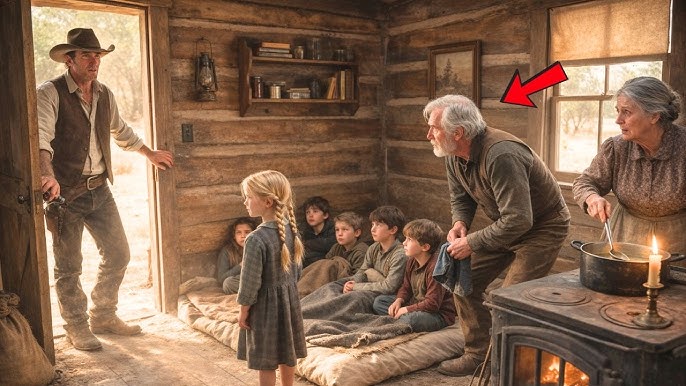
“There’s an old cabin near the cottonwoods. Needs cleaning. Fence line too. I’ll pay wages.”
Thomas blinked. “You would?”
Daniel shrugged. “Work’s work.”
Mary squeezed her husband’s hand.
“Thank you, sir.”
Daniel nodded once. “I’ll send someone with supplies.”
They thanked him again and began pulling the cart down the dirt track.
Daniel watched them go.
He had no idea he’d just hired more than two people.
The cabin stood far from the main house, near a shallow creek. It had a sagging roof and shutters that didn’t quite close. Most hands avoided it. But Thomas and Mary worked quietly.
Within days, smoke rose from the chimney.
They repaired the door, mended the roof, and cleared weeds. Daniel noticed from a distance but didn’t interfere.
He paid them weekly—more than they asked.
Mary always thanked him politely.
Thomas always tipped his hat.
They never came to the big house.
Weeks passed.
Then one morning, Daniel rode past the creek and noticed something odd.
Tiny footprints.
Not just two sets—many.
He frowned.
He dismounted and studied the ground. Small shoes. Different sizes. Fresh.
He looked toward the cabin.
The door was closed. Smoke curled gently.
He hesitated.
Maybe visitors.
Still, something tugged at him.
He rode on.
The next week, he saw laundry hanging behind the cabin.
Small shirts.
Tiny socks.
A blue dress no larger than his saddlebag.
Daniel slowed his horse.
He counted.
One… two… five… eight…
He frowned deeply.
That night, he mentioned it to his foreman.
“You send extra workers down there?”
The foreman shook his head. “No, sir.”
“You seen children around the creek?”
“No.”
Daniel leaned back in his chair.
He didn’t like mysteries on his land.
Three days later, he returned unannounced.
The afternoon sun filtered through cottonwoods. The cabin looked peaceful. A pot simmered outside. A wooden bucket sat near the door.
He heard laughter.
Children’s laughter.
Daniel froze.
It came from inside.
He stepped closer quietly. The window curtain moved slightly.
He knocked.
The laughter stopped instantly.
Silence.
Footsteps inside.
The door opened a crack.
Mary appeared, surprised.
“Oh… Mr. Miller.”
Daniel nodded. “Afternoon.”
She hesitated, then opened the door wider.
“Is something wrong?”
He looked past her.
Then he saw them.
Children.
Six of them.
One girl braiding another’s hair. A small boy sitting on the floor carving wood. Two toddlers near the stove. Another child reading from a worn book.
They all froze.
Daniel stared.
Mary’s hands trembled slightly.
“I… I was going to tell you,” she whispered.
Thomas stepped forward from the back room.
“They had nowhere to go.”
Daniel’s voice was calm but firm. “Explain.”
Thomas swallowed.
“We found the first one near the rail line. Boy lost his parents. Then two sisters… then another… word spread.”
Mary added softly, “We couldn’t turn them away.”
Daniel looked around.
The cabin was small. Beds made from pallets. Blankets folded neatly. A pot of soup simmering. Shoes lined along the wall.
Everything clean.
Everything cared for.
He counted again.
Seven children.
The smallest toddled toward him.
“Are you the boss?” she asked.
Daniel blinked.
“Yes.”
She smiled. “Miss Mary makes good soup.”
The older girl whispered, “Lila, come back.”
Daniel’s chest tightened unexpectedly.
“You’re feeding all of them?” he asked.
Mary nodded. “We stretch the wages.”
Thomas lowered his eyes. “If it’s not allowed… we’ll leave.”
The children stiffened.
The little boy stepped forward protectively.
“Don’t send them away,” he said.
The words hung heavy in the room.
Daniel didn’t answer immediately.
He walked slowly around the cabin. Saw patched clothes. Handmade toys. Books worn thin. A chalkboard nailed to the wall with letters written carefully.
An orphan’s home.
Built from nothing.
He stopped near the stove.
“You’ve been using your wages for this?” he asked.
Mary nodded. “Every cent.”
Daniel looked at Thomas.
“You didn’t tell me.”
Thomas shook his head. “Didn’t want to trouble you.”
Silence filled the cabin.
Then Daniel did something no one expected.
He reached into his coat and pulled out a folded envelope.
He set it on the table.
Mary frowned. “What is it?”
“Your wages,” he said. “Three months.”
Thomas blinked. “But you already paid us—”
Daniel interrupted quietly.
“That was for two workers.”
He looked at the children.
“This is for running an orphans’ home.”
Mary’s eyes filled instantly.
Thomas couldn’t speak.
The children watched, confused.
Daniel cleared his throat.
“You’ll need more space,” he added.
Thomas whispered, “Sir… we don’t expect—”
“You don’t expect,” Daniel said softly. “But they need.”
He turned toward the door.
Before leaving, he looked back once.
“No child on my land goes hungry,” he said.
The door closed behind him.
Inside, the children stared at Mary.
“Are we staying?” Lila asked.
Mary knelt, tears falling.
“Yes,” she whispered. “We’re staying.”
The next morning, wagons arrived.
Wood.
Blankets.
Flour.
Milk.
Books.
Thomas stood speechless.
Mary covered her mouth.
Daniel watched from horseback.
“We’ll expand the cabin,” he said simply.
The foreman nodded.
Children ran outside, laughing.
The little boy looked up at Daniel.
“Are you the one who saved us?”
Daniel hesitated.
Then he answered quietly.
“No.”
He looked at Thomas and Mary.
“They did.”
The expansion of the cabin began the very next day.
Carpenters arrived with lumber stacked high in two wagons. The sound of hammers echoed through the cottonwoods, mixing with children’s laughter and Mary’s gentle voice calling them in for meals. What had once been a lonely, sagging cabin slowly transformed into something larger—two extra rooms, a wider porch, and a small loft for sleeping.
Daniel Miller didn’t come close while they worked. He watched from a distance, riding the fence lines, pretending he had business elsewhere. But every afternoon, he noticed something new: a line of blankets drying, chalk drawings on the porch, tiny boots outside the door.
The place felt alive.
One evening, after the workers left, Daniel rode down quietly. The sun dipped low, casting gold through the trees. He dismounted and approached on foot.
He heard singing.
Soft, uneven, but heartfelt.
Mary sat on the porch with three of the younger children, teaching them a lullaby. Thomas carved a wooden horse while two boys watched closely. The older girl—Anna—was reading aloud from a book, sounding out difficult words carefully.
Daniel stood still.
He hadn’t heard singing on his land in years.
Mary noticed him first. She rose gently. “Mr. Miller.”
The children turned.
Lila ran toward him again, as if it were the most natural thing in the world. “Look! We got new beds!”
She grabbed his hand and pulled him inside before he could protest.
The new room smelled of fresh pine. Small cots lined the wall, each with a folded blanket. A chalkboard hung near the window. Someone had drawn a crooked sun.
Daniel looked around slowly.
“You did all this in two days?” he asked.
Thomas shook his head. “Your men did most of it.”
Mary added softly, “But we’ll take care of it.”
Daniel nodded once.
He noticed a small table near the wall with bowls set out—more than before.
“You expecting more?” he asked.
Mary hesitated.
“We don’t know,” she admitted. “Sometimes they just… appear.”
Daniel’s jaw tightened slightly.
He looked at the children again.
“How many now?”
“Seven,” Thomas replied. “Still seven.”
Daniel nodded.
But two days later, it became eight.
A boy no older than six wandered onto the property at dawn. Barefoot. Hungry. Silent. Mary found him near the creek. He wouldn’t speak at first, only clutched a broken toy wagon.
She wrapped him in a blanket and brought him inside.
By noon, he was sitting with the others, eating soup.
When Daniel heard, he didn’t ask questions.
He simply sent another sack of flour.
Weeks passed.
The orphan cabin became known quietly among nearby towns. No sign marked it. No announcement made. Yet children kept arriving—some brought by kind strangers, others wandering alone.
Nine.
Then ten.
Then eleven.
Mary stretched meals carefully. Thomas built shelves, fixed toys, and made extra stools. The older children helped with chores, proud to be useful.
Daniel increased their wages without comment.
One afternoon, he finally rode down while the children played outside.
They were chasing a ball made from rags. Lila tripped and fell, then burst into giggles. Two boys argued over who cheated. Anna clapped her hands to organize teams.
Daniel leaned against the fence, watching.
Thomas walked over.
“They’ve never had this before,” he said quietly.
“Neither did you?” Daniel asked.
Thomas shook his head. “No. But Mary… she always believed children shouldn’t grow up alone.”
Daniel looked at the porch, where Mary was mending clothes.
“She’s strong,” he said.
Thomas smiled. “Stronger than me.”
Silence settled.
Then Daniel spoke again.
“You two ever thought about… making this official?”
Thomas blinked. “Official?”
“A real orphan home. Papers. Supplies. Teachers.”
Thomas hesitated. “We wouldn’t know how.”
Daniel nodded. “I do.”
Thomas studied him carefully. “Why are you helping us?”
Daniel didn’t answer immediately.
Instead, he watched Lila run across the yard, hair flying.
“My parents died when I was twelve,” he said finally. “No one took me in. I worked… survived. But I remember what it felt like.”
Thomas’s expression softened.
“You’re giving them what you never had,” he said.
Daniel looked away slightly.
“Maybe.”
That night, a storm rolled in.
Wind shook the cottonwoods. Rain hammered the roof. The children grew restless, crowding close to Mary. Thomas checked the shutters repeatedly.
Just after midnight, a knock sounded.
Three sharp raps.
Everyone froze.
Thomas opened the door carefully.
A woman stood outside, soaked, holding a bundled child.
“I heard… this place helps,” she whispered.
Mary stepped forward immediately.
“Come in.”
The woman handed over the toddler and collapsed onto a chair.
“I can’t keep him,” she cried. “I have nothing.”
Mary wrapped the child gently.
“He’ll be safe,” she promised.
Thomas looked at the woman kindly. “You can rest tonight.”
The storm raged outside.
Inside, another child found shelter.
Twelve.
The next morning, Daniel arrived early. He noticed the extra boots immediately.
He didn’t say anything.
He simply unloaded another crate—milk, eggs, blankets.
Mary’s eyes filled again.
“You don’t have to keep doing this,” she said softly.
Daniel shook his head. “Yes, I do.”
The children gathered around him, curiosity growing. He had become a familiar presence now—the quiet man who brought supplies and sometimes watched them play.
The silent boy who arrived earlier finally spoke.
“What’s your name?”
Daniel looked surprised.
“Daniel.”
The boy nodded. “I’m Jacob.”
Daniel smiled faintly. “Nice to meet you, Jacob.”
It was the first time the boy had spoken to anyone.
Mary wiped her eyes quietly.
Months passed.
The cabin no longer looked like a cabin. It looked like a small home—full, warm, alive. A vegetable garden grew behind it. Chickens wandered freely. The older children took turns reading to the younger ones.
One afternoon, Daniel rode down with a folded document.
Thomas met him at the porch.
“What’s this?” he asked.
Daniel handed it over.
“A deed.”
Thomas frowned. “To what?”
Daniel looked at the house.
“This land. The cabin. It’s yours now. For the children.”
Thomas’s hands shook.
Mary covered her mouth.
“You can’t—” Thomas began.
“I can,” Daniel said quietly. “And I want to.”
The children watched, sensing something important.
Mary whispered, “We don’t know how to thank you.”
Daniel looked at them all—twelve children, two elderly caretakers, one humble home.
“You already did,” he replied.
Lila ran forward and hugged his leg.
“You’re part of our home too,” she declared.
Daniel froze.
Then slowly… he placed a hand on her head.
And for the first time in years, the richest rancher in three counties felt something he couldn’t buy—
A family.