
He Returned 200 Stolen Horses… Then 20 Apaches Said, “From Now On, We Belong to You”.
The dust cloud on the horizon looked wrong.
Tom Walker had spent half his life reading the plains, and that cloud didn’t move like cattle. It stretched long and low, drifting in broken lines instead of a single herd. Too many separate movements. Too fast.
He shaded his eyes.
“Horses,” he muttered.
But not grazing. Running.
He climbed the ridge above his small ranch and watched carefully. The animals were packed tight, driven hard, cutting across the valley toward the foothills. Whoever pushed them wasn’t letting them slow.
Tom’s jaw tightened.
No rancher drove horses like that unless something was wrong.
He saddled up without hesitation.
Tom Walker wasn’t a sheriff. He wasn’t even particularly wealthy—just a quiet cowboy with a modest spread and a reputation for minding his own business. But he hated thieves more than drought, and horse thieves worst of all.
Because out here, stealing horses wasn’t just theft.
It was survival taken away.
He rode fast, angling toward the trail the herd had carved. Hoofprints confirmed it—hundreds of animals, maybe two hundred. Driven hard, no rest.
He followed for miles until he spotted them.
Three riders.
That was all.
Three men pushing a massive stolen herd.
Tom frowned. That didn’t make sense either. No one could manage two hundred horses alone unless they planned to hand them off.
He slowed, keeping distance.
The riders pushed toward a narrow canyon—bad country. Rocky. Easy to ambush. Tom circled wide, climbing a ridge above them.
That’s when he saw something else.
Smoke.
Thin. Hidden. On the far side of the canyon.
Camp.
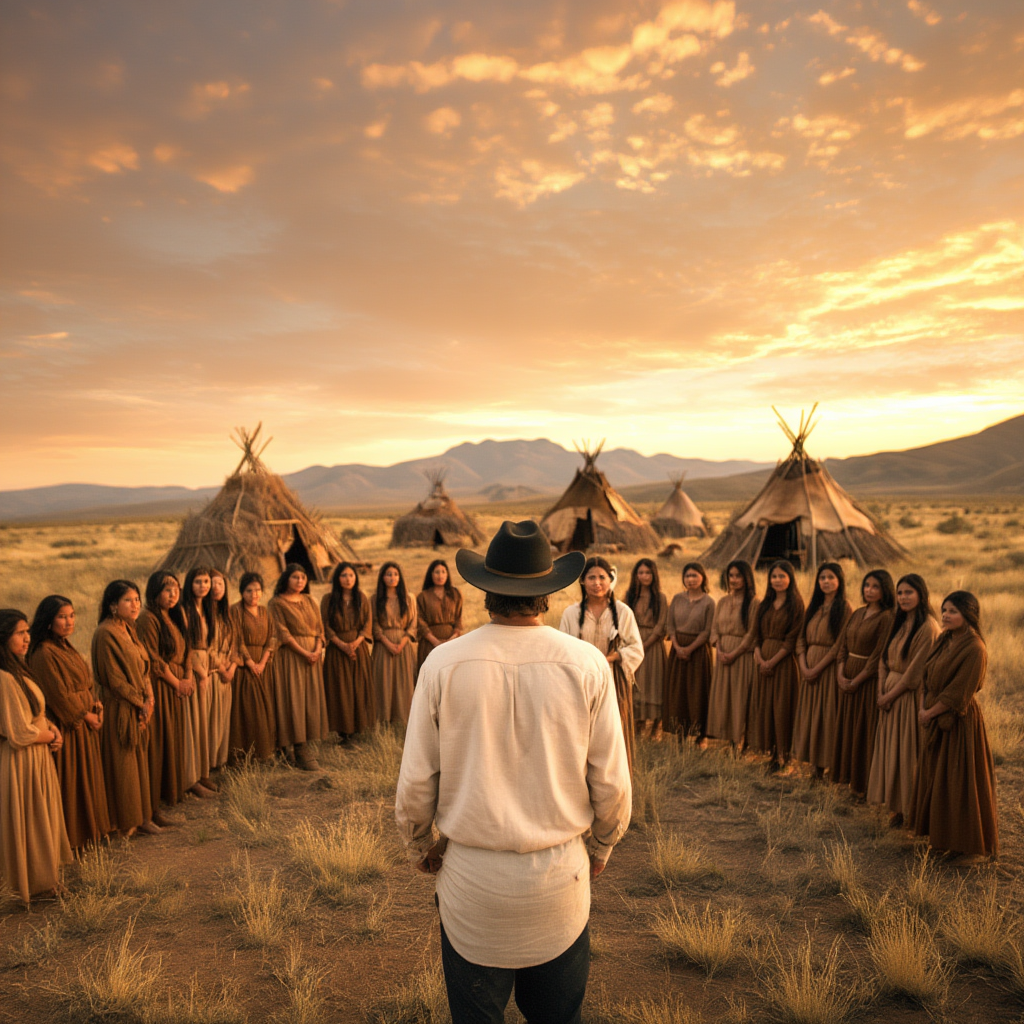
Not just one fire—several.
Tom realized what was happening.
The thieves weren’t working alone.
They were delivering.
To whom, he didn’t know—but he knew trouble when he saw it.
He studied the canyon. If the herd reached the far side, it would vanish into rugged terrain impossible to track. Whoever waited there would disappear with them.
Tom exhaled slowly.
He was alone.
Two hundred horses. Three thieves. Unknown number waiting ahead.
He should ride back. Warn the sheriff.
But by then, it would be too late.
He made a decision.
Tom rode down the slope, cutting wide behind the herd. He didn’t approach the riders directly. Instead, he circled toward the lead edge of the horses. Quietly. Slowly.
Then he did something risky.
He spooked the front line.
He fired a single shot into the air.
The herd panicked, scattering sideways instead of forward. Horses bolted in multiple directions, breaking the thieves’ control instantly.
“Hey!” one rider shouted.
They chased, trying to regroup, but two hundred frightened horses don’t listen. The herd split into three groups, turning away from the canyon.
Tom rode hard, pushing them further apart.
Chaos swallowed the valley.
The thieves cursed, chasing strays. One spotted Tom.
“You! Stop!”
Tom didn’t.
He drove the largest group toward open plains—away from the canyon, away from the waiting camp. The horses ran, spreading wide, impossible to regather quickly.
By the time the thieves regained partial control, half the herd was miles away.
Tom kept riding.
It took hours. He guided them slowly, calming them, regrouping what he could. By sunset, he had maybe a hundred and twenty horses under loose control.
He whistled softly, using old cattle-driving tricks.
They followed.
Over the next two days, he tracked and recovered more. Some wandered far. Some joined small bands. He worked tirelessly, sleeping little, eating in the saddle.
By the fourth day, he had nearly all of them.
Two hundred horses.
He began the long drive back toward ranch country.
Word spread quickly. Ranchers rode out, stunned.
“Those are ours!”
“You found them!”
“Thought we lost everything!”
Tom nodded, handing over animals as owners identified brands. Gratitude poured in. Offers of money, supplies, help.
He refused most.
“Just returning what’s yours,” he said.
But one thing bothered him.
The camp.
The smoke.
The people waiting for the delivery.
They would be angry.
And he wasn’t wrong.
On the fifth evening, as Tom watered the remaining horses near a creek, he felt it—silence. The kind that falls when watchers are near.
He turned slowly.
Twenty riders stood along the ridge.
Apache warriors.
They sat their horses calmly, faces unreadable.
Tom’s pulse quickened—but he didn’t reach for his gun.
The leader rode forward. He was older, weathered, eyes sharp.
“You scattered the herd,” the man said.
Tom nodded. “They were stolen.”
The warrior studied him.
“They were promised to us.”
Tom met his gaze. “By thieves.”
Silence stretched.
The warriors murmured quietly among themselves.
Tom stayed still. No sudden moves.
Finally, the leader spoke again.
“You could have taken horses for yourself.”
“I didn’t steal them.”
“You could have run.”
“I didn’t.”
The man nodded slowly.
“You returned them… all?”
“Every one I found.”
Another pause.
Then something unexpected happened.
The leader dismounted.
He stepped closer, studying Tom like measuring him.
“You fight alone,” he said. “Against many.”
Tom shrugged. “Did what was right.”
The warrior turned to his people, speaking in Apache. They listened intently. Some nodded.
Then he faced Tom again.
“Thieves lied to us,” he said. “They said these horses were payment. We believed them.”
Tom said nothing.
The leader’s expression softened slightly.
“You returned two hundred stolen horses… when you could have kept them. That is strong medicine.”
Tom shifted, unsure what to say.
The warrior extended his hand—not in the white man’s way, but open, respectful.
“From now on,” he said, voice steady, “we belong to you.”
Tom blinked.
“I don’t want anyone belonging to me,” he replied.
The warrior smiled faintly.
“You misunderstand. We stand with you. Your enemies… are ours. Your trail… is safe.”
The other nineteen dismounted, forming a quiet line behind him.
It wasn’t submission.
It was allegiance.
Tom felt the weight of it.
“You don’t owe me,” he said.
The leader shook his head.
“You showed honor. We answer honor.”
He pointed toward the horizon.
“No one will steal your horses again.”
The warriors mounted again.
Before leaving, the leader spoke once more.
“You returned what was not yours. Few men do that.”
Then they rode away, silent as they had appeared.
Tom watched until they vanished.
He didn’t know if he’d ever see them again.
But months later, when rustlers passed near his land, they turned away suddenly. Tracks suggested riders had intercepted them.
Another time, a lost calf was returned—no explanation.
Word spread quietly: Tom Walker’s ranch was protected.
Not by law.
Not by guns.
But by honor.
He had returned two hundred stolen horses.
And in doing so, he gained something far rarer—
Respect that crossed cultures…
And twenty Apache warriors who chose, by their own words:
“From now on, we belong to you.”
Tom Walker didn’t expect to see them again.
The plains had a way of swallowing moments whole—dust storms erased tracks, seasons shifted loyalties, and promises often faded with distance. Tom assumed the encounter at the creek would become just another story people exaggerated over time.
But three weeks later, he realized it hadn’t ended.
He was repairing fence along the north pasture when his horse lifted its head, ears pricked. Tom followed its gaze. On the far ridge, silhouettes appeared—still as stones.
Twenty riders.
They didn’t move closer. They didn’t call out. They simply watched.
Tom set down his hammer, wiped his hands, and lifted one arm in quiet acknowledgment.
The riders remained for several minutes.
Then, one by one, they turned and disappeared.
Tom exhaled slowly.
They were keeping their word.
He didn’t speak of it much, but the effects became obvious. Rustlers avoided his grazing routes. Travelers mentioned seeing Apache scouts near water crossings. Once, a trader told him quietly:
“Your range is the safest stretch for fifty miles. Folks say you got guardians.”
Tom shrugged, but inside he knew.
Autumn came, bringing long cattle drives. Tom joined a neighboring rancher, Daniel Brooks, to move a herd south. Halfway through the journey, they spotted dust behind them.
Daniel squinted. “We got company.”
Tom studied the horizon.
Riders.
Too many to be coincidence.
Daniel reached for his rifle. “Rustlers?”
“Maybe,” Tom replied.
The riders closed distance—then slowed.
Twenty shapes spread along the ridgeline.
Apache.
Daniel swallowed. “You know them?”
Tom nodded slightly. “They’re… friends.”
The Apache didn’t approach. They simply shadowed the drive from a distance. Every night, faint silhouettes appeared on nearby hills. Every morning, they were gone.
On the third day, Daniel laughed quietly.
“No one’s touching this herd.”
Tom agreed.
When the drive ended safely, Daniel shook his head.
“You returned those horses… and now they’re guarding you like family.”
Tom considered the word.
Family.
He wasn’t sure—but it felt close.
Winter approached early that year. Snow dusted the plains, and supplies grew thin. One evening, Tom returned to find something unexpected at his door: two deer, freshly dressed, laid neatly beside the porch.
No tracks.
Just the gift.
He smiled faintly.
A week later, he left sacks of flour and coffee near the creek where he’d first met them. By morning, they were gone.
The exchange became quiet routine.
Not payment.
Respect.
Then came trouble.
Late January, a group of armed men rode into the valley—new faces, rough, clearly not ranchers. They asked questions in town, loud and careless.
“Walker’s the one who stopped the horse drive,” one said.
“Word is he rides alone.”
They weren’t subtle.
Tom heard about it from the storekeeper.
“You got enemies now,” the man warned.
Tom nodded. “Maybe.”
He prepared quietly—checked fences, kept rifle close, avoided unnecessary trips.
Three days later, the men rode toward his ranch.
Tom saw them coming—six riders, confident. He stepped outside, calm but ready.
They halted twenty yards away.
“You Walker?” the leader asked.
“Yes.”
“You interfered with our business.”
“Those horses were stolen.”
The man smiled thinly. “They weren’t yours to return.”
Tom didn’t respond.
The tension thickened.
Then something shifted.
One of the riders glanced behind Tom—eyes widening.
The leader turned.
Along the ridge behind the cabin stood twenty Apache warriors.
Silent.
Watching.
The wind seemed to stop.
The men shifted uneasily.
The Apache leader—same man from the creek—rode forward slowly. He said nothing. He didn’t threaten. He simply rested his gaze on the strangers.
It was enough.
The leader of the six men swallowed.
“This ain’t worth it,” he muttered.
They turned their horses.
Within seconds, they rode away fast.
The Apache remained until the dust settled.
Then the leader approached Tom.
“You have enemies,” he said.
“Seems so.”
“We keep watch.”
Tom nodded. “You don’t have to.”
The man shook his head.
“We choose.”
They sat in silence a moment.
“You returned horses,” the leader added. “We return safety.”
Tom felt something settle deep in his chest.
Not ownership.
Not debt.
Something closer to trust.
Spring returned again. Grass grew tall. The land softened. Tom noticed Apache riders less frequently—but signs of them remained: fresh tracks near water, distant silhouettes, once a repaired section of fence he hadn’t fixed.
They were still there.
One evening, Tom rode to the creek. He found the leader waiting.
“You ride far,” the man said.
“Wanted to say something,” Tom replied.
The leader waited.
“You told me… ‘From now on, we belong to you.’”
The man nodded.
Tom shook his head gently.
“I don’t want that. No one belongs to me.”
The leader studied him, then smiled faintly.
“We know.”
He gestured to the land.
“We belong… to this place. You protect it. So we stand with you.”
Tom understood.
Not possession.
Partnership.
They sat quietly, watching water flow.
When the leader finally rose to leave, he spoke one last time.
“You returned two hundred stolen horses. That showed who you are. We do not forget.”
He rode away, the others following.
Tom watched them disappear into the hills.
He had never asked for allies. Never expected loyalty beyond neighbors. But one act—returning what wasn’t his—had created something rare.
Not fear.
Not obligation.
Respect.
And from that respect came something stronger than force—
Twenty Apache warriors who chose, freely and quietly, to stand beside him… not because they belonged to him—
But because honor had bound them together.