
Rich Farmer Caught a Poor Woman Stealing Corn – His Reaction Left Everyone Stunned
The wind moved low across the corn, whispering through the dry leaves like a warning. The sky hung heavy and gray over the valley, clouds pressed low enough to make the hills look smaller than they were. Dust and small stones lined the narrow dirt path cutting through the farmland. Everything felt quiet—too quiet for harvest season.
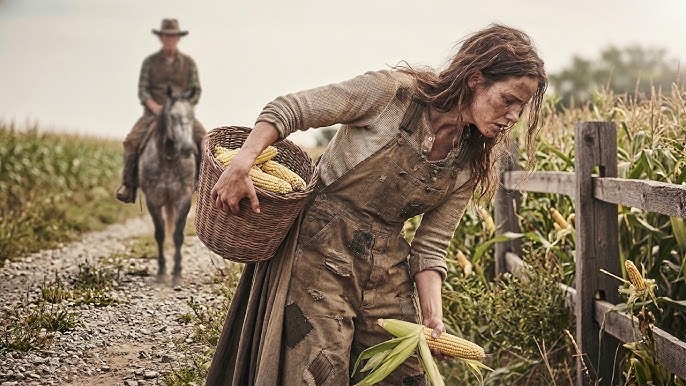
Mary Caldwell moved carefully between the rows.
Her long brown hair hung loose and tangled, strands sticking to her dirt-smudged cheeks. Her patched overalls were worn thin at the knees, and the sleeves of her faded shirt had been mended more times than she could count. In one hand, she held a large wicker basket already heavy with corn. With the other, she twisted another ear free from the stalk.
She paused, listening.
Only wind.
Only silence.
She placed the corn gently into the basket and kept moving.
Mary hated stealing.
But hunger had a way of bending rules until they snapped.
Three miles away, in a crooked cabin at the edge of a dry creek, her two boys waited. The youngest, Daniel, had stopped asking when supper would be ready. That silence hurt worse than any question. The older one, Luke, pretended he wasn’t hungry, but she’d seen him licking crumbs from the table yesterday.
She pulled another ear.
This would be enough. Just enough.
She never took from the same place twice. Never took more than she needed. Never left broken stalks behind. She told herself that mattered.
Still, her hands trembled.
A distant sound cut through the wind.
Hoofbeats.
Mary froze.
Slow. Rhythmic. Getting closer.
Her heart dropped.
She turned slightly, trying not to rustle the leaves. Along the dirt path beyond the rustic wooden fence, a man rode toward her on a dark horse. His silhouette was unmistakable — wide-brimmed hat, straight back, long coat shifting with the movement of the horse.
He wasn’t passing by.
He was heading straight for the field.
Mary’s breath caught. She lowered the basket slowly, hoping to slip away through the rows. But the corn here wasn’t tall enough. Anyone riding above ground level would see her clearly.
The horse slowed.
Stopped.
Silence again — except now it felt heavy.
She didn’t turn. If she ran, she’d drop the basket. If she stayed, she might still talk her way out.
Boots hit the ground behind the fence.
A gate creaked.
Mary closed her eyes for half a second.
Then she turned.
The man stepped into the row, leading the horse by the reins. He was taller than she expected. Broad shoulders. Weathered face. Dark beard trimmed short. His coat was well-made but dusty from work, not show. Everything about him said he belonged here.
He looked at the basket first.
Then at her.
Then at the broken stalk in her hand.
“You planning to pay for those?” he asked calmly.
His voice wasn’t angry. That somehow made it worse.
Mary swallowed. “No, sir.”
The man nodded once, as if confirming something he already knew.
“You know whose land this is?”
“Yes.”
“And you still took it.”
“Yes.”
Wind pushed the corn leaves between them.
Mary tightened her grip on the basket handle. “I’ll put them back.”
“You can’t put corn back,” he replied quietly.
She hesitated. “I’ll… I’ll leave. I won’t come again.”
He studied her. Not just her face — her clothes, her boots, the dirt on her hands. His gaze lingered on the careful way she had harvested, clean twist, no waste.
“You didn’t break the stalks,” he said.
Mary blinked. “No, sir.”
“You picked the ripe ones.”
“Yes.”
“And you brought a basket.”
She didn’t understand where he was going. “Yes.”
“You’ve done this before.”
She hesitated. Then nodded. “Only when we needed it.”
“We?”
“My boys.”
The man’s expression shifted slightly. Not soft — just less hard.
“How many?”
“Two.”
He looked past her toward the distant hills. The horse flicked its tail behind him.
“How long since they ate?” he asked.
Mary felt heat rise to her face. Pride told her not to answer. But pride didn’t fill stomachs.
“Yesterday morning.”
Silence stretched.
The man stepped closer. He reached into the basket, lifted an ear of corn, turned it in his hands, then placed it back.
“You picked good ones,” he said.
Mary didn’t know whether that was praise or accusation.
“I’ll leave now,” she repeated.
“You walked here?”
“Yes.”
“Three miles?”
She nodded.
“With that basket?”
“Yes.”
He looked at her boots — cracked leather, thin soles.
Then he did something unexpected.
He picked up the basket.
Mary stiffened. “Sir, please—”
He handed her the reins of his horse.
“Hold this,” he said.
She stared at him. “What?”
“Hold the horse.”
Confused, she took the reins. The animal snorted softly but stood calm.
The man walked deeper into the corn rows.
Mary’s heart pounded. Was he gathering evidence? Was he going to bring more people?
She almost ran.
But she didn’t.
After a minute, he returned — carrying two more baskets, both filled.
He set them beside hers.
Mary stared.
“I— I didn’t take those,” she whispered.
“I know,” he said.
He picked up all three baskets and carried them toward the path.
Mary followed, stunned.
At the fence, he loaded the baskets across the saddle.
Then he looked at her.
“Get on.”
Her mouth opened. “Sir?”
“I said get on.”
“I… I can walk.”
“You’ll spill half of it.”
“I don’t want trouble.”
“You already have trouble,” he said calmly. “Get on.”
Slowly, uncertainly, Mary climbed onto the horse. He adjusted the baskets so they wouldn’t fall.
Then he took the reins and began walking down the dirt path.
They moved in silence.
After a while, she whispered, “Why?”
He didn’t answer right away.
“What’s your name?” he asked instead.
“Mary.”
“I’m Thomas Whitaker.”
She stiffened. Everyone knew that name.
The richest farmer in three counties.
Owner of more land than anyone else.
The man whose fields she had just stolen from.
“I’m sorry,” she said quickly.
He shook his head. “You already said that.”
They walked another stretch.
“You ever work a field?” he asked.
“Yes.”
“You know harvest?”
“Yes.”
“You know how to pick without ruining yield.”
She nodded slowly.
He stopped walking.
Turned.
Looked up at her.
“I’ve got thirty acres needing hands,” he said. “Half the men I hired quit when the weather turned.”
Mary stared at him.
“You want to steal,” he continued quietly, “or you want to earn?”
Her throat tightened.
“I… I’d rather earn.”
“Then you start tomorrow.”
She blinked rapidly. “You mean… work?”
“Yes.”
“For pay?”
“Yes.”
“And… the corn?”
He shrugged. “Advance.”
She couldn’t speak.
They resumed walking.
When they reached the crooked cabin, two boys rushed out. They froze at the sight of the horse, then at the baskets.
Mary slid down.
“They’re yours,” Thomas told the boys.
The younger one looked at Mary. “Mama?”
She nodded, tears in her eyes.
Thomas turned to leave, but Luke spoke.
“Mister?”
Thomas stopped.
“Why are you helping us?”
The farmer considered the boy carefully.
“Because,” he said slowly, “your mother only took what she needed… and she took it like someone who respected the land.”
He placed the reins in Mary’s hands.
“Sunrise,” he said. “North field.”
Then he mounted and rode away.
Word spread by evening.
By morning, half the town knew.
People gathered near the north field, whispering. Some expected him to punish her publicly. Others expected him to turn her away.
Instead, Thomas handed Mary a pair of work gloves.
“Start with row one,” he said.
The crowd fell silent.
A stunned murmur rolled through them.
The richest farmer in the valley had caught a thief — and hired her.
By midday, he walked past her rows.
“You’re fast,” he noted.
“I’ve done this before.”
“I can tell.”
By sunset, she had outpicked three men.
Thomas said nothing.
But the next morning, he brought her better boots.
By the end of the week, he gave her steady wages.
By the end of the month, the boys were laughing again.
And every time someone asked why he helped a thief, Thomas gave the same answer:
“She wasn’t stealing,” he said quietly.
“She was surviving.”