
No One Wanted a Widow With 10 Children — Until a Cowboy Broke Every Rule
The dust rolled slowly across the road, thin as smoke in the late afternoon light. The small frontier town of Red Hollow sat quiet under a pale sky, the wooden buildings worn by wind and years. Horses shifted lazily outside the general store, and a few townsfolk gathered near the water trough, whispering as they watched the woman walking into town.
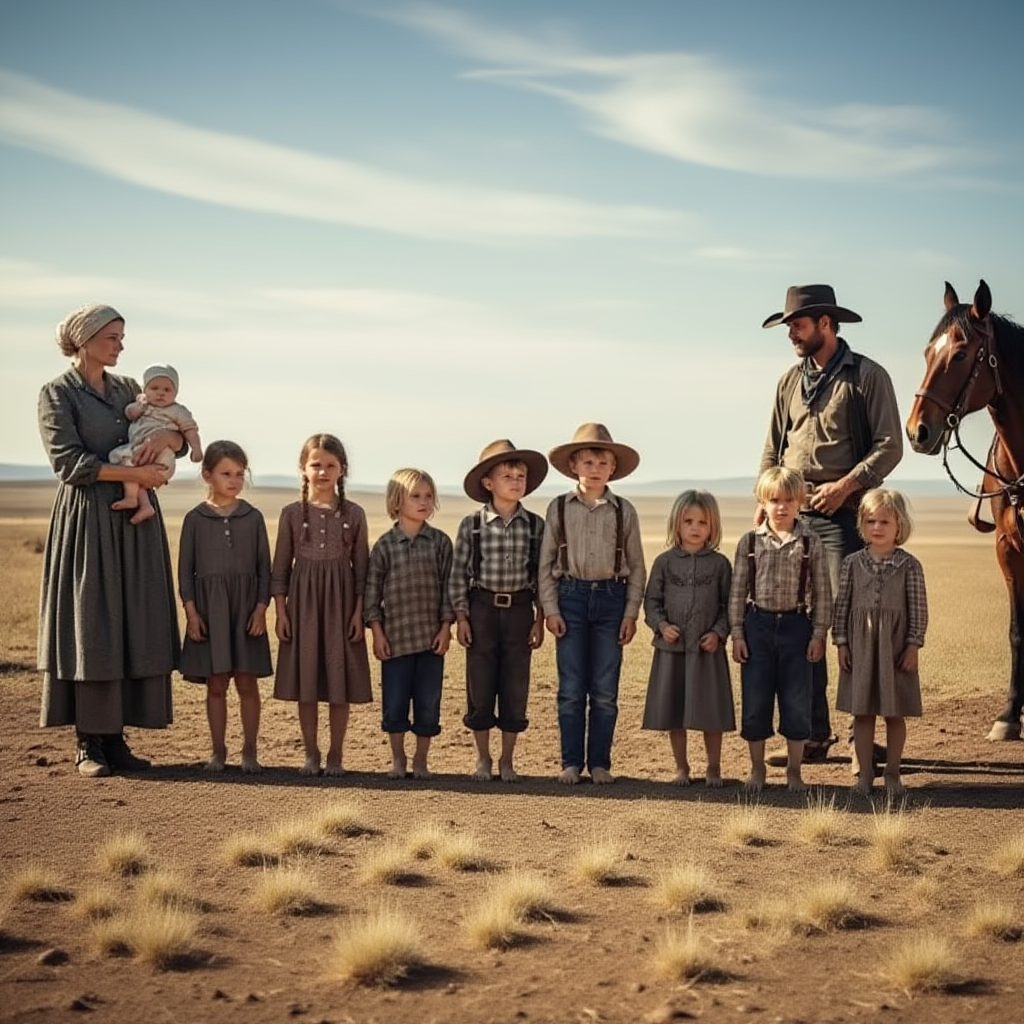
She moved carefully, one hand gripping the youngest child on her hip, the others trailing behind her in uneven steps.
Ten children.
They stretched behind her like a fragile caravan — some barefoot, some holding hands, one carrying a patched sack, another clutching a ragged doll. Their clothes were clean but worn thin, mended so many times that the fabric looked like a quilt of survival.
At their head walked Hannah Whitaker.
Her black dress, once proper mourning cloth, had faded under sun and labor. Loose strands of brown hair framed her tired face. Her shoulders were straight, but exhaustion showed in every movement. She had walked twelve miles to reach Red Hollow, and the children had walked with her.
She stopped in front of the general store.
The conversation around the trough went quiet.
Mr. Dawson, the store owner, stepped outside and wiped his hands on his apron. His eyes traveled from Hannah… to the children… then back again.
“Yes?” he asked cautiously.
Hannah shifted the toddler on her hip. “I’m looking for work.”
Mr. Dawson hesitated. “Work?”
“Yes, sir. Cleaning, washing, cooking. Anything.”
He glanced again at the line of children.
“All of them yours?”
“Yes.”
He inhaled slowly. “That’s… a lot.”
“My husband passed last winter,” she said quietly. “Fever. We lost the farm two months after.”
Mr. Dawson nodded, but his expression tightened. “I’m sorry, ma’am… but I don’t have work for—” he gestured vaguely “—this situation.”
“I’ll take anything,” she pressed. “You can pay me in food.”
He shook his head gently. “I don’t mean offense… but ten children… folks won’t want the trouble.”
The youngest boy squeezed her hand.
Hannah swallowed. “I understand.”
She turned away.
The children followed silently.
They tried the boarding house next.
The owner didn’t even open the door fully.
“No vacancies,” she said quickly, eyes fixed on the children.
“We don’t need rooms,” Hannah replied. “Just work.”
The door closed.
At the blacksmith, the answer was the same.
At the bakery, the same.
At the ranch south of town, the same.
By sunset, the children were quiet from hunger. The older ones pretended not to notice. The younger ones leaned against Hannah’s skirts.
They reached the edge of town and stopped near an abandoned wagon.
Hannah lowered the toddler and sank onto the wheel. The sky turned orange behind the hills.
“We’ll rest,” she told them softly. “Then we’ll keep walking.”
“To where?” asked Sarah, the eldest.
Hannah didn’t answer right away.
“Somewhere,” she said finally.
Hoofbeats sounded in the distance.
A lone rider approached from the western trail. He wore a dark hat, a long dust coat, and boots that had seen years of work. His horse moved slow and steady, ears flicking toward the quiet group.
He slowed as he neared them.
The man studied the children first — then Hannah.
“You folks traveling?” he asked.
Hannah stood. “Yes, sir.”
“Where to?”
“We’re… looking for work.”
He nodded once. “That many?”
“Yes.”
He shifted in the saddle. “You eat today?”
The younger boy shook his head before Hannah could answer.
The cowboy noticed.
He swung down from the horse.
“Name’s Caleb Turner,” he said.
“Hannah Whitaker.”
He glanced at the children again. “All ten?”
“Yes.”
He whistled softly under his breath. “That’s a whole town.”
The smallest girl hid behind Hannah’s skirt.
Caleb crouched slightly, softening his voice. “What’s your name?”
“Emily,” she whispered.
“Well, Emily,” he said gently, “you look like you could use supper.”
Hannah stiffened. “We don’t want charity.”
“Good,” he replied. “I wasn’t offering charity.”
She frowned slightly.
“I’ve got a ranch eight miles west,” he continued. “Need hands. Lots of hands.”
Her eyes narrowed. “You mean… work?”
“Yes.”
“For all of us?”
He shrugged. “You cook?”
“Yes.”
“They carry water?”
“Yes.”
“They gather eggs?”
“Yes.”
“They learn fast?”
“Yes.”
He nodded. “Then I’ve got work.”
Hannah hesitated. “You don’t even know us.”
Caleb tilted his head. “I know ten kids who aren’t eating… and a mother still standing.”
Silence stretched.
“You sure?” she asked quietly.
He gestured to the horse. “Load the little ones. We’ll walk the rest.”
The children exchanged hopeful looks.
Hannah swallowed. “Why?”
Caleb answered simply. “Because I need people… and you need a place.”
The ranch sat in a wide valley surrounded by low hills. The barn leaned slightly but stood strong. Chickens scratched in the yard. Smoke drifted from a small cabin.
The children stared in awe.
“This… this is yours?” Sarah asked.
“Mostly,” Caleb replied.
He opened the cabin door.
“It’s small,” he admitted. “But it’s dry.”
The younger children rushed inside.
Hannah followed slowly.
There were two beds, a table, a stove, and shelves with supplies.
“It’s more than we’ve had,” she whispered.
Caleb set a sack of flour on the table. “You cook, I’ll fetch water.”
That night, the children ate until they fell asleep sitting up.
Hannah watched them quietly.
“You don’t have to keep us,” she said to Caleb.
He leaned against the doorway. “I didn’t bring you here for one night.”
“You know what people will say.”
He shrugged. “They always say something.”
“You’re breaking every rule,” she said softly.
He smiled faintly. “Rules never fed ten kids.”
Days turned into weeks.
The children worked hard. They gathered eggs, fixed fences, carried wood. Hannah cooked, washed, and organized the chaos into rhythm.
The ranch came alive.
Neighbors began to notice.
“You hired a widow with ten children?” one rancher asked.
Caleb nodded.
“You’ll regret it.”
He didn’t.
The children repaired tools. They planted vegetables. They cleaned the barn. The ranch grew stronger than before.
One evening, Sarah approached Caleb.
“Why did you really help us?” she asked.
He considered the question.
“Because,” he said slowly, “no one else would.”
She nodded.
Months passed.
The valley changed. Laughter filled the yard. The children grew stronger. Hannah smiled more.
One morning, the townsfolk rode out.
They expected chaos.
Instead, they found order.
The fences were repaired. The fields planted. The animals healthy.
Ten children worked together like a team.
Hannah stood beside Caleb.
“No one wanted a widow with ten children,” one man muttered.
Caleb tipped his hat.
“Then they missed out,” he said quietly.