
Parents In Law Left Her a Cabin With No Stove — What She Built Inside Nobody Expected
Snow came early to the valley that year.
By the second week of October, the pines of northern Montana were already carrying white shoulders, and the narrow dirt road leading to the Hollow Creek settlement had disappeared beneath six inches of ice-crusted powder.
Most families had their wood stacked.
Most homes had smoke rising.
Most kitchens were warm.
But not the cabin at the far edge of the ridge.
That cabin belonged—at least on paper—to Emily Carter.
And on the day she received the keys, everyone in Hollow Creek agreed on one thing:
Her in-laws had not given her a gift.
They had given her a burden.
Emily stood in knee-deep snow, staring at the old log structure.
The cabin leaned slightly to the left, as if tired of standing.
Its roof sagged under frozen pine needles. Frost clung to every seam between the logs. Two narrow windows looked out over the valley like pale, cloudy eyes.
Her husband, Daniel Carter, shifted beside her, breath steaming.
“You don’t have to do this,” he said quietly.
Emily turned the brass key over in her glove.
“I do.”
Daniel looked toward the road where his parents’ truck was disappearing through the trees.
Neither of them waved.
After seven years of marriage, Daniel’s parents still blamed Emily for taking their son away from the family ranch—even though he’d left on his own.
When old Martha Carter passed away three weeks earlier, everyone assumed the main house, land, and money would go to Daniel’s older brother.
And it had.
Emily received one line in the will:
To my daughter-in-law Emily—who always sees potential where others see inconvenience—I leave the ridge cabin.
That was it.
No money.
No tools.
No explanation.
Just a cabin.
And when the town learned one more detail—that the place had no stove, no furnace, no chimney, and no modern utilities—they laughed.
At the general store in town, men shook their heads.
“She’ll last two nights.”
“Three if she burns the furniture.”
“My money says she’s back in town by Thanksgiving.”
Emily heard every word.
She said nothing.
Because they weren’t wrong.
The cabin was nearly unlivable.
The first night inside, frost formed on the inside walls.
Emily lit three lanterns.
Their weak yellow glow revealed warped floorboards, hanging bundles of dried herbs left by someone decades earlier, and shelves filled with cracked jars.
No plumbing.
No insulation.
No heat.
She wore two coats and still shivered.
Daniel knelt by a pile of old papers and maps.
“Em…”
He hesitated.
“I think they set you up.”
Emily looked around.
At the beams.
At the logs.
At the strange shape in the center of the room.
It looked like a mound of clay and stone buried beneath dust and time.
Almost like…
A giant bed.
Connected to an oven.
She walked closer.
Ran her fingers across the dried surface.
Hard-packed earth.
River clay.
Fire brick.
And underneath—
A hollow chamber.
Her pulse quickened.
“No,” she whispered.
Daniel frowned.
“What?”
Emily smiled for the first time all day.
“They didn’t set me up.”
She brushed away another layer of dust.
“They left me a secret.”
Emily grew up in rural Minnesota, the daughter of a carpenter and a librarian.
While other girls collected dolls, Emily collected books on architecture.
Ancient homes.
Earth structures.
Passive heating.
Thermal mass systems.
At fourteen, she’d built a miniature clay oven behind her father’s barn.
At sixteen, she’d spent an entire summer studying Eastern European masonry stoves.
And now—
In the middle of a forgotten Montana cabin—
She was staring at one.
Or what used to be one.
An old earthen heat bed.
A structure that stored fire for hours—sometimes days.
A stove.
A bed.
A heater.
A home.
All in one.
Daniel stared.
“You know what that is?”
Emily grinned.
“I know exactly what it is.”
The next morning, she went into town.
Everyone watched.
No groceries.
No blankets.
No hotel reservation.
Instead, Emily bought:
Clay.
Sand.
Brick.
Iron grates.
A kettle.
And every shovel the hardware store had left.
By noon, the rumors started.
By evening, bets were being placed.
By the end of the week, half the county was driving past the ridge just to see the city girl fail.
She worked in snow.
In sleet.
In freezing wind.
She tore open the ancient structure and found a maze of internal flues.
Most had collapsed.
Some were clogged with soot older than her parents.
One chamber held a rusted iron door.
Another held carved initials:
M.C. — 1947
Martha Carter.
Her mother-in-law.
Emily sat back on her heels.
Martha hadn’t mocked her.
Martha had chosen her.
Because Martha knew.
For fourteen days, Emily rebuilt.
She mixed clay with straw using her boots.
She patched chambers.
Reset brick.
Rebuilt airflow tunnels.
Added three hearths.
Extended the sleeping platform.
Daniel chopped wood until his hands bled.
And still the town laughed.
Until the first smoke appeared.
It rose from the cabin on a morning so cold the trees cracked.
Thin.
Blue.
Steady.
A perfect draw.
No backdraft.
No sparks.
No waste.
Emily knelt beside the lower firebox.
Fed in pine.
Closed the iron door.
And waited.
The clay structure hummed softly.
Crack.
Tick.
Pop.
Heat began moving through hidden channels.
By noon, the cabin was warm.
By sunset, the walls were warm.
By midnight—
The bed itself radiated heat.
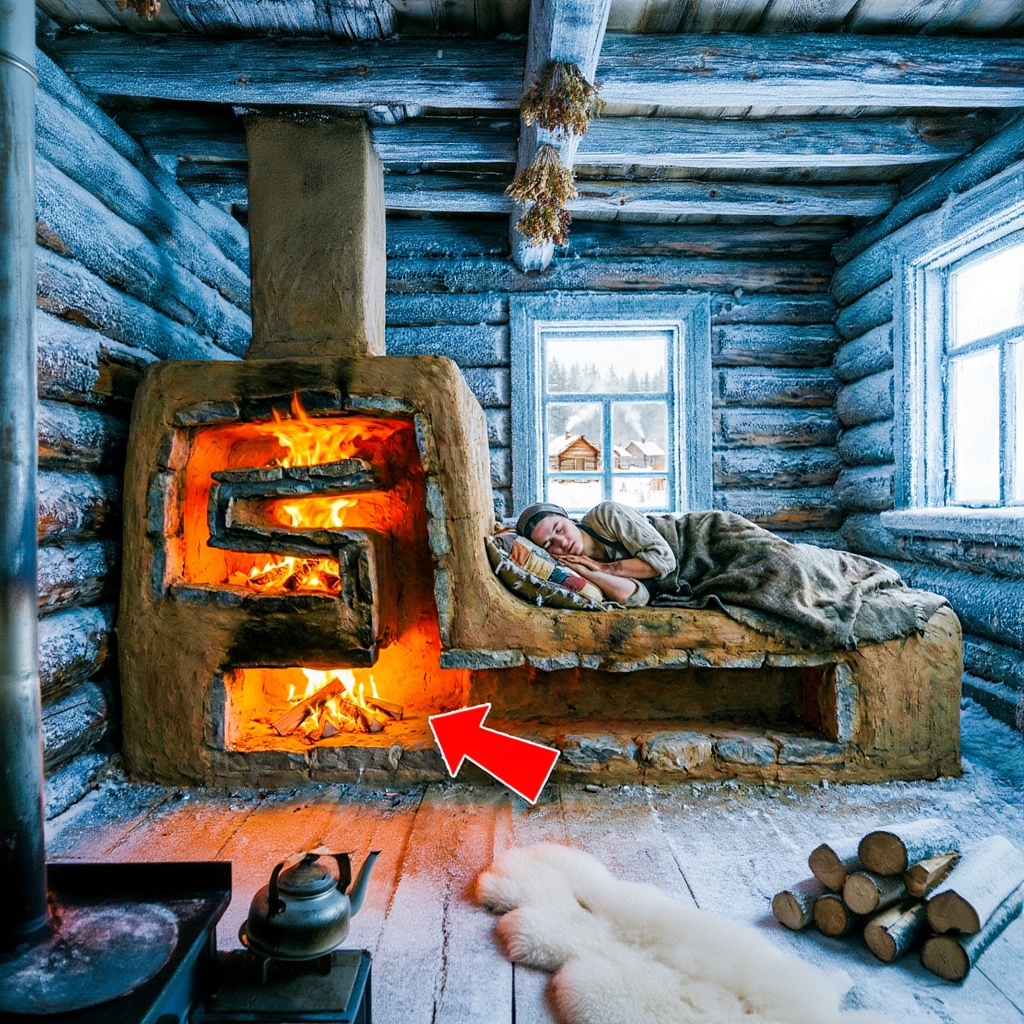
Daniel lay on top of the clay platform beneath a heavy gray blanket.
His eyes widened.
“Oh my God.”
Emily laughed.
“What?”
He rolled over, pressing his palms into the warm surface.
“It’s… alive.”
Outside—
The temperature dropped to minus fifteen.
Inside—
Emily sat barefoot.
Sipping tea.
Watching orange firelight dance across frost-covered logs.
Dried herbs swayed gently from the ceiling beams.
A sheepskin rug lay beside neatly stacked firewood.
And in the center of the room—
A giant earthen oven glowed like the heart of the earth.
Exactly where everyone said she’d fail.
Three days later—
The storm came.
The worst in twenty years.
Power lines snapped across the valley.
Roads vanished.
Generators froze.
Fuel deliveries stopped.
Modern homes went dark.
Electric furnaces died.
Propane tanks emptied.
By nightfall—
Half of Hollow Creek had no heat.
And the temperature dropped below minus twenty-five.
At eight that evening—
Someone knocked.
Emily opened the door.
Standing there was old Frank Miller, the same man who had laughed loudest in the general store.
Snow clung to his beard.
His face was pale.
“My heater’s dead.”
He swallowed.
“My grandson’s with me.”
Emily stepped aside.
“Come in.”
Then came another knock.
And another.
And another.
By midnight—
The cabin was full.
Children.
Grandparents.
Neighbors.
People who had mocked her.
People who had doubted her.
People who now stood speechless in the orange glow.
One little girl climbed onto the heated clay bed.
Her eyes widened.
“It’s warm.”
Emily smiled.
“Yes.”
The girl looked up.
“Like a dragon.”
Emily laughed.
“Exactly like a dragon.”
For four days—
That cabin became the warmest place in the county.
Emily fed the lower hearth.
Then the side chamber.
Then the upper firebox.
Each flame sent heat through hidden tunnels.
The clay absorbed everything.
Released it slowly.
Silently.
Perfectly.
No electricity.
No gas.
No furnace.
Just earth.
Fire.
And knowledge.
On the fourth day—
Daniel’s father arrived.
Robert Carter stood in the doorway, hat in hand.
For a long moment, he said nothing.
Then his eyes found the initials carved in the brick.
M.C.
His wife’s.
His voice cracked.
“She built this.”
Emily nodded.
“She did.”
Robert stared into the fire.
“She wanted our daughters to learn.”
He swallowed hard.
“They didn’t care.”
Then he looked at Emily.
“But you did.”
Emily said nothing.
Because some apologies don’t need words.
When spring came—
People stopped laughing.
Instead—
They started knocking.
Not for shelter.
For advice.
For plans.
For help.
Emily taught ranchers how to build thermal benches.
She helped families restore old masonry stoves.
She turned abandoned cabins into winter homes.
And by the next snow season—
There were fourteen earthen heaters across Hollow Creek.
All inspired by one forgotten cabin.
And one inheritance nobody wanted.
Years later—
Visitors still drove to the ridge.
Not because the cabin was beautiful.
Though it was.
Not because it was warm.
Though it always was.
They came because of the sign hanging beside the front door.
Hand-carved.
Simple.
And true.
It read:
“Some people leave you nothing…
until you discover what they really left behind.”
And beneath that—
Smaller letters.
M.C.