
Everyone Called Her Hillside Cabin “Foolish” — Until Outlaws Couldn’t Find It
The wind came first.
It rolled across the Kansas prairie like an invisible ocean, bending the dry grass until it whispered against itself in long, trembling waves. Dust rose from wagon trails. Clouds gathered low and dark across the horizon, swallowing the late-afternoon sun.
And on a lonely rise of earth forty miles from the nearest town, Eleanor Whitmore stood with both hands wrapped around a shovel.
Her boots were sunk ankle-deep in clay.
Her dress—dark gray and already stained with sweat and dirt—clung heavily to her frame. Loose strands of chestnut hair had escaped her bonnet and danced wildly in the prairie wind.
Three men stood at the base of the hill, watching.
Then laughing.
“She’s lost her mind.”
“She could’ve built down by the creek.”
“Woman’s digging herself a grave.”
The loudest laugh came from Caleb Turner, owner of two hundred acres and every ounce of arrogance that came with them.
He spat tobacco into the grass.
“A cabin halfway underground?” he called.
Eleanor paused, leaned on her shovel, and looked down at them.
“No.”
She smiled faintly.
“A home.”
The men laughed harder.
And Eleanor went back to digging.
1
Three months earlier, Eleanor Whitmore had buried her husband.
Thomas Whitmore had been a quiet man. Strong hands. Kind eyes.
And terrible luck.
A broken axle.
A runaway horse.
A wagon overturned in a dry creek bed.
By the time Eleanor dragged him back to camp, his breathing was shallow.
By dawn—
he was gone.
No children.
No brothers.
No inheritance.
Just thirty acres of wind-beaten prairie and a widow barely twenty-eight.
The town expected her to sell.
Or remarry.
Or leave.
Instead, she bought a shovel.
And climbed the hill.
2
The hill wasn’t much to look at.
A crooked rise of limestone and packed earth.
Dry grass.
Scattered stones.
Nothing grew there except stubborn weeds and prairie flowers.
But Eleanor noticed what nobody else did.
The north face stayed cool.
The western slope blocked the wind.
And from the top—
you could see riders coming for miles.
She spent two weeks studying the land.
Two more marking lines with sticks.
Then she started digging.
Not down.
Into.
Straight into the hillside.
Room by room.
Wall by wall.
Day after day.
The townspeople came to watch.
Children pointed.
Farmers shook their heads.
Women whispered.
“She’s grieving.”
“She’s confused.”
“She’s alone.”
But Eleanor kept digging.
And as the weeks passed—
the hill began swallowing her.
First her tools disappeared.
Then her lumber.
Then her chimney stones.
By autumn—
all anyone could see from the road was grass.
3
That was when the rumors began.
“She lives underground.”
“Like a mole.”
“Like an Indian spirit cave.”
“Like someone hiding.”
The rumors reached Red Bluff, a dusty frontier town seven miles east.
And in Red Bluff—
rumors traveled faster than horses.
Especially to men like Silas Crowe.
Silas Crowe was wanted in three territories.
Robbery.
Arson.
Murder.
By winter—
his gang had burned four homesteads.
Looted supply wagons.
Shot two marshals.
And vanished.
Every time.
4
The first snow came early.
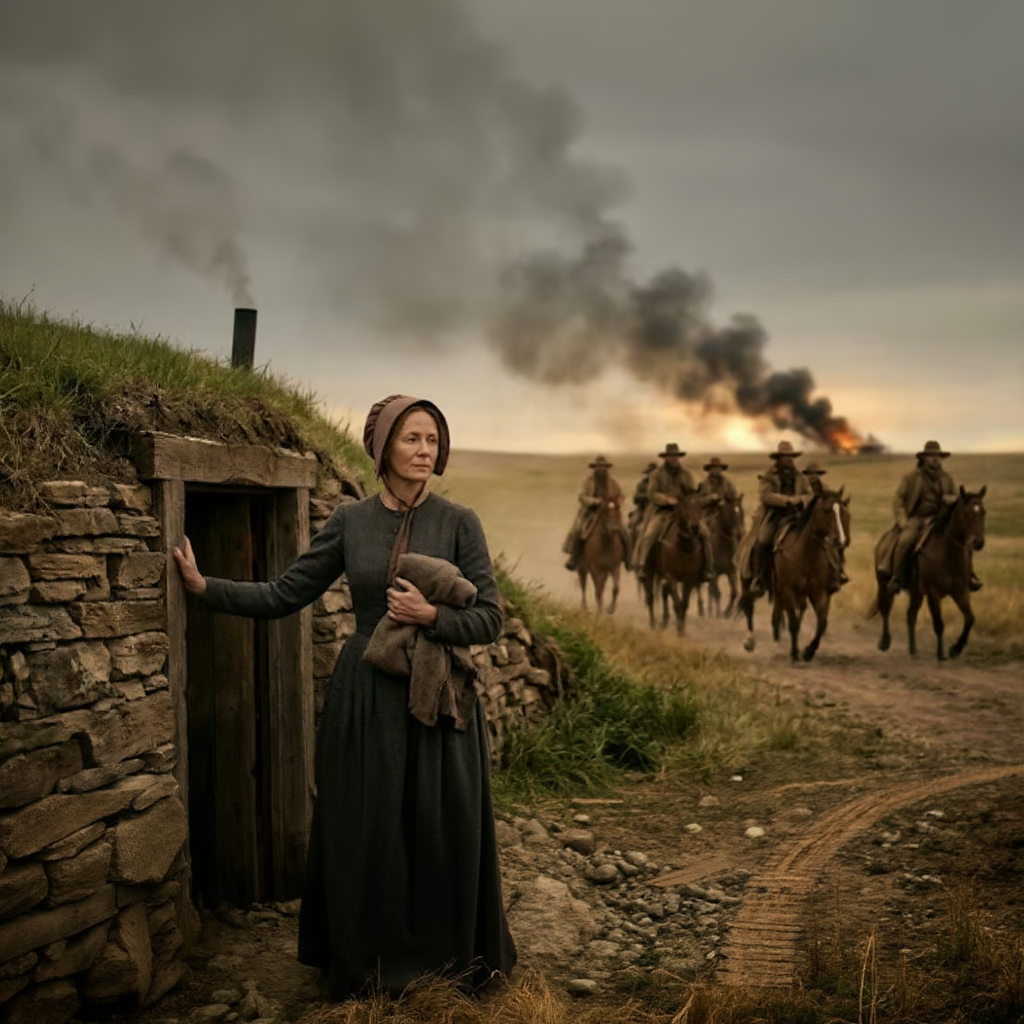
Eleanor was inside her hillside cabin when she heard it.
Hooves.
Fast.
Too many.
She moved silently to the narrow observation slit carved into stone.
Ten riders.
Black hats.
Long rifles.
Dust and snow behind them.
Her heartbeat slowed.
Not from fear.
From certainty.
She had known this day would come.
The riders thundered down the road below.
Straight toward neighboring farms.
Toward smoke.
Toward fire.
Toward screaming.
Eleanor closed her eyes.
And listened.
Gunshots echoed across the prairie.
Then silence.
Then laughter.
Then—
hoofbeats coming closer.
5
Silas Crowe led them.
Tall.
Lean.
Scar across his jaw.
Eyes like winter steel.
He raised a hand.
The gang stopped.
Crowe studied the hill.
He frowned.
“There was supposed to be a widow here.”
One of the riders nodded.
“Town said she built somewhere on this ridge.”
Crowe scanned the prairie.
Nothing.
No chimney smoke.
No cabin.
No barn.
No fences.
Just grass.
Wind.
And stone.
He squinted.
“Spread out.”
The riders separated.
Searching.
Circling.
Looking.
One rode within twenty feet of Eleanor’s hidden doorway.
So close she could hear leather creak.
Could smell horse sweat.
Could hear him mutter—
“Ain’t nothing here.”
The riders searched for nearly an hour.
Nothing.
Finally Crowe cursed.
“Waste of time.”
He pulled his horse around.
“Move.”
And the outlaws disappeared into the snow.
6
Eleanor waited another hour.
Then two.
Then she opened the hidden stone door.
The cold air hit her face.
Smoke drifted across the horizon.
She grabbed blankets.
Bandages.
A lantern.
And ran.
The first farm was burning.
The second had been looted.
At the third—
she found Margaret Hale clutching two crying children beside a frozen well.
Margaret looked up in disbelief.
“Eleanor?”
Eleanor wrapped a blanket around the youngest child.
“Can you walk?”
Margaret nodded.
“Where are we going?”
Eleanor looked toward the hill.
And smiled.
“Somewhere nobody can find.”
7
By dawn—
eleven people were inside the hillside cabin.
Women.
Children.
An injured ranch hand.
Two elderly brothers.
And one terrified boy who hadn’t spoken since the attack.
They expected darkness.
Cold.
Dirt.
Instead—
they found warmth.
Stone walls.
Oil lamps.
Shelves carved into earth.
A hidden stove venting through split limestone.
Beds built into alcoves.
Storage rooms.
Water barrels.
Food.
Blankets.
And silence.
The little boy looked around in wonder.
“Is this… under the hill?”
Eleanor nodded.
He whispered—
“It’s like the hill is protecting us.”
Eleanor smiled.
“Maybe it is.”
8
Three days later—
the outlaws came back.
This time—
with twenty men.
Silas Crowe was angry.
He knew survivors had vanished.
He knew supplies were missing.
And he knew somebody was hiding them.
He rode straight to Eleanor’s hill.
And searched again.
For six hours.
Nothing.
One rider jabbed a metal rod into the ground.
Missed the roof by inches.
Another walked directly over the hidden entrance.
Crowe stared at the grass.
At the stone.
At the empty wind.
Then something changed in his face.
Not anger.
Fear.
He whispered—
“This place ain’t natural.”
Then he turned his horse.
And left.
For good.
9
Spring came slowly.
Snow melted.
Grass returned.
Wildflowers bloomed.
And stories spread faster than prairie fire.
At first—
nobody believed them.
A woman.
A hidden house.
Twenty armed outlaws.
And not a single person found.
Then survivors told the truth.
Then children drew pictures.
Then ranchers climbed the hill themselves.
And found—
nothing.
Until Eleanor stepped out of the earth.
Like the prairie itself had given birth to her.
Caleb Turner stared with his mouth open.
“You… built this?”
Eleanor folded her arms.
“You still think it’s foolish?”
Caleb looked at the hill.
At the invisible chimney.
At the hidden stone door.
At the families alive because of it.
And for once—
Caleb Turner had nothing to say.
10
Years passed.
Railroads came.
Telegraph poles rose.
Towns grew.
Outlaws disappeared.
But Eleanor’s hillside cabin remained.
Hidden.
Cool in summer.
Warm in winter.
Invisible from a hundred yards away.
Travelers came just to see it—
and usually failed.
Children called it—
The Prairie Ghost House.
Settlers called it—
The Widow’s Hill.
But the people Eleanor saved—
they called it something else.
Home.
And when Eleanor Whitmore died peacefully at eighty-three—
they buried her exactly where she had first stood with her shovel.
At the top of the hill.
Where the wind came first.
And where fools—
had once laughed.