
Kicked Out at 18, My Sister and I Bought a Rusted Bait Shop for $5 What It Became Changed Us
The sign hanging above the door read LIVE BAIT – COLD SODA – OPEN, but nothing about the place looked alive.
The paint peeled in long curls. The windows were dusty and cracked. The metal roof sagged like it had given up years ago. The smell of stale lake water and rust drifted from inside whenever the wind shifted.
And that’s where my little sister and I stood, holding the paper that said we owned it.
Five dollars.
That’s what we paid.
Five dollars for a rusted bait shop no one wanted.
Five dollars… after we were kicked out with nowhere else to go.
We were eighteen and sixteen when our dad told us to leave.
He didn’t yell. That almost made it worse.
“You’re both old enough,” he said, arms crossed in the doorway. “I can’t carry you anymore.”
I held my backpack tighter. My sister, Lily, stood beside me, her fingers curled in my sleeve.
“Just until we figure something out,” I said quietly.
He shook his head.
“No.”
The door closed.
That was it.
No dramatic scene. No crying. Just the sound of a latch and the porch light turning off.
We slept in my old car that night, parked near Miller Lake. It was early spring, cold enough to see our breath.
Lily whispered, “What are we going to do?”
I didn’t have an answer.
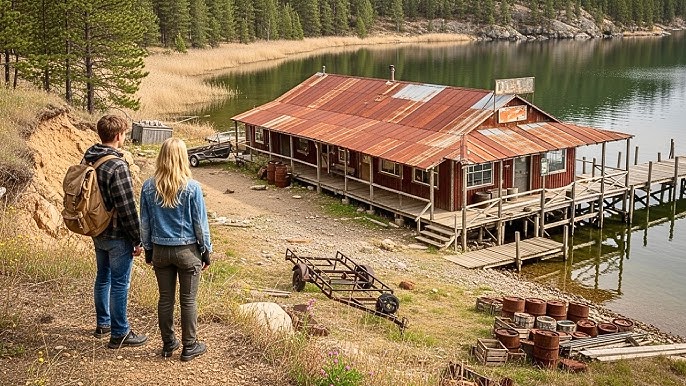
The bait shop sat at the edge of the lake, abandoned for years. Everyone in town knew it. Fishermen passed it on their way to better spots. Kids dared each other to throw rocks at the broken sign.
The property had been tied up in taxes, then auctioned off for almost nothing.
We found the listing taped to the notice board outside the post office.
“Delinquent property. As-is. Minimum bid: $5.”
Lily looked at me. “Five dollars?”
“We don’t even have rent money,” I said.
She pointed at the line again. “But we have five.”
We scraped together coins. Three dollars in quarters. Two in crumpled bills.
The clerk barely looked up when we handed them over.
“You sure you want that place?” he asked.
“Yeah,” I said.
He shrugged and stamped the paper.
Just like that, we owned something.
Not much.
But it was ours.
The first night inside the bait shop was colder than the car.
The windows rattled. The floor creaked. The old bait tanks were dry and cracked. A single bulb hung from a wire, barely glowing.
Lily wrapped herself in a blanket and looked around.
“It’s… ugly,” she whispered.
I laughed quietly. “Yeah.”
But then she said something that stuck with me.
“It’s not someone else’s.”
That mattered.
We cleaned the next morning.
Dust flew everywhere. We dragged broken shelves outside. We scrubbed the counter with lake water. We patched holes with cardboard.
A pickup slowed on the road.
Earl Dawson leaned out the window. “You girls camping?”
“We bought it,” I replied.
He laughed so hard he coughed.
“You bought… that?”
“For five dollars.”
He shook his head. “Well… good luck.”
He drove off still laughing.
That became the pattern.
People stopped. People stared. People laughed.
Two girls. No money. Fixing a bait shop that looked ready to collapse.
We found the old icebox behind the counter.
Rusty, but intact.
“Think it works?” Lily asked.
“No idea.”
We filled it with lake water and borrowed ice from a gas station owner who took pity on us. Then we walked along the shoreline, collecting worms.
Buckets. Coffee cans. Anything we could find.
By afternoon, we had a sign.
LIVE WORMS – $1
The first customer was an old fisherman named Ray.
“You girls running this?” he asked.
“Yes, sir.”
He studied the worms. Then he handed us two dollars.
“I’ll take one.”
“You gave too much,” Lily said.
He shook his head. “Keep the change.”
He came back the next day.
And the day after.
It didn’t happen fast.
Some days we made three dollars.
Some days nothing.
We slept on the floor. Ate cheap noodles. Counted coins at night.
But slowly, people stopped laughing.
They started stopping.
“Got minnows?” someone asked.
“Not yet,” I replied.
We caught some in a net that evening.
Then we sold those.
The twist came three weeks later.
We were cleaning behind the counter when Lily knocked on a loose board in the floor.
It sounded hollow.
“Listen,” she said.
I tapped it. Same sound.
We pried it up carefully.
Underneath was a shallow storage space — old, dusty, forgotten.
Inside were jars.
Dozens of them.
Metal lids. Yellowed labels.
We opened one.
Hand-tied fishing flies.
Another jar.
Vintage lures.
Another.
Old tackle, handmade, still in good shape.
Lily stared. “These… are nice.”
We took them to Ray.
His eyes widened.
“Where’d you get these?”
“Under the floor.”
He picked one up gently. “These are old. Handmade. Some collectors pay for these.”
“How much?” I asked.
He shrugged. “Depends. But more than worms.”
We cleaned them carefully and set up a new sign.
VINTAGE TACKLE
The first buyer offered twenty dollars for three pieces.
That was more money than we’d seen at once.
Word spread fast.
Collectors drove in. Fishermen stopped out of curiosity.
Suddenly, the rusted bait shop wasn’t just selling worms.
It was selling stories.
Summer came.
We added cold sodas in a borrowed cooler.
Then snacks.
Then a small bench outside.
People lingered.
They talked.
The bait shop became… alive.
Lily painted the sign bright blue.
I fixed the roof with scrap metal.
We planted flowers in old bait buckets.
No one laughed anymore.
The shocking moment came late August.
A man in a clean truck pulled up. Not a fisherman. Too polished.
He walked inside, looked around, then said, “You own this place?”
“Yes.”
He nodded. “I represent a developer. We’re buying lakefront properties. We can offer you ten thousand.”
Lily’s eyes widened.
Ten thousand.
For something we bought for five dollars.
My heart pounded.
“That’s a lot,” Lily whispered.
The man smiled. “You girls could use a fresh start.”
I looked around.
The crooked shelves.
The hand-painted sign.
The jars we cleaned together.
This place wasn’t just wood.
It was the first thing we built ourselves.
I shook my head.
“We’re not selling.”
He blinked. “You sure?”
“Yes.”
He left.
Lily stared at me. “We turned down ten thousand.”
I nodded.
“We’re not done yet.”
Fall brought fishermen chasing bigger catches.
Business doubled.
We added coffee.
Then homemade sandwiches.
Lily learned to bake.
People started coming even when they weren’t fishing.
Just to sit.
Just to talk.
The rusted bait shop became the heart of the lake.
One evening, Dad’s truck pulled up.
I froze.
He stepped out slowly.
“I heard about this place,” he said.
Lily stood beside me, tense.
He looked around quietly.
“You built this?”
“We did.”
He nodded once.
Then he bought two sodas and sat outside.
We didn’t say much.
But when he left, he said softly:
“You did okay.”
It wasn’t an apology.
But it was something.
Winter slowed everything.
The lake froze.
Customers disappeared.
We worried.
But something unexpected happened.
People still came.
Not for bait.
For coffee.
For warmth.
We added a small heater.
The shop glowed in the snow.
It felt… steady.
By spring, we expanded.
We knocked out a back wall.
Added a small kitchen.
Built a deck overlooking the lake.
The bait shop wasn’t rusted anymore.
It was colorful. Busy. Full of laughter.
Someone joked, “This is the best five-dollar investment in town.”
They weren’t wrong.
The real change wasn’t the building.
It was us.
We weren’t scared anymore.
We weren’t homeless.
We weren’t kids trying to survive.
We were owners.
Partners.
Sisters who built something together.
One sunset, Lily leaned on the railing.
“Remember the first night?” she asked.
“In the cold?”
She nodded. “I thought we were doomed.”
I laughed softly. “Me too.”
She looked at the lake glowing orange.
“This place changed us.”
I nodded.
It didn’t just give us money.
It gave us proof.
That five dollars and stubborn hope could become something bigger.
Now people still ask about the old sign.
We kept it, hanging inside.
LIVE BAIT – COLD SODA – OPEN
Underneath it, we taped the original receipt.
Five dollars.
Whenever someone points at it, Lily smiles and says:
“We bought it when we had nothing.”
And I always add:
“And it gave us everything.”
So here’s the question people always argue about when they hear our story:
Did two girls turn a five-dollar rusted bait shop into something special…
—or did that broken little shop turn two scared sisters into something stronger than they ever imagined?
By the second year, people stopped asking how two girls turned five dollars into a business.
They started asking what we were going to build next.
The bait shop wasn’t rusted anymore. The deck overlooked Miller Lake. A hand-painted chalkboard listed bait, sandwiches, coffee, and Lily’s now-famous cinnamon rolls. On weekends, trucks lined the dirt road.
But we still slept in the tiny storage room behind the counter.
We didn’t mind.
That little room felt safer than any place we’d ever lived.
Still, we both knew something was changing.
And we weren’t ready for how fast it would happen.
It started with a storm.
Late April. Sudden wind. Heavy rain pounding the lake. The kind that makes everyone run for shelter.
Three fishermen rushed inside, dripping water everywhere.
“You girls open?” one asked.
“Always,” Lily smiled.
They sat, drank coffee, and waited for the rain to pass.
Then two more came.
Then a couple driving around the lake.
Within thirty minutes, the bait shop was packed.
People weren’t just buying bait.
They were staying.
Talking.
Laughing.
Watching the rain hit the water.
When the storm cleared, no one rushed out.
That’s when Lily leaned toward me and whispered, “This isn’t just a bait shop anymore.”
She was right.
It was becoming a place.
We expanded the menu carefully.
Breakfast sandwiches first.
Then soup.
Then homemade pie.
Lily experimented every night, scribbling notes in a spiral notebook.
“Too salty.”
“More cinnamon.”
“Use butter, not oil.”
Customers became testers.
“You gotta try this,” she’d say, sliding a plate across the counter.
They always did.
And they always came back.
The twist came one quiet Tuesday morning.
I was sorting bait when a woman walked in wearing a blazer and holding a tablet. Definitely not a fisherman.
“You’re the owners?” she asked.
“Yes,” I said cautiously.
She nodded. “I’m with the county tourism board. Your shop’s been mentioned in three travel blogs.”
I blinked. “Travel blogs?”
She turned the tablet toward me.
There we were — our blue-painted shack, the lake behind it, Lily smiling with flour on her cheek.
The headline read:
“The $5 Bait Shop That Became the Heart of Miller Lake.”
Lily gasped.
“They wrote about us?”
The woman smiled. “You’re getting visitors from outside the county.”
We didn’t believe her.
Until Saturday.
Cars with out-of-state plates started showing up.
People took photos of the sign.
They asked for “the cinnamon rolls from the article.”
They wanted to hear the story.
“Kicked out at eighteen?” someone asked.
“Five dollars?” another repeated.
We told it again and again.
Each time, the shop felt fuller.
Warmer.
Louder.
The place that saved us… was now drawing people in.
Then came the second shock.
Remember the developer who offered ten thousand?
He came back.
This time, he walked slower, looking around at the crowd.
“You’ve done… quite a bit,” he admitted.
I nodded.
He cleared his throat. “We’re prepared to offer eighty thousand.”
Lily froze.
Eighty thousand.
That number hung in the air like thunder.
“You could buy a house,” he added gently. “Start fresh.”
I looked at Lily.
Her eyes were wide — but not tempted.
She shook her head slightly.
I turned back.
“We’re not selling.”
He exhaled slowly. “You’re turning down eighty thousand dollars.”
“Yes.”
He nodded once.
“I hope you know what you’re doing.”
He left.
Lily grabbed my arm the second he drove away.
“We just said no to eighty thousand.”
I nodded, heart racing.
“We did.”
She smiled.
“I’m glad.”
Summer exploded.
Fishing tournaments used the shop as a meeting point. Families stopped for lunch. Kids bought candy with sticky hands. The deck filled every evening.
We hired our first employee — a shy high school kid named Ben.
“Never thought I’d work at a bait shop,” he said.
“Neither did we,” Lily laughed.
We added picnic tables.
Then string lights.
At sunset, the lake glowed gold and the shop buzzed with voices.
Sometimes I stepped back and just watched.
It didn’t feel real.
Then came the moment neither of us expected.
Dad came back.
Not just for soda this time.
He sat quietly at the counter while Lily poured coffee.
“You girls busy,” he said.
“Yeah,” I replied.
He nodded slowly.
“I drove by last week. Didn’t recognize the place.”
Silence hung between us.
Then he pulled something from his pocket.
A folded paper.
He slid it across the counter.
It was a photo.
Old. Faded.
The bait shop… years ago.
Fresh paint. Boats tied at the dock. People laughing.
“My dad ran this place,” he said quietly.
I looked up, stunned.
“You’re kidding.”
He shook his head. “Closed after he passed. Nobody wanted it.”
Lily whispered, “You never told us.”
He shrugged. “Didn’t think it mattered.”
I stared at the photo.
We hadn’t just bought a random shack.
We had unknowingly rebuilt part of our own family history.
Dad looked around the shop, eyes softer.
“You brought it back,” he said.
That was the closest thing to pride we’d ever heard from him.
Fall brought cooler air and steady business.
We added a small stage on the deck.
Local musicians played on weekends.
People danced.
Laughed.
The place felt alive in a way we never imagined.
One night, Lily leaned against the railing.
“Remember sleeping on the floor?” she asked.
I nodded.
“Now look at this.”
Lights reflected off the lake. People filled the deck. Music drifted through the air.
“It’s crazy,” I said.
She smiled softly.
“No,” she said. “It’s ours.”
Winter came again, quieter but still steady.
We added heaters on the deck. Served hot chocolate. Fishermen came for ice fishing supplies.
Even in snow, the shop glowed warm.
One morning, I found Lily staring at the original receipt taped under the sign.
Five dollars.
She touched it gently.
“You know,” she said, “getting kicked out felt like the worst thing that ever happened.”
I nodded.
“But if it hadn’t happened… we never would’ve bought this.”
I looked around the shop.
She was right.
The thing that broke us… built us.
Now, when people walk in and ask, “Is it true you bought this place for five dollars?” we always smile.
“Yes,” Lily says.
“And you were kicked out?” they ask.
“Yes.”
They look around in disbelief.
The lake.
The deck.
The crowd.
The life.
And they always say the same thing:
“That changed everything.”
They’re right.
But not in the way they think.
Because the real change wasn’t the business.
It wasn’t the money.
It was two sisters who learned that being kicked out wasn’t the end…
It was the beginning.
So here’s what people still argue about in the comments whenever someone posts our story:
Did two girls turn a rusted $5 bait shop into something incredible…
—or did that broken little shop turn two scared sisters into people who never needed anyone to save them again?