
He Paid $1 for the Ug::ly Bride No One Wanted — She Was Worth Far More Than Anyone Could Fathom
The first time Daniel Harper saw her, she was standing behind three other women, half-hidden by a warped wooden pillar at the edge of the auction platform.
It was 1878, late summer in a dry Kansas cattle town where dust coated everything—boots, hats, horses, and sometimes even reputations. Daniel hadn’t come for a bride. He’d come for fencing wire and a second mule. But when he saw the crowd gathering near the saloon porch, he knew what it was.
A bride auction.
He hated them.
Men laughed too loud. Women stood too still. And everything about it felt wrong. But in towns where winters were harsh and farms were isolated, people convinced themselves it was practical. Widowers needed wives. Women without families needed protection. The town called it opportunity.
Daniel called it desperation.
He was turning away when he heard the auctioneer shout, “Next!”
The third woman stepped forward—young, pretty, cheeks flushed. Bidding started at twenty dollars. It climbed fast. Thirty. Forty-two. A rancher won her, grinning wide.
Then the auctioneer cleared his throat.
“Last one, folks.”
The crowd shifted.
She stepped forward slowly.
Murmurs spread.
Some men chuckled.
She wore a plain gray dress too big for her shoulders. Her hair—thick, dark, and unevenly cut—hung around her face. A faint scar traced along her jaw. One eye seemed slightly clouded, not blind, but not fully clear either. She kept her hands clasped tightly, knuckles pale.
“She’s… not much,” someone muttered.
“Looks like she’s been through a storm,” another laughed.
Daniel felt his jaw tighten.
The auctioneer forced a smile. “Hardworking girl. Strong. Good for house and field. We’ll start at… five dollars.”
Silence.
Wind rattled a loose sign.
“Four dollars?”
Nothing.
“Three?”
A man snorted. “You’d have to pay me.”
Laughter broke out.
The woman didn’t look up.
The auctioneer swallowed. “Two dollars?”
No one moved.
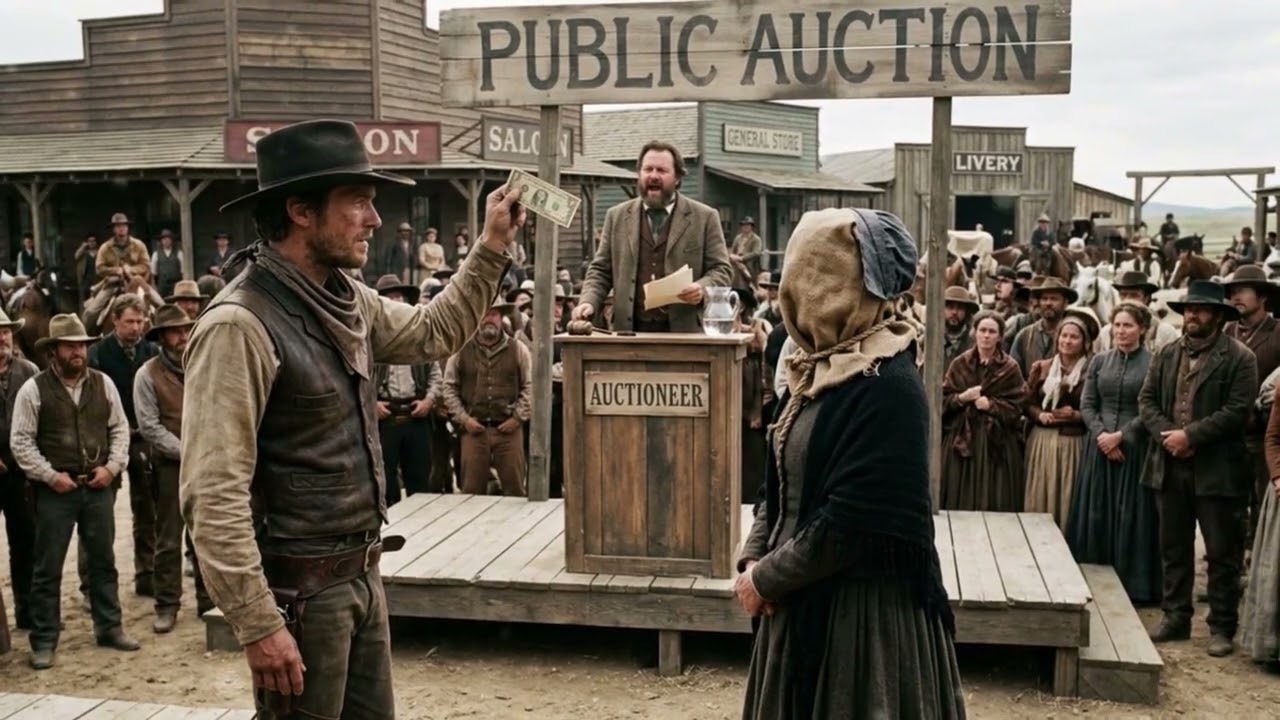
Daniel felt something heavy settle in his chest.
“One dollar?” the auctioneer tried weakly.
The crowd was quiet now, awkward.
Daniel stepped forward.
“I’ll give a dollar.”
Heads turned.
“You serious, Harper?” someone called.
He nodded. “Yes.”
The auctioneer looked relieved. “Sold. One dollar.”
The gavel struck.
The woman looked up, startled. Their eyes met for the first time. Hers were dark—deep, cautious, and unexpectedly steady.
Daniel approached slowly. “You coming?”
She nodded once.
They walked to his wagon in silence. The town watched them go.
After a few minutes, she spoke softly.
“My name is Clara.”
“Daniel.”
“Thank you… for not letting them send me back.”
“Back where?”
She hesitated. “The boarding house. They said I had three days.”
He nodded. “You know how to cook?”
“Yes.”
“Sew?”
“Yes.”
“Work outdoors?”
“Yes.”
“That’s all I need.”
She folded her hands again. “I’ll earn the dollar.”
He almost smiled.
The ride to his ranch took half a day. Rolling plains, scattered cottonwoods, long fences stretching toward the horizon. Clara sat quietly, absorbing everything.
When they arrived, she stared at the small farmhouse.
“You live alone?” she asked.
“Since my mother passed.”
She stepped down from the wagon carefully.
Inside, the house was clean but sparse. One table, two chairs, iron stove, narrow bed in the back room.
“I’ll sleep in the kitchen,” she said quickly.
“No. There’s a spare cot in the shed.”
She nodded gratefully.
That first night, Daniel heard quiet movement long after sunset. Clara sweeping. Then washing dishes. Then… silence.
At dawn, he woke to the smell of bread.
He stepped into the kitchen.
Clara stood at the stove, sleeves rolled, hair tied back. Fresh bread cooled on a cloth. Eggs simmered in a pan. The floor—cleaner than he’d ever seen.
“You didn’t have to—” he started.
“I wanted to.”
He sat. Took a bite.
It was the best bread he’d eaten in years.
“You bake often?” he asked.
“My mother taught me.”
After breakfast, she followed him outside.
“You don’t need to work today,” he said.
“I do.”
He handed her a bucket. “Chickens need feeding.”
She moved carefully at first, then more confidently. By noon, she’d fed animals, patched a torn feed sack, and organized tools he hadn’t touched in months.
Daniel watched quietly.
“She works like she’s afraid of stopping,” he muttered to himself.
Days passed.
Clara spoke little, but everything she did improved the ranch. She repaired shirts. Mended quilts. Replanted the kitchen garden. Even Buck—the old ranch dog—started following her everywhere.
One evening, Daniel noticed something else.
She was reading.
A worn book, pages yellowed.
“You read?” he asked.
“Yes.”
“Where’d you learn?”
“My father was a schoolteacher.”
Daniel sat across from her. “What happened?”
She hesitated.
“Fire. Our house burned. My parents… didn’t make it.”
He nodded slowly.
“After that?”
“Relatives took me in. Then… I became a burden.”
Silence stretched.
“You’re not a burden here,” he said.
She looked up, surprised.
“Thank you.”
Weeks turned into months.
The ranch improved in ways Daniel couldn’t explain. Clara planted herbs near the porch. She rotated crops. She even suggested digging a shallow irrigation trench from the creek.
“You think it’ll help?” he asked.
“Yes.”
He trusted her.
By summer, the garden doubled. Vegetables grew strong. They sold extra produce in town.
People noticed.
One afternoon at the general store, a man smirked. “That ugly bride working out?”
Daniel didn’t smile. “Better than you’d expect.”
Another laughed. “Still think you overpaid at a dollar.”
Daniel turned. “Best dollar I ever spent.”
Clara heard about it later. She didn’t react, but that night she worked longer than usual, quietly stitching.
Daniel finally said, “You don’t need to prove anything.”
She whispered, “I want to.”
Autumn arrived with golden fields.
Then trouble came.
A banker rode out one morning.
“I heard you’re expanding,” he said, eyeing the land.
“Thinking about it,” Daniel replied.
“You don’t have the capital.”
Clara stepped forward. “We do.”
The banker raised a brow.
She brought out a ledger.
Neat handwriting. Detailed accounts. Profits from produce, eggs, repairs, preserved goods.
Daniel stared. “You kept all this?”
“Yes.”
The banker flipped pages, impressed.
“You’ve doubled productivity.”
Daniel blinked.
“I’d consider a loan,” the banker admitted.
After he left, Daniel turned to Clara.
“You did this?”
“We did.”
“No,” he said quietly. “You did.”
Winter came early that year. Heavy snow trapped them indoors.
Even then, Clara found ways to work. She taught Daniel to read better. Organized storage. Planned next year’s crops.
One night, he asked, “Why didn’t anyone want you?”
She touched the scar on her jaw.
“When I was ten, a horse kicked me. Broke my face. My eye never healed right.”
“That’s all?”
She nodded.
He shook his head slowly.
“That’s nothing.”
She smiled faintly. “To them, it was everything.”
Spring returned.
Their ranch was now thriving. They bought two more cows. Hired a young hand. Expanded fencing.
The town began to change its tone.
“Harper’s wife knows farming.”
“She’s clever.”
“She turned that place around.”
One day, the auctioneer who sold her came to visit.
“I heard things,” he said awkwardly.
Clara served tea politely.
He looked around, stunned.
“You’ve built something remarkable.”
Daniel replied calmly, “She did.”
The auctioneer nodded. “Seems that dollar was… undervalued.”
After he left, Clara laughed softly.
“First time I’ve heard that.”
Daniel leaned back.
“You were never worth a dollar.”
She looked at him.
“You were worth everything.”
She lowered her gaze, cheeks warm.
Years later, travelers passed the Harper ranch and saw flourishing fields, strong barns, and a warm house filled with laughter.
Some asked how it started.
Daniel always answered the same way.
“I paid one dollar for the bride no one wanted.”
Then he’d smile.
“And she turned out to be worth more than anyone could fathom.”
By the second spring after Clara arrived, the Harper ranch no longer looked like the lonely, weather-beaten homestead Daniel had inherited. Fences stood straight. The barn roof no longer sagged. Rows of vegetables stretched behind the house, and a small orchard—Clara’s idea—had begun to take root along the creek.
But the biggest change wasn’t the land.
It was the way people spoke about her.
At first, the town had called her “the ugly bride.” Then it became “Harper’s quiet wife.” By the time the second harvest came in, they were saying something else entirely.
“The smart one.”
Daniel noticed it at the general store.
Old Mr. Wilkins leaned across the counter. “You selling early apples this year?”
Daniel nodded. “Clara grafted the trees. Said they’d fruit sooner.”
Wilkins whistled. “That woman of yours… she’s got a head for land.”
Daniel didn’t answer, but he felt pride settle warm in his chest.
When he returned home, he found Clara kneeling near the creek, sketching something in the dirt with a stick.
“What’s that?” he asked.
“I think we should build a small waterwheel,” she said.
He blinked. “A what?”
“For pumping water uphill. It’ll irrigate the far field.”
“You know how to build one?”
She hesitated. “My father showed me drawings once. I remember.”
Daniel crouched beside her. The sketch was rough—but thoughtful. Angles. Flow direction. Support beams.
“You’re serious?”
“Yes.”
He stared at the creek. It wasn’t large—but it moved steadily.
“Alright,” he said. “Let’s try.”
They worked for two weeks. Cutting timber. Shaping paddles. Reinforcing supports. Clara measured carefully, sometimes stepping back and adjusting everything by inches.
When they finally set it into the creek, Daniel held his breath.
The wheel creaked… then turned.
Water lifted slowly through a narrow wooden trough.
Clara smiled—wide, bright, the biggest smile he’d seen from her.
“It works.”
By midsummer, the far field—once dry and useless—turned green.
Neighbors began riding over just to look.
“You built that?” one rancher asked.
Clara nodded.
He shook his head. “Never seen anything like it.”
Daniel crossed his arms. “Told you she was worth more than a dollar.”
The story spread.
Soon, other ranchers asked for advice. Clara helped them design irrigation channels, crop rotations, and herb gardens. She never charged—just asked them to share seeds or tools.
Daniel noticed something else too.
She was changing.
Her shoulders no longer hunched. Her voice grew steadier. She laughed more often—quietly, but freely. Even the scar on her face seemed less noticeable, not because it vanished, but because people stopped staring.
Then one afternoon, a stranger arrived.
He rode a polished bay horse and wore a city coat too fine for prairie dust. He dismounted slowly, eyes scanning the land with interest.
“Daniel Harper?” he asked.
“That’s me.”
“I’m Charles Morton. Land buyer from Wichita.”
Daniel frowned. “Not selling.”
Morton smiled thinly. “You might reconsider. I’ve heard about your irrigation. Your yields. This land’s becoming valuable.”
Clara stepped out of the house, wiping flour from her hands.
Morton’s gaze shifted to her—and lingered.
“You must be Mrs. Harper,” he said. “I’ve heard quite a bit.”
She nodded politely.
Morton pulled papers from his coat. “I’ll offer five thousand dollars for the property.”
Daniel almost laughed. That was more money than he’d ever seen.
But Clara spoke first.
“No.”
Morton raised a brow. “You didn’t even think.”
“We’re not selling,” she said calmly.
Morton looked at Daniel. “You letting her decide?”
Daniel shrugged. “She knows the land better than me.”
Morton studied her carefully, as if seeing her for the first time.
“Interesting,” he muttered.
He left without another word.
That night, Daniel sat quietly at the table.
“Five thousand,” he said softly.
“Yes.”
“That’s… a lot.”
She nodded.
“You never considered it?”
She shook her head. “This is home.”
He looked at her. “You mean that?”
“Yes.”
Silence stretched—but it was comfortable.
Late summer brought another surprise.
Clara asked, “Can we build something near the road?”
“What kind of something?”
“A small stand. Sell produce. Bread. Herbs.”
“You want to run a shop?”
“Yes.”
Daniel grinned. “Let’s do it.”
They built a wooden stand with a shade roof. Clara painted a simple sign:
HARPER FARM GOODS
The first day, only one wagon stopped.
The second day, three.
By the end of the month, travelers planned routes to pass their stand. Clara’s bread became famous. Her dried herbs sold quickly. She even started making preserves.
Daniel handled the heavy lifting. Clara handled everything else.
One evening, she counted coins at the table.
“We made forty-two dollars today.”
Daniel whistled. “That’s more than the cattle some weeks.”
She smiled. “We can expand.”
Autumn arrived again, golden and warm.
Then something unexpected happened.
The auctioneer who had sold Clara returned.
He stepped down from his wagon slowly, hat in hand.
“I was passing through,” he said awkwardly.
Daniel leaned against the porch. “What do you want?”
The man looked around, stunned.
“I heard stories… didn’t believe them.”
Clara brought him water.
He studied her face, the scar he once thought ruined her chances.
“You’ve done well,” he said quietly.
She nodded.
“I owe you an apology,” he continued. “I shouldn’t have put you up like that.”
Clara answered gently, “If you hadn’t… I wouldn’t be here.”
The man looked at Daniel. “You paid one dollar.”
Daniel smiled faintly. “Best investment I ever made.”
The auctioneer chuckled. “Seems she was worth far more.”
After he left, Clara sat on the porch steps.
“You don’t like when people say that,” she said.
“What?”
“That you bought me.”
Daniel sat beside her.
“I didn’t buy you. I just… refused to let them throw you away.”
She looked at him, eyes soft.
“You gave me a chance.”
“You gave me a life,” he replied.
The wind rustled through the orchard.
The waterwheel turned steadily in the creek.
Fields stretched green toward the horizon.
And in that quiet moment, both of them understood something neither had said aloud:
The dollar had never mattered.
What mattered was that someone saw value where no one else did.
And because of that, everything changed.