
STORY
Six-year-old Lucy Bennett had been told that prayers were supposed to be private.
That Sunday morning, she forgot.
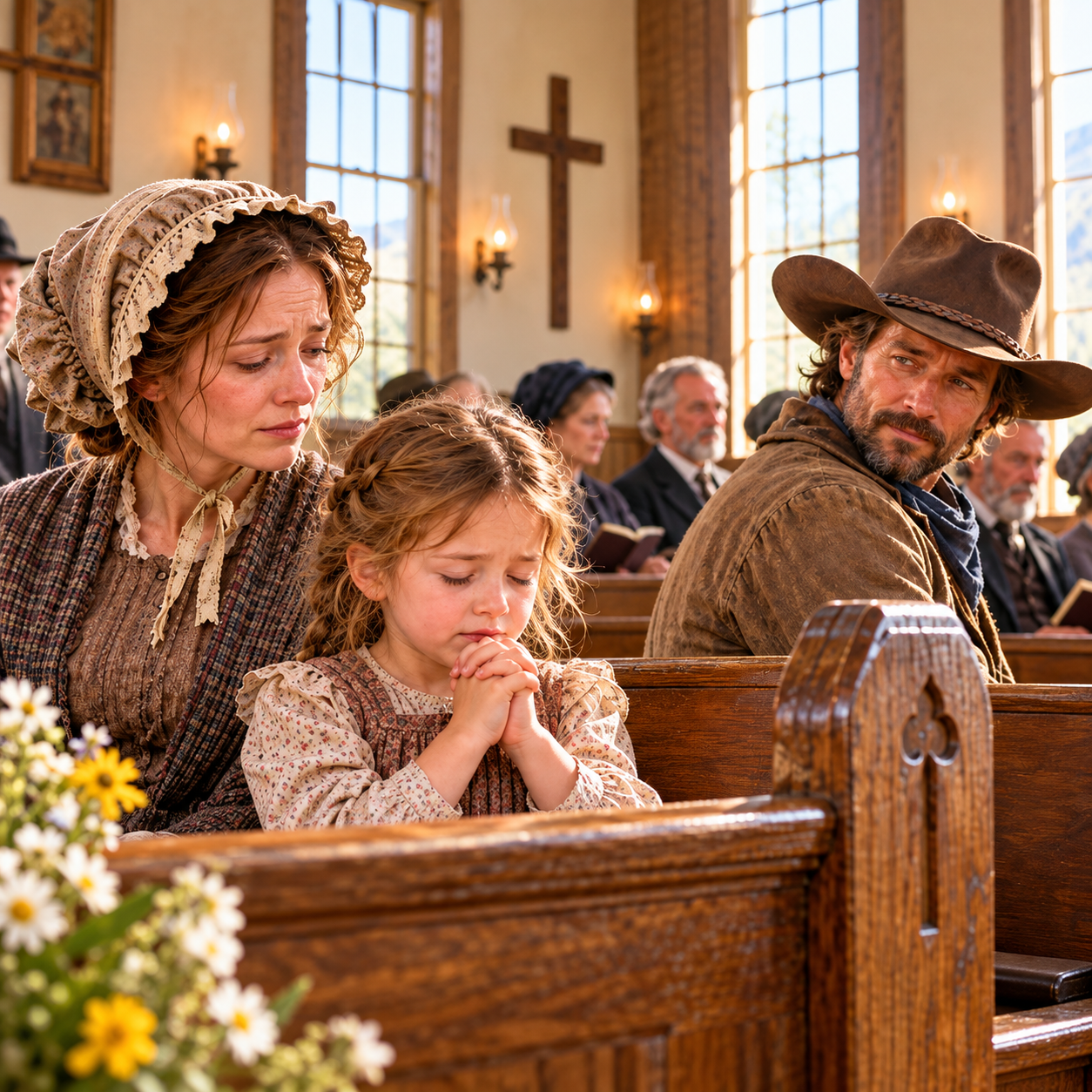
The little church was so quiet that Sarah Bennett could hear the wooden rafters creak above them. Autumn sunlight poured through the tall windows, warming the polished pews while Reverend Harris bowed his gray head.
“Let us pray.”
Sarah closed her eyes.
Beside her, Lucy folded both hands beneath her chin.
Sarah expected the usual prayer—the one about their old milk cow getting better, or perhaps the one asking God to keep mice out of the flour barrel.
Instead, Lucy whispered loudly enough for half the pew to hear.
“Dear Lord… please send Mama a good man.”
Sarah’s eyes flew open.
“Lucy!”
The girl squeezed her eyes tighter.
“A good one,” she continued urgently. “Not Mr. Pritchard because he smells like onions.”
Someone behind them coughed.
It sounded suspiciously like laughter.
Sarah’s face burned.
“Lucy Bennett,” she whispered.
But Lucy was determined.
“Mama says we don’t need anybody, but she cries sometimes when she thinks I’m sleeping.”
Sarah went completely still.
Three feet away, in the next pew, a rancher named Caleb Mercer slowly turned his head.
He had been staring at the floor.
Now he was staring at Sarah.
Their eyes met.
Sarah wanted the church floor to open beneath her.
Lucy continued.
“And our roof leaks over Mama’s bed, and she carries the wood herself, and yesterday she hurt her hand chopping—”
Sarah gently covered her daughter’s hands.
“That’s enough praying.”
“But I’m not finished.”
“I believe the Lord heard you.”
Lucy frowned.
“Well… I hope He was listening carefully.”
This time the muffled laughter came from several pews.
Even Reverend Harris seemed to be fighting a smile.
Sarah stared straight ahead for the remainder of the service.
She absolutely did not look toward Caleb Mercer again.
Everyone knew Caleb.
He owned a cattle ranch several miles outside town. Thirty-eight years old, broad-shouldered, quiet, and rarely seen anywhere except the feed store, blacksmith shop, and Sunday service.
His wife had died four winters earlier.
People said he had never recovered.
Sarah understood grief better than most.
Her husband, Thomas, had died from pneumonia three years earlier, leaving Sarah with Lucy, twelve acres of poor ground, a small cabin, two chickens, one stubborn cow, and a mortgage that seemed to grow larger every time she looked at it.
She survived by sewing clothes, washing linens, and selling preserves.
She accepted charity from nobody.
Especially not men who mistook a widow’s hardship for an invitation.
When church ended, Sarah gathered Lucy quickly.
“We’re leaving.”
“But Mama—”
“Now.”
They reached the church steps before a deep voice came behind them.
“Mrs. Bennett.”
Sarah stopped.
She already knew who it was.
Caleb Mercer stood beneath the doorway, hat in his hands.
Lucy brightened.
“You heard my prayer.”
“Lucy!”
Caleb’s mouth twitched.
“I reckon everyone heard it.”
Sarah wished she could disappear.
“I apologize.”
“No need.”
“There certainly is.”
Caleb placed his hat on his head.
For several seconds, neither adult spoke.
Then Lucy asked, “Are you a good man?”
Caleb blinked.
Sarah nearly choked.
“Lucy!”
“What?” the child asked. “I need to know.”
Caleb crouched until he was level with her.
“I try to be.”
“Do you smell like onions?”
“No, ma’am.”
Lucy considered this seriously.
“That’s a good start.”
“Lucy, go wait beside the wagon.”
“But—”
“Now.”
The girl trudged away.
Sarah faced Caleb.
“I’m sorry.”
“You already said that.”
“She’s been worried since the roof started leaking.”
Caleb’s expression changed.
“Your roof leaks?”
Sarah regretted the words immediately.
“Nothing I can’t repair.”
“You know roofing?”
“I know buckets.”
That earned the faintest smile.
Then Caleb looked toward her wagon.
“If you need lumber—”
“No.”
“I’ve got cedar boards stacked behind my barn.”
“No, thank you.”
“They’re just sitting there.”
“And they can continue sitting there.”
His smile disappeared.
Sarah softened her voice.
“I appreciate the offer, Mr. Mercer. Truly. But I’ve managed this long.”
Caleb studied her for a moment.
Then nodded.
“Yes, ma’am.”
He walked away.
Sarah told herself that was the end of it.
It wasn’t.
Three days later, she returned from delivering sewing to Mrs. Whitcomb and found six cedar boards leaning against her porch.
No note.
No name.
Sarah stared at them.
“Caleb Mercer.”
The next morning, she loaded every board onto her wagon and drove to his ranch.
Caleb was repairing a corral when she arrived.
He looked at the boards.
Then at Sarah.
“Morning.”
“These belong to you.”
“Do they?”
“You know they do.”
“Plenty of cedar trees around.”
“Mr. Mercer.”
He rested both hands on the fence.
“Yes, ma’am?”
“I said no.”
Something in her voice made him straighten.
“I wasn’t trying to insult you.”
“Then why didn’t you listen?”
Caleb said nothing.
Sarah hated how angry she sounded.
Because beneath the anger was embarrassment.
And beneath that was fear.
People helped widows until they grew tired of helping them.
Thomas had once told her, Never build your life on promises somebody else can withdraw.
Sarah had remembered.
Caleb finally spoke.
“I’m sorry.”
That surprised her.
“I figured leaving the boards wasn’t charity. Thought maybe it was neighborly.”
“I can pay for them.”
“I don’t want your money.”
“Then I can’t take them.”
Caleb nodded slowly.
“All right.”
Sarah turned toward her wagon.
Then he said, “What if we trade?”
She stopped.
“Trade?”
“My ranch hands tear their shirts faster than I can buy them.”
Sarah looked suspiciously at him.
“You need sewing?”
“Badly.”
“How badly?”
Caleb disappeared into the bunkhouse and returned carrying a basket.
Sarah stared.
There must have been twenty shirts inside.
Some looked as though they had fought bears.
“You’re serious.”
“Unfortunately.”
Sarah lifted one shirt by two fingers.
“How does a man even tear a sleeve there?”
“Don’t ask.”
Against her will, Sarah laughed.
It was the first time Caleb had heard her laugh.
He remembered the sound.
They agreed on a trade.
Sarah repaired twelve shirts.
Caleb delivered enough lumber to patch the roof.
Nothing more.
But after that, small trades became strangely frequent.
Sarah exchanged preserves for horseshoe nails.
Mending for lamp oil.
Fresh bread for a repaired wagon wheel.
And somehow Caleb always seemed to need exactly what Sarah could provide.
One afternoon Lucy whispered, “I think Mr. Mercer makes up jobs.”
Sarah looked sharply at her.
“What?”
“He brought you a shirt yesterday with one button missing.”
“That requires sewing.”
“He could have put the button on.”
“Some men can’t sew.”
“He can.”
“How do you know?”
“I saw him sew his saddlebag.”
Sarah paused.
Lucy smiled triumphantly.
“He likes you.”
“Eat your supper.”
Winter approached.
One evening Caleb arrived carrying a sack of flour.
Sarah folded her arms.
“What needs sewing?”
“Nothing.”
“Then take the flour home.”
“It isn’t for you.”
Caleb handed it to Lucy.
“For the lady who prayed for me.”
Sarah stared.
Lucy gasped.
“Did God send you?”
Caleb nearly dropped his hat.
Sarah’s cheeks reddened.
“Lucy!”
The girl hugged the flour sack.
Caleb cleared his throat.
“I think God has more important business.”
Lucy looked disappointed.
Then she asked, “Do you want supper?”
Sarah opened her mouth.
Caleb answered first.
“Yes.”
That night, the three of them ate stew around Sarah’s small table.
Caleb told Lucy stories about a calf that repeatedly escaped its pen.
Lucy laughed until milk nearly came through her nose.
Sarah watched them.
Something inside her frightened her.
Not Caleb.
Hope.
Hope was dangerous.
Because once you had lost someone, loving again meant giving life another opportunity to break you.
After Lucy went to bed, Caleb helped Sarah carry dishes to the basin.
“You don’t have to do that,” she said.
“I know.”
They stood close.
Too close.
Sarah stepped away.
“Caleb.”
It was the first time she had used his first name.
He noticed.
“So did I.”
She looked toward the fire.
“You shouldn’t come here so often.”
His expression changed.
“All right.”
“I mean people talk.”
“Let them.”
“I can’t.”
“Why?”
Sarah turned.
“Because Lucy is getting attached to you.”
Caleb was silent.
“And?” he finally asked.
“And someday you might stop coming.”
His face softened.
“Is that what you think?”
“I think people leave.”
“My wife died, Sarah.”
The room became still.
He had never spoken to her about his wife.
“I know.”
“No. You know she died. That’s different.”
Caleb stared into the fire.
“Elizabeth got sick in January. One week she was laughing at me because I burned biscuits. Two weeks later I was digging her grave through frozen ground.”
Sarah swallowed.
“I’m sorry.”
“For four years, I kept everyone at arm’s length because I figured if you don’t love anything, you can’t lose anything.”
He looked at her.
“Then your little girl prayed too loud.”
Sarah almost smiled.
Caleb continued.
“I started coming here because Lucy made me laugh.”
His voice lowered.
“I kept coming because of you.”
Sarah’s breath caught.
Before she could answer, a violent crash came from outside.
Both turned.
The old cottonwood beside the cabin had split under the weight of wet snow.
A massive limb had fallen across the roof.
Lucy screamed from the bedroom.
Sarah ran.
“Lucy!”
Caleb reached the door first.
Part of the ceiling had collapsed.
Cold air poured through a jagged hole.
Lucy stood crying beside her bed.
Caleb lifted her into his arms.
“You’re all right, sweetheart.”
Sarah rushed forward.
“My baby.”
Lucy wrapped her arms around her mother.
Outside, snow thickened.
Caleb examined the damaged roof.
“You can’t stay here tonight.”
Sarah looked around helplessly.
“We’ll go to town.”
“Road’s already disappearing.”
“Then—”
“You’re coming to my ranch.”
Sarah hesitated.
Caleb’s voice softened.
“This isn’t charity.”
Lucy sniffled.
“Is it neighborly?”
Caleb looked at her.
“Yes, ma’am.”
Lucy nodded.
“Then Mama can say yes.”
Sarah laughed despite herself.
“All right.”
They spent three nights at Caleb’s ranch while the storm passed.
On the second evening, Sarah found Lucy asleep on the sofa beneath a wool blanket.
Caleb sat beside the fireplace.
Sarah joined him.
For a while, neither spoke.
Then she said, “Thomas used to tell me never to depend on promises.”
Caleb nodded.
“He probably had reasons.”
“He did.”
“But maybe there’s a difference between depending on somebody and walking beside them.”
Sarah looked at him.
Caleb continued quietly.
“I don’t want you because you need saving.”
Her eyes filled.
“I don’t.”
“I know.”
He smiled.
“That’s one of the things I admire about you.”
Sarah laughed softly.
Then Caleb reached into his pocket.
Not for a ring.
For a small wooden button.
Sarah recognized it immediately.
“You tore that shirt deliberately.”
Caleb looked guilty.
“The first one?”
“Yes.”
“And the second?”
“Yes.”
“The third?”
He hesitated.
Sarah stared.
“All of them?”
“Most.”
She covered her mouth, laughing.
“You ridiculous man.”
“I needed excuses.”
“You could have simply asked to visit.”
“I didn’t know if you’d let me.”
Sarah’s laughter faded into something gentler.
“I might have.”
Caleb looked toward sleeping Lucy.
“Think she’d approve?”
Sarah smiled.
“I suspect she arranged the whole thing.”
Spring arrived early that year.
The church windows stood open on the morning Caleb Mercer sat beside Sarah Bennett instead of one pew away.
Lucy sat between them.
When Reverend Harris announced that Caleb and Sarah intended to marry, half the congregation smiled as though they had known for months.
Lucy looked particularly satisfied.
During prayer, she folded her hands again.
Sarah immediately opened one eye.
“Quietly this time,” she whispered.
Lucy nodded.
Then whispered anyway.
“Thank you for sending Mama a good man.”
Caleb heard.
He reached across Lucy and took Sarah’s hand.
But Lucy wasn’t finished.
“And please send Mr. Pritchard some soap so he doesn’t smell like onions anymore.”
A laugh escaped Caleb before he could stop it.
Then Sarah laughed.
Then the pew behind them.
Within seconds, even Reverend Harris was chuckling.
Lucy opened her eyes, confused.
“What?”
Caleb bent down.
“Nothing, sweetheart.”
He looked at Sarah, still holding her hand.
“Seems to me the Lord heard the important part.”
Sarah squeezed his fingers.
For years she had believed strength meant carrying everything alone.
But as morning sunlight streamed through the church windows, Sarah finally understood something Thomas had never lived long enough to teach her.
Sometimes love did not arrive like a rescue.
Sometimes it sat quietly in the next pew.
And listened.