
Before Winter, She Quietly Filled an Abandoned Mine With Food and Firewood—Then an Eight-Day Blizzard Buried the Mountain and Proved Why She Had Prepared…
STORY
By the first week of October, everyone in town had an opinion about Clara Whitmore.
Most of those opinions began with the same word.
Crazy.
Clara heard it when she bought six sacks of beans from Mr. Dalton’s store. She heard it again when she ordered fifty pounds of flour, twenty pounds of salt, dried apples, coffee, lamp oil, candles, and enough potatoes to fill the back of her wagon.
But people laughed hardest when they discovered where she was taking everything.
Up the mountain.
Into an abandoned silver mine.
“You planning to feed ghosts?” Hank Mercer called from outside the general store.
The men beside him laughed.
Clara tightened the rope around a crate of mason jars.
“No.”
“Then who?”
“My daughter and me.”
That stopped the laughter for perhaps two seconds.
Then Hank grinned.
“You’re spending winter in that hole?”
Clara looked toward the mountains. Their highest ridges already carried a thin white line.
“If I have to.”
Hank shook his head. “Woman, that mine’s been empty twenty years.”
“That’s why nobody wants it.”
“And that makes it valuable?”
“It makes it available.”
She climbed onto her wagon and left them laughing behind her.
Her daughter Emily, sixteen, waited beside the old mine entrance when Clara arrived that afternoon.
The place had once belonged to Clara’s husband, Daniel, or at least partly. He had worked there before an accident closed the operation. After Daniel died from pneumonia three winters later, Clara inherited almost nothing except a small cabin, two tired horses, and a forgotten claim nobody believed was worth anything.
But Clara remembered something Daniel had once said.
That mountain keeps its own weather.
He had explained that storms arriving from the northwest could become trapped against the ridge.
Most winters, nothing extraordinary happened.
But every ten or fifteen years, Daniel said, the snow came differently.
Deep.
Fast.
Relentless.
And Daniel had shown her the mine.
“Temperature hardly changes in here,” he had told her. “Summer or winter.”
Clara had never forgotten.
Now she intended to trust him.
“More beans?” Emily asked as Clara unloaded the wagon.
“And potatoes.”
“We already have potatoes.”
“We need more.”
Emily smiled. “Mr. Mercer laughed again?”
“Mr. Mercer laughs whenever thinking becomes difficult.”
Emily covered her mouth to hide a grin.
They carried everything inside.
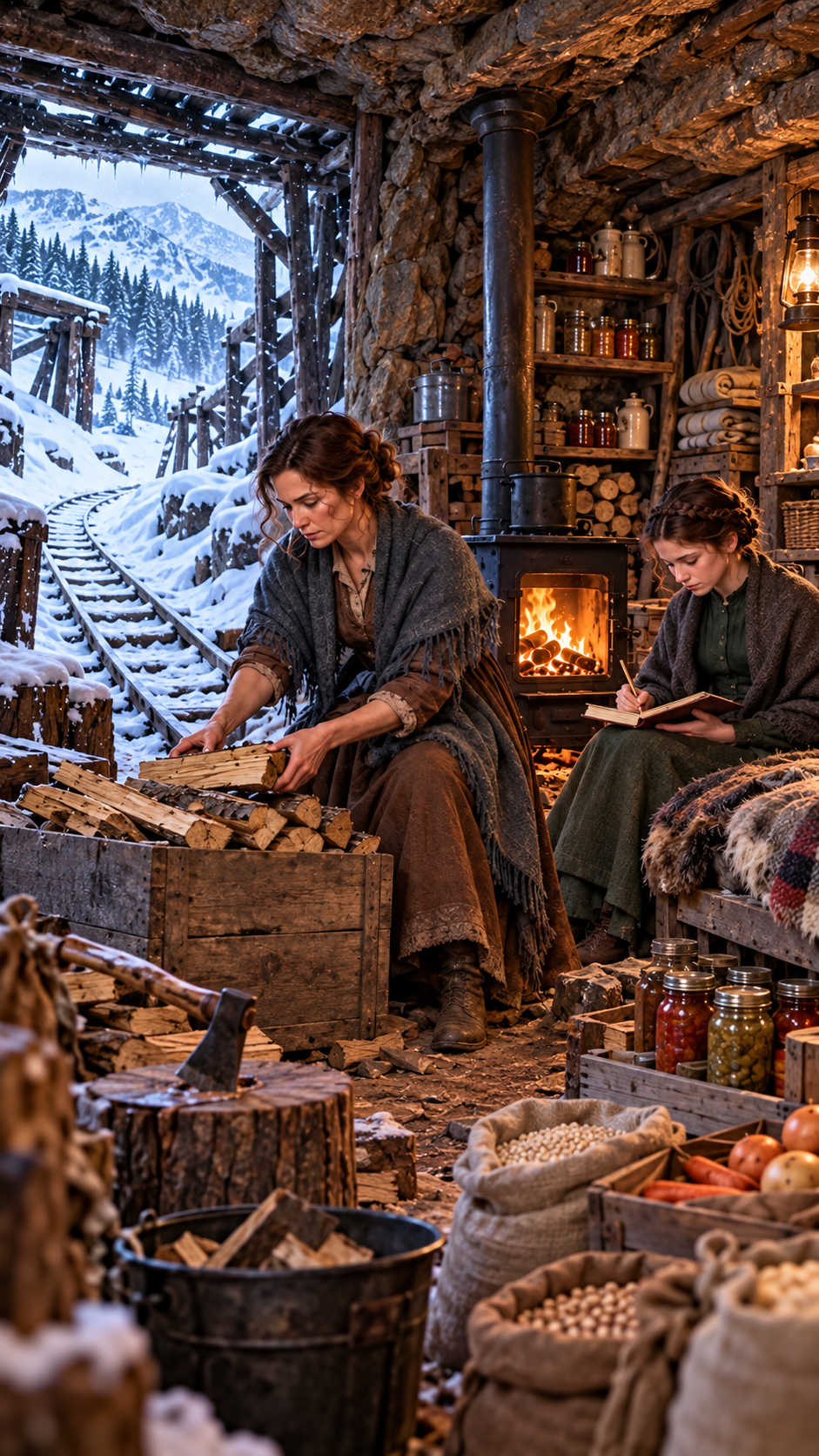
The first chamber of the mine was surprisingly spacious. Clara had spent weeks cleaning it. She repaired the timber supports, cleared loose stones, built wooden shelves against the rock wall, and moved an old iron stove near the entrance.
A rusted stovepipe ran through a gap in the stone.
Farther inside, Clara stored supplies where temperatures stayed cool and steady.
Beans.
Cornmeal.
Flour.
Salt pork.
Dried fruit.
Potatoes.
Carrots.
Onions.
Preserved tomatoes.
Pickled vegetables.
Jars of peaches.
Coffee.
Tea.
And medicine.
But food was only half her preparation.
Firewood occupied nearly an entire wall.
Every morning Clara chopped.
Every afternoon she stacked.
Emily kept count in a small leather notebook.
“Twenty-six days,” she announced one evening.
Clara looked up.
“What?”
“If we burn wood at the rate we did yesterday, we have twenty-six days.”
Clara nodded.
“Make it thirty-five.”
Emily stared at her.
“Thirty-five?”
“Thirty-five.”
“Mother, winter doesn’t last thirty-five days.”
“No.”
Clara placed another log onto the stack.
“But storms sometimes last longer than people expect.”
By November, snow covered the upper trail.
People stopped laughing quite so loudly.
Then came December.
The temperature dropped sharply.
One evening Clara stepped outside and noticed something strange.
Silence.
No birds.
No wind.
No movement among the pines.
Even the horses seemed uneasy.
Emily joined her.
“What is it?”
Clara studied the western sky.
A dark band stretched along the horizon.
“Bring the water buckets inside.”
Emily looked confused.
“Now?”
“Now.”
They worked until midnight.
Water.
Blankets.
Kindling.
Lantern oil.
Tools.
Everything went into the mine.
Before sleeping, Clara walked down the mountain to their small cabin and opened the barn.
She released both horses.
“Go,” she whispered.
The animals hesitated.
Then they disappeared down the trail toward lower country.
At sunrise, the storm arrived.
It did not begin gently.
Wind slammed into the mountain with such force that Clara heard timber cracking somewhere outside.
Snow moved sideways.
Within three hours, the trail vanished.
By afternoon, drifts covered the lower half of the mine entrance.
Emily stared through the doorway.
“I’ve never seen anything like this.”
Clara closed the heavy wooden door.
“Neither have I.”
That was day one.
They kept the stove burning low.
Not roaring.
That was important.
Clara had calculated carefully. Too much heat meant too much wood.
They cooked beans and potatoes in a black iron pot.
Emily read aloud beside the stove.
Outside, the storm screamed.
Day two brought colder temperatures.
Day three brought more snow.
By day four, they could no longer open the main door.
Emily tried pushing.
Nothing moved.
“Snow’s packed against it.”
Clara nodded.
“How much?”
“Could be five feet.”
Emily’s face changed.
“Could be ten.”
“Mother…”
“We have another exit.”
Emily looked toward the darkness deeper inside the mine.
Months earlier Clara had cleared an old ventilation shaft. It climbed toward a second opening higher on the mountainside.
Nobody in town knew about it.
Except Daniel had.
Clara smiled faintly.
“Your father planned better than people gave him credit for.”
On the fifth morning, they heard something.
Three knocks.
Emily stopped writing.
“Did you hear that?”
Clara raised one finger.
Silence.
Then—
Bang.
Bang.
Bang.
Someone was outside.
Clara grabbed a lantern.
They climbed through the ventilation passage and reached the upper opening.
Clara removed the wooden cover.
Wind exploded inward.
A man collapsed through the opening.
Hank Mercer.
His beard was frozen white.
His coat was covered with ice.
“Help…” he whispered.
Clara and Emily dragged him inside.
Hank could barely speak.
Once they warmed him near the stove, his story came in fragments.
Several families had tried leaving town.
The road disappeared.
Two wagons overturned.
Hank had remembered Clara’s mine.
“There are others,” he said.
Clara stopped.
“How many?”
“Seven. Maybe nine.”
“Where?”
“Below the ridge.”
Clara immediately pulled on her coat.
Hank grabbed her wrist.
“You can’t go out there.”
“You just did.”
“I nearly died.”
“Then tell me exactly where they are.”
For the next three hours, Clara tied herself to a rope anchored inside the mine and fought through snow nearly to her waist.
She found the first group huddled beneath an overturned wagon.
Three people.
Then two more beside a stand of pines.
Finally four sheltering behind a rock shelf.
Nine people.
Every one of them entered the mine.
By nightfall, Clara’s quiet shelter held eleven people.
Nobody laughed about the beans anymore.
Nobody laughed about the firewood.
Clara divided portions carefully.
Emily recorded everything.
Eleven people changed the arithmetic.
Thirty-five days of wood became perhaps twelve.
Food remained plentiful.
Fuel became precious.
On day six, the storm worsened.
The stove burned constantly.
Hank sat near Clara while she split kindling.
“I owe you an apology.”
Clara continued working.
“For what?”
“For calling you crazy.”
She smiled.
“You weren’t the only one.”
“I was the loudest.”
“That you were.”
Hank looked around at the shelves.
“You knew this would happen?”
“No.”
“Then why all this?”
Clara stopped chopping.
“Because my husband once told me something.”
“What?”
“He said people prepare for ordinary winters because ordinary winters are what they remember.”
She placed another piece of wood in the crate.
“But mountains don’t care what people remember.”
On day seven, something frightening happened.
The chimney stopped drawing.
Smoke rolled into the chamber.
“Clara!” Emily shouted.
Everyone scrambled.
Clara understood immediately.
Snow had buried the chimney outlet.
Without ventilation, the stove became dangerous.
She extinguished the fire.
Within an hour, the mine began cooling.
Hank stared toward the sealed entrance.
“We have to clear it.”
“We can’t reach it from outside.”
“Then what?”
Clara looked upward.
The ventilation shaft.
There was one chance.
She tied a rope around herself and climbed.
Emily held the other end.
“Mother, please.”
Clara touched her daughter’s cheek.
“I’ll be back.”
She disappeared into the narrow passage.
At the upper opening, the wind nearly knocked her down.
She crawled across the mountainside, probing beneath the snow until she found the chimney pipe.
Buried completely.
Clara dug with her hands.
Snow filled the hole almost as quickly as she removed it.
Her fingers went numb.
Then she remembered Daniel.
Never fight the mountain straight on.
She crawled uphill and began digging a trench diagonally across the slope.
Wind carried loose snow away.
Slowly, the chimney emerged.
Clara cleared the cap.
Smoke burst upward.
Inside the mine, Emily screamed with relief when the stove began drawing again.
Minutes later Clara stumbled through the upper opening.
Hank caught her.
“You did it.”
Clara was trembling too hard to answer.
That night, eleven people slept around the stove.
Outside, the mountain disappeared beneath white.
Then, sometime before dawn on the eighth day—
the wind stopped.
The silence woke Clara.
She opened her eyes.
Emily was already sitting upright.
“Mother?”
Clara listened.
Nothing.
She climbed through the upper passage.
Morning sunlight struck her face.
The storm was gone.
The world outside had changed completely.
Snow covered roofs.
Fences had vanished.
Trees lay broken across the valley.
The road no longer existed.
Clara stood quietly until Emily climbed beside her.
Together they looked toward town.
Smoke rose from only a handful of chimneys.
Later that day, when people began digging one another out, the truth became clear.
Several homes had lost roofs.
Barns collapsed.
Livestock scattered.
Families who had remained in poorly insulated cabins suffered terribly.
But everyone who reached Clara’s mine survived.
All eleven.
Weeks later, Hank Mercer returned carrying lumber.
Clara found him repairing the mine door.
“What are you doing?”
“Making it stronger.”
“I didn’t ask you.”
“No.”
He drove another nail.
“But winter might.”
By spring, something unexpected happened.
The abandoned mine was no longer abandoned.
The townspeople stocked it together.
Every family contributed something.
Beans.
Flour.
Blankets.
Medicine.
Firewood.
Lantern oil.
They built benches along the walls.
They widened the ventilation passage.
They installed a second stove.
And above the entrance, Hank nailed a wooden sign.
Clara stared at it.
MOUNTAIN SHELTER.
“Too plain?” Hank asked.
Clara smiled.
“Perfect.”
Emily stood nearby with her leather notebook.
She opened to the page where she’d recorded the eight days.
At the bottom she had written one final sentence:
Mother prepared for a storm nobody believed would come.
Clara read it twice.
Then she took the pencil.
She crossed out four words.
Emily frowned.
“What are you changing?”
Clara handed the notebook back.
The sentence now read:
Mother prepared for a storm nobody knew would come.
Emily looked at her.
“Why change it?”
“Because there’s a difference.”
Clara turned toward the mine.
Shelves were already filling again.
“Preparation isn’t about knowing disaster will happen.”
She picked up another piece of firewood.
“It’s about understanding that someday, something will.”
And from then on, whenever the first snow appeared on the mountain, nobody laughed when Clara Whitmore began stacking wood.
They brought their axes.
And helped.