
He Found a Tunnel Under His Barn — Entered It, and Realized He’d Never Come Back the Same
When Caleb Turner bought the old farm outside Ash Hollow, Nebraska, everyone told him he was buying trouble.
The land had been abandoned for nearly fifteen years. The farmhouse leaned slightly to the left like a tired man resting on his elbow. The barn’s red paint had peeled into thin, curling strips, and the wind pushed through broken slats with a hollow whistle that sounded almost like someone calling your name.
But Caleb wasn’t afraid of tired buildings. He’d come home from Afghanistan with a knee that hurt in cold weather, a head that didn’t always sleep, and a quiet ache that only open land seemed to ease. The farm was cheap, the acreage wide, and the silence felt like medicine.
His nearest neighbor, Earl Donnelly, leaned against his pickup the first day Caleb arrived.
“You know why nobody bought this place?” Earl asked, squinting at the barn.
“Because it needs work,” Caleb said.
Earl shook his head. “Because things don’t stay where you leave ‘em. And because that barn… well. Folks stopped going in there.”
Caleb smiled politely. “I’ll take my chances.”
Earl spat into the dust. “Suit yourself.”
The first week passed in sweat and small victories. Caleb replaced broken windows, patched the roof, and cleared weeds that had swallowed half the yard. He saved the barn for last. Something about it made him hesitate, though he didn’t admit that to himself.
On the eighth morning, he finally stepped inside.
The air smelled like dry hay and old wood. Dust floated in sunlight cutting through the gaps. A rusted chain hung from a beam. A few broken tools lay scattered along the walls. It looked like any abandoned barn—except for the floor.
Near the center, one section of boards dipped slightly. Not broken. Not rotten. Just… lower.
Caleb stepped on it.
It creaked differently.
He knelt and brushed aside the dirt. The boards were newer than the rest—maybe twenty years old. Someone had replaced this section. Carefully.
He pried one plank loose with a crowbar.
Underneath, darkness.
And a ladder.
Caleb froze.
The ladder disappeared into a narrow shaft lined with rough wooden beams. Cold air rose from below, smelling faintly of earth and something metallic.
He should’ve covered it back up. Called someone. Asked Earl.
Instead, he grabbed a flashlight.
The beam cut into the darkness. The ladder looked sturdy. The shaft dropped maybe ten feet before opening into a tunnel.
His pulse quickened.
He climbed down.
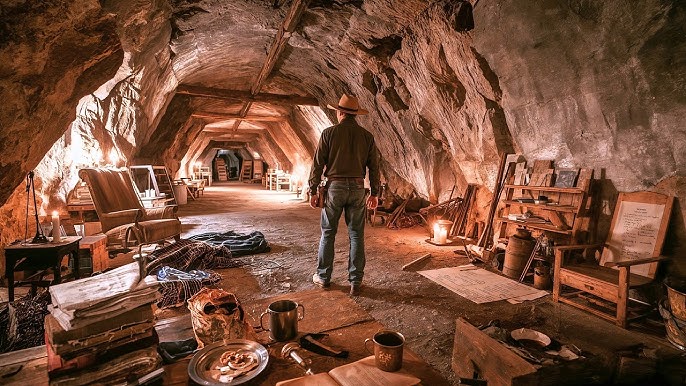
The temperature dropped immediately. The earth muffled every sound above. When his boots hit the bottom, the silence felt thick, like he’d stepped into a place forgotten by time.
The tunnel stretched ahead, just tall enough to stand. Wooden supports lined the walls. The dirt floor showed faint tracks—old ones, softened by years.
Someone had built this intentionally.
Caleb moved forward slowly, flashlight shaking slightly in his hand.
After twenty feet, the tunnel curved.
After fifty, he saw something that made him stop.
A lantern.
Not electric. Oil. Sitting on a crate.
Next to it: a tin cup.
And a blanket folded neatly.
His chest tightened.
This wasn’t just a tunnel. Someone had lived down here.
He stepped closer. The blanket was dusty but intact. The crate held a few items: a pocketknife, a deck of cards, and a small notebook.
Caleb opened it.
The first page read:
If you found this, you’re standing where I survived.
He swallowed.
The handwriting was careful, slightly shaky.
My name is Walter Briggs. Year: 1962. If the sirens ever came, this is where I planned to wait them out.
Caleb frowned.
Sirens?
He flipped the page.
They say missiles could reach us in thirty minutes. Folks laugh, but I built this anyway. Dug it by hand. Took me three winters. My wife called me paranoid. Maybe she’s right. But I sleep better knowing it’s here.
Cold War.
A fallout shelter.
Caleb exhaled slowly.
He turned another page.
October 22, 1962. They’re talking about Cuba on the radio. I moved supplies down here tonight. Just in case.
The date hit him like a quiet echo.
The Cuban Missile Crisis.
He kept reading.
October 25. No sirens yet. Martha says I’m foolish. But I heard jets overhead tonight. I stayed down here an hour. Just listening.
The entries continued for several pages. Then the handwriting changed.
Messier.
Uneven.
October 27. Sirens. Not sure if test. Came down here anyway. Stayed longer. Hard to breathe after a while. Must improve ventilation.
Caleb’s heartbeat grew louder.
Next page:
October 28. Radio says tension easing. Martha relieved. I’ll still keep the tunnel ready. You never know.
Then… blank pages.
Until the last entry.
November 3. Martha left. Says she won’t live with a man who expects the world to end. I’ll finish the tunnel anyway. If anyone ever needs it… it’s here.
Caleb closed the notebook slowly.
The silence pressed in.
He looked deeper into the tunnel.
It didn’t end here.
It continued.
The tunnel narrowed slightly as he walked. The air grew colder. The supports changed from wood to rough stone. Whoever built this had expanded it.
After another thirty feet, the tunnel opened into a small chamber.
Caleb stopped.
Shelves lined the walls. Old canned food. Rusted water jugs. A cot. A radio. A battery box.
It was a full shelter.
He stepped inside.
The air smelled stale but dry. The radio sat on a crate. Curious, he turned the dial.
Nothing.
He was about to turn away when something caught his eye.
A second tunnel.
Smaller. Narrower. Leading deeper.
Caleb hesitated.
He should leave.
But something pulled him forward.
He crouched and entered.
The passage sloped downward. The dirt here was darker. Damp. His flashlight flickered briefly.
He moved faster.
Then the tunnel ended.
In a door.
A metal door.
Old, but solid. A hand-painted sign read:
VENT SHAFT — DO NOT BLOCK
Caleb tried the handle.
It stuck.
He pushed harder.
The door groaned open.
Fresh air rushed in.
He stepped through—and froze.
He wasn’t underground anymore.
He stood in a narrow ravine behind his property. Trees rose steeply on both sides. The exit was hidden by brush. Impossible to see from above.
The tunnel ran from his barn… all the way here.
An escape route.
Caleb stepped outside fully.
The sun felt brighter than before. The wind sharper. He turned back and looked at the hidden entrance.
Walter hadn’t just built a shelter.
He built a way out.
A way to survive.
Caleb leaned against a tree, breathing slowly.
For months, he’d felt stuck. Since coming home, every night felt like waiting for something. A sound. A memory. A shadow.
Walter had lived like that too.
Expecting disaster.
Preparing for it.
But he hadn’t just hidden.
He built.
He dug.
He made something.
Caleb looked at his hands, still dusty from the tunnel.
For the first time in years, he felt something shift inside him.
Not fear.
Purpose.
He spent the next weeks restoring the tunnel.
He reinforced supports. Cleared debris. Replaced old lanterns with LED lights. He kept Walter’s notebook on a shelf in the chamber.
He didn’t tell Earl at first.
This felt… personal.
One evening, while fixing the vent door, he heard footsteps above.
A voice called, “Hello?”
Caleb climbed out.
A woman stood on the ridge, holding a leash. A golden retriever wagged beside her.
“Sorry,” she said. “My dog ran down here. I didn’t know anyone used this ravine.”
“It’s mine,” Caleb said, then corrected himself. “Well… the farm up there is.”
She nodded. “I’m Hannah. Just moved into the Miller place.”
“Caleb.”
Her dog sniffed the tunnel entrance.
“What’s that?” she asked.
Caleb hesitated.
“Old storm shelter,” he said.
She looked impressed. “Smart. Nebraska weather isn’t gentle.”
He smiled faintly.
“No. It isn’t.”
They talked a few minutes. Nothing dramatic. But when she left, Caleb realized something surprising.
He hadn’t felt the urge to retreat.
He hadn’t scanned for exits.
He’d just… stood there.
Winter came early that year.
The forecast warned of a blizzard—stronger than usual. Winds up to sixty miles per hour. Heavy snow.
Earl stopped by the day before.
“You ready?” he asked.
“I’ve got supplies,” Caleb said.
Earl glanced at the barn. “You’ll be fine. Just don’t lose power. This place gets mean when it’s cold.”
That night, the wind started.
By morning, the world vanished in white.
Snow hammered the windows. The power flickered… then died.
Caleb lit lanterns.
Hours passed.
The house grew colder.
He checked the thermometer: 40°F and dropping.
He knew what he had to do.
He grabbed his pack and headed to the barn.
The tunnel waited.
Down below, the temperature held steady. The chamber felt calm, protected. Caleb turned on the battery lights and sat on the cot.
The storm roared above, but here, it was distant.
He opened Walter’s notebook again.
If anyone ever needs it… it’s here.
Caleb whispered, “Thanks, Walter.”
He stayed there through the worst of it. Ate canned beans. Listened to wind rumble through the earth. Slept better than he had in months.
The next morning, silence.
He climbed the escape tunnel.
The ravine was buried. Snow waist-deep. Trees bent under ice.
But he was safe.
And for the first time since coming home, Caleb realized something:
He hadn’t just survived the storm.
He’d chosen to face it.
And he hadn’t been alone.
Walter’s tunnel had given him more than shelter.
It gave him a way forward.
Weeks later, Caleb invited Earl and Hannah to see it.
Earl whistled low. “Well I’ll be damned. That old rumor was real.”
Hannah ran her hand along the wall. “You restored all this?”
Caleb nodded. “Didn’t build it. Just… finished what someone started.”
Earl chuckled. “Place might save your life someday.”
Caleb looked down the tunnel, toward the hidden exit.
“It already did.”
He didn’t mean the blizzard.
He meant something deeper.
Before the tunnel, he’d been stuck in memories—waiting for danger, expecting collapse.
After the tunnel, he started building again.
He repaired fences. Planted winter wheat. Fixed the barn roof. Even painted the farmhouse.
Slowly, the land came alive.
So did he.
And sometimes, late at night, he’d walk down into the tunnel, sit beside Walter’s notebook, and listen to the quiet.
Not because he was afraid.
But because that quiet reminded him:
Even in the dark, someone had dug forward.
And now, so had he.
Caleb Turner entered the tunnel looking for answers.
He came back with something else entirely.
A past he respected.
A future he chose.
And a life that—like the tunnel beneath his barn—ran deeper than anyone could see.
Part 2 — He Found a Tunnel Under His Barn — Entered It, and Realized He’d Never Come Back the Same
By spring, the farm didn’t look abandoned anymore.
Green shoots pushed through soil Caleb had turned by hand. The barn wore fresh paint—still red, but deeper, like dried clay after rain. He’d repaired the roof, replaced the sagging doors, and installed a hidden hatch that blended perfectly with the floor. No one would ever notice the tunnel unless he showed them.
He didn’t show many people.
Only Earl.
And Hannah.
And once, reluctantly, the county inspector after Caleb registered the underground space as a storm shelter.
“You’re telling me this runs under half your property?” the inspector asked.
“More like a third,” Caleb replied.
“And you reinforced the supports?”
“Yes.”
The man nodded slowly. “Well… it’s not standard. But it’s safer than half the basements I’ve seen.” He signed the paperwork and handed it back. “Whoever built it originally… he knew what he was doing.”
Caleb thought of Walter Briggs.
He kept the notebook in a sealed plastic sleeve now. He’d also found something else while cleaning the deeper chamber—a wooden box tucked behind a loose plank. Inside it were old photographs: a man in overalls standing beside a younger woman, both smiling in front of the same barn.
Walter and Martha.
On the back of one photo, faint pencil read:
If she ever comes back, tell her I waited.
Caleb never told anyone about that note. Not even Hannah.
Hannah began stopping by more often.
Sometimes she brought coffee. Sometimes her dog, Milo, bounded into the barn before she even knocked. One afternoon, she leaned against the fence while Caleb fixed a tractor belt.
“You seem different,” she said.
“Different from what?”
“From when you first moved in. You used to look like you were listening for something all the time.”
Caleb wiped grease from his hands. “Maybe I was.”
“And now?”
He glanced toward the barn. “Now I know where to go if things get bad.”
She smiled. “That tunnel again.”
“Yeah.”
“You ever think about why he built it?” she asked.
Caleb nodded. “Fear, mostly.”
“And why did you restore it?”
He thought for a long moment.
“Hope,” he said quietly.
In late May, Caleb heard something strange in the tunnel.
He’d gone down to check humidity levels—he’d installed a simple ventilation fan powered by a solar battery. As he passed the second chamber, he heard a faint tapping.
He froze.
Tap… tap… tap.
Not from behind.
From deeper.
From the vent tunnel.
Caleb grabbed his flashlight and moved cautiously forward. The sound stopped.
He opened the metal door and stepped into the ravine.
Nothing.
Just wind moving leaves.
He almost laughed at himself—until he noticed the ground.
Footprints.
Fresh.
Someone had walked right up to the hidden entrance.
His pulse spiked.
The tracks were narrow—boots, maybe size seven or eight. Not Earl. Not Hannah. Someone smaller.
He followed them a few yards.
They disappeared into the trees.
Caleb stood still, listening.
Nothing.
He returned to the tunnel, closed the door, and locked it from inside.
For the first time since winter, the underground space felt less like sanctuary… and more like secret.
Two nights later, he heard it again.
This time while he was in the barn.
A faint thump beneath his boots.
Caleb grabbed the hatch handle and lifted it quietly.
Darkness.
He climbed down slowly.
The air felt disturbed, like someone had moved through recently. Dust shifted near the crate. The tin cup had rolled slightly from where he’d left it.
He wasn’t alone.
“Hello?” he called softly.
No answer.
He moved deeper.
The second chamber was empty—but something new lay on the shelf.
A folded piece of paper.
Caleb’s throat tightened.
He opened it.
The handwriting was messy, rushed.
Please don’t close this. I need somewhere safe. I won’t steal.
No name.
Just that.
Caleb stared at the words.
Someone had found the tunnel.
And they were using it.
He didn’t tell Earl right away.
Instead, he left supplies.
A bottle of water. Two protein bars. A flashlight.
Then he waited.
Three days passed.
On the fourth, the supplies were gone.
And another note appeared.
Thank you. I’ll stay out of the house. Just the tunnel.
Caleb exhaled slowly.
He felt oddly calm.
Not angry.
Not afraid.
He understood needing somewhere to hide.
That evening, he sat in the chamber with a lantern lit.
“If you’re here,” he said, “you don’t have to stay quiet.”
Silence.
Then—
A faint shuffle.
From the deeper passage.
A girl stepped into the light.
She couldn’t have been older than sixteen. Thin. Dirt-smudged. A backpack hung from one shoulder. Her eyes darted toward the exit.
“I wasn’t stealing,” she said quickly.
“I know,” Caleb replied.
She hesitated. “You’re not calling anyone?”
“No.”
Her shoulders dropped slightly.
“What’s your name?” he asked.
“Lena.”
“You running from something?”
She nodded, but didn’t elaborate.
Caleb didn’t push.
“You can stay down here tonight,” he said. “But you should know… this place isn’t really meant for long-term.”
She looked around. “It’s safer than outside.”
He understood that answer too well.
Over the next week, Lena came and went. She never entered the house. She used the ravine entrance, slept in the chamber, and left at dawn.
Caleb left food.
Eventually, she started talking.
Her mother had died the year before. Her stepfather drank. Things got worse. She left.
“I just needed somewhere nobody knew,” she said.
“You picked a good spot,” Caleb replied.
She glanced at the tunnel walls. “Who built it?”
“Man named Walter. He thought the world might end.”
Lena gave a faint smile. “Feels like it already did for some people.”
Caleb didn’t argue.
One night, a storm rolled in—sudden, violent. Thunder cracked across the plains. Rain poured like sheets.
Lena arrived soaked, shaking.
Caleb led her to the chamber and handed her a blanket.
“You can come up to the house,” he said.
She shook her head. “I’m okay here.”
Lightning flashed.
The tunnel trembled faintly.
Lena looked scared.
Caleb sat across from her. “You know… this place wasn’t just built for hiding.”
She frowned. “What else?”
“For waiting. For surviving. Then going back out.”
She stared at the floor.
“I don’t know if I have anywhere to go back to,” she whispered.
Caleb thought of Walter’s note.
If she ever comes back, tell her I waited.
Some people built tunnels hoping someone would return.
Some entered them hoping they wouldn’t have to.
“You could stay,” Caleb said quietly. “Not in the tunnel. I mean… here. Help with the farm. No pressure.”
Lena looked up, surprised.
“You serious?”
“Yeah.”
She blinked rapidly.
“I’ll think about it.”
She moved into the farmhouse two days later.
Not officially.
Just a backpack in the spare room.
She helped repair fences. Fed chickens. Learned to drive the old pickup across the fields.
The tunnel remained open—but she stopped sleeping down there.
One evening, she asked, “Why didn’t you kick me out?”
Caleb leaned against the fence. “Someone once built this place for a stranger. Figured I could do the same.”
She nodded slowly.
“You’re not the same guy who first found it, are you?”
“No,” Caleb admitted. “I’m not.”
Summer deepened. The wheat grew tall. Hannah started joining them for dinners. Milo chased chickens until Lena trained him not to.
The farm felt alive.
One night, they all sat outside watching lightning bugs flicker over the fields.
Hannah nudged Caleb. “You realize something?”
“What?”
“That tunnel didn’t just save you.”
He glanced toward the barn.
“No,” he said. “It didn’t.”
It had saved Lena too.
And maybe, in some quiet way, Walter’s hope had traveled forward in time—passed from one hidden space to another, until someone needed it again.
Later that night, Caleb walked down into the tunnel alone.
He opened Walter’s notebook.
He added a new page.
June 12, 2026. Someone else needed this place. She’s safe now. You built more than a shelter, Walter. You built a second chance.
He closed the notebook gently.
The tunnel no longer felt like an escape.
It felt like a bridge.
Between fear and healing.
Between past and future.
Between the man who dug it… and the lives it would keep changing.
Caleb climbed back up into the warm summer night.
And for the first time, he realized something else:
He hadn’t just come back different.
He had made sure someone else could too.