
He Covered His Quonset in Mud So Thick It Looked Like a Hill — Then the Worst Freeze Came
The first time people saw Daniel Mercer shoveling mud onto his Quonset hut, they assumed he’d lost his mind.
The structure itself sat alone on the edge of a wide northern plain—corrugated steel ribs arched into a half-cylinder, the kind left behind after the war. Most folks used them for storage, maybe a workshop. Daniel had made his home inside one five winters ago, hauling in a stove, laying down planks, insulating the walls with scrap lumber and wool.
It worked well enough.
Until winter came hard.
Steel sweated in the cold. Wind knifed through every seam. Nights turned the curved roof into a drum that echoed with the sound of freezing air. Twice he woke to frost forming on his blanket. Once he found the water bucket frozen solid beside his bed.
After that winter, he started hauling dirt.
At first, it was just a thin layer—mud mixed with straw, slapped against the lower walls. It hardened like crude plaster. Wind slowed. Heat stayed longer.
So he added more.
And more.
By late autumn, Daniel spent every spare hour digging from a shallow pit beside the hut, loading dirt into a wheelbarrow, and packing it onto the steel. He built it up in thick layers, smoothing the slope, rounding the sides. Rain hardened the mud. He added another coat. Then another.
Soon the Quonset hut disappeared beneath earth.
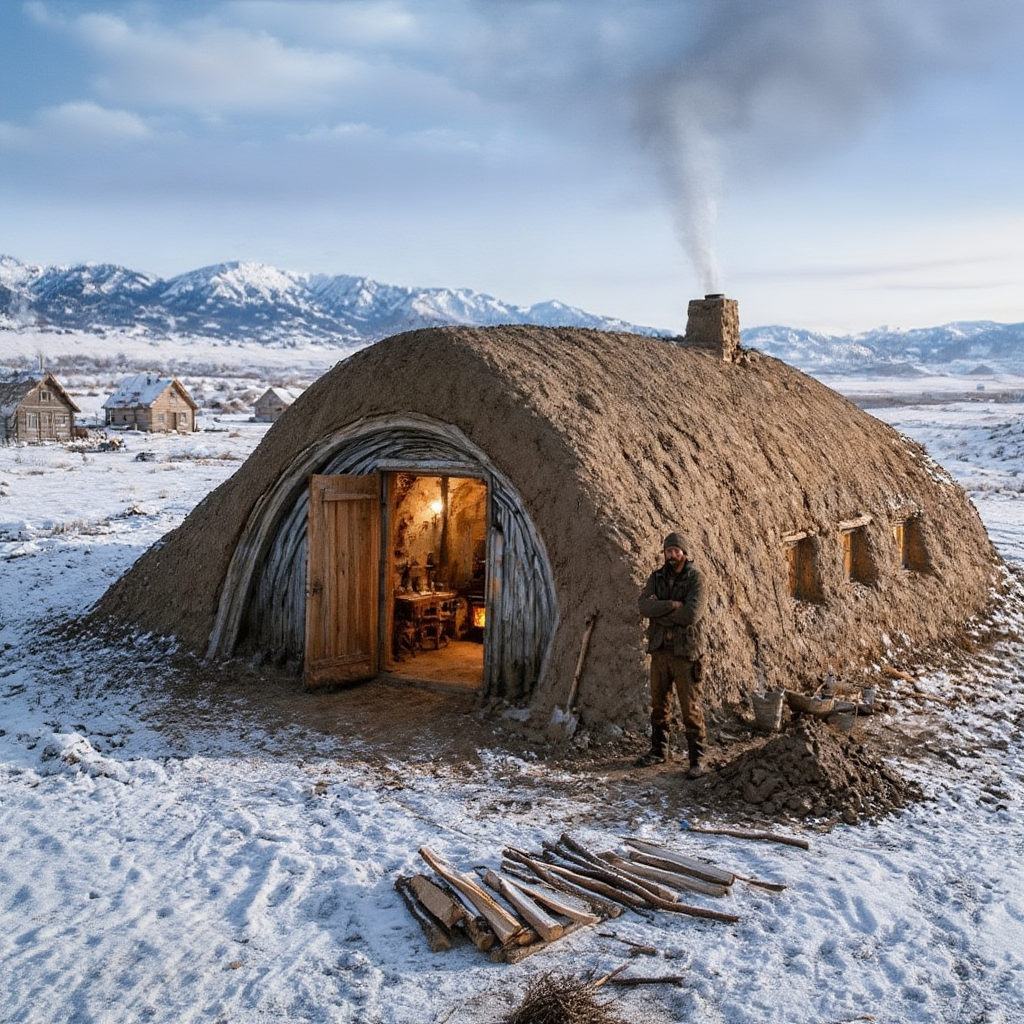
Only the wooden door remained visible, set into a low mound shaped like a hill. A stovepipe rose from the top, thin smoke curling into the sky.
Neighbors rode by and stared.
“You burying yourself alive, Mercer?” old Carl Donnelly called one afternoon.
Daniel wiped sweat from his brow. “Trying not to freeze.”
Carl shook his head. “Steel’s good enough.”
“Not in January.”
“You’re building a dirt grave.”
Daniel leaned on his shovel. “Maybe. But it’ll be a warm one.”
They laughed and rode on.
Daniel kept working.
He thickened the roof until the mound rose nearly twice the height of the original structure. He tamped the mud hard, layered straw for insulation, and carved shallow drainage channels around the base. By the time the first snow fell, his home looked less like a hut and more like a low, rounded hill.
Only footprints in the snow led to the door.
Inside, it felt different.
Warmer.
Quiet.
The wind no longer rattled metal overhead. Instead, sound dulled to a soft murmur. The stove heat lingered. Even when the fire burned low, the air stayed gentle instead of biting.
Daniel noticed immediately.
He added more firewood anyway.
Because he knew what was coming.
The radio crackled one evening in early December.
“…Arctic front moving south… temperatures expected to drop below minus forty… prolonged freeze likely…”
Daniel turned the dial slowly, listening.
The voice continued.
“…livestock losses expected… residents advised to shelter… prolonged exposure dangerous…”
He glanced at the curved ceiling above him—now hidden under nearly three feet of packed mud.
“Let’s see if you work,” he murmured.
The freeze arrived three days later.
The temperature dropped fast. Snow fell light at first, then thick and relentless. Wind flattened the drifts into long white waves across the plain. By morning, the world had turned silent and pale.
Daniel stepped outside briefly, bundled in wool and fur. The mud dome rose behind him, snow clinging to its sides. Smoke drifted steadily from the chimney.
He crossed his arms, studying the horizon.
Distant cabins dotted the plain—tiny shapes against endless white. One by one, their chimneys began smoking as neighbors fired stoves full.
He turned back and stepped inside.
Warmth wrapped around him instantly.
He shut the door and listened.
No howling wind. No rattling steel.
Just the soft crackle of fire.
He smiled faintly.
The freeze deepened.
By the second night, temperatures plunged further. Frost coated the inside of nearby barns. Animals huddled close. Wood snapped like gunshots in the cold.
Daniel kept the stove steady but not roaring. He wanted to test the insulation.
The interior stayed comfortable.
Even near the floor, warmth lingered. The mud walls absorbed heat and slowly released it back. He noticed the difference when he let the fire burn low—the temperature dropped only slightly.
On the third day, a knock sounded.
He frowned.
No one traveled in weather like this.
The knock came again, faint but urgent.
Daniel grabbed his coat and opened the door. A blast of icy air rushed in, stinging his face.
Outside stood a man wrapped in blankets, beard frosted white.
“Mercer!” he shouted.
It was Carl Donnelly.
Daniel pulled him inside quickly and shut the door.
Carl staggered toward the fire, hands trembling. “Your place… warm as spring.”
“What happened?” Daniel asked.
“Stove pipe cracked. Cabin freezing. I walked over.”
Daniel handed him a mug of hot coffee.
Carl looked around, amazed. “You really buried it.”
“Three feet of mud.”
Carl nodded slowly. “Smart.”
They sat quietly, listening to the storm.
Carl finally spoke. “Mind if I stay till it eases?”
Daniel shrugged. “Room enough.”
By nightfall, another knock came.
Then another.
A young couple from the southern ridge. An older woman from the creek. A ranch hand whose bunkhouse lost heat.
Daniel opened the door each time.
They crowded inside, stamping snow from boots, marveling at the warmth. The dome held heat surprisingly well even with extra bodies. The mud walls radiated gentle warmth, like a banked fire.
Someone laughed. “Looks like a hill outside… feels like a house inside.”
Daniel nodded.
The worst night came a week later.
The temperature dropped lower than anyone remembered. Breath froze instantly outdoors. Trees cracked. Even the distant river slowed beneath forming ice.
Inside the mud-covered Quonset, the stove burned steady. People slept wrapped in blankets. The air stayed warm, almost still.
Daniel woke near midnight and stepped outside briefly.
The sky stretched clear and star-filled, cold beyond measure. Snow glittered like glass. The mud dome rose from the white field, chimney smoking gently.
It truly looked like a hill.
But inside, life continued.
He stepped back in and shut the door.
The freeze lasted ten days.
When it finally broke, the sun returned pale but hopeful. People began leaving, thanking him quietly.
Carl paused at the door. “You saved us, Mercer.”
Daniel shook his head. “Mud did.”
Carl laughed. “Still takes a stubborn man to pile it.”
When the last guest left, Daniel stood outside again.
The plain stretched wide and silent. Footprints crisscrossed the snow around the dome. Firewood piles sat half-buried. Smoke drifted gently upward.
The mud-covered Quonset looked simple. Almost invisible.
But it had held.
He crossed his arms, watching the distant mountains glow under dusk clouds. Warm light spilled from the open door behind him, cutting a golden rectangle into the snow.
The worst freeze had come.
And the hill he built had become the warmest place for miles.