
Everyone Laughed at a Navy SEAL and His Dog’s Mud Bricks — Until Their Nail Houses Fell Apart
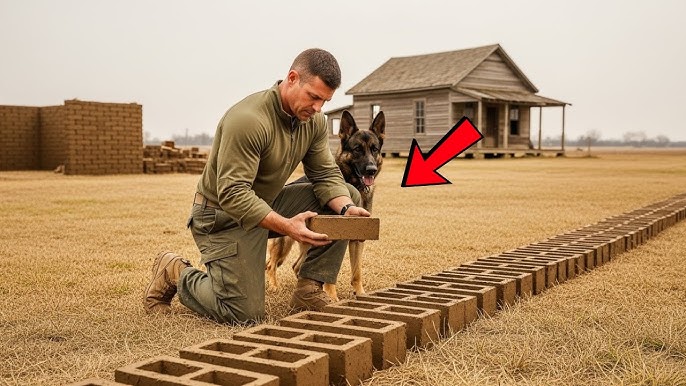
When Jake Mercer stacked the first mud brick outside his property, the laughter started almost immediately.
“You building a sandbox, Jake?” called Marty Willis from across the fence.
Jake didn’t answer. He pressed another brick into place, checking the alignment carefully. Beside him, his German Shepherd, Ranger, watched intently, ears forward, tail still.
The bricks looked crude—brown rectangles made of clay, sand, and straw. They dried in rows under the summer sun, uneven but sturdy. Jake wiped sweat from his forehead and set another.
Marty leaned over the fence. “You serious? You’re not using lumber?”
Jake shook his head. “Nope.”
“Why not? Everyone’s building nail houses. Fast and cheap.”
Jake glanced at the half-finished wooden frames dotting the valley. “Cheap doesn’t mean strong.”
Marty laughed. “You spent too long in the Navy, man.”
Jake had, in fact, spent twelve years as a Navy SEAL. Desert deployments taught him something most folks here ignored—earth walls insulated better, resisted heat, and didn’t rot when built right.
He’d seen villages survive sandstorms that flattened prefabricated structures. He’d learned from locals who built with mud, straw, and patience.
Now he wanted to try it himself.
The land he’d bought sat at the edge of a dry valley in Arizona. Summers were brutal. Winters dropped cold at night. Most people here built quick wooden “nail houses”—light frames hammered together in a week.
Jake wasn’t interested in quick.
Ranger barked once as Jake lifted another brick.
“Yeah, buddy,” he muttered. “We’re getting there.”
Every morning, Jake mixed clay in a shallow pit. Ranger splashed through it happily, paws churning the mud.
“You’re helping,” Jake said with a grin.
He formed bricks by hand, letting them dry for days before stacking. The walls rose slowly—thick, heavy, solid.
Neighbors stopped by often, mostly to laugh.
“You’ll be done in ten years!”
“What happens when it rains?”
“Looks like a giant cookie!”
Jake kept working.
By mid-summer, the walls reached waist height. They were nearly two feet thick. Jake embedded wooden beams across the top, then added more layers.
Ranger followed him everywhere, sometimes carrying small sticks that Jake used for reinforcement.
“You’re the foreman now,” Jake joked.
One afternoon, a pickup truck pulled in. A woman stepped out, arms crossed.
“You really building with mud?” she asked.
Jake nodded.
“I’m Sarah,” she said. “Bought the lot down the road.”
“Jake.”
She studied the walls. “Feels cool in here.”
Even under the sun, the interior remained noticeably cooler.
“That’s the idea,” Jake said.
She tapped the surface. “Strong too.”
“Stronger than it looks.”
Sarah smiled faintly. “I might try something similar.”
“Take your time,” he advised.
By autumn, Jake’s house stood complete—a small, rectangular structure with rounded corners, thick earthen walls, and a simple metal roof. It looked unusual but solid.
Meanwhile, neighbors finished their nail houses—light wood frames, thin walls, fast construction.
Winter passed quietly. Jake’s house stayed warm at night, cool during day. He burned little firewood.
Then spring storms came.
The first heavy rain lasted two days. Water pooled across the valley. Wooden houses creaked as moisture soaked thin siding.
Jake walked outside. His mud walls darkened slightly but remained firm. The wide roof overhang protected them.
Marty shouted from his porch. “Guess your mud didn’t melt!”
Jake shrugged. “Told you.”
But the real test came months later.
Summer heat hit early—110 degrees for days. Nail houses baked. Air conditioners ran nonstop. Power flickered under strain.
Jake’s house stayed surprisingly cool. The thick walls absorbed heat slowly, releasing it at night.
Sarah visited one afternoon, wiping sweat. “It’s ten degrees cooler in here.”
Jake nodded. “Thermal mass.”
Ranger lay stretched on the floor, perfectly comfortable.
Word spread. More neighbors came to see.
“Feels like a cave,” one said.
“In a good way,” another added.
Marty scratched his head. “Maybe you were onto something.”
Jake smiled but said nothing.
Then the monsoon storms arrived.
Winds tore across the valley. Rain hammered sideways. Lightning cracked nearby hills. Nail houses rattled under pressure.
One roof lifted partially. Another siding panel tore loose. Water seeped through seams.
Jake’s mud house stood still. Heavy walls didn’t shake. Rounded edges deflected wind. The roof held firm.
Ranger stayed calm, barely lifting his head.
After the storm, neighbors surveyed damage. Warped boards. Loose nails. Leaks.
Marty knocked on Jake’s door.
“You alright?”
“Yeah.”
Marty looked around. “Not even a crack?”
“Nope.”
He exhaled slowly. “My wall split. Water inside.”
Jake nodded. “Wood moves.”
That week, repairs echoed across the valley. Hammering, patching, replacing boards.
Jake continued quietly, reinforcing his roof and planting shade trees.
Then came the heatwave.
Temperatures hit record highs. Several nail houses warped further. One small shed collapsed after its nails loosened from expansion.
People started comparing.
“Jake’s place is still cool.”
“His walls don’t move.”
“He barely runs power.”
The laughter faded.
One evening, Sarah approached again.
“I’m building mine with mud,” she said.
Jake nodded. “I’ll help.”
They mixed clay together. Ranger supervised, occasionally stepping into the mud.
“You really trained him?” she asked.
“He just likes working,” Jake replied.
Her walls rose faster with Jake’s guidance. Others began asking too.
Marty eventually walked over.
“Think you could show me?”
Jake smiled. “Sure.”
By next spring, three new mud houses stood in the valley.
Then a severe windstorm hit—stronger than any before. Gusts ripped shingles from nail houses. One entire wall panel collapsed on a lightweight structure.
Jake’s house didn’t budge.
Neither did Sarah’s.
After the storm, people gathered quietly.
Marty shook his head. “We laughed at you.”
Jake shrugged. “I’m used to that.”
“You and that dog,” he added, glancing at Ranger.
Ranger wagged his tail.
“You built something that lasts,” Sarah said.
Jake looked at the thick earthen walls glowing in sunset light. “Just used what works.”
The valley changed slowly after that. More mud bricks dried in rows. Fewer nail houses appeared.
Months later, another heavy storm passed through. This time, the mud houses stood firm. But two older nail houses partially collapsed.
Neighbors gathered near Jake’s place.
Marty exhaled. “Everyone laughed at a Navy SEAL and his dog’s mud bricks.”
Sarah smiled. “Until the nail houses fell apart.”
Jake scratched Ranger’s ears.
“Sometimes slow beats fast,” he said quietly.
The sun dipped behind the hills. Thick earthen walls held the day’s cool air. The valley looked different now—stronger, quieter, wiser.
And the house built from mud and patience stood as proof that what looks simple… can outlast everything.
By the second summer, the valley looked completely different.
Where thin wooden nail houses once lined the dirt road, thick earthen walls now rose in warm brown tones. Some were square, others rounded. A few had whitewashed finishes. But all of them shared the same foundation—mud bricks, patience, and lessons learned the hard way.
Jake Mercer stood outside his house at sunrise, coffee in hand. Ranger sat beside him, alert as always. The air was cool, even though the forecast promised another brutal heatwave.
“You started something, buddy,” Jake murmured, scratching the dog’s neck.
Ranger’s ears twitched, like he understood.
Across the road, Marty hammered gently—not repairing damage this time, but finishing his new mud-brick workshop. The old nail structure beside it leaned slightly, warped from last year’s storms.
“Hey, Jake!” Marty called. “Come look at this corner. I think I got the angle right.”
Jake walked over. The walls were thick, but Marty had tried to rush one section.
“You need more straw in this mix,” Jake said. “It’ll crack when it dries.”
Marty nodded. “Still learning.”
“Everyone is.”
Sarah joined them carrying a bucket. “My roof beams are ready. Think we can set them today?”
Jake glanced at the sun. “Better do it before noon.”
The three of them worked steadily. Ranger trotted between them, occasionally dropping sticks near Jake’s feet. The dog had become something of a symbol in the valley—people joked that if Ranger approved of your mud mix, your house would last.
By midday, the heat climbed fast. The metal roof panels shimmered. Sarah wiped sweat from her forehead.
“Let’s take a break inside,” Jake said.
They stepped into his house. Instantly, the temperature dropped. The thick earthen walls held the night’s coolness.
Marty sighed. “Still amazes me.”
Sarah leaned against the wall. “No air conditioner, barely any fan… and it’s comfortable.”
Jake nodded. “Thermal mass. Same principle every time.”
Marty looked around. “My nail house used to feel like an oven by noon.”
Jake didn’t respond. He didn’t need to.
That afternoon, a pickup truck rolled into the valley. Two men stepped out wearing construction hats. They looked around curiously.
“You Jake Mercer?” one asked.
“That’s me.”
“We heard about your mud houses. Mind if we take a look?”
Jake shrugged. “Go ahead.”
They walked slowly around the structure, measuring wall thickness, tapping surfaces.
“Solid,” one muttered.
“Wind-resistant too,” the other added.
“We’re building outside Phoenix,” the first man said. “Heat’s brutal. These might work.”
Jake nodded. “They do.”
The men thanked him and left, but word spread quickly. Soon, more visitors arrived—builders, homesteaders, even a local reporter.
Jake stayed quiet through it all. He kept mixing mud, stacking bricks, helping neighbors.
But then came the storm.
Late August brought dark clouds rolling in from the west. Wind picked up fast, stronger than last year. Dust spiraled across the valley.
“Looks bad,” Sarah said, securing her door.
Jake nodded. “Tie everything down.”
The first gust hit like a wall. Wooden debris from old nail houses rattled loose. A shed roof lifted and slammed back down. The wind howled for hours.
Inside Jake’s house, Ranger lay calmly on the cool floor. The walls didn’t shake. The rounded corners softened the wind’s force.
By morning, the storm passed.
Jake stepped outside.
One of the last remaining nail houses had partially collapsed—its frame twisted, nails pulled loose by repeated stress. Another had siding ripped away.
But the mud houses stood firm.
Not a single major crack.
Neighbors gathered quietly, surveying the damage.
Marty shook his head. “That’s the third time nails failed.”
Sarah folded her arms. “Wood flexes. Mud holds.”
Jake crouched, examining a small crack near his doorway. He filled it easily with fresh clay.
“Maintenance is simple,” he said.
The others nodded.
Later that week, the valley council met informally under a shade tree.
“We should build everything this way,” one man suggested.
“Costs less too,” another added.
Sarah glanced at Jake. “You started this.”
Jake shook his head. “You all chose it.”
Marty laughed. “We laughed first.”
“Yeah,” someone added. “We thought you were crazy.”
Jake scratched Ranger’s ears. “Wouldn’t be the first time.”
Months passed. More mud houses appeared. The valley’s energy use dropped. Fewer repairs were needed after storms.
One evening, Sarah stood beside Jake watching sunset.
“Remember when everyone mocked you?” she asked.
“Vaguely.”
“They said your mud bricks would melt.”
Jake smiled faintly. “Still here.”
She looked around. “Your house changed everything.”
Ranger barked softly as a cool breeze passed.
“Not just mine,” Jake said. “Everyone learned.”
The sun dipped low, casting long shadows across thick earthen walls. The valley looked unified now—solid, grounded, built to last.
Sarah nodded toward the old collapsed nail house in the distance.
“Funny,” she said quietly. “Everyone laughed at a Navy SEAL and his dog’s mud bricks…”
Jake finished the thought.
“…until their nail houses fell apart.”
Ranger wagged his tail, as if agreeing.
The air cooled quickly as evening settled. Inside the mud homes, the day’s heat faded. No rattling walls. No creaking nails. Just quiet strength.
Jake leaned back against the thick wall of his house. It still held the coolness from dawn.
Slow. Simple. Strong.
And now, the entire valley knew why.