
STORY
At seventeen, Clara Whitmore owned everything she had in one small leather satchel.
Two dresses. A hairbrush with three missing teeth. Her mother’s faded handkerchief. Eleven dollars and forty cents.
And a folded deed to a homestead everyone in town insisted was worthless.
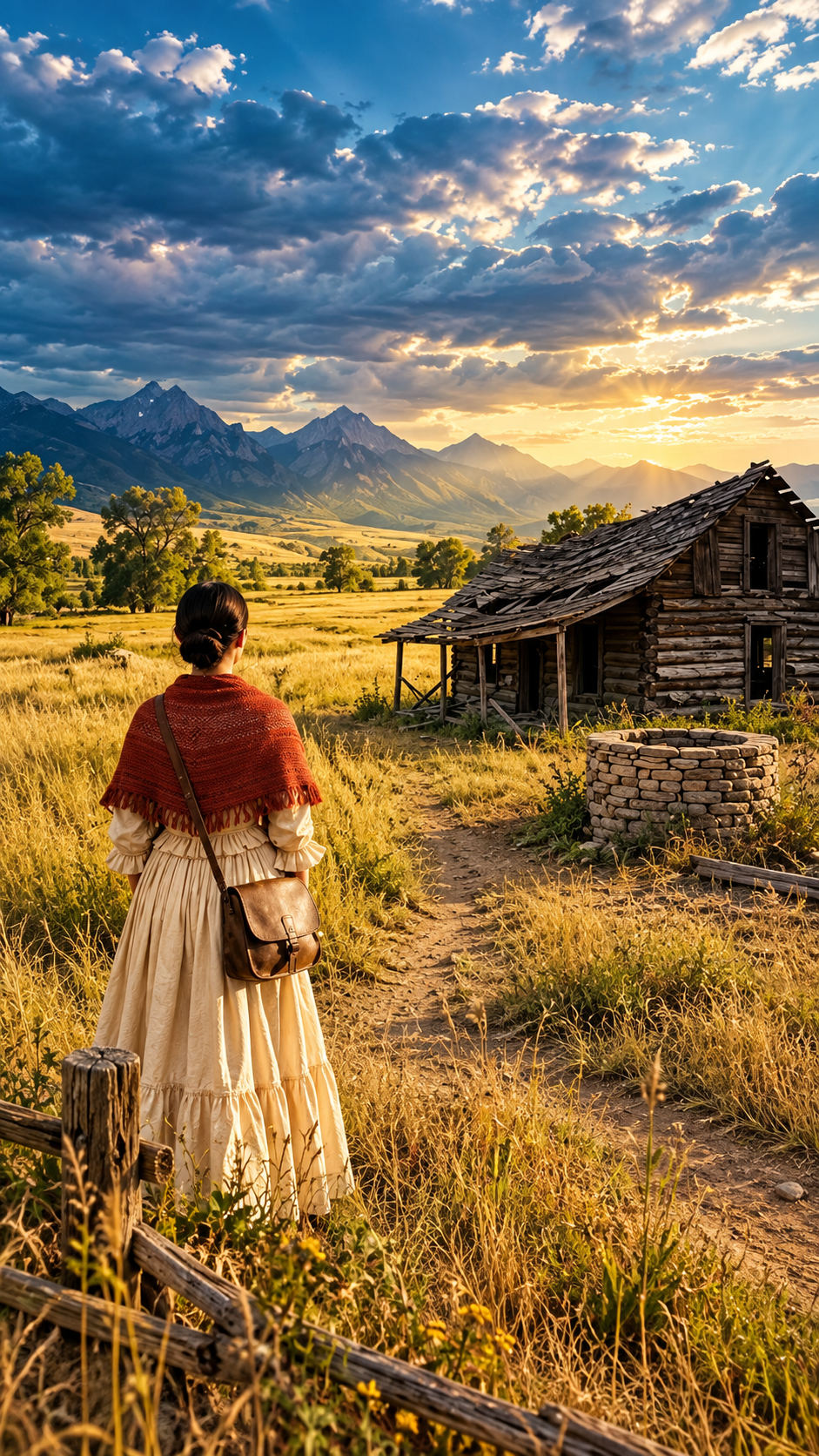
Clara stood at the edge of the property as the evening sun spilled gold across the grass. Before her sat an old log house with a sagging roof, a porch leaning badly to one side, and windows so dark they seemed to stare back at her.
Beside it stood a circular stone well.
“So this is it,” Clara whispered.
The wind stirred her rust-colored shawl.
Her grandmother, Martha Whitmore, had died six weeks earlier.
Clara’s parents had been gone much longer. Fever had taken her mother when Clara was eleven. Her father died in a logging accident three years later. Martha had taken Clara in afterward, but failing health eventually forced the old woman to live with relatives.
Now Martha was gone too.
And those relatives had wasted no time explaining what Clara had inherited.
“A collapsing cabin and forty acres of bad grass,” Uncle Vernon had said.
His wife had added, “You’d be wiser to sell it for whatever someone offers.”
Someone already had.
A cattleman named Silas Boone offered Clara three hundred dollars before she had even seen the place.
When Clara refused, he increased it to four hundred.
That bothered her.
Why would a man offer four hundred dollars for something everyone called worthless?
So Clara had taken a wagon as far as the road allowed and walked the final mile alone.
She pushed open the cabin door.
Dust floated through shafts of sunset.
Inside stood a stone fireplace, a table, two chairs, an iron stove, and a narrow bed. Part of the ceiling had fallen near the back wall.
Clara swallowed her disappointment.
“Grandma,” she murmured, “what were you thinking?”
A floorboard creaked beneath her boot.
She froze.
Then laughed nervously.
“Old house. That’s all.”
She spent her first night wrapped in blankets beside the fireplace.
Just before dawn, something woke her.
Knock.
Clara opened her eyes.
Knock.
She sat upright.
The sound came again.
Knock.
Not from the door.
From beneath the floor.
Clara grabbed the fireplace poker.
“Who’s there?”
Silence.
Then—
Knock.
She waited until daylight before investigating.
The sound, she discovered, came whenever the wind shook one particular section of wall. A loose board was striking something underneath.
Clara pried it away.
Behind it was a narrow cavity.
Inside lay a small tin box.
Her heart began pounding.
The box contained no money.
Only a brass key and a folded piece of paper.
Clara recognized her grandmother’s handwriting immediately.
If Clara ever comes home, tell her to begin where the water stopped.
That was all.
Clara read it three times.
“Where the water stopped?”
Her eyes drifted toward the window.
The well.
She hurried outside.
The stone well stood twenty yards from the cabin, choked with leaves and dry weeds. Clara dropped a pebble into it.
One second.
Two.
Clack.
No splash.
Dry.
She spent the morning pulling weeds from around the stones.
Near noon she noticed something strange.
One stone was different.
Most were gray granite. This one was reddish sandstone.
Clara worked it loose.
Behind it was a small iron plate with a keyhole.
Her breath caught.
She pulled the brass key from her pocket.
It fit.
Clara turned it.
Click.
A hidden metal latch released inside the well wall.
She stepped backward.
“What in heaven’s name…”
A narrow section of stone swung outward like a door.
Behind it were descending steps.
Clara stared into darkness.
Every sensible thought told her not to enter.
She went anyway.
With a lantern in one hand, she descended twelve stone steps into cool earth.
At the bottom was a tunnel.
Its walls had been carefully reinforced with timber.
“This wasn’t a well,” Clara whispered.
Or at least, not only a well.
The tunnel continued beneath the homestead.
Twenty feet in, Clara reached a heavy wooden door.
She tried the brass key again.
Nothing.
The lock was different.
But the door wasn’t fully closed.
Clara pushed.
The hinges groaned.
Her lantern illuminated shelves.
Dozens of them.
Glass jars.
Tools.
Seed sacks.
Bundles of papers.
Wooden crates.
And against the far wall stood a large iron-bound chest.
Clara slowly entered.
Everything was covered in dust, but the chamber was remarkably dry.
One crate contained hand tools wrapped in oiled cloth.
Another contained books.
A third held carefully labeled seed jars.
CORN — NORTH FIELD
WINTER WHEAT
BEANS
APPLE
Clara found ledgers next.
They belonged to her grandfather, Samuel Whitmore.
She sat on the dirt floor and began reading.
Samuel had apparently spent years experimenting with irrigation.
The valley suffered recurring droughts. Wells dried. Creeks disappeared by midsummer.
But Samuel believed water remained underground.
One ledger contained maps.
Another contained measurements.
Then Clara found an entry dated twenty-eight years earlier.
Found it. Strong flow beneath north ridge. Martha says we should keep quiet until legal claim is secured.
Clara stopped breathing.
She turned the page.
Channel completed beneath lower field. Flow sufficient for house, stock, and perhaps neighboring farms.
Another page.
Boone offered to buy the north acreage again. Refused him.
Clara frowned.
Boone.
Silas Boone’s father?
She kept reading.
The final pages were different.
Samuel had discovered an underground spring.
Not a small one.
A substantial flow of clean mountain water passed beneath the property and emerged through limestone beneath the north field.
Samuel had built an underground stone channel to capture part of it.
But after his death, Martha sealed everything.
Why?
Clara searched until sunset.
Then she found another envelope.
On the front was written:
For Clara.
Her hands trembled as she opened it.
Inside was a letter.
My darling girl,
If you are reading this, then I did not live long enough to bring you here myself.
Clara pressed her lips together.
People will tell you this land is poor. Let them.
People will tell you the house is broken. They are right about that.
Despite herself, Clara smiled.
That sounded exactly like Grandma.
But a house can be repaired.
What cannot easily be replaced is water.
Clara looked toward the ledgers.
Your grandfather found enough beneath this land to keep a hundred acres green through the driest summer. After he died, men tried repeatedly to buy the property. I refused because Samuel wanted the land kept for our family.
Then came the sentence that changed everything.
The spring does not begin on our land.
Clara frowned.
It begins in the mountains, but the only accessible outlet lies beneath the north pasture. Samuel registered the water rights legally. The papers are in the iron chest.
Clara turned toward it.
She rushed across the chamber.
The chest wasn’t locked.
Inside were documents wrapped in waxed cloth.
Deeds.
Survey maps.
County seals.
And water rights.
Clara barely understood the legal language, but she understood her grandfather’s name.
And then hers.
Martha had transferred everything to Clara before dying.
The next morning, hoofbeats approached the cabin.
Clara stepped onto the porch.
Silas Boone dismounted.
He was broad-shouldered, gray-haired, and smiling.
“Well,” he said, looking around. “You survived your first night.”
“I did.”
“Changed your mind?”
“About?”
“Selling.”
Clara studied him.
“Why do you want this place so badly?”
His smile weakened.
“Good grazing land.”
Clara looked across the dry grass.
“You called it worthless yesterday.”
Boone’s eyes hardened.
“Four hundred fifty.”
“No.”
“Five hundred.”
“No.”
“Girl, that roof won’t survive winter.”
“I’ll repair it.”
“The well is dry.”
“I noticed.”
Something changed in Boone’s face.
Only for a second.
But Clara saw it.
He glanced toward the stone well.
That was enough.
“You know,” Clara said.
“Know what?”
“What my grandfather found.”
Boone became very still.
Clara’s fear disappeared.
“My grandmother knew you knew, too.”
He stepped closer.
“Your grandmother was a stubborn old woman.”
“She said the same about your father.”
Boone stared at her.
Then he laughed once, without humor.
“You found the papers.”
“Yes.”
“How much?”
Clara blinked.
“What?”
“For the water rights.”
“They aren’t for sale.”
“Everything is for sale.”
“Not this.”
Boone’s jaw tightened.
“You’re seventeen years old.”
“Eighteen next spring.”
“You know nothing about running land.”
“Then I suppose I’ll learn.”
He climbed onto his horse.
Before leaving, he looked toward the mountains.
“Water makes enemies faster than gold, Miss Whitmore.”
Clara watched him ride away.
That night she barely slept.
But Boone never returned.
Instead, three days later, someone else arrived.
An elderly farmer named Ezra Bell.
Then another neighbor.
Then a widow with two sons.
They had heard Clara was repairing Martha Whitmore’s old place.
None mentioned the spring.
They simply brought things.
Ezra brought lumber.
The widow brought bread.
Two brothers brought roofing shingles.
“Why?” Clara finally asked.
Ezra leaned against his wagon.
“Your grandmother helped people.”
“How?”
“Drought of ’61.”
Clara waited.
“Half the valley’s wells went dry,” Ezra said. “Martha somehow kept finding water. Filled barrels at night and left them at people’s gates.”
Clara stared at him.
“She never told anyone?”
Ezra smiled.
“Your grandmother wasn’t much interested in applause.”
Clara understood.
Martha had secretly used Samuel’s underground channel.
Not to become rich.
To keep families alive.
Over the next month, Clara repaired the cabin.
Then she repaired the old channel.
Ezra and his sons helped her clear stones from the underground passage. On the seventh day they reached an iron gate buried beneath mud.
Clara remembered Samuel’s diagram.
“Open it slowly,” she said.
Ezra pulled the lever.
Nothing happened.
Then came a rumble.
A trickle appeared.
Then another.
Suddenly clear water surged through the stone channel.
Ezra stumbled backward laughing.
“Well, I’ll be…”
The water rushed beneath the field toward an old irrigation ditch everyone believed had been dry for decades.
Clara ran outside.
Minutes later, water appeared in the ditch.
It moved through the yellow grass like a silver ribbon.
Neighbors gathered.
Some cried.
By the following spring, Clara’s north field was green.
By summer, she had enough water for vegetables, wheat, six cattle, and two horses.
But she remembered Martha’s letter.
So she did something Silas Boone never expected.
She didn’t sell the water.
She shared it.
Every neighboring household received a measured allotment during dry weeks, provided they helped maintain the channels.
Within three years, abandoned farms were producing again.
The crumbling cabin changed too.
Clara repaired the porch but kept the original logs. She rebuilt the roof. She planted apple trees using seeds from Samuel’s underground room.
And beside the old stone well, she placed a simple wooden bench.
Years later, travelers occasionally stopped and asked Clara how much the property was worth.
She never gave them a number.
One autumn afternoon, when Clara was twenty-six, her little daughter sat beside her at the well.
“Mama?”
“Yes?”
“Is this where you found Grandma’s treasure?”
Clara smiled.
“Part of it.”
The child peered over the stones.
“Where’s the rest?”
Clara looked across the valley.
Green fields rolled toward the mountains.
Smoke curled from neighboring chimneys.
Children chased one another beside a full irrigation ditch.
The cabin that everyone had called worthless stood warm behind them.
Clara wrapped an arm around her daughter.
“There.”
The girl squinted.
“I don’t see treasure.”
“You will someday.”
Clara reached into her pocket.
She still carried the old brass key.
Her grandmother had left her land.
Her grandfather had left her water.
But the greatest inheritance had been neither.
They had left her proof that something didn’t have to look valuable to be worth saving—and that the richest thing a person could inherit was something powerful enough to save others, too.