
Homeless at 21, She Bought an Old Ranger Station for $10 — What Was Locked Inside Changed Everything
The key was heavier than she expected.
It hung from a rusted ring, dull brass worn smooth by hands long gone. When the county clerk dropped it into her palm, it landed with a quiet weight that felt bigger than metal.
“Like I said,” the clerk muttered, sliding the paperwork across the counter, “ten dollars. Structure’s condemned. You assume liability.”
“I understand,” she said.
“You really don’t,” he replied, but he stamped the paper anyway.
Her name looked strange in the ownership line.
Savannah Reed — Owner
Owner of what, exactly, was still questionable.
But ten dollars had bought her something.
Something with walls.
Something with a roof.
Something that wasn’t a bench at the bus station.
At twenty-one, Savannah had been sleeping in places that never stayed warm long enough. She’d lost her apartment when the diner closed. Lost the couch she’d borrowed when her friend moved away. Lost her car when the transmission died and she couldn’t afford the tow.
She’d been living out of a backpack for three weeks.
Then she saw the listing pinned on the county board:
ABANDONED RANGER STATION
FOREST SERVICE SURPLUS
AS-IS
$10 MINIMUM BID
No one else bid.
Now she held the key.
The drive took two hours on a borrowed ride from a landscaper who didn’t ask many questions. He dropped her at the start of a narrow dirt road.
“That thing’s way back there,” he said. “You sure?”
She nodded.
“Alright. Good luck.”
The truck disappeared in dust.
Savannah adjusted her backpack and started walking.
Pines crowded the road. The air smelled of sap and dry needles. After a mile, the path opened into a clearing.
The ranger station sat in the middle.
It looked forgotten.
A low log building with a sagging porch. Windows boarded. Roof patched with mismatched shingles. A metal tower leaned slightly beside it—an old radio mast, wires hanging loose.
Grass pushed through cracked concrete.
She stepped closer.
“Okay,” she whispered. “This is mine.”
The front door stuck at first. The key turned slowly, grinding inside the lock. She pushed harder.
The door creaked open.
Dust filled the air. Sunlight filtered through gaps in the boards. The main room held a desk, two chairs, and a wood stove coated in ash. Maps curled on the walls.
It smelled stale but dry.
Dry was good.
She walked through slowly. A small kitchen. A back room with bunks. Another room that might’ve been storage.
It wasn’t pretty.
But it was shelter.
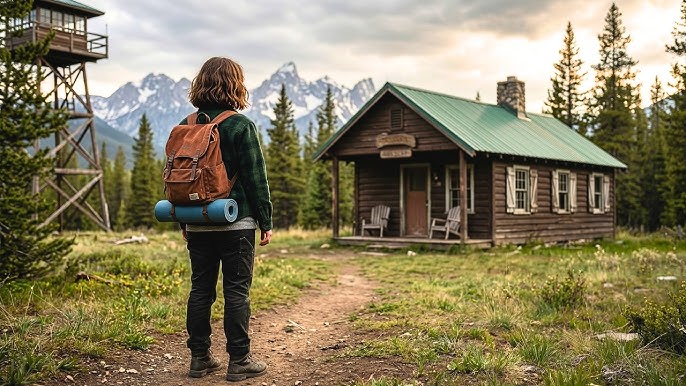
She dropped her backpack and sat on the floor.
For the first time in weeks, she closed her eyes without worrying someone would tell her to move.
That night, she slept wrapped in her jacket. Wind rattled the boards. An owl called in the distance. The quiet felt enormous.
The next morning, she began cleaning.
She swept dust into piles. Pulled boards from one window to let in light. Found an old broom in the corner. It took hours just to clear the main room.
By afternoon, she noticed the locked door.
It sat at the end of the hallway—solid, metal-reinforced, unlike the others. A heavy padlock hung from a latch.
She frowned.
“Storage?” she guessed.
She tried the key.
It didn’t fit.
She searched drawers. Cabinets. The desk.
Nothing.
The door remained locked.
Curiosity burned.
She tapped the metal. Solid. No give.
“Guess it stays closed,” she muttered.
But that night, she couldn’t stop thinking about it.
Three days later, she found the toolbox.
It sat under a bunk—rusted but usable. Inside were screwdrivers, pliers, and a small pry bar.
She stared at the locked door.
“Just a look,” she said.
The padlock resisted at first. Then, with a loud snap, it broke.
She pulled the latch.
The door opened.
The air inside smelled different—older, but preserved. A narrow room stretched back, lined with shelves.
Boxes.
Metal cases.
A filing cabinet.
She stepped inside slowly.
The first box held radios—portable field radios, carefully wrapped. Another box contained notebooks labeled by year: 1968, 1972, 1979.
She opened one.
Handwritten entries filled the pages. Ranger logs. Weather notes. Wildlife sightings.
She flipped further.
Coordinates.
Dozens of them.
Marked carefully.
She frowned. “What is this?”
Then she noticed the map.
Pinned to the back wall.
It covered the entire forest region. Red circles dotted remote areas. Each marked with a number.
She matched one to the notebook.
Same coordinate.
Her heart started racing.
She opened another cabinet.
Inside were metal tubes—survey markers. Old but intact. Alongside them, sealed envelopes labeled “Claims.”
Claims?
She opened one.
Inside was a document: Mineral Survey Authorization — 1974.
Her breath caught.
She opened another.
Same type.
Another.
Dozens.
The notes referenced old mineral surveys—quartz, copper, even traces of gold. Small deposits scattered across the forest.
Not enough for companies.
But valuable.
Very valuable.
She sat back on her heels.
“Why was this locked?” she whispered.
Then she saw the final box.
Inside were rolled maps and a letter.
The envelope was brittle.
She opened it carefully.
The paper inside read:
“If anyone finds this, these surveys were never filed. Budget cuts shut the station before we could report. Small deposits, but real. Someone patient could make a life from them. — Ranger Tom Whitaker, 1981.”
Savannah stared at the page.
Her hands trembled.
She spent the next week studying everything. At the library in town, she checked land records. Many of the coordinates fell on public land—open to small claims.
No one had filed them.
No one even knew.
Except her.
She marked the closest coordinate and hiked out the next morning.
The hike took two hours. The terrain was rough. But she found the marker location—just as the map showed.
She dug lightly.
Quartz veins glinted in the sunlight.
She laughed—half disbelief, half hope.
Over the next months, Savannah filed small claims legally. She sold samples to a local geology shop. Then a hobby miner bought rights to one site.
It wasn’t millions.
But it was enough.
Enough to fix the roof.
Enough to buy supplies.
Enough to turn the ranger station into a real home.
Word spread slowly.
“The girl at the old station found something,” people said.
She hired help. Cleared trails. Marked safe paths. Small-scale mining and guided tours brought more income.
The locked room became her office.
The maps stayed pinned to the wall.
One evening, she sat on the porch, watching sunset spill across the trees. The wind moved gently through the pines.
She held the heavy key in her hand.
Ten dollars.
An abandoned ranger station.
And what was locked inside.
Not treasure in a chest.
But knowledge.
Forgotten.
Waiting.
At twenty-one, she’d been homeless.
Now she had land, work, and a future carved from old maps and a locked door.
She smiled softly.
Sometimes, the places everyone walks away from… are the ones still holding everything.
Like and follow to read more powerful American stories about forgotten places, second chances, and lives rebuilt from nothing.