
Thrown Out at 17, My Sister and I Discovered a Sealed Forest Cave — What We Built Saved Our Lives
The night we were thrown out, it was raining hard enough to make the road shine like black glass.
I was seventeen. My sister Lily was thirteen.
We stood at the end of the gravel driveway with two backpacks, one blanket, and the sound of our stepfather’s truck engine fading into the distance. The porch light snapped off behind us, and just like that, the house we had grown up in disappeared into darkness.
“You think Mom’s coming back?” Lily asked, her voice small under the rain.
I didn’t answer right away. I already knew she wouldn’t. She had stood behind him with her arms crossed, eyes red but silent. She didn’t stop him when he told us we were “too much trouble.” She didn’t stop him when he threw our bags outside.
“No,” I finally said.
Lily swallowed hard, but she didn’t cry. She never cried in front of him, and I think she’d learned not to cry at all.
We started walking.
The county road curved through farmland and patches of pine forest. We had no destination. No relatives nearby. No money except the eight dollars I’d been saving for a used guitar string.
We walked until our shoes filled with water.
Around midnight, we reached the tree line. The forest looked darker than anything I’d ever seen—tall pines packed tightly together, branches rattling in the wind.
“We should go in,” I said.
“Why?” Lily asked.
“Less wind. Maybe we find somewhere dry.”
She nodded.
We stepped under the trees, and the rain softened instantly, caught by the thick canopy. The ground smelled of wet leaves and earth. It felt quieter there, like the world outside had disappeared.
We walked deeper, using my phone’s last bit of battery as a flashlight. The beam flickered weakly across rocks and fallen branches.
Then Lily stopped.
“Do you see that?”
I followed her finger. Between two large boulders, there was a dark opening—low and partially blocked by dirt and tangled roots.
A cave.
At least, it looked like one.
The entrance was sealed halfway, like something had collapsed long ago. But there was enough space to crawl through.
“You think it’s safe?” Lily whispered.
“No idea.”
But we were soaked, cold, and out of options.
“I’ll go first,” I said.
I pushed aside wet branches and crouched. The opening smelled of damp stone. I squeezed through, scraping my shoulders, then slid down a short slope.
My feet landed on solid ground.
“Okay!” I called. “It’s clear.”
Lily crawled in behind me.
Inside, the cave widened unexpectedly. My phone light revealed smooth rock walls and a dry, sandy floor. The ceiling arched overhead, high enough to stand.
It was completely dry.
We looked at each other.
“This… this is perfect,” Lily whispered.
The rain outside faded to a distant hiss.
We spread the blanket on the ground and sat down. For the first time that night, we stopped shaking.
“Just for tonight,” I said.
Lily nodded, already curling up.
We fell asleep listening to the wind outside, sheltered by stone we hadn’t known existed an hour earlier.
The next morning, sunlight filtered through the entrance. The cave looked even better in daylight. It extended deeper than we’d realized, turning slightly to the right. There were small shelves in the rock walls, and the floor sloped gently for drainage.
“This could work,” Lily said.
“For what?”
She looked around. “Living.”
I laughed at first.
Then I stopped.
Because she was right.
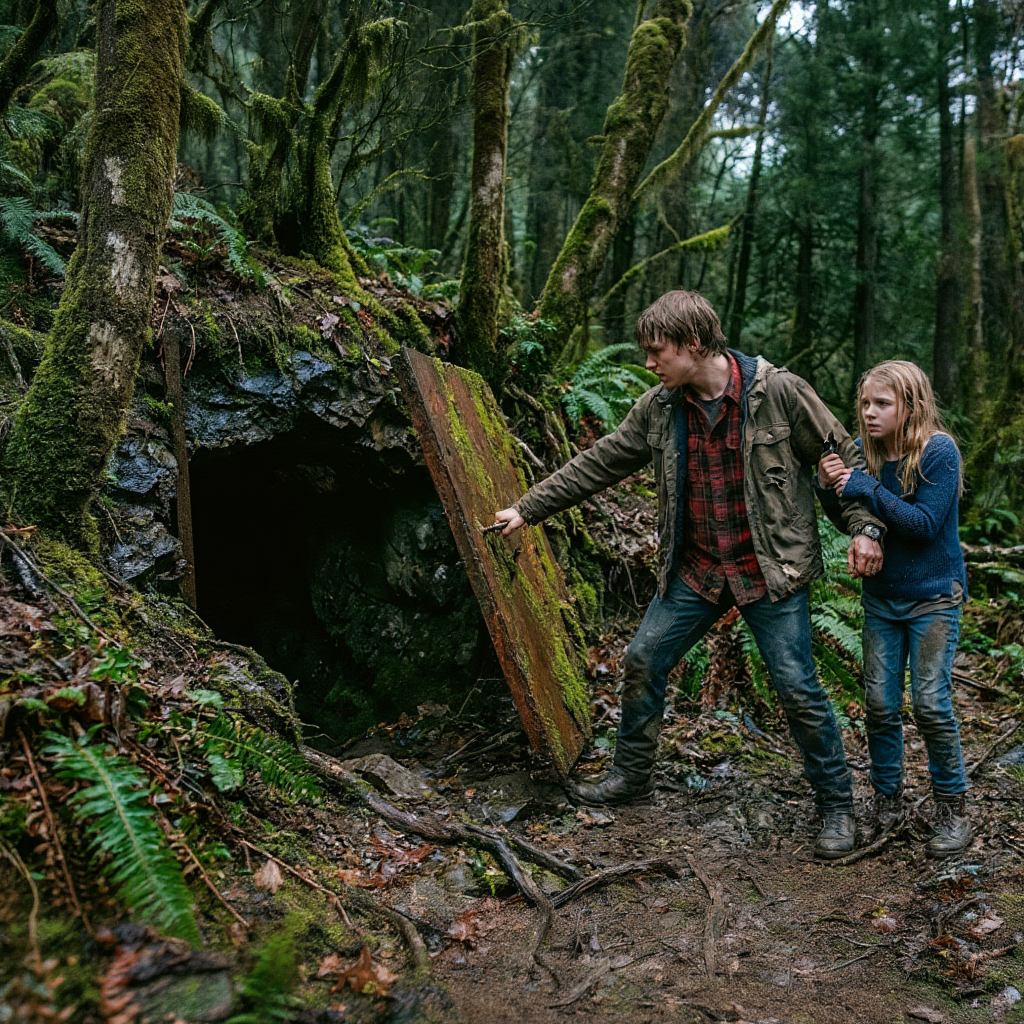
We spent the day exploring. The cave wasn’t huge, but it was big enough for two people. There was a narrow crack in the ceiling where fresh air came through. Outside, a small stream ran about fifty yards downhill.
Water. Shelter. Concealment.
It was more than we had anywhere else.
We decided to stay.
The first week was survival.
We collected fallen branches and stacked them near the entrance. We used flat stones to build a small fire pit just inside, where smoke could drift upward and out through the crack. It wasn’t perfect, but it worked.
Lily turned the rock shelves into storage. Food on one side—mostly wild berries and canned goods from a gas station we walked to at night. Clothes on another. We laid pine needles under the blanket for insulation.
By day three, it started to feel like a place.
By day five, it felt like ours.
We sealed the entrance better using branches and mud, leaving a narrow gap for crawling in. From outside, it looked like just another pile of debris.
“Hidden,” Lily said proudly.
She was good at that—seeing possibilities.
We found more improvements every day. I carved a small groove to direct rainwater away from the entrance. Lily braided vines into a hanging rack. We found a fallen metal sign near the road and used it as a makeshift table.
The cave became a system.
We woke at sunrise, fetched water, gathered wood, checked for footprints near the entrance. We learned which berries were safe. We set simple snares for rabbits—most failed, but one didn’t.
The first time we cooked rabbit over the fire, Lily grinned like we’d won the lottery.
“We’re doing it,” she said. “We’re actually doing it.”
Weeks passed.
Summer warmed the forest, making life easier. We bathed in the stream. We found an abandoned cooler behind a campground and used it for storage. I patched a tarp over the entrance to keep rain out.
One afternoon, Lily came running back from the stream.
“Jake! You have to see this!”
She led me uphill behind the cave. Hidden by thick brush was a fallen tree forming a natural lean-to. Beneath it, the ground was flat.
“We could build here,” she said.
We started that day.
Using branches, mud, and scrap wood, we built a small structure—half shelter, half lookout. It gave us a place to sit during the day and watch the path below.
“What if winter comes?” Lily asked one night.
The thought hit me like cold water.
We started preparing immediately.
We collected firewood—piles and piles of it. We dug a deeper pit inside the cave for heat retention. We lined the walls with bark for insulation. We stored dry leaves for bedding.
By October, we had more supplies than I’d ever seen.
When the first frost came, we were ready.
Winter in the forest was brutal.
Snow blocked the entrance twice. The stream froze at the edges. The cold seeped into everything.
But the cave held.
Stone trapped heat. Our fire burned steadily. We slept close under layered blankets and coats we’d scavenged.
One night, during a blizzard, Lily whispered, “If we didn’t find this place… we’d be dead.”
I didn’t answer.
Because she was right.
By spring, we had survived six months.
The cave wasn’t just shelter anymore. It was home. We had shelves, storage, a cooking area, even a small bench carved from a log. Outside, our lean-to had become a real structure with walls.
We started calling it “The Hollow.”
Then one day, everything changed.
A hiker stumbled onto our stream.
We froze when we saw him. He hadn’t seen us yet. We hid behind brush, watching.
“What do we do?” Lily whispered.
If he found the cave, we could lose everything.
But he slipped on wet rocks and fell hard. He cried out, clutching his ankle.
Lily looked at me.
“We can’t just leave him,” she said.
We stepped out slowly.
He stared at us like we were ghosts.
“Are… are you kids living out here?” he asked.
We didn’t answer.
He winced in pain.
Lily knelt and examined his ankle carefully, just like she’d done for me once.
“It’s not broken,” she said. “But you can’t walk far.”
We helped him to our lean-to. He stared at the cave entrance, then at us.
“You built this?” he asked.
I nodded.
He shook his head in disbelief.
“You saved my life,” he said quietly.
We exchanged a glance.
“No,” Lily replied. “This place saved ours first.”
The sealed forest cave we had stumbled into by accident had become more than shelter. It became protection, warmth, and a chance to survive when no one else cared if we did.
Thrown out at seventeen, we had nothing.
But in the heart of the forest, behind a hidden entrance of stone and roots, my sister and I built something strong enough to hold us through storms, winter, and fear.
We built a life.
And that cave—sealed, forgotten, and hidden—saved it.