
A poor cowboy paid just $1 for a woman with a sack over her head—but the moment she spoke, he realized she was the one who would change his life forever.
The auction yard smelled of dust, sweat, and stale tobacco. It was the kind of place where broken things ended up—old wagons with cracked wheels, mules too stubborn to work, rifles with bent barrels. People came here when they had nothing left worth selling, or when they had nothing left worth keeping.
Eli Carter stood near the back fence, hat pulled low over his eyes. His boots were worn thin at the soles, and the cuffs of his trousers were stiff with dried mud. He had ridden three days from the scrublands south of Abilene, chasing a rumor that a rancher was liquidating everything. Eli wasn’t here to buy anything big. He didn’t have the money. He had two dollars and thirty cents in his pocket—his entire fortune.
He told himself he was only here to watch.
The auctioneer, a narrow man with a red face and a voice like cracking wood, slammed his gavel against a crate. “Next item!” he shouted. “Lot twenty-three!”
Two men dragged something—or someone—forward.
The crowd murmured.
It was a woman.
Her wrists were tied loosely in front of her, and a rough burlap sack covered her head, hanging down to her shoulders. She wore a faded brown dress, patched at the elbows, and boots too big for her feet. She stood quietly, shoulders straight, as if she had decided long ago not to struggle.
Eli frowned.
This wasn’t unusual, not exactly. Some places still sold labor contracts—indentured workers, widows with debts, women who agreed to work for room and board. But there was something about the silence around her. No one laughed. No one jeered. They just watched.
The auctioneer cleared his throat. “Now then, gentlemen… this here is… well… she don’t talk much. Came in with the old Wilkes estate. No papers, no family. Strong enough, though. Can cook. Can sew. Might be useful.”
Someone in the front chuckled. “Why’s she got a sack on her head?”
The auctioneer shrugged. “Seller’s request. Says she’s shy.”
More laughter.
“Start the bidding at five dollars.”
Silence.
Eli shifted his weight. Five dollars might as well have been fifty. No one raised a hand.
“Four dollars?”
Nothing.
The woman didn’t move. She stood still as a fence post.
“Three dollars?”
A man in a black vest spat into the dirt. “I ain’t buying trouble with a sack over it.”
A few men nodded.
“Two dollars?” the auctioneer pressed.
Still nothing.
Eli felt something twist in his chest. He didn’t know why. Maybe it was the way her hands were steady. Maybe it was the way she didn’t shrink from the crowd. She looked… dignified, even with the sack.
“One dollar,” the auctioneer said, his voice losing enthusiasm. “Anybody?”
Eli swallowed.
He didn’t need another mouth to feed. He barely fed himself. His cabin roof leaked. His horse was half-lame. Buying a stranger—especially one no one else wanted—was foolish.
But he heard himself speak anyway.
“One dollar.”
The word hung in the air.
Heads turned.
The auctioneer blinked. “One dollar… from the gentleman in the back.”
No one else spoke.
The gavel fell. “Sold.”
Just like that, Eli Carter owned the strangest purchase of his life.
The ropes were cut, and the woman stepped down from the crate. She walked toward him slowly. Eli suddenly felt every eye in the yard watching him. He shifted his hat, unsure what to do.
When she stopped in front of him, she tilted her head slightly, as if trying to see him through the sack.
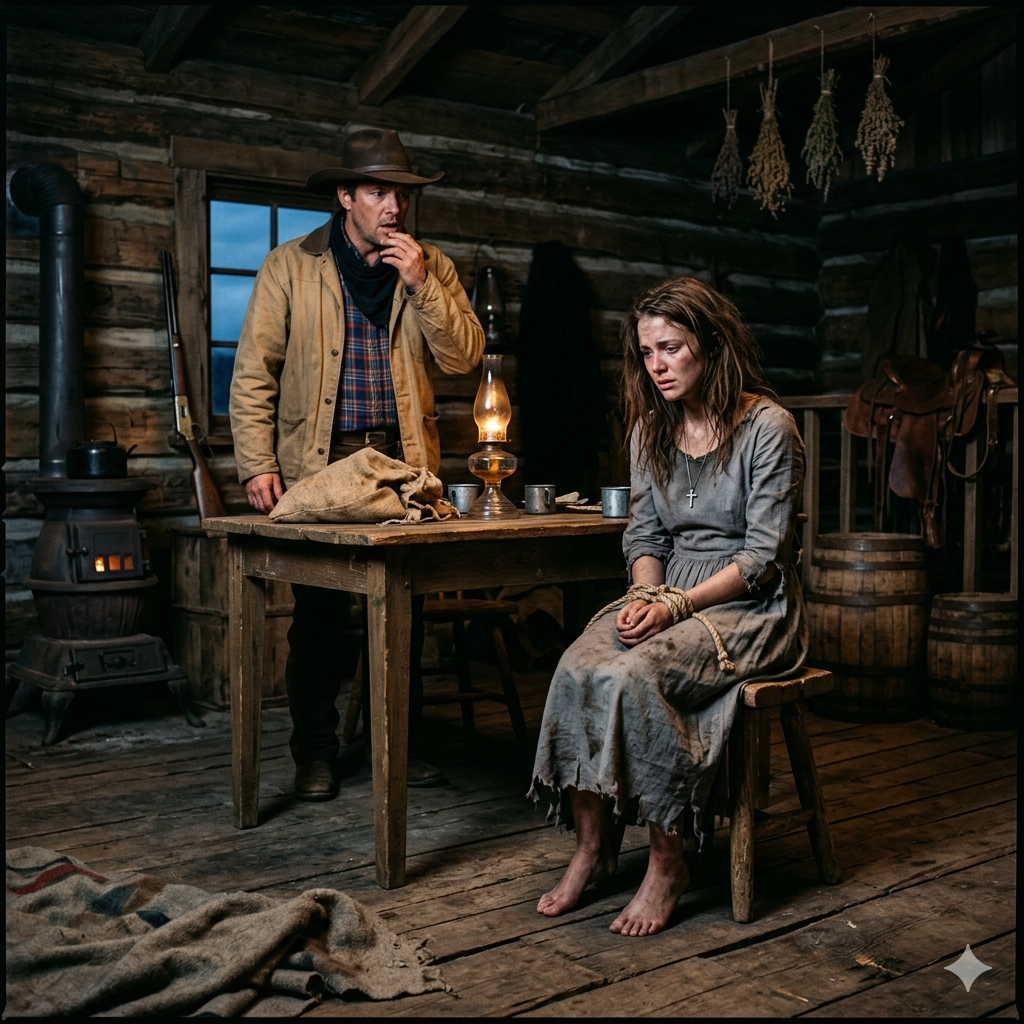
“You… uh… you can take that off,” Eli muttered.
She didn’t move.
“Or… I mean… when you want,” he added awkwardly.
She nodded once.
They left the yard together. No one said goodbye.
Eli’s horse, Dusty, snorted when he saw her. Eli helped her mount first, then climbed up behind. The sack brushed his shoulder. He noticed she smelled faintly of soap and wild sage.
They rode in silence for nearly an hour.
The prairie stretched wide and empty. The wind tugged at the edges of the sack.
Finally, Eli cleared his throat. “You got a name?”
For a moment, he thought she wouldn’t answer.
Then she spoke.
“Yes.”
Her voice was soft, but clear. Educated. Not the rough drawl he expected. It carried calm authority, like someone used to being listened to.
Eli stiffened slightly.
“I’m… Eli,” he said.
“I know.”
That made him blink. “You do?”
“Yes. The auctioneer said your name when you signed.”
He realized she was right. Still, something about the way she spoke unsettled him. She sounded… composed. Confident.
“What’s yours?” he asked.
A pause.
“Margaret.”
The name sounded out of place in the dusty wind.
They rode another mile before Eli spoke again. “You can take the sack off, you know. Ain’t no one around.”
She hesitated. Then slowly, she reached up and untied the string.
The burlap fell away.
Eli nearly dropped the reins.
She wasn’t what he expected at all.
Her hair was dark, pinned loosely, strands escaping in the wind. Her face was pale but strong-featured, with intelligent gray eyes. She looked… refined. Not like someone dragged from a failing ranch. Not like someone sold for a dollar.
She turned slightly to look at him. “Is something wrong?”
Eli shook his head. “No. I just… didn’t expect…”
He stopped.
“You expected someone else,” she finished gently.
“Yeah.”
She gave a small, understanding smile. “Most people do.”
They reached Eli’s cabin near sunset. It leaned slightly to one side, with smoke stains above the chimney. The door creaked when he pushed it open.
“It ain’t much,” he said.
“It’s home,” she replied.
That night, she cooked with what little he had—beans, salt pork, and stale flour. Somehow, she turned it into something that tasted better than anything he’d eaten in months. She moved confidently in the small space, as if she had always been there.
After dinner, she washed the dishes carefully.
Eli watched her. “You said you can cook. That was… more than cooking.”
She dried her hands. “I learned.”
“Where?”
She hesitated.
“In a house much larger than this.”
He didn’t press.
The next morning, Eli woke to the sound of hammering. He stepped outside and saw Margaret patching the loose board on the chicken coop.
“You don’t have to do that,” he said.
She glanced back. “The wind would’ve taken it tonight.”
He nodded slowly.
Days passed. Then weeks.
Margaret repaired the roof. She organized his tools. She planted a small garden near the well. She even coaxed Dusty into better health with careful feeding.
But more than that, she talked to him.
Not constantly—just enough. She asked about his past. She listened. She laughed quietly at his awkward jokes. And when he struggled with numbers while trading supplies, she helped him calculate fair prices faster than any rancher he’d known.
One evening, he finally asked, “Margaret… how’d you end up there? At the auction?”
She sat on the porch, watching the sunset.
“My father owned a publishing house in St. Louis,” she said quietly. “After he died, his partner forged documents. Took everything. Said I owed debts I never made.”
Eli frowned.
“I refused to marry the man he chose for me. So he arranged… other solutions.”
Eli’s jaw tightened.
“They sent me west. Said I’d work off the debt. But debts like that never end.”
“And the sack?”
She looked at him. “He said I was too proud. He wanted me humbled.”
Silence settled between them.
“You paid a dollar,” she added softly. “I suppose he thought that was fitting.”
Eli stared at the horizon. “Best dollar I ever spent.”
She smiled faintly.
Months later, a wagon arrived. Two men stepped down, dressed in city coats.
They demanded Margaret return.
Eli stood between them and the porch. “She ain’t going nowhere.”
“She’s legally bound,” one man snapped.
Margaret stepped forward. Calm. Composed.
“No,” she said. “Your papers are forged. And I can prove it.”
She produced documents she had quietly written, detailing dates, signatures, and inconsistencies. The men faltered. They left, threatening to return.
They never did.
That night, Eli sat beside her under the stars.
“You changed everything,” he said.
She looked at him. “You changed mine first.”
He shook his head. “I bought you for a dollar.”
She smiled. “No. You gave me a life.”
The wind moved softly through the prairie grass.
Eli realized something then. He hadn’t just bought help. He hadn’t just saved someone.
He had found the person who made the empty land feel full.
He reached for her hand, hesitantly.
She didn’t pull away.
And in that quiet moment, the poor cowboy understood that the woman no one wanted—the woman sold for a single dollar with a sack over her head—was the one who would change his life forever.