
Wolves Circled Her Cabin for Days — But the Horses Were Hidden Beneath Their Feet
The first wolf appeared on a Tuesday.
Eleanor Whitmore saw it through the frost that had crept across her cabin window during the night, delicate as lace, cruel as iron. It stood motionless near the split-rail fence thirty yards from her porch, its thick grey fur dusted white with snow, its yellow eyes fixed on her home as though it had been waiting for her to wake.
She held her breath.
Outside, the Wyoming wilderness lay silent beneath another storm. Snow covered the valley in an endless sheet of white, stretching all the way to the jagged peaks of the Wind River Range. Pine forests bent beneath the weight of winter, their branches frozen stiff. Smoke rose from Eleanor’s chimney in a thin black ribbon, disappearing into a sky the color of old steel.
The wolf did not move.
Neither did Eleanor.
Then, from behind the trees, another emerged.
And another.
By the time she counted seven, her coffee had gone cold in her hand.
She was thirty-two years old, five feet seven, broad-shouldered from labor, and tougher than most men who claimed the frontier had made them hard. Her father had raised her with an axe in her hands and frost in her lungs. Her husband, Samuel Whitmore, had once joked that Eleanor was the only woman west of the Mississippi who could split a log, birth a lamb, and shoot a wolf before breakfast.
Samuel had been dead for eighteen months.
Pneumonia.
Three days from the nearest doctor.
He’d died in this very cabin, with Eleanor’s hand in his and snow hammering the roof overhead.
Now the cabin belonged to her.
And so did everything beneath it.
The wolves stayed all day.
Eleanor watched from the narrow window, rifle resting across her lap, while the pack prowled around the property like tax collectors. They sniffed at the frozen chicken coop. They circled the barn.
But something strange happened.
They never barked.
Never dug.
Never attacked.
They simply paced.
Watching.
Waiting.
That night, Eleanor checked the lanterns twice and barred the door with a thick timber beam. The fire popped in the stove while shadows danced across the cabin walls. Outside, she heard the first howl.
Long.
Low.
Ancient.
It rolled through the valley like a funeral hymn.
She reached for Samuel’s rifle.
Then she heard another sound.
A muffled thud.
Beneath her feet.
She smiled.
“Easy now,” she whispered.
The answering sound came again.
A horse.
Most people in Crowheart thought Eleanor Whitmore had lost her animals in the early winter storm.
That was exactly what she wanted them to think.
The horses had vanished after the first heavy snow, along with her sheep, her chickens, and half her feed.
Even old Walter Briggs from the neighboring ranch had ridden over and shaken his head.
“Damn shame,” he’d said. “Tracks just disappear.”
Eleanor had only nodded.
She never told him the truth.
Because the truth was buried thirty feet underground.
And Samuel had built it with his own hands.
Years earlier, before sickness took him, Samuel had become obsessed with stories from Siberia, Mongolia, and old Scandinavian farms—places where winter didn’t merely threaten life but actively hunted it.
He’d spent two summers carving through frozen earth with picks, shovels, mule teams, and pure stubbornness.
The neighbors laughed.
“What’s Whitmore digging now?” they’d say.
“Looking for gold?”
“Or hell?”
Samuel only grinned.
“Neither,” he’d answer.
“I’m building summer beneath winter.”
At first, even Eleanor thought he’d gone half mad.
Until the day he showed her.
Hidden beneath the barn floor, concealed by a false hay platform and a trapdoor made from reclaimed pine, was an entire underground stable.
A tunnel reinforced with cedar beams.
Stone foundations.
Ventilation shafts disguised as fence posts.
A root cellar.
Feed storage.
Water cisterns.
Animal stalls.
A wood stove connected to a chimney hidden inside the main barn wall.
Warm enough to keep livestock alive through any storm.
Hidden enough that no predator—or thief—would ever know it existed.
Samuel had looked at her with dirt on his face and pride in his eyes.
“If winter ever comes harder than us,” he’d said, “we go underground.”
Now winter had come.
And Samuel was gone.
But his barn remained.
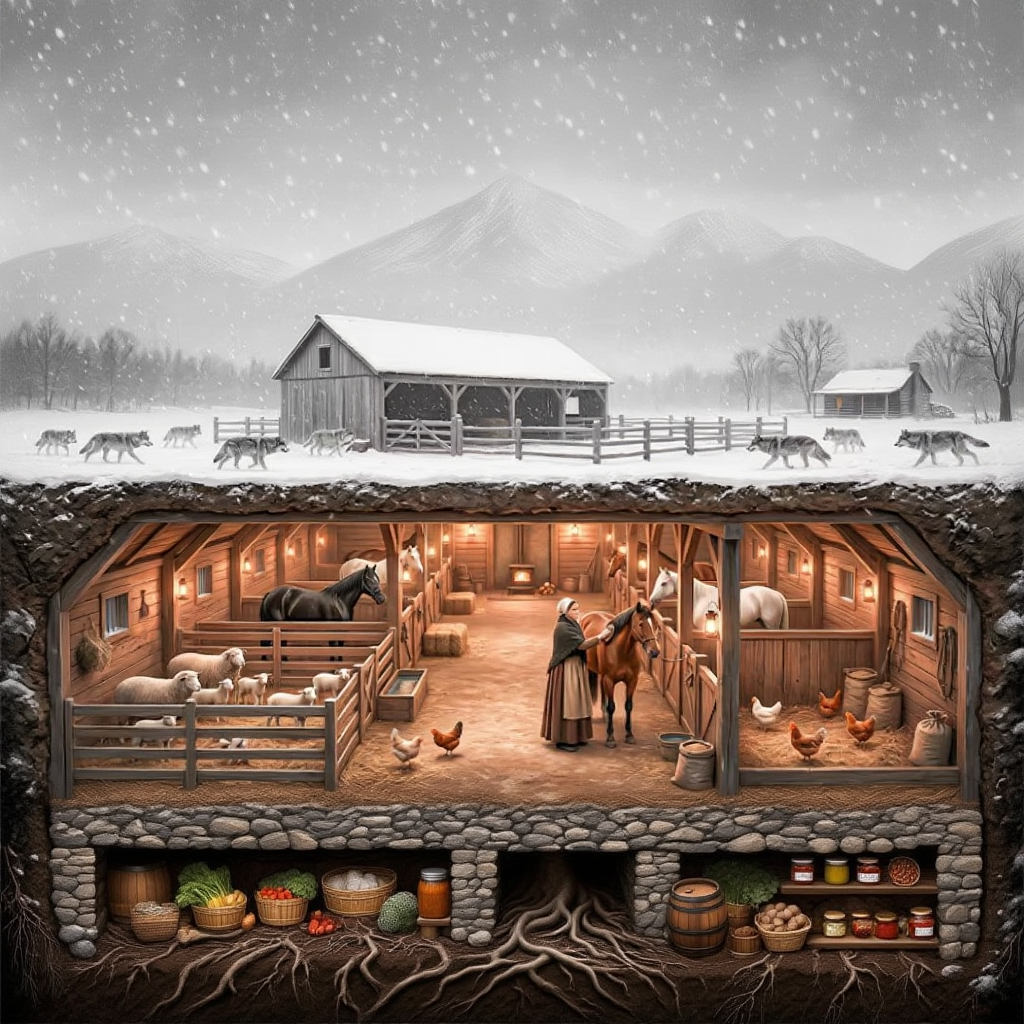
On the second day, there were twelve wolves.
Eleanor counted them from the attic window.
The alpha stood nearest the porch—a massive silver male with one torn ear and a scar running down his muzzle.
He looked less like an animal than an old warrior.
Snow gathered on his back while he stared directly into the cabin.
Eleanor stared back.
“You’re wasting your time,” she muttered.
Below her, another thud came from underground.
Then a soft whinny.
She climbed down from the attic and crossed the cabin floor to the hidden hatch beneath her braided rug.
She pulled it aside.
Lifted the trapdoor.
Warm air rushed upward, smelling of hay, pine resin, horses, and woodsmoke.
It felt like opening summer itself.
Eleanor climbed down the ladder.
Below, lantern light painted the underground barn in soft gold.
Dust floated lazily in warm air.
Her chestnut mare, Daisy, nickered as soon as Eleanor appeared.
In the neighboring stalls stood Moses, a black gelding, and the twin white mares Samuel had named Winter and Mercy.
Sheep huddled together near the far wall.
Chickens wandered freely across the packed dirt floor.
The stove crackled in the corner.
Eleanor set down fresh hay.
“You’re safer than I am,” she told them.
Daisy nudged her shoulder.
For a moment, Eleanor rested her forehead against the mare’s neck.
She closed her eyes.
And remembered Samuel.
On the third day, the wolves came closer.
They scratched at the barn.
Sniffed around the foundation.
One even climbed onto the porch.
Eleanor fired a warning shot through the cabin window.
The crack shattered the silence.
Snow fell from nearby pine branches.
The wolves retreated twenty yards.
Then sat down.
Watching.
Waiting.
Eleanor frowned.
They weren’t acting hungry.
Hungry wolves attacked.
Hungry wolves tested weakness.
These wolves were doing something else.
Something smarter.
Something patient.
That night, Eleanor barely slept.
The howling never stopped.
At dawn, she climbed to the ridge behind the cabin with her rifle slung over her shoulder.
From there, she saw what the wolves had already known.
Movement.
Far across the valley.
Men.
Three riders.
Not neighbors.
Not ranchers.
And definitely not lost.
Eleanor’s stomach tightened.
Horse thieves.
She recognized one immediately.
Caleb Turner.
A drifter with gambling debts and a reputation for selling other men’s property.
Or women’s.
Now the wolves made sense.
They weren’t hunting her animals.
They were drawn by the riders.
By unfamiliar horses.
By blood.
By meat.
The pack had simply claimed the valley first.
And now everyone was trapped inside it.
By sundown, Caleb and his men reached the property.
Eleanor met them on the porch, rifle in hand.
Snow blew sideways between them.
Caleb smiled.
“Evening, Ellie.”
She hated when men shortened her name without permission.
“Turn around.”
He chuckled.
“Now why would I do that?”
“Because I’m aiming at your chest.”
One of his men laughed.
Caleb didn’t.
His eyes moved toward the barn.
“Heard your stock disappeared.”
Eleanor said nothing.
“Funny thing,” Caleb continued.
“Tracks vanish. Animals vanish. But you’re still buying feed.”
Her finger tightened on the trigger.
“You’ve got ten seconds.”
Caleb smiled again.
Then the wolves howled.
Close.
Very close.
The men turned.
Shapes emerged from the trees.
Grey.
Silent.
Eyes glowing in twilight.
Twelve wolves.
Maybe more.
Caleb’s horse panicked instantly.
“Jesus!”
The animal reared.
One rider fell.
Another lost his hat.
The wolves moved closer.
Not attacking.
Herding.
Eleanor almost laughed.
“Looks like you boys overstayed.”
Caleb backed his horse away.
“This ain’t over.”
Eleanor raised the rifle.
“It is if you’re still here in five.”
He left in three.
That night, the wolves came closer than ever.
The alpha stood directly outside Eleanor’s porch.
No growling.
No teeth.
Just those yellow eyes.
Eleanor opened the door.
The cold slapped her face.
She stepped outside.
Rifle in hand.
The wolf didn’t move.
For nearly ten seconds, woman and predator stared at one another.
Then the wolf turned.
Walked into the snow.
And the rest followed.
By morning…
They were gone.
Every track.
Every shadow.
Every howl.
Gone.
Spring came slowly.
Snow melted from the valley in silver streams.
Grass pushed through frozen ground.
Birdsong returned.
And on the first warm morning of April, Eleanor opened the hidden barn doors.
One by one, the horses emerged into sunlight.
Daisy first.
Then Moses.
Then Winter and Mercy.
The sheep followed.
The chickens scattered.
And Eleanor stood in the melting snow, tears freezing on her cheeks.
Walter Briggs rode over that afternoon.
He nearly fell off his horse.
“Sweet Lord…”
Eleanor smiled.
Walter stared at the animals.
Then at the barn.
Then at Eleanor.
“Where in God’s name were they?”
She looked toward the mountains.
Toward the forest.
Toward the place where yellow eyes had once watched her cabin.
Then she smiled faintly.
“Beneath their feet.”
And somewhere deep in the pines…
A lone wolf howled once.
As if in agreement.