
They Sent Her to a Widowed Mountain Man With 3 Children—But Her First Week Shocked the Entire Valley
The wagon that carried Mary Collins into the Bitterroot Valley creaked like it might fall apart before reaching the last bend. The driver spat tobacco into the dust and didn’t bother looking at her when he spoke.
“You sure about this?” he muttered. “Most folks don’t go up that mountain unless they got nowhere else.”
Mary adjusted the worn satchel on her lap. “I don’t.”
He grunted. “Widowed man. Three kids. Lives alone since last winter. People say he barely talks. Hard man.”
She nodded. “I can handle hard.”
The driver glanced at her then—really looked. She was young, maybe twenty-three, though worry made her seem older. Her dress was plain, hands rough, eyes steady. Not afraid, just… resolved.
“Well,” he said, flicking the reins. “You’re about to find out.”
The wagon climbed the narrow road until the valley opened below them like a painted map—fields, smoke trails, scattered cabins. High above, near the timberline, a lone cabin stood against the mountainside.
“That’s his,” the driver said.
Mary’s chest tightened.
No neighbors close. No town. Just forest and silence.
The wagon stopped near a rough split-rail fence. The driver set her bag down.
“Name’s Ethan Hale,” he said. “Lost his wife birthing the youngest. Folks tried helping. He sent ’em all away.”
Mary nodded.
“Good luck,” he added, softer than before.
Then he turned and left.
Mary stood alone.
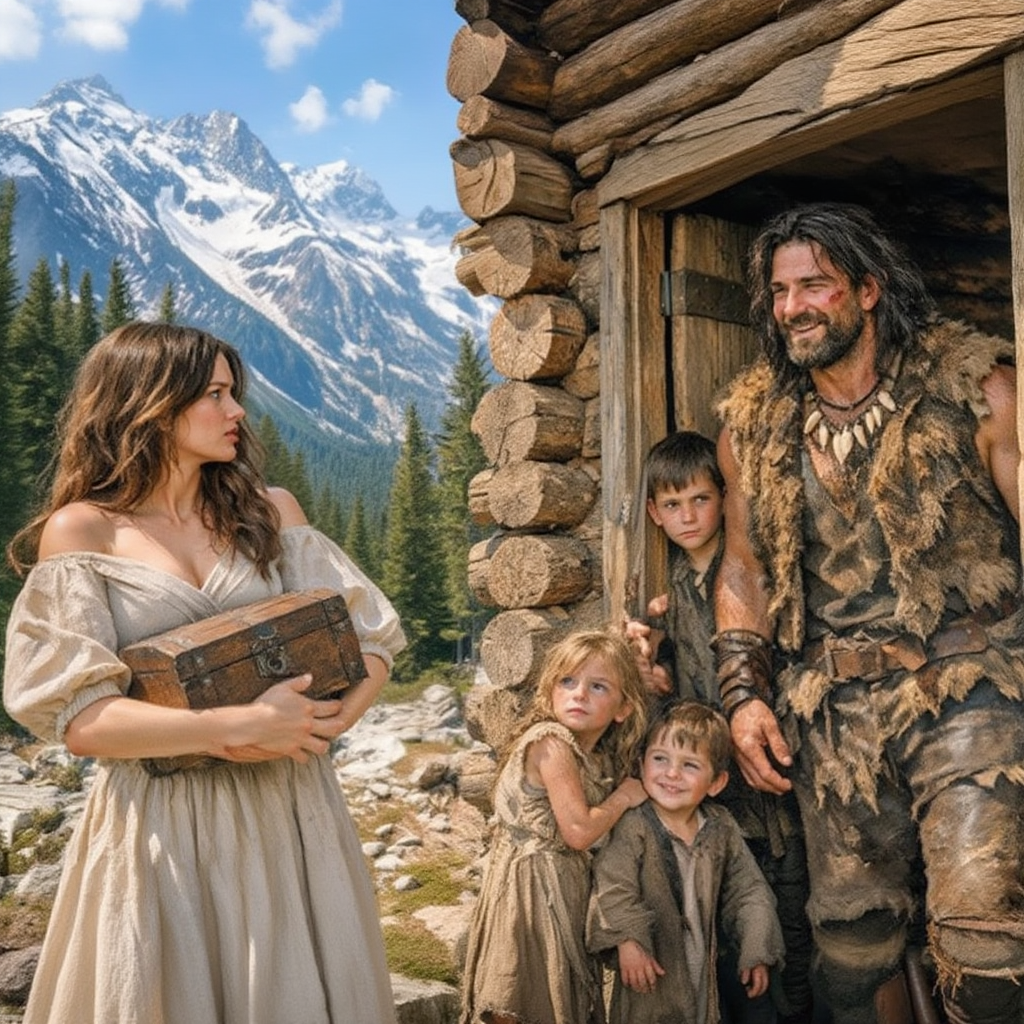
The wind carried pine scent and distant crow calls. She walked toward the cabin, boots crunching gravel. Smoke rose faintly from the chimney.
She knocked.
Silence.
Then footsteps.
The door opened a few inches. A tall man filled the frame—broad shoulders, thick beard, eyes sharp with suspicion. He looked like he belonged to the mountain itself.
“You lost?” he asked.
“No,” she said. “I’m Mary Collins.”
His eyes narrowed. “Why are you here?”
“The church sent me.”
His jaw tightened. “I told them not to.”
“They said your children needed help.”
“I don’t take charity.”
“I’m not charity,” she said quietly.
He studied her. “You planning to leave after a week like the last one?”
“I don’t plan to leave.”
From inside, a small voice called, “Pa?”
Ethan glanced back, then opened the door reluctantly. “Come in. But don’t expect much.”
Mary stepped inside.
The cabin was clean but strained—like someone keeping things together by force. A pot simmered weakly on the stove. Laundry hung indoors. Toys—simple carved ones—sat in a corner.
Three children watched her.
The oldest boy, maybe ten, stood stiffly with crossed arms. A girl around seven clutched a rag doll. The youngest, barely two, sat on the floor chewing a wooden spoon.
Ethan gestured. “This is Tom. Sarah. And Luke.”
Mary smiled gently. “Hello.”
None of them answered.
Tom spoke first. “You gonna leave too?”
Mary crouched to his level. “Not if you’ll have me.”
He didn’t reply, but his arms loosened slightly.
Ethan crossed his arms. “You eat?”
“I can cook.”
“There’s beans.”
“I’ll manage.”
She moved to the stove, lifting the lid, assessing quietly. Within minutes she added water, chopped onion from a basket, stirred carefully.
Ethan watched, surprised by her calm.
“You know your way around a kitchen,” he said.
“I had to.”
That night they ate better than they had in weeks.
The next morning, Mary rose before dawn.
She swept the floor, aired blankets, boiled water, washed clothes. She didn’t ask what to do—she simply began.
By mid-morning, she stepped outside and examined the yard. The woodpile was low. Chicken coop broken. Garden overgrown.
She rolled up her sleeves.
Tom watched from the doorway. “You don’t have to do that.”
“I know.”
“You’ll get tired.”
“I’ve been tired before.”
By afternoon, she’d repaired the coop door with scrap wood and collected eggs. Sarah followed her silently, eventually handing her nails.
“Thank you,” Mary said.
Sarah whispered, “Mama used to fix things too.”
Mary paused. “She must’ve been strong.”
Sarah nodded.
Inside, Ethan returned from chopping timber. He stopped cold.
The table was cleared. Floor swept. Laundry folded. Children clean.
“What…?” he muttered.
Mary looked up. “I hope that’s alright.”
He nodded slowly. “It is.”
But that was only day one.
On day two, she hiked to the creek with buckets, scrubbing clothes against rocks. On day three, she cleared weeds from the garden and planted seeds she’d carried in her satchel.
“You brought seeds?” Ethan asked.
“I always do.”
“You planned this?”
“I planned to stay somewhere.”
On day four, she fixed the broken window using cloth and resin. On day five, she organized the pantry, stretching food supplies.
The children began following her everywhere.
Luke cried when she stepped outside.
Tom started chopping wood without being asked.
Sarah brushed Mary’s hair one evening, shyly.
Ethan watched it all, uneasy.
He wasn’t used to warmth.
On the sixth day, Mary did something that shocked the valley.
She walked down the mountain.
Alone.
Neighbors saw her first—Mrs. Dawson near the lower ridge.
“You from Hale’s place?” the woman asked.
“Yes.”
“Everything alright?”
Mary smiled. “I came to trade.”
“Trade?”
She opened her satchel—eggs, herbs, mended cloth. “For flour. Maybe salt.”
Mrs. Dawson blinked. “He never trades.”
“He will now.”
Word spread fast.
By evening, Mary returned with flour, dried apples, and two blankets.
Ethan stared. “You went down there?”
“Yes.”
“You shouldn’t wander alone.”
“I wasn’t afraid.”
“You don’t know these mountains.”
“I’m learning.”
He looked at the supplies. “You traded all that?”
“Yes.”
Tom whispered, “She got us apples.”
Ethan didn’t know what to say.
On the seventh day, the valley truly noticed.
Smoke rose from Hale’s chimney—not thin, but steady. Children’s laughter echoed. The garden rows were visible from below.
Neighbors gathered at the ridge.
“She’s been there a week,” someone said.
“Look at that place.”
“Didn’t think anyone could change him.”
Mary hung laundry in sunlight while the children chased each other. Ethan chopped wood nearby, glancing at her more than he realized.
She caught him watching.
“You’re not used to help,” she said.
“No.”
“You don’t have to carry everything alone.”
He leaned on the axe. “I’ve done it this long.”
“And now?”
He looked at the children laughing. “Now… I don’t have to.”
That evening, Tom approached him.
“Pa?”
“Yeah?”
“Can she stay?”
Ethan hesitated. “You want her to?”
Tom nodded. “It feels… like before.”
Ethan swallowed.
Later, he found Mary on the porch.
“You’ve done more in one week than anyone,” he said.
She shrugged. “They needed someone.”
“We needed you.”
She looked at him, surprised.
“You’re not leaving?” he added.
“No.”
He nodded slowly. “Good.”
The valley kept watching.
By the second week, more changes came—stacked firewood, repaired fence, chickens roaming, children healthier.
People started saying the impossible.
“She’s turned that mountain man human again.”
“She brought life back.”
But Mary didn’t think about that. She simply worked, cooked, laughed softly with the children.
One night, Luke woke crying.
Mary lifted him gently. Ethan watched from the doorway.
“You don’t have to,” he said.
“I want to.”
She rocked the child until he slept.
Ethan spoke quietly. “You’re not afraid of us?”
“No.”
“Why?”
She looked at him. “Because I see a man trying his best. And three children who need more than survival.”
He sat beside her.
“You gave them that,” he said.
She shook her head. “We’re building it together.”
Outside, the valley lights flickered below. The mountain wind softened.
And in just one week, the woman they sent to a widowed mountain man with three children had done what no one believed possible—she didn’t just help.
She brought a family back to life.
The second week began with rain.
Cold mountain rain that turned the paths to mud and wrapped the cabin in a gray silence. Ethan expected the usual—children restless, chores delayed, tension building inside tight walls. That was how it had always been since his wife died. Rain meant everything slowed, and grief crept in.
But Mary didn’t slow.
Before sunrise, she lit the stove, then dragged the small table closer to the window where light was strongest. She spread scraps of paper she’d found in an old drawer, along with a stub of charcoal.
Tom rubbed his eyes as he walked in. “What’re you doing?”
“School,” Mary said.
He blinked. “We don’t have school.”
“You do now.”
Sarah appeared behind him, clutching her doll. “Mama used to read to us.”
Mary smiled softly. “Then we’ll start there.”
Even Ethan paused when he saw them gathered around the table. Mary wrote letters slowly: A, B, C. Tom leaned forward, curious despite himself. Sarah traced the shapes with her finger. Luke banged the table and laughed.
“You’re teaching them?” Ethan asked quietly.
“They deserve it.”
He leaned against the wall, watching. He hadn’t realized how much the children had missed—how quiet they’d become without someone guiding them. Tom’s eyes lit up when he recognized a letter. Sarah giggled when she wrote her name crooked.
The sound filled the cabin.
That afternoon, the rain cleared. Mary stepped outside and studied the slope behind the cabin. Water had carved small channels in the soil.
“What’re you looking at?” Ethan asked.
“This hill washes away every storm.”
“Yeah. Been meaning to fix it.”
She nodded. “Let’s do it today.”
They worked side by side, placing rocks to hold the soil, digging shallow trenches to redirect water. Tom helped carry stones. Sarah gathered branches. Luke toddled behind, supervised by laughter.
Neighbors passing below noticed something new—movement. Cooperation. A family forming.
By the end of the second week, the cabin looked different. Not bigger. Not richer. But alive.
Then, on the fifteenth day, a rider came.
Mary saw him first—a man climbing the trail slowly, hat pulled low. Ethan stiffened when he recognized him.
“Daniel Crowe,” he muttered.
“You know him?” Mary asked.
“Neighbor. Closest one. Haven’t spoken since winter.”
Daniel dismounted near the fence. “Heard you got help,” he called.
Ethan nodded. “Seems I do.”
Daniel glanced at Mary, then the children. “Place looks… different.”
Mary stepped forward politely. “Would you like coffee?”
Daniel looked surprised. “I—sure.”
Inside, he sat awkwardly while Mary poured coffee. The children stared. Ethan leaned against the counter, unsure.
Daniel cleared his throat. “Folks in the valley talking. Say you’ve turned this place around.”
Mary shook her head. “Just doing what needs doing.”
Daniel studied her, then Ethan. “You planning to keep her?”
Ethan answered without thinking. “Yes.”
The word hung in the air.
Mary looked at him quietly.
Daniel smiled faintly. “Good. Valley could use more like you.” He stood. “If you need tools, I got extras.”
After he left, Ethan rubbed his neck. “Didn’t mean to say it like that.”
Mary tilted her head. “Like what?”
“Like you’re staying.”
She smiled softly. “I am.”
That night, Tom asked a question.
“Mary?”
“Yes?”
“Can we call you something else?”
She paused. “Like what?”
Sarah whispered, “Mama?”
The room went still.
Mary’s breath caught. She looked at Ethan. His expression softened, eyes uncertain.
“You don’t have to,” Mary said gently.
Tom shook his head. “We want to.”
Luke reached up and babbled something that sounded like “Ma.”
Mary’s eyes filled. She nodded slowly. “If that’s what you want.”
The children hugged her all at once.
Ethan turned away briefly, blinking hard.
The valley heard about that too.
By the third week, more changes followed. Daniel brought lumber. Mrs. Dawson sent preserves. A neighbor offered two hens. People who had once avoided Ethan now came by.
“He’s different,” they said.
But the biggest change was quieter.
One evening, Mary found Ethan sitting alone outside, watching the sunset. She sat beside him.
“You don’t talk much,” she said gently.
“Never been good at it.”
“You don’t have to be.”
He nodded.
After a moment, he spoke. “I thought after my wife died… that was it. Just me and the kids surviving.”
“And now?”
He looked at the cabin where laughter drifted out. “Now it feels like we’re living again.”
Mary folded her hands. “I’m glad.”
He hesitated. “Why did you really come?”
She answered honestly. “I had nowhere else. But… I think I was meant to be here.”
He looked at her, something steady forming in his chest.
“You didn’t just help,” he said. “You gave them back their childhood.”
“And you?”
He smiled faintly. “You gave me back my home.”
The wind rolled across the mountain, carrying pine scent and distant valley sounds. Smoke rose from the chimney, steady and warm.
The woman they sent to a widowed mountain man with three children had shocked the entire valley in her first week.
But by the third, she had done something even more unbelievable.
She hadn’t just changed the house.
She became the heart of it.