
He Coated His Cabin in Mud So Thick It Looked Like a Hill — Then the Deadliest Winter Came
When Elias Harper started shoveling mud onto his cabin, the townsfolk laughed.
They laughed when he filled wagon after wagon with clay from the riverbank.
They laughed when he hauled it up the ridge alone.
They laughed when he slapped it against the walls until the logs disappeared.
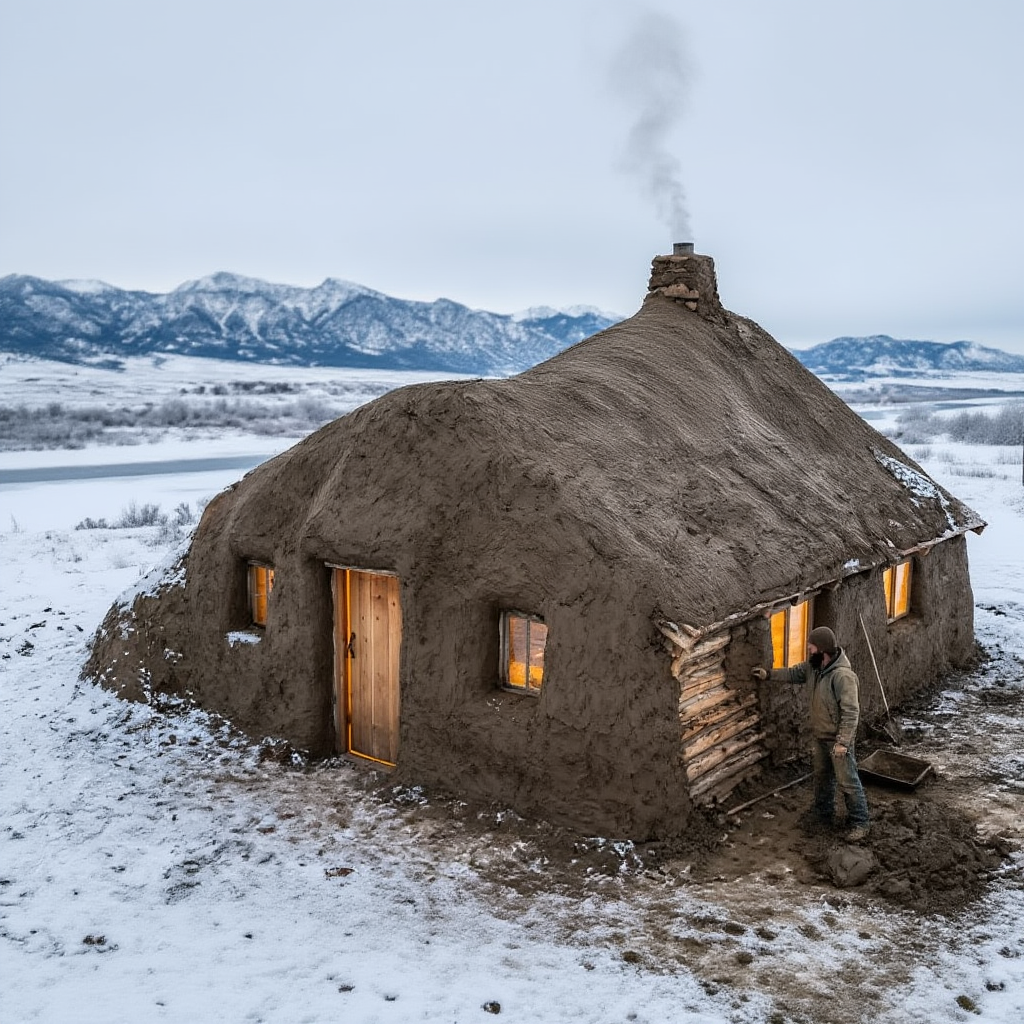
And they laughed hardest when he piled it over the roof so thick the cabin no longer looked like a cabin at all—but like a small, lumpy hill.
“You building a house,” one man called, “or burying it?”
Elias didn’t answer.
He just kept working.
The mountain air in late autumn had already turned sharp, and Elias could feel winter creeping closer. The wind carried a different bite. The birds left early. Even the deer moved lower than usual.
He’d seen winters before.
But this one felt wrong.
The clay was heavy and cold in his hands. He mixed it with straw, pine needles, and gravel, stomping the mixture with his boots before slapping it onto the cabin walls. Inch by inch, the logs vanished beneath thick layers of earth.
By the time November arrived, the cabin had transformed. Only a small chimney poked from the top. The windows were recessed deep inside earthen tunnels. From a distance, it looked like nothing more than a natural mound rising from the hillside.
People passing through shook their heads.
“He’s gone strange,” someone muttered in town.
“He’ll suffocate himself,” another said.
But Elias kept adding more.
He packed mud along the windward side, shaping it into a slope. He carved a narrow entrance angled downward, then up again, like a tunnel. He reinforced the door with pine beams. He stacked firewood inside until the back wall was hidden.
When the first snow fell, he was still working.
The storm arrived three days later.
It didn’t stop.
Snow fell thick and fast, swallowing the valley. The wind howled across the ridge, driving drifts taller than a man. Trees bent. Fences disappeared. Trails vanished.
By the second day, the road to town was gone.
By the third, the roofs of distant cabins were buried.
Elias stayed inside his mud-covered hill.
The wind roared overhead, but inside, the air stayed still. The thick earth walls held the warmth from his stove. The temperature barely dropped.
He sat quietly, listening.
The storm grew worse.
Snow piled against the hill, but instead of pressing inward, it slid over the sloped mud like water over stone. The cabin disappeared entirely beneath white.
Elias wasn’t worried.
He’d built it that way.
On the fifth day, he heard something.
A faint thump.
He paused.
Another thump.
Not wind.
He grabbed his coat and crawled through the narrow tunnel. The door resisted—snow packed hard outside. He shoved until it cracked open.
White.
Nothing but white.
Then movement.
A figure stumbled through the drift—wrapped in blankets, barely standing.
Elias rushed forward.
It was Mrs. Caldwell from the lower valley. Her face was pale, lips blue.
“Please…” she whispered. “My boy…”
He helped her inside.
“What happened?” he asked.
“Cabin collapsed,” she said weakly. “Snow… too heavy… he’s still there…”
Elias didn’t hesitate.
He grabbed a shovel and rope.
Outside, the wind nearly knocked him down. Mrs. Caldwell pointed shakily downhill.
He followed her tracks, now half-filled with snow.
After twenty minutes, he found it—a crushed roof, barely visible beneath drifts. He dug frantically. Snow packed like stone. His hands burned.
Then he heard a faint cry.
He dug faster.
A small opening appeared. He reached inside and pulled out a boy—shivering but alive.
Elias wrapped him and carried him back.
Inside the mud-covered hill, warmth returned quickly. The boy stopped shaking within minutes.
Mrs. Caldwell wept quietly.
“You saved him,” she said.
Elias shook his head. “The hill did.”
The storm didn’t stop.
More days passed.
On the eighth day, another knock.
Two men—half-frozen.
Their cabin roof had caved in.
Elias let them in.
On the tenth day, three more.
By the second week, eight people crowded inside the earthen shelter. They slept shoulder to shoulder, shared food, and took turns feeding the stove.
Outside, winter raged harder than anyone remembered.
Trees snapped.
Livestock froze.
Entire sheds vanished under drifts.
But the hill held.
The thick mud walls absorbed the wind. The snow insulated further. The small entrance prevented heat from escaping. The cabin stayed warm, steady, safe.
One night, as the wind screamed like something alive, the boy Elias rescued asked quietly, “How did you know?”
Elias stared at the fire.
“Didn’t know,” he said. “Just listened.”
“To what?”
“The mountains.”
They fell silent.
After nearly three weeks, the storm finally broke.
The sky cleared.
Sunlight hit a world buried under mountains of snow.
Elias dug out the entrance. One by one, the group stepped outside.
They stared in disbelief.
Where their cabins once stood, only lumps of snow remained.
But Elias’s home—still shaped like a hill—sat untouched, solid.
Word spread when the road reopened.
People came to see it.
“The mud saved you,” someone said.
Elias nodded.
They ran hands along the frozen earth walls. Snow slid harmlessly down the sloped sides.
“You built a mountain,” another man murmured.
Elias looked at the horizon.
“No,” he said quietly. “Just borrowed one.”
Spring came slowly.
The snow melted, revealing broken fences, crushed roofs, and scattered debris across the valley.
But Elias’s cabin emerged exactly as before—still shaped like a hill.
The townsfolk stopped laughing.
Instead, they asked questions.
“How thick are the walls?”
“How’d you shape the roof?”
“What kind of clay?”
Elias answered simply.
That summer, three new mud-covered cabins appeared in the valley.
Then five more.
By autumn, the hillside looked like a line of gentle mounds instead of wooden houses.
People called them “earth lodges.”
Elias didn’t mind.
The next winter came cold—but not deadly.
And when the wind howled again, the valley stayed warm beneath the hills.
The man who buried his cabin in mud had been laughed at.
Until the deadliest winter came.
And the hill he built became the reason they lived.