
STORY
The first thing Clara Whitmore heard when she stepped down from the wagon was laughter.
Not cruel laughter at first. More the low, knowing chuckle of men who had watched too many foolish people lose money and believed they were about to watch it happen again.
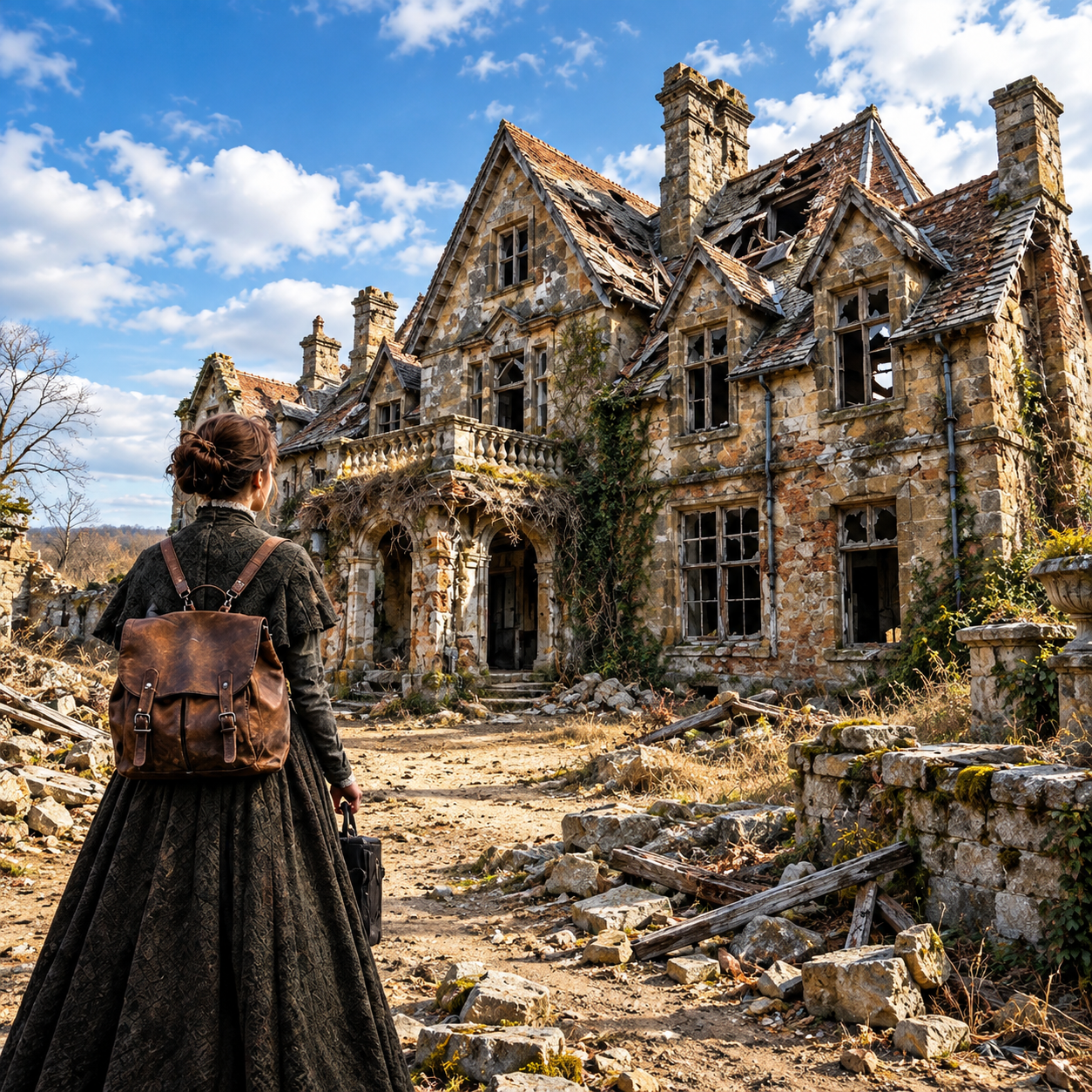
Clara stood beside her single leather case and stared up at the house she had just purchased.
Blackwood Manor had once been magnificent.
Now half the windows were broken. Ivy crawled across the stone walls. Several sections of roof sagged dangerously inward, and a chimney leaned enough to make Clara wonder whether the next hard wind would finish it.
A pile of fallen masonry covered what had once been a garden.
Behind her, the wagon driver cleared his throat.
“Ma’am?”
“Yes?”
“You’re certain this is the place?”
Clara almost smiled.
“I’ve already paid for it.”
“That wasn’t exactly what I asked.”
She turned.
The driver, a gray-haired man named Walter Briggs, looked from Clara to the enormous ruined house.
“They say nobody’s lived here for twenty-seven years.”
“Then I suppose it has been waiting.”
Walter raised an eyebrow.
“For what?”
Clara picked up her suitcase.
“For someone stubborn enough to open the door.”
Three men standing beside the road laughed again.
One called out, “Lady, there ain’t much door left!”
Clara ignored him.
At thirty-two, she had already learned that people were most confident about another person’s failure when they had risked nothing themselves.
Six months earlier, Clara had been caring for her widowed aunt while working as a seamstress. When her aunt died, Clara discovered that nearly every dollar she had expected to inherit had been consumed by debts.
What remained was modest.
Enough to rent a room for several years.
Enough to open a tiny dress shop.
Or enough to purchase Blackwood Manor at a county auction.
Everyone advised her to choose one of the first two.
Clara chose the ruins.
There was a reason.
Among her aunt’s possessions, she had found an old photograph.
It showed Blackwood Manor before decay swallowed it.
On the back, written in faded ink, were seven words:
Our family left something here. Find it.
Nothing more.
Clara had spent weeks researching the property.
Blackwood Manor had belonged to Silas Whitmore.
Her great-grandfather.
Yet after Silas disappeared, the property passed through creditors, distant owners, and finally the county.
No one in Clara’s family had spoken of it.
Until that photograph.
Walter helped her carry her trunk inside.
The entrance hall smelled of wet stone, dust, and rotting wood.
A chandelier hung crookedly overhead.
Wallpaper peeled in long strips.
Their footsteps echoed.
Walter looked around.
“You planning to live here?”
“I am.”
“Tonight?”
“Yes.”
He stared at her.
“Miss Whitmore, I wouldn’t sleep beneath that ceiling for ten dollars.”
“Fortunately, nobody is paying you to.”
Walter laughed despite himself.
“You’ve got nerve. I’ll give you that.”
Before leaving, he helped Clara inspect several rooms. Most were unsafe, but a small chamber near the rear had a solid ceiling and intact fireplace.
That became her bedroom.
For the next three weeks, Clara worked from sunrise until darkness.
She cleared debris.
Patched windows.
Scrubbed soot from fireplaces.
Removed rotten boards.
Every few days townspeople wandered past merely to stare.
Some offered advice.
Most offered predictions.
“That roof will cost more than the house.”
“You’ll never heat those rooms.”
“Should’ve bought farmland.”
“There’s a reason nobody wanted Blackwood.”
Clara answered each comment the same way.
“Perhaps.”
Then she returned to work.
But every evening, she searched.
Her aunt’s photograph remained tucked inside her journal.
Our family left something here. Find it.
Clara searched drawers, fireplaces, cupboards, attic beams, and floorboards.
Nothing.
After a month, doubt began creeping in.
Maybe the message meant nothing.
Maybe her aunt had believed some family legend.
Maybe Clara had purchased a collapsing monument to a dead woman’s imagination.
Then, on a rainy Tuesday evening, something happened.
Clara was cleaning the old library.
Unlike the rest of the manor, its walls were paneled in dark oak. Most shelves had been emptied decades earlier.
She moved a damaged bookcase away from the wall.
Behind it was a carved wooden panel.
Clara froze.
There was nothing remarkable about the panel itself.
Except for the symbol carved into its center.
A small bird beneath three stars.
Clara reached into her dress pocket.
Her aunt’s photograph.
In one corner of the photograph, almost invisible beside the entrance steps, was the same symbol.
Bird.
Three stars.
Clara touched the carving.
Nothing happened.
She pushed.
Nothing.
Pulled.
Nothing.
Then she noticed the bird’s wooden eye.
It was slightly darker than the surrounding wood.
Clara pressed it.
Click.
The sound was so small she nearly missed it.
Then something shifted behind the wall.
Clara stepped backward.
The panel opened perhaps half an inch.
Her heartbeat quickened.
She pulled.
A narrow doorway swung inward.
Behind it was darkness.
Clara stood motionless.
For weeks, neighbors had laughed at the ruined manor.
Now the manor seemed to be answering.
She fetched a lantern.
Behind the hidden door, stone steps descended steeply beneath the house.
“Good Lord,” Clara whispered.
She started downward.
Twenty steps.
Thirty.
The air became colder.
At the bottom was a narrow corridor constructed from perfectly fitted stone blocks.
This was no ordinary cellar.
Clara raised the lantern.
The corridor continued beneath the manor.
Several doors lined it.
The first opened into an empty storage room.
The second contained broken furniture covered with canvas.
The third was locked.
Clara continued.
At the corridor’s end stood an iron door.
There was no handle.
Only another bird beneath three stars.
Clara searched the wall until she discovered a small brass lever hidden behind a stone.
She pulled.
The iron door groaned open.
Her lantern illuminated shelves.
Dozens of them.
Clara stepped inside.
Wooden crates lined the walls.
A desk stood in the center.
On it rested a leather-bound ledger.
Clara opened it.
The first page contained handwriting.
Property of Silas Whitmore.
Her knees nearly weakened.
She turned pages.
Land purchases.
Business accounts.
Correspondence.
Then she found a sealed envelope.
Across the front:
For the Whitmore who finds this room.
Clara stared at it for nearly a minute before breaking the seal.
The letter inside had been written more than thirty years earlier.
Silas explained that Blackwood Manor had never represented the family’s true wealth.
The house was merely its guardian.
During a financial panic, he had quietly transferred his most valuable assets—not gold, as Clara initially imagined, but deeds.
Land.
Hundreds of acres.
Timber property.
Commercial lots.
Mineral rights.
Several parcels had eventually been abandoned because nobody knew who legally owned them.
But Silas had preserved the original deeds.
Clara’s hands began trembling.
Then she reached the final paragraph.
If you are reading this, then the house has returned to one of us. Do not sell quickly. The land beneath and beyond Blackwood is worth more than the walls above it.
Clara lowered the letter.
Beneath the desk was another wooden chest.
Inside were maps.
One showed the manor.
Another showed surrounding acreage.
A third showed something extraordinary.
A boundary stretching far beyond the ruined estate.
Clara whispered, “This can’t be.”
The following morning she rode into town carrying only the ledger and copies of several documents.
She went directly to attorney Samuel Pike.
He examined the first deed.
Then the second.
By the fourth, his expression had changed completely.
“Where did you get these?”
“My house.”
“These were inside Blackwood?”
“Yes.”
Samuel removed his spectacles.
“Miss Whitmore, do you understand what this might mean?”
“I suspect you’re about to tell me.”
He leaned forward.
“Some of these parcels became extremely valuable when the railway expanded.”
Clara said nothing.
“And this timber acreage…”
Samuel looked again.
“Assuming these deeds remained legally valid through the estate succession, you may have inherited considerably more than Blackwood Manor.”
“How much more?”
“I won’t guess.”
“Guess.”
Samuel hesitated.
“Enough that the people laughing at your purchase may soon stop.”
Clara smiled faintly.
“I don’t care about that.”
But the story spread anyway.
Within days, men who had mocked her began appearing at the manor.
One offered to buy the house for twice what Clara paid.
Another offered four times.
A land company sent a representative.
Then another.
Clara refused everyone.
She spent two months working with Samuel to establish ownership.
The process revealed something even Silas might not have predicted.
The railway wanted a portion of the land.
A lumber company wanted another.
Several growing businesses were leasing structures located on parcels that technically belonged to the Whitmore estate.
By winter, Clara’s ownership was confirmed.
She was wealthy.
Not unimaginably wealthy.
But wealthy enough that she would never again need to sew twelve hours a day simply to pay rent.
Walter Briggs visited after hearing the news.
He found Clara standing on scaffolding beside the manor entrance.
“You know,” he called, “rich women generally hire people to do that.”
Clara looked down.
“And miss all the fun?”
Walter laughed.
“So it’s true?”
“What?”
“You found a fortune underneath the house.”
Clara climbed down.
“No.”
He frowned.
“That’s what everybody says.”
“I found paperwork.”
“Worth a fortune.”
“Apparently.”
Walter looked toward the damaged roof.
“Then why are you still fixing this place?”
Clara brushed dust from her sleeves.
“Because money wasn’t what my aunt wanted me to find.”
Walter studied her.
“What was?”
Clara looked at Blackwood Manor.
For the first time, she understood.
The hidden passage had contained deeds.
But it had also contained letters.
Family records.
Birth certificates.
Photographs.
Journals.
The history of people who had disappeared from family memory.
Her aunt hadn’t sent Clara searching for treasure.
She had sent her home.
Over the next two years, Blackwood Manor changed.
The roof was repaired.
Broken windows were replaced.
Gardens returned.
Clara converted part of the house into a small school and library for local children.
She hired local craftsmen rather than distant contractors.
Some of those craftsmen were the same men who had laughed when she arrived.
One afternoon, Clara recognized a mason repairing the front terrace.
He was the man who had shouted that there wasn’t much door left.
He looked embarrassed when she approached.
“Miss Whitmore.”
“Mr. Hayes.”
He rubbed the back of his neck.
“I suppose I owe you an apology.”
“For what?”
“For laughing.”
Clara glanced at the restored doorway.
“You were right about one thing.”
“What?”
“There wasn’t much door left.”
He laughed.
Then his expression softened.
“Didn’t figure you’d last a month.”
“Neither did I some days.”
“What made you keep going?”
Clara thought about the photograph.
The seven words.
The hidden bird carved into the library wall.
“Someone before me believed this place was worth saving.”
Years later, visitors would come to Blackwood Manor and admire its stonework, library, gardens, and long restored halls.
Most heard the famous story.
The foolish young woman who bought a ruin.
The secret passage.
The forgotten deeds.
The unexpected inheritance.
But Clara rarely told the story that way.
When children asked whether she had discovered treasure beneath the house, she would smile.
“Yes.”
“Gold?”
“No.”
“Jewels?”
“No.”
“Money?”
“Some, eventually.”
Then she would lead them into the restored library.
On one wall, protected beneath glass, hung an old photograph of Blackwood Manor.
Beside it was the message written by her aunt:
Our family left something here. Find it.
Clara would point toward it.
“This was the treasure.”
The children usually looked disappointed.
Until Clara explained.
“A ruined thing isn’t always worthless. Sometimes people simply stop looking closely enough to see what remains.”
Outside, sunlight spilled across the restored stone walls.
And above the library fireplace remained one small carving Clara had deliberately refused to repair or replace.
A bird.
Three stars.
And beneath it, almost invisible unless someone knew where to look, the entrance to the passage that had changed everything.